AI Ethics 101 What Every Pakistani Tech User Should Understand
AI ethics isn't just for experts. These 9 lessons, built on real Pakistani cases, show how to use AI safely, protect your data and avoid legal trouble.
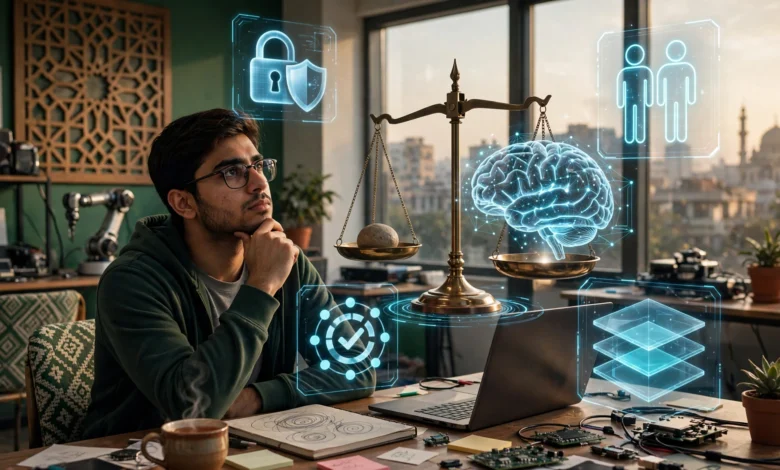
AI Ethics: 9 Essential Lessons to Keep Pakistani Tech Users Safe in 2026
AI ethics sounds like something debated in university seminars or tech company boardrooms. In reality, it’s about everyday choices Pakistani users are already making. Should you paste your bank statement into a chatbot to get budgeting advice? Is it harmless to make a funny face-swap video of a friend? Can you use AI to write your assignment? Is that viral video of a politician real?
These questions are no longer hypothetical. In Pakistan, AI has already been used to create a sexualised deepfake of a provincial minister, to generate “leaked” exam papers sold to thousands of students, and to power scam call centres that used AI-generated images to trick victims. At the same time, AI is helping pensioners verify their identity from home, supporting teachers, and driving record exports in the call centre industry.
The government has started to respond. The federal cabinet approved the National AI Policy 2025, which talks about data security, ethics and responsible AI. But critics point out that ethical principles on paper don’t protect anyone without enforcement, and Pakistan’s long-pending data protection bill still hasn’t been implemented.
That leaves a lot of responsibility with ordinary users. This guide breaks down AI ethics into nine practical lessons, each tied to real cases, so you can use AI confidently without harming yourself or others, and without ending up on the wrong side of the law.
What Is AI Ethics, in Plain Words?
AI ethics is the set of values and rules that guide how artificial intelligence should be built and used so it helps people rather than harms them. For developers, it covers how systems are trained and tested. For ordinary users, it comes down to a few simple questions:
- Am I respecting other people’s privacy and consent?
- Am I being honest about what’s real and what’s AI-generated?
- Could this harm someone, even if I don’t intend it?
- Am I trusting AI more than I should?
- Is this legal?
Responsible AI isn’t about avoiding the technology. It’s about using it in ways you’d be comfortable defending in front of your family, your employer, or a court.
Why AI Ethics Matters More in Pakistan
A few local realities make AI ethics in Pakistan especially urgent:
- Fast adoption, low awareness. Millions of people came online recently through cheap mobile internet, often without guidance on digital risks.
- Weak legal protection for data. Analysts note that the National AI Policy has ethical principles but no enforcement mechanism, while the Personal Data Protection Bill from 2023 is still pending. Digital rights groups raised the same concern when the policy was approved.
- Social consequences are severe. Fake content about someone’s character, religion or politics can lead to harassment, violence or ruined lives in a conservative society.
- Organised fraud networks exist. Scam call centres and cheating mafias already operate, and AI makes their work easier.
With that context, here are the nine lessons.
Lesson 1: Protect Your Data Before You Share It With AI
The first rule of AI ethics for users is protecting your own information and other people’s.


Your Data Has Already Been Exposed Before
Pakistanis have good reason to be careful. A Joint Investigation Team found that personal data of 2.7 million citizens was compromised from NADRA between 2019 and 2023, with evidence of the data surfacing in Argentina and Romania. In 2025, NADRA employees in Hyderabad were caught selling citizens’ data.
Once your data leaks, it can be used for fraud, fake SIMs and identity theft, and you can’t take it back.
What Not to Paste Into AI Tools
Many AI chatbots may store conversations, and some use them to improve their systems unless you opt out. As a rule, avoid sharing:
- CNIC numbers, passport details or photos of ID cards
- Bank account numbers, card details, OTPs or passwords
- Medical reports with your name attached
- Private details about family members, colleagues or clients
- Confidential work documents, unless your employer approves the tool
If you need help with a document, remove names and numbers first.
Lesson 2: Never Create Content of Real People Without Consent
Consent is at the heart of AI ethics. Face-swap apps, voice cloning tools and image generators make it easy to put real people into fake situations. Easy doesn’t mean acceptable.
The Azma Bukhari Case
In 2024, Punjab Information Minister Azma Bukhari discovered a sexualised deepfake video of herself spreading online, with her face placed on another woman’s body. She described being shattered and depressed for days before deciding to fight the case in court. The case has since moved through the courts, with the Lahore High Court granting bail to two suspects in April 2026 after a complaint to the NCCIA. No one has been found guilty so far.
AFP’s reporting on the case noted that in Pakistan, where media literacy is poor, deepfakes are being weaponised against women in public life.
The Ethical Rule
Don’t create or share AI images, videos or audio of a real person without their clear permission, especially anything sexual, humiliating, political or religious. “It was just a joke” doesn’t reduce the harm once content spreads, and it can also be a crime under Pakistan’s cybercrime laws.
Lesson 3: Don’t Spread What You Haven’t Verified
Misinformation is one of the biggest ethical risks of AI, and every user who forwards content plays a part.
The May 2025 Conflict
During the India-Pakistan conflict, AI videos, recycled war footage and fabricated stories spread across X, WhatsApp, Facebook and YouTube on both sides of the border. A deepfake of Prime Minister Shehbaz Sharif was edited to show him conceding defeat, when the real clip showed him praising the air force. Similar deepfakes of Indian leaders apologising to Pakistan also circulated.
The Legal Angle
Pakistan’s cybercrime law was amended in 2025, and recent cases have been registered under sections including 26-A, which deals with false information. Critics worry this law could be used against legitimate speech, but it also means careless forwarding can carry real legal risk.
The Ethical Rule
Before you share, check the source, run a reverse image search, and look for coverage from credible outlets or fact-checkers. If you’re unsure, don’t forward it.
Lesson 4: Watch for AI-Powered Fraud and Impersonation
Fraudsters were early adopters of AI. Understanding how they work is part of protecting yourself and your family.
Scam Call Centres Using AI
In July 2025, the NCCIA raided an illegal call centre in Islamabad that allegedly used fake online earning platforms, AI-generated images and social media to trick victims, with money laundered through crypto wallets. The same month, a raid in Faisalabad led to 149 arrests in an alleged Ponzi and investment scam operation.
Voice Cloning
Internationally, criminals have used cloned voices of family members in fake emergency calls. One well-documented case involved a Mumbai father whose “son” was supposedly arrested in Dubai; he lost ₹80,000 after hearing what sounded like his son in distress.
The Ethical Rule
Set a family safe word, always call back on a known number before sending money, and never share OTPs. And on the other side: never use AI to impersonate anyone, even as a prank.
Lesson 5: Use AI to Learn, Not to Cheat
Academic integrity is one of the most practical parts of AI ethics for Pakistani students.
When AI Fed the Cheating Business
In April 2026, Karachi police arrested members of a network leaking Matric and Intermediate papers through WhatsApp. The network collected millions of rupees from more than 1,300 students, and one suspect confessed to generating papers using AI. An Express Tribune editorial pointed out that whether the papers were real or AI-generated almost didn’t matter, because students paid believing the system could be beaten.
The Ethical Rule
Using AI to explain a concept, quiz yourself or improve your writing is fine. Submitting AI-written work as your own, or buying “leaked” papers, is dishonest and can lead to disqualification or criminal charges. Check your school or university’s AI policy, and when you use AI for help, say so.
Lesson 6: Understand That AI Can Be Biased
Algorithmic bias happens when AI systems treat some groups unfairly, usually because of the data they were trained on.
Where Bias Shows Up
- Facial recognition may work less accurately for some ages, genders or skin tones. As NADRA expands facial verification for pensioners, passports and SIMs, accuracy for elderly and rural citizens matters a lot.
- Language tools often work better in English than Urdu, Punjabi, Sindhi, Pashto or Balochi, which can exclude many Pakistanis.
- Hiring and lending tools may score people differently based on where they live or where they studied.
Surveillance Concerns
Amnesty International has raised concerns that the AI policy’s emphasis on surveillance and data collection lacks safeguards, warning of possible government overreach and discriminatory practices in areas like law enforcement. Commentators in Pakistan have called for an independent AI Ethics Council to oversee surveillance, policing and facial recognition.
The Ethical Rule
Don’t treat AI decisions as automatically neutral. If an AI system rejects you for a loan, job or service, you have a right to ask why and to request a human review.
Lesson 7: Be Transparent About AI-Generated Content
Transparency means being honest when AI played a meaningful role in what you share.
Platforms Now Require It
YouTube requires creators to disclose realistic AI-generated or altered content that viewers could mistake for real footage. If you skip it, YouTube can apply the label itself, and repeated non-disclosure can lead to removal or loss of monetisation.
Fake Reviews
Businesses have also used AI to generate fake reviews. In the US, the FTC banned fake reviews, including AI-generated ones, along with buying reviews and suppressing honest negative ones. Pakistan has no equivalent rule yet, but the ethical principle applies everywhere.
The Ethical Rule
If you’re a creator, seller or freelancer, label realistic AI content, don’t fake reviews or testimonials, and tell clients when their deliverables include AI-generated material.
Lesson 8: Respect Creators and Intellectual Property
Generative AI raises tough questions about who owns what.
The Hollywood Lawsuit
In 2025, Disney and Universal sued Midjourney, claiming its AI let users create near-exact copies of characters like Homer Simpson, the Minions and Elsa. Disney’s chief legal officer put it bluntly: piracy is still piracy when an AI company does it.
Pakistan’s Gap
Commentators have noted that Pakistan’s intellectual property laws remain outdated and unprepared for AI-generated content. That doesn’t make copying ethical. It just means creators here have fewer protections.
The Ethical Rule
Don’t use AI to copy famous characters, logos, artists’ distinctive styles or other people’s work for commercial use. Support local artists, writers and designers rather than replacing them with imitations of their own work.
Lesson 9: Keep a Human in the Loop
The final lesson of AI ethics is about knowing AI’s limits.
AI Makes Confident Mistakes
AI chatbots can produce answers that sound certain but are wrong, including fake statistics, invented legal sections and made-up references. This is sometimes called “hallucination.”
High-Stakes Decisions Need People
Don’t rely on AI alone for medical diagnoses, legal advice, financial decisions or religious rulings. Use it to understand options, then confirm with a qualified professional.
Replacing Humans Has Costs
Pakistan’s own debates show this. When Khyber Pakhtunkhwa announced AI-powered “human clone” teachers for remote areas, teachers’ representatives questioned whether the system could work without connectivity and raised concerns about replacing teachers with technical staff. AI can support people, but it shouldn’t become an excuse to remove human care and accountability.
What Pakistan’s National AI Policy Says About Ethics
The National AI Policy 2025 is the government’s main framework for AI. According to official statements, it aims to:
- Build a national AI ecosystem and train 1 million AI professionals by 2030
- Launch 3,000 scholarships a year, 50,000 AI-enabled civic projects and 1,000 local AI products within five years
- Include women and differently-abled people in the AI workforce
- Strengthen cybersecurity and data protection frameworks
The Ministry of IT describes the policy as a roadmap for ethical, inclusive and innovative AI adoption built on six pillars. Commentators have noted proposals for regulatory sandboxes, public registries of AI systems, and oversight of high-risk uses.
The criticism is equally important. Researchers at PIDE highlight the lack of a dedicated AI law or regulator, and the absence of enforcement for ethical principles. Until that changes, users should assume they need to protect themselves.
A Quick AI Ethics Checklist for Pakistani Users
Before using AI for anything important, run through these questions:
- Privacy: Am I sharing personal or sensitive data I shouldn’t?
- Consent: Does this involve a real person who hasn’t agreed?
- Truth: Could this mislead anyone about what’s real?
- Harm: Could this embarrass, endanger or defraud someone?
- Honesty: Am I presenting AI work as entirely my own?
- Fairness: Could this treat someone unfairly because of who they are?
- Ownership: Am I copying someone else’s creative work?
- Verification: Have I checked the AI’s output before relying on it?
- Legality: Would this be acceptable under PECA and platform rules?
If the answer to any of these worries you, stop and rethink.
What to Do If AI Is Used Against You
If you’re targeted by a deepfake, AI scam or misuse of your data:
- Save evidence: screenshots, links, usernames, dates and transaction IDs.
- Report to platforms using their tools for impersonation, manipulated media or intimate content.
- Contact your bank immediately if money is involved.
- File a complaint with the NCCIA through its official channels.
- Get support from organisations like the Digital Rights Foundation, which runs a helpline for people facing online harassment.
- Tell trusted people so they can help and won’t be fooled by fake content.
For further reading, the Ministry of IT’s announcement of Pakistan’s National AI Policy 2025 explains the government’s goals, and Digital Rights Monitor offers a critical look at the policy’s impact on privacy and rights. For real-world cases, Dawn’s report on the NADRA data leak affecting 2.7 million citizens and The Express Tribune’s coverage of the Karachi exam leak network that used AI show why these lessons matter.
Conclusion
AI ethics isn’t an abstract topic for Pakistani tech users, because real cases have already shown what happens when AI is misused, from the leak of 2.7 million citizens’ data and insiders selling records, to a sexualised deepfake targeting a provincial minister, AI-driven disinformation during the May 2025 conflict, scam call centres using AI-generated images, and exam leak networks selling AI-generated papers to students. The nine lessons in this guide, protecting your data, respecting consent, verifying before sharing, guarding against fraud, using AI to learn rather than cheat, recognising bias, being transparent, respecting creators and keeping humans in charge of important decisions, give every user a practical way to act responsibly. Pakistan’s National AI Policy 2025 promises ethical, inclusive AI, but without a dedicated AI law, an enforced data protection framework and independent oversight, much of the responsibility still falls on individuals, and the simplest rule remains the best one: use AI in ways you’d be comfortable explaining openly, and never in ways that deceive, exploit or harm another person.