How AI Is Fueling Phishing Scams: Smishing, QR Code Fraud, and Voice Clone Risks
AI phishing scams surged 14x in one month, now driving 40% of all attacks. Learn how to identify smishing, QR code fraud, and voice cloning before they cost you.
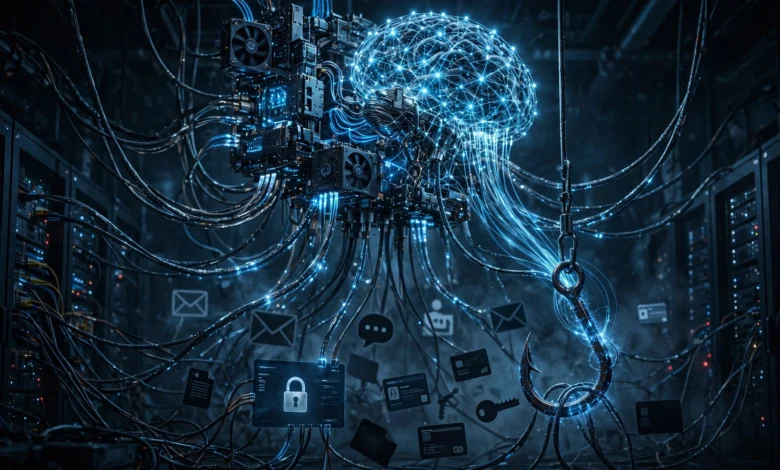
AI phishing scams jumped 14x in a single month at the end of 2025, and that number should stop you cold. According to Hoxhunt’s 2026 Phishing Trends Report, AI-assisted attacks rocketed from 4% of all phishing in November 2025 to 56% in December — a shift so sudden it caught most security teams completely off-guard. By early 2026, that share had settled around 40%, meaning four in every ten phishing attempts you encounter today are generated by artificial intelligence.
This isn’t a theoretical future problem. The Federal Trade Commission logged $3.5 billion in losses from imposter scams in 2025 alone — the ninth consecutive year impersonation fraud topped the charts. A finance employee at engineering firm Arup wired $25 million to fraudsters after a video call featuring what appeared to be his CFO and colleagues, all of whom were AI-generated deepfakes. The money was never recovered.
What makes today’s threat landscape so dangerous isn’t just the volume — it’s the quality. Generative AI has eliminated the typos, awkward phrasing, and generic greetings that used to help people spot a scam. AI-generated phishing emails now achieve a 54% click-through rate compared to 12% for traditional phishing. The old “just look for bad grammar” advice is officially dead.
This article breaks down exactly how smishing, QR code phishing (quishing), and AI voice cloning work, how to spot each one, and what you can do right now to protect yourself or your organization.
AI Phishing Scams Jumped 14x: Understanding the Scale of the Problem
The numbers are difficult to absorb without context. In 2024, the FBI’s Internet Crime Complaint Center recorded $16.6 billion in cybercrime losses — a 33% year-over-year increase — with AI-enhanced social engineering driving a growing share of those incidents. Globally, GenAI-enabled scams rose 456% between May 2024 and April 2025, according to Sift’s Q2 2025 Digital Trust Index. Breached personal data surged 186% in Q1 2025 alone.
The reason AI has changed this game so completely comes down to economics and scale. Before large language models became freely accessible, a convincing phishing email required time, skill, and native fluency in the target’s language. Today, IBM researchers demonstrated that AI can construct a sophisticated phishing campaign in five minutes using five prompts — a task that previously took security experts 16 hours to replicate in a red team exercise.
The consequences are measurable. A 2024 study found that AI-generated phishing emails achieve a click-through rate more than four times higher than their human-crafted counterparts. According to the World Economic Forum’s Global Cybersecurity Outlook 2026, 73% of organizations were directly affected by cyber-enabled fraud in 2025. That’s not a minority problem — that’s essentially every major enterprise on earth.
Why Traditional Defenses Are Failing
The two pillars most organizations relied on — pattern recognition and multi-factor authentication (MFA) — have been undermined simultaneously.
Pattern recognition is broken because AI produces polymorphic attacks where every email differs in subject line, sender name, tone, and content structure. Signature-based detection systems that look for known bad patterns simply cannot keep up when each message is essentially unique.


MFA is no longer a guaranteed safeguard because adversary-in-the-middle (AiTM) attack frameworks like EvilGinx2 and Modlishka can intercept the session cookie after MFA authentication has already completed. Microsoft reported more than 10,000 AiTM attacks per month targeting its users in 2024. The attacker doesn’t need your password or your authentication code — they steal the authenticated session itself.
The Anti-Phishing Working Group recorded 4.8 million attacks in 2024, the highest level in the organization’s history, and 2025 projections expected that number to exceed five million. These figures only count reported attacks; the real volume is estimated at two to three times higher.
What Is Smishing and Why SMS Is the Deadliest Channel
Smishing — phishing delivered via SMS text message — became the dominant way malicious links reached phones in 2025. Understanding why SMS outperforms email as an attack channel is key to defending against it.
When a text message appears to come from your bank, your carrier, or a delivery service, it lands in the same conversation thread as messages from real contacts. Unlike a promotional email that sits in a separate folder with visible sender headers, an SMS carries an implicit authority that most people don’t question. On a small mobile screen, the full URL of a link is often hidden or truncated, making it nearly impossible to inspect before tapping.
How Smishing Attacks Work in 2026
Modern smishing campaigns follow a predictable structure, but they’re executed at a quality that makes them genuinely hard to dismiss:
- Fake delivery notifications claim your package is held or a fee is due, with a link to resolve the issue
- Bank security alerts warn of suspicious activity and ask you to verify your identity immediately
- Government impersonation texts claim to be from the IRS, Social Security Administration, or USPS
- Two-factor authentication spoofs pretend your account requires reverification, directing you to a credential-harvesting page
- Toll payment scams claim you owe an outstanding balance and provide a payment link
The psychological levers are urgency and fear. A text that says your account will be locked in 24 hours bypasses analytical thinking and activates reactive behavior. AI makes these messages personalized — scraped data from LinkedIn, corporate websites, and social media means the scam text may include your name, your employer, a recent transaction, or other details that make it feel completely legitimate.
How to Spot a Smishing Attempt
- The message creates sudden urgency around money, account access, or security
- The sender number doesn’t match a recognizable contact or appears as a string of random digits
- The link uses a URL shortener, a misspelled brand name, or an unusual domain extension
- You weren’t expecting any communication from this company about this topic
- The message asks you to take action via a link rather than directing you to the company’s official app
The single most important rule: never tap a link in an unexpected text message. If the message claims to be from your bank, close the text and open your bank’s official app directly. If it’s from a delivery company, track your package through the retailer’s website or the carrier’s official site.
QR Code Phishing (Quishing): The Scam Hiding in Plain Sight
QR code phishing, commonly called quishing, has become one of the fastest-growing attack vectors in cybersecurity. According to Abnormal Security, QR code attacks increased 400% between 2023 and 2025, with the most affected sectors being energy, healthcare, and manufacturing.
The reason quishing works so well is structural. When a traditional phishing email contains a suspicious link, email security filters can scan and flag it. When that same link is embedded inside a QR code image, most filters see only an image — the malicious URL is invisible to automated scanning tools. The attack moves from the email client to the phone’s camera, bypassing the entire enterprise security stack.
Where Quishing Attacks Show Up
Physical quishing attacks are particularly insidious because they exploit environments we’ve been conditioned to trust:
- Parking meters: Scammers place sticker QR codes over legitimate payment codes. You think you’re paying for parking; you’re actually handing your card details to criminals.
- Restaurant menus: Malicious codes replace real menu links, especially in high-traffic tourist areas. When you enter payment details at the end, it goes to a fraudulent page.
- Retail locations: One documented case involved scammers placing fake QR sticker codes over legitimate ones at 200 store locations during a holiday campaign, resulting in $2.3 million in damage control costs within 48 hours.
- Parcel deliveries: Unexpected packages include QR codes prompting you to “scan to see who sent this” — a tactic the FTC has formally warned consumers about.
- Email-based quishing: An email from what appears to be HR, a vendor, or your bank includes a QR code instead of a hyperlink, often paired with urgency language about MFA resets, invoice reviews, or contract signing.
The Anatomy of a QR Fraud Attack
A typical quishing attack runs through five stages:
- Creation: Attackers generate a QR code linking to a spoofed website that mimics a trusted brand
- Distribution: The code is placed physically (sticker over a real code) or digitally (embedded in an email, text, or social media post)
- Scanning: The victim scans the code on their mobile device, which takes the attack outside corporate email filters
- Credential harvesting: The spoofed page asks for login credentials, payment details, or MFA tokens
- Exploitation: Stolen data is used for account takeover, financial fraud, or sold on dark web markets
How to Protect Yourself from QR Code Scams
- Inspect before scanning: In any public location, look for signs of tampering — a sticker placed over a printed code is a major red flag
- Preview the URL: Most modern smartphones show you the destination URL before opening it; read it carefully for misspellings, unusual domains, or URL shorteners
- Never enter sensitive information on a page reached via QR code: If the landing page asks for login credentials or payment details, navigate to the website manually by typing the address
- Be skeptical of urgency: Any QR code paired with language like “act now,” “your account will be suspended,” or “limited time” deserves extra suspicion
- Use a QR scanner with security features: Some apps preview destination URLs and check against threat intelligence databases before opening
For organizations, the FTC’s guidance on QR code scams provides a practical baseline for employee awareness training.
AI Voice Cloning: When You Can’t Trust What You Hear
Voice cloning fraud may be the most psychologically destabilizing form of AI-driven scam because it attacks something we’ve relied on as an infallible trust signal for our entire lives: the sound of a familiar voice.
Research from McAfee found that just three seconds of audio is enough to create a voice clone with an 85% accuracy match to the original speaker. That audio is trivially easy to obtain — a brief video posted on social media, a clip from a company webinar, an earnings call recording, or a podcast appearance all provide more than enough source material. According to research published in late 2025, voice cloning has crossed what experts are calling the “indistinguishable threshold,” meaning human listeners can no longer reliably tell the difference between a real voice and a cloned one.
The financial consequences are not theoretical. In 2024, the Arup case — where a finance employee wired $25 million after a video call featuring deepfaked versions of colleagues — became the defining example of what AI-enabled fraud can accomplish at enterprise scale. Earlier, a UK energy firm lost €220,000 when an executive’s voice was cloned and used to authorize a wire transfer. These aren’t edge cases anymore.
The Grandparent Scam Gets an AI Upgrade
The grandparent scam — a call from a voice that sounds exactly like a child or grandchild in distress, demanding money immediately — has existed for years. AI has made it nearly perfect. The cloned voice captures not just the general sound but the specific speech patterns, verbal tics, and emotional cadence of the person being impersonated. When you hear what sounds exactly like your child’s panicked voice saying they’ve been in an accident and need money wired immediately, the instinct to help overrides almost every rational check.
A 2024 McAfee survey found that 1 in 4 adults have experienced an AI voice scam, with 1 in 10 personally targeted. Adults over 60 account for 43% of total fraud losses despite representing fewer incidents, which reflects how effectively voice cloning exploits the trust hierarchies of family relationships.
Corporate Voice Cloning: The $25 Million Problem
In business settings, AI voice cloning has evolved into a sophisticated multi-channel attack:
- An initial phishing email establishes a pretext (a pending wire transfer, a vendor payment, a security issue)
- A follow-up call — using a cloned version of an executive’s voice — references the email and provides authorization
- Because the voice matches and the email established context, the request passes scrutiny
Deepfake-enabled vishing attacks surged by more than 1,600% in Q1 2025 compared to Q4 2024. Projections estimate $40 billion in global losses from deepfake-enabled scams by 2027. More than 10% of banks have already lost over $1 million each to deepfake voice fraud. The average loss per deepfake incident now exceeds $500,000.
How to Verify Identity When You Can’t Trust Your Ears
- Establish a pre-agreed safe word or code phrase with close family members, specifically for emergency money requests. If the caller doesn’t know the word, hang up.
- Call back on a known number: If you receive a call from someone claiming to be a colleague or executive asking for urgent action, hang up and call them directly on a number you already have.
- Implement callback verification for wire transfers: Any financial transaction above a set threshold should require independent verification through a separate channel.
- Slow down: Voice cloning attacks depend on urgency. Any call that demands immediate financial action and discourages you from verifying through other channels is a major warning sign.
- Use video confirmation, carefully: A video call adds a layer of verification, though deepfake video is also advancing rapidly (the Arup case involved a video call). Ask the person to perform an unexpected action — wave with a specific hand, hold up a specific number of fingers — and watch for the slight delay or unnatural movement that can reveal a deepfake.
The FBI’s public service announcement on voice cloning scams offers additional guidance on reporting and reporting channels for these incidents.
AI-Powered Business Email Compromise: The Boardroom Threat
Business Email Compromise (BEC) has been transformed by generative AI from a targeted but manual process into a scalable, highly automated threat. The FBI IC3 reported $2.77 billion in BEC losses across 21,442 incidents in 2024, making it one of the most costly cybercrime categories.
Traditional BEC relied on a compromised email account or a convincing lookalike domain. AI has expanded this into multimodal campaigns combining email, voice, and video to create layered impersonations that are far more convincing than any single channel could achieve.
What AI-Powered BEC Looks Like in Practice
Attackers use AI to:
- Scrape LinkedIn, corporate websites, and social media to identify employees with financial authority and their reporting relationships
- Generate personalized emails that reference real projects, real colleagues, and real recent events to establish credibility
- Clone the writing style of specific executives, making impersonation emails stylistically indistinguishable from real communications
- Pair email attacks with cloned voice calls that reference the email and provide verbal “authorization” for wire transfers or data access
One documented attack against a healthcare organization used AI to identify 47 staff members who had recently completed cybersecurity certifications — then sent personalized “certificate verification” phishing emails that achieved a 38% click rate by exploiting the recency of a legitimate activity. The targeting precision that AI enables is genuinely novel.
What Organizations Can Do Right Now
- Verify all wire transfer requests out-of-band: Any instruction that changes payment details or authorizes a large transfer should require a phone call to a known number — not a number provided in the email.
- Implement DMARC, DKIM, and SPF: These email authentication protocols prevent attackers from spoofing your domain in emails to employees or vendors.
- Run phishing simulations that use AI-generated content: Training employees to recognize poor grammar is no longer sufficient. Simulations need to reflect the actual quality of modern attacks.
- Establish financial transaction limits with multi-party approval: No single individual should be able to authorize a large transfer based on a single communication channel.
The Role of Data Breaches in Powering AI Scams
One reason AI phishing attacks have become so convincing is the unprecedented amount of personal data available to criminals. Breached personal data surged 186% in Q1 2025 alone. This data — names, email addresses, employer information, phone numbers, purchase histories, and relationship networks — feeds the personalization engine that makes AI phishing so effective.
When a criminal has your name, your employer, your manager’s name, and a recent event you participated in, they can construct a phishing message that reads as if the sender actually knows you. The “generic greeting” tell that used to expose phishing is gone. The “unexpected request” that should trigger suspicion is masked by context that appears real.
This is why password hygiene and data minimization matter even when you’re not the direct target of a breach. Every data point you expose reduces your margin for skepticism when a scam message appears.
Practical Steps for Personal Data Protection
- Use a password manager and ensure every account has a unique, complex password so a single breached credential doesn’t cascade
- Enable hardware-based authentication (like a FIDO2 security key or passkey) wherever possible — these are resistant to AiTM attacks because they bind authentication to the site’s actual domain
- Minimize your public digital footprint: the less audio, video, and personal information available online, the harder it is to train a voice clone or build a convincing phishing profile on you
- Monitor haveibeenpwned.com or similar services for breach notifications tied to your email addresses
How to Build a Scam-Resistant Mindset in 2026
The technology arms race between attackers and defenders will continue, but the most reliable defense is human judgment that doesn’t rely on spotting low-quality fakes. Since AI has eliminated most quality-based tells, the new mental model needs to focus on process rather than perception.
The Three Questions to Ask Before Acting
1. Was this communication expected? Legitimate banks, employers, and government agencies rarely initiate contact through texts or calls demanding immediate action. If you weren’t expecting the communication, treat it as suspect until verified independently.
2. Does it create urgency around money or access? Urgency is the primary manipulation tool in every category of AI-driven scam — smishing, quishing, voice cloning, and BEC all depend on pushing you to act before you think. If a message pressures you to act immediately or warns of severe consequences for delay, slow down.
3. Can I verify this through a channel I already trust? Hang up. Close the text. Close the email. Open your bank’s official app, call the person on a number you already have, or navigate manually to the website. If the threat or opportunity is real, it will still be there after you verify.
Signs You’re Being Targeted by an AI Scam
- A text, call, or email claims to be from an institution you recognize but uses a link, number, or QR code you can’t independently verify
- The communication combines personal details (your name, your employer, a recent event) with an urgent request involving money or account access
- A caller’s voice sounds familiar but something about the conversation feels slightly off — an unusual delay, an inability to engage with off-script questions, or pressure to avoid calling back
- A QR code appears in a physical location where one wasn’t before, or shows signs of a sticker overlaid on a printed surface
- An email from a known contact or executive asks for an unusual financial action and specifically discourages normal verification steps
Conclusion
AI phishing scams jumped 14x in a single month, and the surge shows no sign of reversal — smishing now dominates mobile fraud channels, QR code phishing has expanded from digital to physical spaces in ways email filters can’t catch, and voice cloning has crossed the threshold where human ears alone can no longer be trusted to distinguish real from fake. The $3.5 billion the FTC logged in imposter scam losses in 2025, the $25 million wired by a single finance employee to deepfaked executives, and the 456% surge in GenAI-enabled scams between 2024 and 2025 all point to the same conclusion: the quality gap between a real communication and a fraudulent one is now essentially zero, which means the only reliable defense is a process-driven habit of independent verification — not visual or auditory pattern recognition — combined with strong authentication tools, reduced public data exposure, and a healthy institutional skepticism toward any message that pairs personal familiarity with urgent financial requests.