Can AI Replace Human Teachers in Pakistani Schools
AI in Pakistani schools is growing fast, from KP's virtual teachers to Punjab's AI syllabus. Can it replace human teachers? Here is an honest answer.
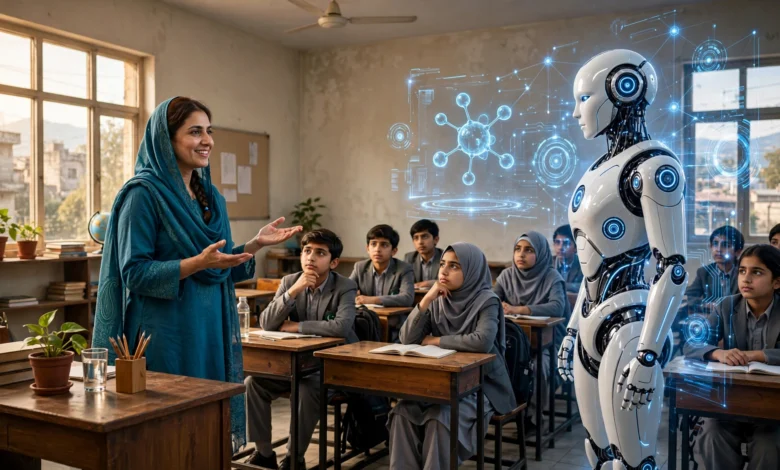
AI in Pakistani Schools: 5 Hard Truths About Replacing Human Teachers
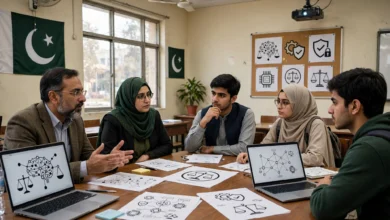
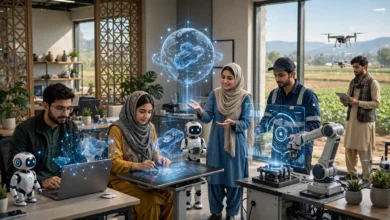
AI in Pakistani schools has moved from seminar talk to real classrooms in a matter of months. In Khyber Pakhtunkhwa, the government is testing virtual “human clones” of real teachers, built from their faces and voices, to teach students in areas where no qualified teacher is available. In Punjab, artificial intelligence is being added to the curriculum from Class I to XII, and 160,000 teachers are being lined up for AI training.
So the question on many parents’ and teachers’ minds is fair: can AI actually replace human teachers in Pakistan?
It’s tempting to say yes. Pakistan has one of the world’s worst teacher shortages and millions of children who’ve never sat in a classroom. A virtual teacher that never gets transferred, never goes absent, and can teach physics in Bajaur and Bannu at the same time sounds like a solution.
But the reality is messier. Many schools still lack electricity, reliable internet, and even boundary walls. And AI is already being misused inside our education system, most visibly by exam paper leak networks that have admitted to using AI to generate “leaked” papers sold to thousands of students.
This article looks at AI in Pakistani schools honestly. It covers what’s actually being rolled out, why governments are interested, five hard truths about replacing teachers, what AI genuinely does well, and the ethical lines that shouldn’t be crossed.
The Short Answer: Can AI Replace Teachers in Pakistan?
No, not in any meaningful sense, at least not in the foreseeable future. But that’s not the end of the conversation.
AI in Pakistani schools can fill some gaps, support overworked teachers, and give students in remote areas access to lessons they’d otherwise never get. What it can’t do is replace the human work of teaching: noticing a child who’s falling behind, keeping a classroom safe, building confidence in a girl whose family isn’t sure she should be in school, or telling a student, face to face, that they’re capable of more.
The real question isn’t “Will AI replace teachers?” It’s “How do we use AI without using it as an excuse to stop hiring teachers?”
Where AI in Pakistani Schools Stands Today
Before judging the idea, it helps to know what’s actually happening on the ground.


Khyber Pakhtunkhwa: Virtual “Human Clone” Teachers
KP has gone the furthest. The provincial government announced a digital education plan in which AI-powered clones of teachers will deliver lessons where conventional teachers aren’t available. The project, called Parho Khyber Pakhtunkhwa, aims to digitise the curriculum, put lessons on mobile phones, and introduce virtual classrooms, AI-assisted personalised learning and virtual science labs.
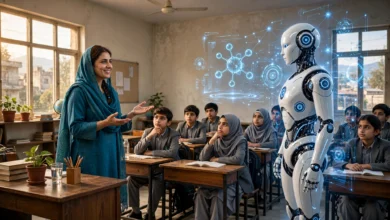
A virtual clone of a well-known Peshawar teacher has already been built. These AI teacher characters are being used for physics, maths, Urdu and other subjects, and the government says they can cover 2,900 curriculum modules for grades six to twelve. Officials also say students will be able to ask the virtual teachers questions and get answers, not just watch recorded lectures.
The focus is on remote areas. Bajaur, South Waziristan, North Waziristan and Bannu face particular teacher shortages, especially in science.
Punjab: AI Curriculum and Teacher Training
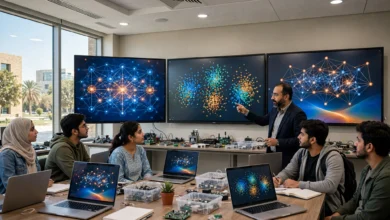
Punjab has taken a different route, focusing on teaching AI rather than replacing teachers with it. The government has approved a curriculum overhaul that introduces AI education from Class I to XII, cuts textbook volume by 25 per cent, and adds QR codes linking to video lessons.
Alongside this, Punjab’s AI Curriculum and Training Initiative aims to train 160,000 teachers in artificial intelligence. There are also plans for dedicated AI schools in Lahore and AI labs in primary schools.
Islamabad: AI From Nursery Onwards
In the federal capital, the Federal Directorate of Education has made AI part of the formal curriculum, introduced step by step from nursery to Class 12.
Why Governments Are Interested: Pakistan’s Teacher Gap
To understand why AI teachers in Pakistan are being taken seriously, you have to look at the size of the problem.
Millions of Children Out of School
According to UN figures, around 26 million children aged 5 to 16, nearly 40 per cent of school-age children, aren’t enrolled in formal education, the highest number of any country. A more recent Civil Services Academy review found the number still sits between 25.1 and 26 million, and concluded that the problem is no longer policy design but failed execution.
Hundreds of Thousands of Empty Teacher Posts
Malala Yousafzai, in a letter to the Prime Minister, pointed out that more than 200,000 teacher seats are vacant nationwide. In KP alone, teachers’ representatives say up to 60,000 teaching positions are vacant and as many as 40,000 schools lack basic facilities.
Money Is Tight
Education spending is low, and most of it goes on salaries. The CSA review notes that Sindh and Balochistan spend 81 to 90 per cent of their education budgets on salaries, and that overall education spending has fallen below 1 per cent of GDP.
When you put these numbers together, the appeal is obvious. If one virtual teacher can reach hundreds of classrooms, the maths looks attractive. KP officials estimate a one-time Rs5 billion investment could save more than Rs100 billion a year.
But attractive maths isn’t the same as good education.
5 Hard Truths About AI Replacing Teachers in Pakistani Schools
1. AI Can’t Teach Where There’s No Power or Internet
This is the most basic problem with AI in Pakistani schools, and it’s also the one most often skipped in announcements.
KP’s own teachers have raised it. The Young Teachers Association Khyber Pakhtunkhwa said many areas don’t even have reliable basic network connectivity, and questioned the government’s claims about offline AI.
Punjab faces similar limits. Its own school census data has historically recorded thousands of schools without reliable power, with functioning computer labs concentrated in urban and higher-secondary schools.
The government says it’s building a learning management system for mobile and web with offline course material. That helps with recorded lessons. But the most impressive part of the pitch, students asking questions and getting AI answers, generally needs a connection. And at home, most Pakistani families don’t have a laptop for every child, and many share a single mobile phone.
The digital divide means that without serious investment in infrastructure, AI could end up helping city students most while leaving rural children, the very ones it was meant to reach, further behind.
2. Teaching Is Much More Than Delivering Lessons
A virtual teacher can explain Newton’s laws. It can’t:
- Notice that a student has stopped eating lunch or seems frightened
- Handle a fight between two boys in the back row
- Convince a father in a conservative village to keep his daughter in school
- Adjust a lesson on the spot because half the class looks confused
- Act as a trusted adult when a child is being abused or bullied
- Model honesty, discipline and respect by example
This is especially important in Pakistan, where the presence of a teacher, particularly a female teacher, is often the deciding factor in whether girls attend school at all. A screen and a technician aren’t a substitute for that trust.
This is also why one detail of KP’s plan has become controversial. In schools using the virtual model, a technical staff member rather than a regular teacher would reportedly be present to run the system. If that becomes the norm, AI stops being a supplement and becomes a replacement, and children in the poorest areas end up with the least human attention.
3. AI Is Already Being Misused in Pakistan’s Exam System
Any honest discussion of artificial intelligence in education in Pakistan has to include the illegal side. The clearest example is the exam cheating business.
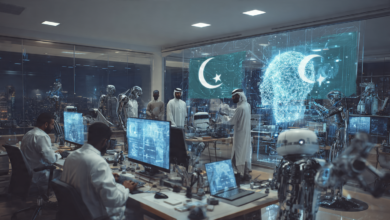
In April 2026, Karachi police arrested four members of an organised network that leaked Matric and Intermediate papers to students via WhatsApp the night before exams. The network had 10 groups and collected millions of rupees from more than 1,300 students, and one suspect confessed to generating papers using AI. Police said the alleged ringleader ran 13 groups with around 13,000 student members, and was reportedly a final-year cybersecurity student.
This wasn’t the first time. In 2024, Karachi police arrested a suspect in a matric paper leak case who was reportedly himself a student of artificial intelligence, and who ran a WhatsApp group where leaked papers and solved answers were posted.
Even elite exams haven’t been safe. In April 2026, the Cambridge AS Level Math Paper 1 leaked hours before the exam and spread on WhatsApp, Reddit and Google Drive, affecting an estimated 25,000 students.
An Express Tribune editorial made a sharp point about this: whether the papers were genuine or generated from past patterns and AI hardly matters, because students paid believing the system could be gamed.
The lesson for AI in Pakistani schools is uncomfortable. If our exam system can be gamed by people with AI tools and WhatsApp groups, then introducing AI into teaching and assessment without strong academic integrity safeguards could make cheating easier, not harder.
4. Cloning Teachers Raises Serious Ethical Questions
KP’s “human clone” approach is technically impressive. It also opens up questions nobody has fully answered yet:
- Consent and ownership: Who owns a teacher’s digital face and voice? Can the government keep using it after the teacher retires, dies, or leaves the job? Is the teacher paid for every lesson their clone delivers?
- Deepfake risk: A realistic digital copy of a trusted teacher is exactly the kind of material that could be misused to create fake videos or messages if it’s leaked or poorly secured.
- Accuracy: AI systems can produce confident but wrong answers. When a respected teacher’s face delivers a mistake, students are less likely to question it.
- Student data privacy: AI systems that answer questions and track progress collect data on children. Where is it stored? Who can access it? Pakistan doesn’t yet have a strong, tested framework for protecting children’s educational data.
None of these are reasons to ban the technology. They’re reasons to set clear rules before scaling it to thousands of schools.
5. The Savings Story Deserves Scrutiny
The claim that Rs5 billion could save Rs100 billion a year is striking. But savings usually come from one place in education budgets: salaries. If the plan saves money by not hiring teachers for remote schools, then AI replacing teachers isn’t a side effect. It’s the business model.
Pakistan has seen what happens when education systems are managed on paper rather than in reality. The long-running problem of ghost schools, which exist in records but not in practice, is a reminder that a school “covered” by a virtual teacher in an official report isn’t necessarily a school where children are learning. Independent monitoring of learning outcomes, not just the number of screens installed, will be essential.
What AI Can Actually Do Well in Pakistani Classrooms
None of this means AI has no place. Used carefully, AI in Pakistani schools can do real good:
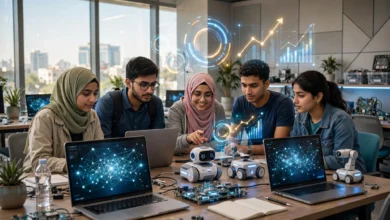
- Support teachers in understaffed schools. A single teacher handling three classes at once can use AI-generated lesson plans, worksheets and quizzes to save hours.
- Offer extra practice. Personalized learning tools can give students maths and English practice at their own level, in Urdu or regional languages.
- Bring science labs to schools without labs. Virtual experiments are better than no experiments at all.
- Help with marking and feedback. AI can check routine homework so teachers can focus on students who need help.
- Reach children outside school. Mobile-based lessons can support non-formal education for working children and girls who can’t travel far.
- Train teachers. Punjab’s plan to train 160,000 teachers is a better starting point than replacing them, as long as training turns into daily practice.
The common thread is simple: AI works best as a teacher’s assistant, not a teacher’s replacement.
Ethical Guidelines for AI in Pakistani Schools
If provinces want AI in Pakistani schools to succeed, a few principles should be non-negotiable:
- Human teachers stay in the room. AI can support lessons, but every classroom needs a trained adult responsible for children’s learning and safety.
- Informed consent for digital clones. Teachers whose faces and voices are used must give clear, written consent with fair pay and the right to withdraw.
- Protect student data. Collect only what’s needed, store it securely, and never share it with third parties for commercial use.
- Fix infrastructure first. Electricity, internet and basic facilities should come before expensive AI rollouts.
- Secure exams properly. Tighter paper handling, digital tracking and real penalties for leak networks, including those using AI.
- Measure learning, not gadgets. Judge success by what students can actually read, write and calculate.
- Be transparent. Publish pilot results, including failures, so parents and teachers can judge the evidence.
What Parents and Teachers Can Do Right Now
For parents:
- Ask your child’s school whether AI or virtual teaching pilots are running, and who supervises them.
- Talk to your children about using AI to learn, not to cheat. Buying “leaked” papers isn’t just risky. It’s a crime and can get a student disqualified.
- Keep an eye on what personal information school apps collect.
For teachers:
- Take up AI training where it’s offered. Teachers who understand AI will shape how it’s used rather than be shaped by it.
- Use AI tools for planning and practice, but always check their accuracy.
- Speak up, through unions and associations, about consent, workload and how AI affects hiring.
For further reading, Daily Pakistan’s detailed report on KP’s plan to use AI human clones of teachers covers both the government’s case and teachers’ objections, while The Express Tribune explains Punjab’s decision to add AI to the curriculum from Class I to XII. On the misuse side, The Express Tribune’s report on the Karachi exam paper leak network that used AI is worth reading, and Dawn’s coverage of Malala Yousafzai’s letter on out-of-school children and vacant teacher seats puts the teacher shortage in context.
Conclusion
AI in Pakistani schools is no longer a distant idea, with KP testing virtual human clones of teachers, Punjab adding AI to the curriculum and training 160,000 teachers, and Islamabad introducing AI from nursery onwards, all against the backdrop of roughly 26 million out-of-school children and hundreds of thousands of vacant teacher posts. But the hard truths are clear: AI can’t teach where there’s no electricity or internet, it can’t replace the care, safety and trust a human teacher provides, it’s already been misused by exam leak networks that sold AI-generated papers to thousands of students, digital teacher clones raise real questions about consent and data, and promised savings may simply mean fewer teachers for the children who need them most. Used as a tool to support teachers, extend lessons to remote areas and give students extra practice, AI can genuinely help Pakistan’s education system, but only if human teachers remain at the centre of every classroom.
Keywords: