Solar Panel Kits for Home Use in Pakistan
Solar panel kits for home in Pakistan compared on 2026 prices, net billing rules and installer quality, with lessons from past import and sale scams.
Solar Panel Kits for Home in Pakistan: 7 Honest Truths on Cost, Rules and Scams
Introduction
Solar panel kits have gone from a luxury to a survival tool for Pakistani households. With grid electricity often costing Rs 40 to 60 per unit and load-shedding still part of daily life in many areas, rooftop solar has become one of the most common home upgrades in the country. Panel prices have also fallen sharply, with A-grade panels selling for roughly Rs 38 to 46 per watt in late 2026.
But 2026 changed the maths. In February, NEPRA replaced the old net metering system with net billing, cutting the rate paid for surplus solar units from about Rs 26 to around Rs 11 for new users. A kit that made perfect sense two years ago may now be oversized, and a badly designed system can take years longer to pay back.
This guide looks at solar panel kits for home use in Pakistan as they really are today: what a complete kit includes, what each size costs, how the new rules affect your savings, and how to choose a system that matches your actual usage.
We also cover the side of the industry most sellers avoid. From a Rs 69.5 billion over-invoicing scandal in solar imports to B-grade panels sold as Tier-1, there are real risks behind the boom. Knowing them helps you buy solar panel kits that are honest, safe and built to last 25 years.
What Do Solar Panel Kits for Home Use Include?
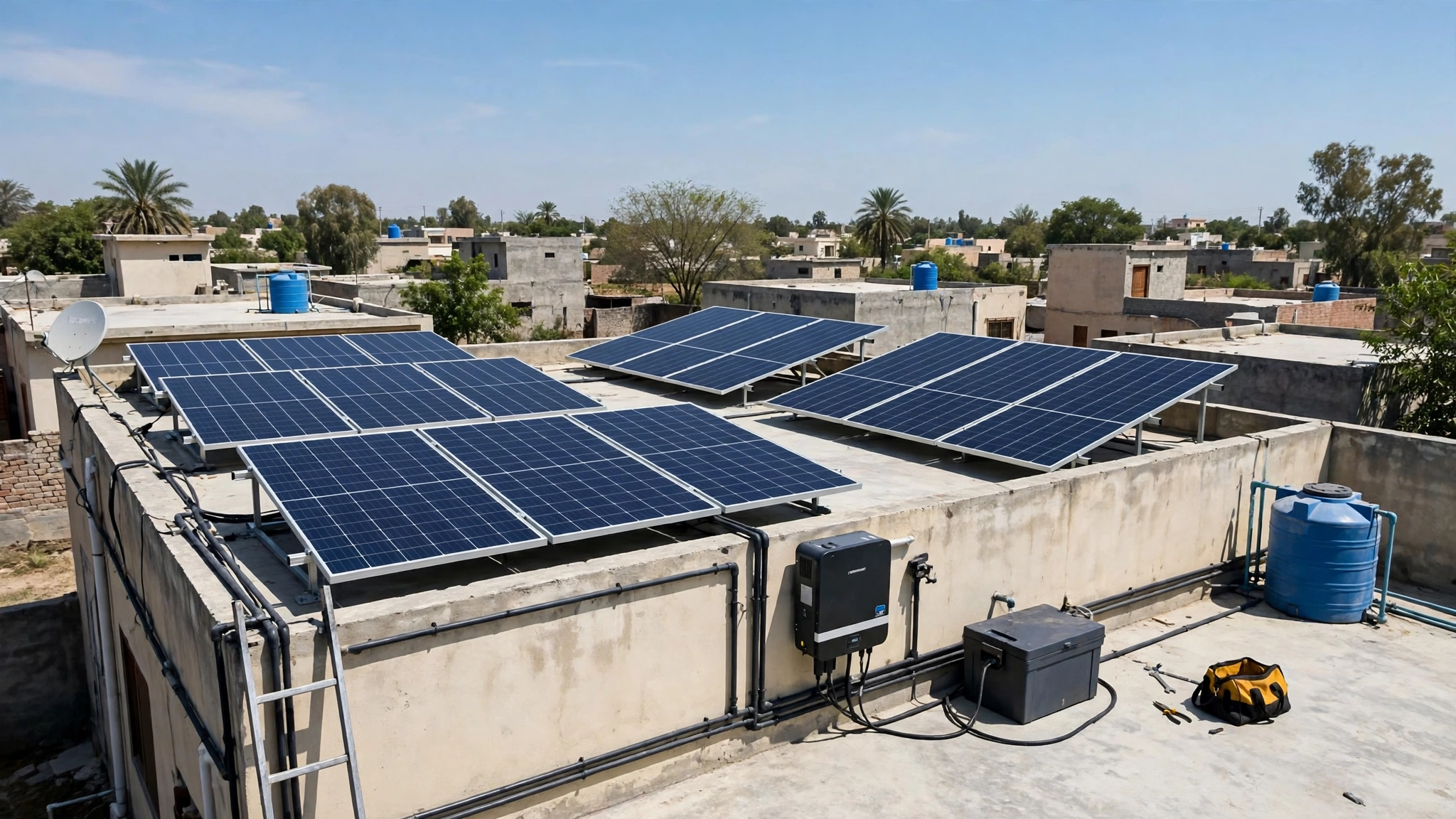
Complete solar panel kits are more than a stack of panels. Good solar panel kits include every part needed to produce, convert and safely deliver electricity to your home. When comparing quotes, check that each of these is listed with a brand and model:
- Solar panels (plates): most home systems in 2026 use 580 to 650-watt N-type panels from Tier-1 makers such as Jinko, Longi, JA Solar, Trina or Canadian Solar.
- Inverter: converts the panels’ DC power into AC power for your home. This is the brain of the system and the part that fails most often if it is cheap.
- Mounting structure: galvanised or aluminium frames that hold panels at the right angle. A weak structure is a real risk during storms.
- Cables and protection: DC and AC cables, breakers, surge protection devices, isolators and proper earthing.
- Batteries (optional): lithium (LiFePO4) batteries for backup during outages or at night.
- Installation and commissioning: labour, testing and setup of the inverter app.
If a quote lists only “panels + inverter + installation” without detail, ask for a full bill of materials before paying anything.
Types of Solar Panel Kits: On-Grid, Hybrid and Off-Grid
Choosing the right type of solar panel kits matters more than ever under the new net billing rules. There are three main kinds of solar panel kits for homes in Pakistan.
On-Grid Solar Panel Kits
On-grid solar panel kits connect directly to your DISCO or K-Electric supply and have no batteries. They are the cheapest option and reduce your daytime bill, but they shut off during load-shedding for safety reasons. With export rates now much lower, on-grid solar panel kits work best when you use most of your solar power during the day, such as running ACs, pumps or a home office.
Hybrid Solar Panel Kits
Hybrid solar panel kits combine grid connection, panels and batteries. They keep the lights and fans on during outages and let you store daytime solar for evening use instead of selling it cheaply to the grid. Under net billing, hybrid solar panel kits have become the most practical choice for many families, though batteries add significantly to the price.


Off-Grid Solar Panel Kits
Off-grid solar panel kits run entirely on panels and batteries, with no grid connection. They suit rural homes, farmhouses and areas with very unreliable supply. They need larger batteries and careful sizing, because there is no grid to fall back on.
Solar Panel Kits Price in Pakistan (Late 2026)
Prices for solar panel kits in Pakistan change almost weekly with the dollar rate, import costs and demand. The figures below come from market price trackers published in September and October 2026 and are a starting point, not a fixed quote.
Solar Panel Prices Per Watt
A-grade Tier-1 N-type panels from brands such as Jinko, JA Solar, Longi, Trina and Canadian Solar sold for roughly Rs 38 to 46 per watt at dealers in late 2026. That puts a single 585-watt panel at about Rs 23,000 to 27,000. Buying one panel at a time online usually costs more per watt than buying a full set from a dealer.
Complete Home Solar Kit Prices
| System size | Typical home use | On-grid (no battery) | Hybrid with lithium battery |
|---|---|---|---|
| 3 kW | Small home, fans, lights, fridge, 1 small AC by day | About Rs 2.5 to 3 lakh (estimate) | Varies widely with battery size |
| 5 kW | Medium home, 1 to 2 ACs by day | About Rs 3.3 to 4.7 lakh | About Rs 4.9 to 7.4 lakh |
| 10 kW | Large home, several ACs, water pump | About Rs 6.3 to 8.9 lakh | Higher, depending on battery capacity |
The 5 kW and 10 kW ranges come from late-2026 market trackers; the 3 kW figure is our estimate based on current per-watt rates. Some branded installers quote noticeably higher for premium inverters, warranties and after-sales service, so a higher price is not automatically a rip-off.
How Much Electricity Will Solar Panel Kits Produce?
As a rough rule, each kilowatt of panels in Pakistan produces about 4 units a day on average, more in summer and less during winter fog and dust. That means 5 kW solar panel kits make roughly 550 to 650 units a month in good conditions. Compare this with your last 12 electricity bills, not just your summer peak.
What Pushes the Price of Solar Panel Kits Up
- Inverter brand and type: hybrid inverters and well-known brands cost more but usually last longer.
- Batteries: lithium batteries can almost double the cost of a kit.
- Structure: elevated or custom structures for limited roof space cost extra.
- Distance and wiring: long cable runs from roof to inverter add cost and losses.
- Net billing application: green meter and DISCO process fees add to the total.
When comparing solar panel kits, divide the total price by the system’s wattage to get a cost per watt, then check that both quotes use the same panel brand, inverter model and battery size. Two kits at the same price can be very different in quality.
Net Metering vs Net Billing: How 2026 Rules Affect Solar Panel Kits
The biggest change for anyone buying solar panel kits this year is not the panel price. It is the rulebook.
What Changed in February 2026
On 9 February 2026, NEPRA notified the Prosumer Regulations 2026, which replaced the Net Metering Regulations of 2015. As Dawn reported, the key changes for new solar users were:
- Net billing instead of net metering: exported and imported units are no longer swapped one for one.
- Lower buyback rate: surplus units are bought at roughly Rs 10 to 11 per unit, down from about Rs 26.
- Full tariff on imports: electricity you take from the grid is billed at normal rates, reported at Rs 37 to 55 per unit.
- Shorter contracts: new agreements run for five years instead of seven.
- Size limits: systems cannot exceed the home’s sanctioned load for grid connection.
Protection for Existing Net Metering Users
The original notification also moved existing users to net billing, which caused a strong public backlash. After the Prime Minister directed a review, NEPRA amended the regulations to protect existing prosumers holding valid agreements as of 9 February 2026 until their seven-year contracts expire. Capacity added to an existing system after that date falls under the new rules.
The government’s argument for the change was that the roughly 466,000 net-metered users were shifting costs onto millions of ordinary grid consumers, estimated at around Rs 3 per unit. Solar users and installers argued the change broke promises made to people who had invested in good faith. Both concerns are real, and the debate is likely to continue.
What Net Billing Means for Your Solar Panel Kit
Under the new system, every unit you use yourself is worth the full retail tariff, while every unit you export earns only about a quarter of that. This changes how you should size and design solar panel kits:
- Size for self-use, not export. A system much larger than your daytime usage now pays back slowly.
- Shift heavy loads to daytime. Run ACs, washing machines, irons and water pumps while the sun is up.
- Consider batteries more seriously. Storing your own solar for the evening is now worth much more than exporting it.
- Recalculate payback honestly. Ask your installer to show the payback with the new buyback rate, not the old one.
Rules in Pakistan’s power sector change often. Before you sign, check the latest NEPRA notifications or ask your DISCO directly about the current terms for new solar panel kits connected to the grid.
The Dark Side of the Solar Panel Kits Boom: Scandals and Scams
Pakistan’s solar rush has brought cheaper power to millions of homes. It has also attracted people looking to exploit a fast-moving, loosely monitored market. These cases explain why buying solar panel kits from accountable suppliers matters.
The Rs 69.5 Billion Solar Import Over-Invoicing Scandal
In October 2022, the Federal Board of Revenue began auditing solar panel importers. The audit of 6,232 goods declarations found that 63 importers had over-invoiced solar panel imports by Rs 69.5 billion between 2017 and 2022. Officials said solar panels had become a high-risk item for trade-based money laundering because they could be imported free of duty and tax.
Two firms, Bright Star Business Solution and Moonlight Traders, were accused of transferring about Rs 72.83 billion out of Pakistan in the name of solar imports while filing nil income tax returns. Investigators later reported that their listed offices in Peshawar did not exist. Panels declared at Rs 72.83 billion on import were sold locally for about Rs 45.61 billion, a gap that pointed clearly to inflated invoices. The FBR registered FIRs, the Senate finance committee directed the FIA to investigate, and in 2026 the government assured the IMF that action would follow.
Why it matters to home buyers: this scandal did not overcharge households directly, but it shows how opaque parts of the supply chain have been. Buying from established importers and dealers who give proper invoices, serial numbers and warranties reduces your exposure to that grey market.
B-Grade and Refurbished Panels Sold as Tier-1
One of the most common tricks in the local solar panel kits market is selling B-grade, rejected or used panels as new A-grade stock. These panels may carry a famous brand sticker but produce less power and degrade faster. Common signs include:
- A price per watt far below the current market range.
- Missing or mismatched serial numbers on the panel back and the box.
- Scratches, uneven cell colour or visible micro-cracks.
- Datasheets that do not match the manufacturer’s official website.
Most Tier-1 brands let you verify a panel’s serial number with their local distributor. Do this before installation, not after.
Cheap Inverters and Unsafe Installation
The inverter, cables and protection devices are where unscrupulous installers cut corners most. Undersized cables, missing surge protection and poor earthing can cause fires, damage appliances and void warranties. Good solar panel kits always include proper DC breakers, surge protection and earthing, listed by brand in the quote.
Illegal Grid Connections and Meter Tampering
Connecting a solar system to the grid and exporting power without an approved DISCO agreement, or tampering with meters to inflate credits, is illegal and can lead to heavy fines, disconnection and criminal cases. Legitimate solar panel kits connected to the grid should always go through the proper application process with your DISCO or K-Electric.
Misleading Payback Promises
Many sales pitches for solar panel kits still quote payback periods based on the old Rs 26 buyback rate. Under net billing, that promise is no longer realistic for new customers. Misleading claims about a product’s performance or benefits can amount to deceptive marketing under Section 10 of the Competition Act, 2010, which the Competition Commission of Pakistan enforces. Ask for payback calculations in writing, using current rates.
7 Honest Truths About Solar Panel Kits in Pakistan
- Panels are the cheap part. Inverters, batteries, structure and wiring decide how long your system lasts.
- Net billing changed the maths. New users earn about Rs 10 to 11 per exported unit, so bigger is no longer automatically better.
- Self-use is where the savings are. Every solar unit you use yourself saves you the full grid tariff.
- Batteries matter more now. Storing daytime solar for the evening is often worth more than exporting it.
- Not every “Tier-1” panel is genuine. Verify serial numbers before installation.
- The supply chain has a fraud history. The Rs 69.5 billion over-invoicing case is a reason to buy from accountable importers and dealers.
- Old payback promises are out of date. Any quote for solar panel kits should use current buyback rates.
How to Choose Solar Panel Kits for Home Use: Step-by-Step
Follow these steps before signing for any of the solar panel kits on offer:
- Study 12 months of electricity bills. Note your average daytime and night-time usage, not just your highest summer bill.
- Decide on on-grid, hybrid or off-grid. If outages are frequent or most of your usage is in the evening, lean towards hybrid.
- Size for self-consumption. Under net billing, a system matched to your daytime load usually pays back faster than an oversized one.
- Get at least three written quotes. Each should list panel brand and wattage, inverter model, battery capacity, structure type, cable sizes and protection devices.
- Verify panel serial numbers and warranties. Check with the brand’s local distributor that the panels are genuine and new.
- Check the installer’s track record. Ask for addresses of past installations and speak to those customers.
- Confirm who handles the DISCO application. Get the green meter and net billing paperwork in writing, including fees and timelines.
- Ask for a written payback estimate at current rates. Insist it uses today’s buyback rate, not the old net metering rate.
Red Flags When Buying Solar Panel Kits
- Prices far below current market rates for “Tier-1” panels.
- Quotes that list “branded panels” or “good inverter” without exact models.
- Payback promises of two to three years that rely on old net metering rates.
- Installers who ask for full payment upfront with no written contract.
- No proper earthing, surge protection or DC breakers in the design.
- Offers to connect your system to the grid “without paperwork”.
- Warranty cards with no serial numbers or a supplier with no physical office.
Which Size of Solar Panel Kit Is Right for Your Home?
- 3 kW: small homes running fans, lights, a fridge and perhaps one small inverter AC during the day.
- 5 kW: the most popular choice for medium homes with one or two ACs used mainly in daytime.
- 10 kW: larger homes with several ACs, a water pump or a home business.
If your evening usage is high, consider a smaller array with batteries rather than a larger on-grid system. Many families now find that well-sized hybrid solar panel kits save more under net billing than bigger on-grid ones.
Frequently Asked Questions
Are solar panel kits still worth it in Pakistan after net billing?
Yes, for most homes, but the payback is longer than it was. Solar panel kits pay off fastest when you use most of the power yourself during the day or store it in batteries for the evening.
How long do solar panel kits last?
Good Tier-1 panels usually carry long performance warranties and can work for 25 years or more with gradual output loss. Inverters typically need repair or replacement sooner, and lithium batteries have their own warranty periods, so check each one separately.
Can I install solar panel kits without net billing?
Yes. You can run an on-grid system for self-use only or a hybrid or off-grid system without exporting to the grid. Exporting power, however, requires an approved agreement with your DISCO.
How can I tell if solar panels are genuine?
Check serial numbers with the official distributor, compare the datasheet with the manufacturer’s website, inspect the panel for damage, and be wary of prices well below the market range.
Conclusion
Solar panel kits remain one of the smartest home investments in Pakistan, but 2026 has made careful planning essential. Tier-1 panels now sell for roughly Rs 38 to 46 per watt, and a typical 5 kW on-grid kit costs around Rs 3.3 to 4.7 lakh, with hybrid systems costing more because of batteries. NEPRA’s switch from net metering to net billing means new users earn only about Rs 10 to 11 for exported units, so the best systems are sized for self-use and often paired with storage, while existing net metering users keep their old terms until their contracts expire. The Rs 69.5 billion solar import over-invoicing scandal, B-grade panels sold as new, unsafe installations and outdated payback promises show why the supplier matters as much as the price. Get detailed written quotes, verify panel serial numbers, use the proper DISCO process, and choose solar panel kits that fit your real usage, and you will get reliable, affordable power for decades.