How SMEs Can Access Business Loans in Pakistan
Business loans in Pakistan for SMEs: government schemes, bank and microfinance options, required documents, and loan frauds to avoid in 2026.
Business Loans in Pakistan: 7 Proven Ways SMEs Can Get Funding and Avoid Costly Loan Traps
Introduction
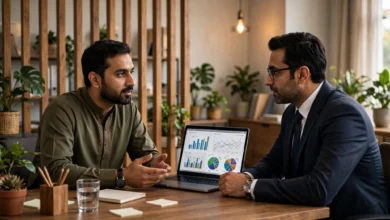
Getting business loans in Pakistan has always been hard for small firms. Banks prefer large, well-documented companies. Many SMEs keep informal records, have no collateral and have never filed a tax return. So when a shopkeeper wants to buy stock, a workshop owner needs a new machine, or a young founder wants to launch a startup, the money often comes from family, a committee or an expensive informal lender instead.
That picture has started to change. Government schemes now offer interest-free and low-markup loans to young entrepreneurs, provincial programmes target small businesses, and banks are under pressure to lend more to SMEs. Microfinance banks and licensed digital lenders have widened access too.
But more money in the system has also brought more traps. Fake websites charge “registration fees” for government loans that are actually free to apply for. Illegal loan apps lure borrowers with instant cash and then harass them. And some of Pakistan’s biggest financial scandals began with loans obtained on the back of fake paperwork.
This guide explains, in plain language, the main routes SMEs can use to borrow, what lenders actually check, how to prepare a strong application, and how to spot the scams. Use it as a practical map, then confirm the latest terms directly with the bank or official portal before you apply.
Why SMEs Struggle to Get Business Loans in Pakistan
Small and medium enterprises make up the vast majority of businesses in Pakistan, yet they receive only a small slice of total bank lending. Understanding why helps you fix the problems on your side before you apply.
- Informal records. Many businesses run on cash, keep no proper accounts and mix personal and business money. Lenders cannot judge what they cannot see.
- No tax history. A business that has never filed a return looks riskier, and some schemes and banks require an NTN or filer status.
- Lack of collateral. Traditional loans often need property or other security, which many young and small owners do not have.
- Weak credit history. If you have never borrowed formally, you have no track record. If you have defaulted, your record follows you.
- Unclear plans. Applications that ask for money without explaining how it will be used and repaid are easy to reject.
- High cost of borrowing. Commercial loans are priced against KIBOR plus a margin, so when interest rates are high, many SMEs cannot afford regular bank finance.
What Lenders Actually Look For
Whether you apply to a bank, a microfinance institution or a government scheme, most lenders assess the same things:
- Character: your identity, reputation, references and repayment history, often checked through credit bureau reports.
- Capacity: whether your business generates enough cash to repay, shown by bank statements, sales records and tax returns.
- Capital: how much of your own money you have put into the business. Lenders like owners who share the risk.
- Collateral: what security you can offer, if the loan requires it. Some schemes offer “clean” loans backed only by personal guarantees.
- Conditions: your sector, market, location and the purpose of the loan.
The good news is that most of these can be improved within a few months. Opening a business bank account, routing sales through it, filing a tax return and writing a clear plan can make a big difference to your chances of getting business loans in Pakistan.
7 Proven Ways to Get Business Loans in Pakistan
Each route below suits a different kind of business. Terms change often, so treat the figures as a guide and confirm current details with the lender or official portal.
1. Prime Minister’s Youth Business and Agriculture Loan Scheme (PMYB&ALS)
This federal scheme, which grew out of the earlier Kamyab Jawan programme, is the best-known source of subsidised SME financing for young entrepreneurs. Loans are disbursed through participating banks, and as of 2026 the scheme has three main business tiers:


| Tier | Loan size | Markup for borrower | Security |
|---|---|---|---|
| Tier 1 | Up to Rs0.5 million | 0% | Clean loan, personal guarantee |
| Tier 2 | Above Rs0.5 million to Rs1.5 million | 5% | Clean loan, personal guarantee |
| Tier 3 | Above Rs1.5 million to Rs7.5 million | 7% | As per bank policy |
Eligibility: Pakistani citizens aged 21 to 45, with the lower age limit relaxed to 18 for IT and e-commerce businesses. For partnerships and companies, at least one owner must fall in the age range. A quota is reserved for women borrowers. Loans can fund startups or expand existing businesses, including machinery and working capital. Banks such as Bank Alfalah publish the scheme’s eligibility and limits on their websites.
Reality check: Approval is not automatic. Banks still assess your business plan, references and ability to repay. Apply only through the official government portal or directly at a participating bank.
2. Provincial Business Loan Programmes
Provinces run their own schemes. The most prominent is Punjab’s Asaan Karobar Finance, run with the Bank of Punjab, which offers markup-subsidised loans to small and medium businesses in the province. According to the Bank of Punjab’s scheme page, Tier 1 covers loans above Rs1 million up to Rs5 million on personal guarantees, Tier 2 covers above Rs5 million up to Rs30 million with security, applicants must be 25 to 55 years old and based in Punjab, and a non-refundable processing fee is paid at the time of application. Punjab also launched the smaller Asaan Karobar Card, though its registration status has changed over time, so check the official portal before applying.
Other provinces have run their own youth and SME programmes. Check your provincial government’s official websites and partner banks for what is currently open.
3. Commercial Bank SME Financing
Most banks offer SME products such as running finance for working capital, term loans for machinery and expansion, and trade finance. The State Bank of Pakistan also runs refinance and credit guarantee schemes through banks, which can lower costs or reduce collateral requirements for specific purposes such as modernisation, renewable energy or lending to women-led businesses. Ask your bank’s SME desk which schemes it participates in.
Best for: Established businesses with a few years of bank statements, filed tax returns and some collateral.
4. Microfinance Banks
Microfinance banks serve borrowers that commercial banks often overlook, including micro-entrepreneurs, small shopkeepers and rural businesses. Loans are smaller, paperwork is lighter and approval can be faster, but markup rates are usually higher than bank loans. They can be a good first step to build a formal credit history.
5. Islamic Financing
Islamic banks and Islamic windows of conventional banks offer Shariah-compliant SME finance. Common structures include Murabaha for buying stock or raw materials, Ijarah for leasing equipment and vehicles, and Diminishing Musharakah for property or machinery. These are a strong option for owners who avoid interest-based borrowing.
6. Equipment Leasing and Trade Finance
If you need a specific machine or vehicle, leasing companies, modarabas and bank leasing products let you pay in instalments while the asset itself serves as security. Exporters can also access export finance and pre-shipment financing through banks, often at better rates than general business loans.
7. Licensed Digital Lenders and Supplier Credit
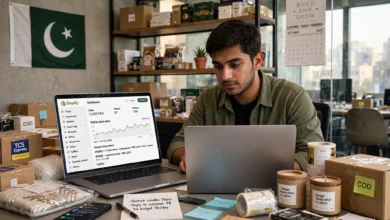
Some fintech platforms, working with licensed banks or SECP-regulated non-bank finance companies, offer short-term working capital or inventory financing to small retailers and online sellers based on their sales data. Supplier credit, where your supplier lets you pay after 30 or 60 days, is another practical form of financing. Use only lenders you can verify, and check SECP’s list of approved digital lending apps before downloading any loan app.
Do Not Ignore Free Support
The Small and Medium Enterprises Development Authority (SMEDA) publishes pre-feasibility studies for many types of businesses and offers advisory support. A business plan built on a SMEDA study gives lenders a clearer picture of your costs and expected returns.
How to Apply for Business Loans in Pakistan: Step by Step
Step 1: Decide Exactly How Much You Need and Why
Lenders want a specific amount tied to a specific purpose: “Rs1.2 million for two sewing machines and three months of raw material,” not “some money to grow the business.” Borrow what you need, not the maximum you can get. Every extra rupee has to be repaid.
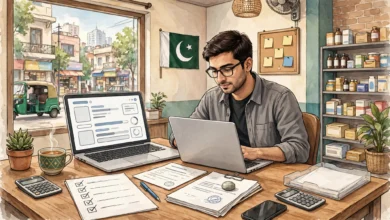
Step 2: Get Your Documents in Order
Most lenders ask for some or all of the following:
- Valid CNIC of the applicant and any partners or directors
- NTN and recent income tax returns, if available
- Business registration documents, such as an SECP certificate, partnership deed or proof of sole proprietorship
- Six to twelve months of business bank statements
- Proof of business premises, such as a rent agreement or utility bill
- A business plan with costs, expected sales and a repayment plan
- Quotations for machinery or equipment you plan to buy
- Personal guarantor details, if the scheme requires them
- Collateral documents, if the loan is secured
Step 3: Write a Simple, Honest Business Plan
You do not need a 50-page report. A good plan answers five questions: what you sell, who buys it, what it costs to produce, how much you expect to sell each month, and how you will repay the loan. Use realistic numbers. Lenders have seen thousands of plans and can tell when figures are inflated.
Step 4: Choose the Right Lender and Scheme
Match your needs to the routes above. A first-time young entrepreneur might start with PMYB&ALS Tier 1. An established workshop in Punjab might look at Asaan Karobar Finance or a bank term loan. A trader who avoids interest might prefer Murabaha from an Islamic bank.
Step 5: Apply Only Through Official Channels
Submit applications through the official government portal, the bank’s own website or branch, or a verified lender’s official app. Pay any processing fee only through the official payment method shown on that portal. Never pay an agent to “guarantee approval.”
Step 6: Prepare for Verification
Expect a credit check, phone calls to references and, for many loans, a visit to your business premises. Keep your shop or workshop ready, and make sure your stated address and activity match reality.
Step 7: Read the Terms Before Signing
Banks are required to share key terms with borrowers. Check the markup rate, total repayment amount, processing and insurance charges, penalties for late payment, prepayment rules and what happens if you default. Ask questions until you understand every line.
Step 8: Use the Money for Its Stated Purpose and Repay on Time
Diverting a business loan to a wedding, a car or another person’s business is one of the main reasons small loans go bad. Repaying on time builds your credit history, which makes your next loan easier and cheaper. Among all the advice about business loans in Pakistan, this is the one that pays off most over the long run.
Loan Frauds That Damaged Trust in Business Loans in Pakistan
Every fraud makes lenders more cautious, which means more paperwork and slower approvals for honest borrowers. These cases show what went wrong and how to stay on the right side of the line.
Fake Scheme Websites and “Approval Agents”
Whenever a popular government loan scheme is announced, copycat websites and social media pages appear within days. They use official logos, promise guaranteed approval, and ask applicants to pay “registration,” “file” or “processing” fees through mobile wallets. Some collect CNIC copies and personal details that can later be misused. Real schemes either charge no fee or collect a fixed processing fee only through their official portal or partner bank.
Lesson: Type the official portal address yourself, or apply at a bank branch. No genuine scheme guarantees approval in exchange for payment to an individual.
Large Loans and Alleged Banking Violations
In 2021, the FIA arrested the founder of Hascol Petroleum in what it described as a Rs54 billion scam. According to Dawn’s report on the arrest, the agency alleged that loans and financing facilities were granted to the company by the National Bank of Pakistan between 2015 and 2020 in violation of prudent banking practices, and that funds were siphoned through fake contractors. Around 30 suspects, including current and former bank officials, were named. These were the agency’s allegations at the time of the arrest.
Lesson: Fraud at the top of the system is a big reason banks tightened lending rules for everyone. For small borrowers, the message is simple: never let anyone, including a bank employee, “adjust” your documents or figures to get a loan approved. You will be the one held responsible.
Taking Money You Are Not Entitled To
In early 2026, the Bank of Punjab said a temporary technical glitch in its credit card system had allowed a limited number of existing customers to make unauthorised transactions beyond their limits, and that it had started recovery action, according to Dunya News. The bank said the affected customers were not linked to the Asaan Karobar Card. Separately, media reports in 2026 said the cybercrime agency had registered a case at the bank’s request over alleged irregular withdrawals connected to the Asaan Karobar scheme, with dozens of people detained.
Lesson: If a system error gives you money or credit you did not apply for, report it and do not spend it. Using funds you know are not yours can turn a bank error into a criminal case against you.
Illegal Loan Apps Targeting Cash-Strapped Owners
Small business owners short on working capital are prime targets for illegal loan apps that offer instant cash with hidden charges and very short repayment periods. When borrowers fall behind, some apps harass them and their contacts. SECP has said it blocked well over a hundred illegal lending apps, and Profit reported in 2024 that the number had reached 142.
Lesson: Check SECP’s list of approved digital lending apps before borrowing, and never give an app access to your contacts and photos.
Loans in Someone Else’s Name
Investigations into fake bank accounts in 2018 showed how accounts could be opened in the names of poor people who knew nothing about them, sometimes with the help of insiders. The same risk applies to loans. If anyone asks to use your CNIC to “help” them get a loan, refuse. The debt and the legal case will carry your name.
Red Flags in Any Loan Offer
- Guaranteed approval regardless of your credit history
- Upfront fees paid to a person rather than through an official bank or portal
- Pressure to sign quickly without reading the terms
- Requests for your OTP, PIN or online banking password
- Offers to inflate your income or prepare fake documents
- Apps or websites not listed by SECP or the State Bank
If you spot these, walk away and report the matter to the bank, SECP or the National Cyber Crime Investigation Agency.
Common Mistakes SMEs Make With Business Loans in Pakistan
- Borrowing before the business is tested. A loan magnifies a good idea and a bad one equally. Test demand with your own small capital first.
- Borrowing too much. Bigger loans mean bigger instalments. Size the loan to your realistic cash flow.
- Ignoring the full cost. Processing fees, insurance, late payment charges and markup all add up. Compare the total repayment, not just the headline rate.
- Using business loans for personal spending. It is the fastest route to default.
- Hiding information. Undisclosed debts or inflated figures usually surface in credit checks and verification, and can lead to rejection or legal trouble.
- Missing instalments without talking to the lender. If you are struggling, contact the bank early. Rescheduling is often possible before a loan is classified as defaulted.
Frequently Asked Questions
Which business loans in Pakistan are interest-free?
Tier 1 of the Prime Minister’s Youth Business and Agriculture Loan Scheme offers loans up to Rs0.5 million at 0 percent markup for eligible borrowers. Punjab’s Asaan Karobar Finance is also markup-subsidised for eligible businesses in Punjab. Processing fees and other charges may still apply, so read the terms.
Can I get a business loan without collateral?
Yes, in some cases. PMYB&ALS Tiers 1 and 2 and Asaan Karobar Finance Tier 1 are clean loans backed by personal guarantees. Microfinance banks also lend smaller amounts without property collateral. Larger loans usually require security.
Do I need an NTN to get a business loan?
Not every scheme demands it at the start, but having an NTN and filed tax returns strengthens your application, helps prove your income and is often required for larger loans.
How long does approval take?
It varies by lender and loan size. Small digital and microfinance loans can be approved in days, while scheme-based and bank loans can take several weeks because of verification and credit checks.
Conclusion
Access to business loans in Pakistan is better than it used to be, with the Prime Minister’s Youth Business and Agriculture Loan Scheme offering tiered loans from interest-free up to Rs7.5 million, provincial programmes such as Punjab’s Asaan Karobar Finance, commercial bank SME products backed by State Bank refinance and guarantee schemes, microfinance banks, Islamic financing, leasing and trade finance, and licensed digital lenders, but every route still rewards the same basics: clean records, a business bank account, filed tax returns, a realistic plan and a loan sized to your cash flow; at the same time, the fake scheme websites charging fees, the alleged multi-billion-rupee abuses of bank lending, cases of people spending money a bank system wrongly gave them, illegal loan apps and loans taken in borrowed names all show that shortcuts end in debt, frozen accounts or criminal cases, so apply only through official channels, read every term, use the money for its stated purpose and repay on time to build the credit history that makes your next loan easier.