Internet Outages in Pakistan: 7 Shocking Reasons They Keep Happening
Internet outages in Pakistan come from undersea cable cuts, power failures, weak backup routes and government shutdowns. Here is how each works.
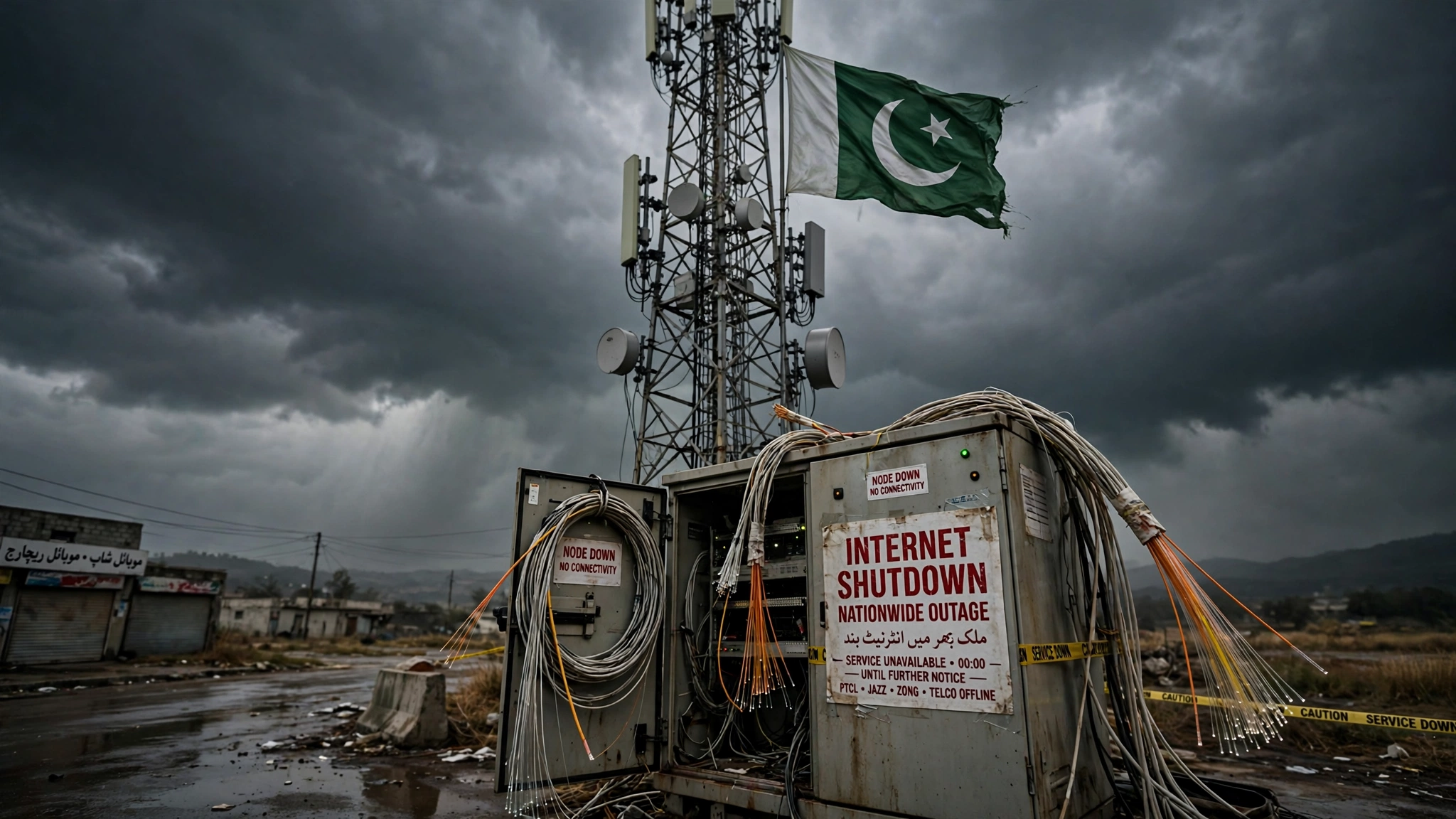
Internet outages in Pakistan have become part of everyday life. One week your Zoom call freezes halfway through a client pitch. The next, WhatsApp images refuse to load, YouTube drops to 240p, and the regulator puts out a short statement about a “submarine cable fault” somewhere in the Red Sea. For a country with well over 100 million broadband users and one of the world’s largest freelance workforces, that is not a minor inconvenience.
The frustrating part is that most people never get a clear answer about what actually went wrong. Was it a ship dragging its anchor across a cable? A power cut at a mobile tower? A deliberate shutdown ordered for security reasons? Sometimes it is all three in the same month, which makes it hard to know who to blame or what to expect next.
This article explains why internet disruptions in Pakistan keep happening, in plain language. We will look at how the country physically connects to the global internet, the seven main causes behind slow internet and full blackouts, and how to tell a cable fault from a government-ordered internet shutdown. We will also cover what these outages cost people and businesses, what is being done to improve internet connectivity in Pakistan, and a few practical steps you can take to stay online when things go wrong. If you have ever stared at a spinning loading icon and wondered whose fault it was, this one is for you.
How Pakistan Connects to the Global Internet
To understand internet outages in Pakistan, you first need to know where the internet physically comes from. When you open Google, Instagram or Netflix, most of that data sits on servers outside the country. It reaches you through thin strands of glass fiber laid on the seabed, called submarine cables or undersea cables.
Pakistan’s international traffic lands almost entirely in one city: Karachi. Karachi hosts the SeaMeWe-3, 4 and 5 systems, along with the AAE-1, IMEWE, PEACE and Transworld-1 cables (SDxCentral). Reports in early 2025 put the country’s total international bandwidth from its seven existing cables at roughly 8 terabits (Nukta).
The main systems serving Pakistan are:
- SEA-ME-WE 3, 4 and 5: Long-haul consortium cables linking South and Southeast Asia with the Middle East and Europe.
- AAE-1 (Asia-Africa-Europe 1): A major route to Europe through the Gulf and the Red Sea.
- IMEWE (India-Middle East-Western Europe): Another Red Sea route that has been hit by faults several times.
- PEACE: A newer cable connecting Pakistan toward East Africa and Europe.
- Transworld-1 (TW1): A regional cable linking Pakistan with the UAE and Oman.
From the Coast to Your Phone
Once data reaches the cable landing stations in Karachi, it travels north through terrestrial fiber run by PTCL and other carriers. From there it moves into internet exchanges, then to your ISP or mobile operator, and finally to your home router or phone. There is also an overland fiber link to China through the north, but it carries a small share of traffic compared with the sea routes.
Why a Single Landing City Is a Weak Point
Every stage in that chain can fail, but the biggest risk is concentration. With nearly all international capacity arriving in one coastal city, and several of those cables sharing the same crowded routes through the Red Sea and the Gulf, a single incident can knock out a large share of Pakistan’s internet bandwidth at once. That design is the root of many internet outages in Pakistan, and it explains why problems thousands of kilometers away show up as slow WhatsApp messages in Lahore or Peshawar.
7 Main Causes of Internet Outages in Pakistan
No single villain explains every disruption. Most internet outages in Pakistan fall into one of seven categories, and some of the worst episodes happen when two or three of them overlap.


1. Undersea Cable Cuts and Faults
Submarine cable cuts are the most common reason the whole country slows down at once. Cables get damaged by ship anchors, fishing trawlers, seabed shifts and, less often, deliberate interference. The track record is long:
- December 2021: The AAE-1 cable was cut, reportedly by vessel activity, cutting Pakistan’s internet supply by more than 10 percent (Subtel Forum).
- February 2022: A fault on Transworld-1 roughly 400 km off Pakistan’s coast slowed speeds nationwide (ARY News).
- August 2024: The PTA blamed weeks of slow browsing on a faulty SMW-4 cable and said repairs would likely run until early October 2024 (Asia News Network).
- September 2025: Cuts in Saudi waters near Jeddah partially disrupted SMW4 and IMEWE, slowing internet for users across Pakistan (Aaj News).
Repairs are slow because a specialized repair ship has to reach the site, lift the cable from the seabed and splice it. In conflict zones like the Red Sea, permits and safety concerns can stretch that timeline from days into weeks.
2. Limited Bandwidth and Weak Backup Capacity
When one cable fails, traffic is shifted to the others. That only works if the remaining cables have spare room. For years, Pakistan’s total international capacity has been tight compared with demand, so losing even one major system leaves the rest congested. This is why a cable fault often shows up as slow internet speed during evening peak hours rather than a full blackout. The network is technically up, but it is too crowded to feel usable.
3. Power Outages and Load Shedding
Your connection depends on electricity at every step: the exchange, the fiber cabinet on your street, the mobile tower and your own router. During load shedding, towers switch to batteries or diesel generators. If the outage runs longer than the backup can last, or if a battery has been stolen or never replaced, the site goes dark. Rising fuel costs make generator backup expensive for operators, so smaller towns and rural areas usually feel this first.
4. Floods, Heavy Rain and Extreme Weather
Pakistan’s monsoon and flood seasons regularly damage ground infrastructure. In August 2022, PTCL reported faults in its optical fiber network during heavy rainfall, and users in Islamabad and Lahore faced blackouts on both fixed and mobile connections (Khaleej Times). Flooded exchanges, washed-out roads carrying fiber, and damaged towers can keep whole districts offline long after the water drops.
5. Government-Ordered Internet Shutdowns
Not every outage is an accident. Federal and provincial authorities regularly suspend mobile internet services for security reasons, usually during protests, religious processions, elections or militant attacks. Nationwide mobile data suspensions followed the unrest of May 2023, and mobile services were also suspended on general election day in February 2024.
Balochistan has seen the longest restrictions. In August 2025, mobile internet was suspended across all 36 districts of the province until the end of the month (Global Voices), and further suspensions followed in Quetta and other areas later that year. Officials say limiting connectivity helps stop militants from coordinating attacks. Rights groups and local businesses argue that blanket shutdowns punish millions of ordinary users and do little for security. The Internet Society Pulse shutdown tracker keeps a running record of these regional suspensions.
6. Web Filtering, Platform Blocks and Throttling
Sometimes the internet works, but parts of it do not. Pakistan has blocked major platforms for long stretches, including X (formerly Twitter) after the February 2024 election, and has pushed for registration of VPNs. In mid-2024, when speeds dropped sharply, many ISPs, business groups and digital rights activists linked the slowdown to a new national internet firewall being tested on the network. The PTA rejected this and blamed a faulty submarine cable instead (Subtel Forum).
Whatever the cause in a given week, it is worth understanding the mechanism. Filtering systems inspect traffic before it passes through. If they are poorly sized or misconfigured, they can add delay or break secure connections for services that were never the target. That can feel exactly like an outage to the end user.
7. Local Fiber Cuts and ISP Network Faults
The last category is the least dramatic but very common. Fiber gets cut by road construction, sewerage work and illegal digging. Equipment fails in exchanges. ISPs push routing changes that go wrong, or their DNS servers stop responding. These problems usually hit one provider or one city at a time, which is why your neighbor on a different ISP may be fine while you are offline.
Outage, Slowdown or Shutdown: How to Tell the Difference
People use “the internet is down” for very different problems. Knowing which one you are dealing with tells you whether to restart your router, switch networks or just wait it out.
| Type of disruption | What you notice | Usual cause | How long it tends to last |
|---|---|---|---|
| Nationwide slowdown | Everything loads, but slowly, worst in the evening | Submarine cable fault, low spare bandwidth | Days to several weeks |
| Regional mobile shutdown | Calls work, mobile data does not; Wi-Fi may still work | Government security order | Hours to weeks; longer in parts of Balochistan |
| Platform block | One app or site fails, others work fine | Filtering or a ban on that service | Weeks to months |
| Local outage | Only your ISP or area is affected | Fiber cut, power failure, equipment fault | Minutes to a few days |
Quick Checks When Your Internet Goes Down
- Test another network. If mobile data fails but home broadband works, a mobile shutdown is likely. If both are slow, think cable fault.
- Check official accounts. PTA and PTCL usually post on X when a submarine cable fault is confirmed.
- Look at outage trackers. Sites like Downdetector show whether others on your ISP are reporting the same problem at the same time.
- Try one specific app. If everything works except one platform, you are probably facing a block, not an outage.
- Ask a friend in another city. If they are fine and you are not, the problem is local to your area or provider.
The Real Cost of Internet Outages in Pakistan
It is easy to treat a slow connection as a nuisance. In practice, internet outages in Pakistan carry a heavy economic and social price.
Economic Losses
The VPN review site Top10VPN ranked Pakistan third in the world for total shutdown duration in 2024, at 9,735 hours, and estimated the economic loss at about USD 1.62 billion (Global Voices). That figure only covers deliberate shutdowns. It does not include the hours lost to cable faults, power cuts and local network failures.
Who Gets Hit Hardest
- Freelancers and IT exporters: Missed deadlines and dropped client calls hurt ratings on platforms like Upwork and Fiverr. Foreign clients rarely care whether the cause was a cable near Jeddah.
- Students: Online classes, admission portals and exam forms often have fixed deadlines that do not move for network disruptions.
- Small businesses: Shops that rely on digital payments, food delivery apps or WhatsApp orders lose sales the moment data stops.
- Banking and public services: Branch systems, ATMs and government offices stall when their links go down, as seen when a prolonged outage halted domicile issuance at a Rawalpindi district office (The Express Tribune).
- Remote and conflict-affected areas: In parts of Balochistan, residents describe mobile internet being unavailable for years at a time, leaving expensive landline connections as the only option.
The Trust Problem
Repeated, poorly explained disruptions also damage confidence. When users cannot tell whether slowness comes from a broken cable or a filtering system, rumors fill the gap. Foreign companies weighing Pakistan for outsourcing or data centers notice unreliable internet too, which affects the country’s long-term digital growth.
What Is Being Done to Reduce Internet Outages in Pakistan
The good news is that several fixes are underway, especially on the international bandwidth side.
New Submarine Cables Landing in Karachi
The biggest change is the 2Africa cable, one of the largest subsea systems ever built. According to the Pakistan Telecommunication Authority, it spans about 45,000 km, connects 46 locations and offers 180 Tbps of design capacity. Its landing partner, Transworld Associates, announced in February 2025 that the cable had landed in Karachi (Transworld Associates), with service expected to start later. SeaMeWe-6 was also scheduled to add capacity at Karachi. More cables mean more room to reroute traffic when one fails, which should make internet speed in Pakistan far less fragile.
More Diverse Routes
Capacity alone is not enough if every cable still squeezes through the same narrow sea lanes. Engineers generally agree that Pakistan needs routes that avoid the Red Sea, more than one landing city, and stronger overland links through neighboring countries. Diversity is what keeps a single anchor drag from turning into a national event.
Better Power Backup at Towers and Exchanges
Operators are gradually adding solar panels and lithium batteries at tower sites to reduce dependence on the grid and on diesel. This matters most in rural areas, where load shedding lasts longest.
Legal and Policy Pressure on Shutdowns
Courts have started to weigh in. In 2025, the Balochistan High Court directed the provincial government to restore mobile internet in areas without security threats (Digital Rights Monitor). Digital rights groups continue to push for clearer rules, shorter suspensions and public notice before internet shutdowns in Pakistan are ordered. The government’s position is that targeted suspensions remain a necessary security tool, so this debate is likely to continue.
Practical Tips to Stay Online During Internet Outages in Pakistan
You cannot repair a cable on the seabed, but you can reduce how much an outage hurts you. These steps work for most home users, freelancers and small offices:
- Keep two different connections. Pair home fiber with a mobile data plan from a different operator. If one network drops, the other often survives, especially during local faults.
- Use a UPS for your router and ONT. A small backup unit keeps Wi-Fi alive through short load shedding, which removes one of the most common causes of home downtime.
- Change your DNS settings. If websites fail to open while apps still work, switching to a public DNS service can fix lookups when your ISP’s servers misbehave.
- Save work for offline use. Turn on offline mode in Google Docs, download key files and keep local copies of anything due soon.
- Plan heavy work outside peak hours. During a cable fault, speeds are usually better early in the morning, so schedule large uploads then.
- Tell clients early. If you freelance, a short heads-up about a national submarine cable fault protects your reputation far more than a missed deadline with no explanation.
- Follow official updates. PTA and your ISP will usually announce repair timelines, which helps you decide whether to wait or move to a backup option.
- Report persistent faults. If your area keeps dropping offline, file a complaint with your ISP and, if it goes unresolved, through the PTA complaint system.
Conclusion
Internet outages in Pakistan keep happening because the country’s connection to the world rests on a small number of undersea cables that all land in Karachi, often share the same risky routes, and have limited spare capacity when one of them fails. Power cuts, floods and local fiber damage add regular disruptions on land, while government-ordered shutdowns and platform blocks create outages that have nothing to do with broken equipment. The combined cost runs into billions of dollars and falls hardest on freelancers, students, small businesses and people in regions like Balochistan.
New capacity such as the 2Africa cable, better tower power backup and growing legal scrutiny of shutdowns offer real reasons for hope, but lasting reliability will depend on more diverse routes and clearer, more transparent rules. Until then, a backup connection, a UPS and a bit of planning remain the best defense against the next slowdown.