Slow Internet in Pakistan: 7 Shocking Reasons It Lags Behind the Region
Slow internet in Pakistan has clear causes: cable faults, scarce spectrum, high taxes and thin fiber. Here is how it compares with its neighbors.

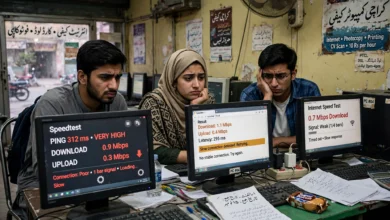
Slow internet in Pakistan is something almost every user has felt. A video call freezes in the middle of a client meeting, a file upload crawls, or WhatsApp voice notes refuse to send for an hour. Freelancers lose work, students miss online lectures, and small businesses watch customers drop off a checkout page that will not load.
What makes it more frustrating is the comparison. People in India, Bangladesh, Sri Lanka and the Gulf often post speed test results that look like a different planet. So the question keeps coming up: why are internet speeds in Pakistan so far behind the region, and is anything actually changing?
The short answer is that there is no single villain. Pakistan internet speed is held back by a mix of things that stack on top of each other. The country leans on a small number of submarine cables, operators have worked with too little mobile spectrum for years, fiber optic coverage is thin outside big cities, and taxes on telecom services are among the highest in Asia. Add power outages, older 3G and 4G equipment, and periods of government filtering, and you get the slow internet in Pakistan that users complain about daily.
This article breaks down each of those reasons in plain language. It looks at how Pakistan ranks against its neighbors on mobile internet speed and fixed broadband speed, explains what the 5G rollout could change, and ends with practical steps you can take right now to get a faster connection at home or on your phone.
How Slow Internet in Pakistan Compares With the Region
Pakistan sits near the bottom of every global speed table, and the gap with its neighbors is wider than most people assume. In the Ookla Speedtest Global Index for September 2026, Pakistan ranked 93rd for mobile speeds and 143rd for fixed broadband. That puts it below almost every country it likes to compare itself with.
Mobile and Fixed Broadband Speeds Side by Side
The numbers below are median download speeds from Ookla’s March 2026 data, as compiled on Wikipedia’s list of countries by internet connection speeds.
| Country | Median mobile download (Mbps) | Median fixed broadband download (Mbps) |
|---|---|---|
| United Arab Emirates | 644.66 | 384.51 |
| Saudi Arabia | 226.53 | 167.93 |
| China | 156.98 | 206.91 |
| India | 126.73 | 60.85 |
| Iran | 57.23 | 26.00 |
| Sri Lanka | 57.14 | 38.61 |
| Bangladesh | 42.45 | 66.02 |
| Pakistan | 26.46 | 17.90 |
| Afghanistan | 15.91 | 4.93 |
A few things stand out right away:
- Indian mobile internet is close to five times faster. India’s median mobile speed of about 127 Mbps reflects its aggressive 5G rollout, while Pakistan is still a 4G market.
- Bangladesh beats Pakistan on both counts. Its fixed broadband is more than three times faster, mostly because cheap fiber has spread through Dhaka and other cities.
- Only Afghanistan is clearly slower in the immediate neighborhood. Even Iran, which faces heavy sanctions, posts better mobile speeds.
- The Gulf is in another league. UAE mobile users get speeds roughly 24 times higher than Pakistani users, which matters because millions of Pakistanis work there and notice the difference the moment they fly home.
Fixed Broadband Is the Bigger Problem
Most discussion of slow internet in Pakistan focuses on phones, but the fixed broadband speed gap is worse. A median of under 18 Mbps for home and office connections is lower than in Kenya, Iraq and Nepal. For freelancers, software houses and call centers, home broadband is the backbone of their income, so this weak spot hurts the digital economy directly.
City-Level Differences
Speeds are not the same everywhere. Karachi, Lahore and Islamabad get the best results because that is where fiber and newer towers are concentrated. Smaller cities and rural areas often depend on older 3G sites and copper DSL lines, so their real-world experience is far below the national median. In other words, the national average actually flatters a large share of users.


7 Reasons Behind Slow Internet in Pakistan
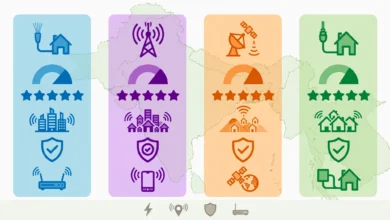
No single fix will solve the problem because slow internet in Pakistan comes from several weak points at once. Here is each one, from the sea floor to your phone.
1. Heavy Dependence on a Few Submarine Cables
Almost all of Pakistan’s international traffic travels through submarine cables that land near Karachi. The country is connected to several systems, but a handful carry most of the load, including AAE-1, SMW4, SMW5, IMEWE and the newer 2Africa and PEACE cables.
When one of these cables is cut or taken down for repairs, there is not enough spare capacity on the others to absorb the traffic smoothly. Users notice it right away as slow page loads and failing video calls. In late October 2026, for example, PTCL warned of slower speeds until November 2 because of maintenance on AAE-1, one of the country’s main international routes.
India, by comparison, has many more cable landing stations spread across both coasts, so a single fault rarely causes a national slowdown there.
2. Years of Spectrum Shortage
Mobile spectrum is the radio bandwidth operators use to carry data. Think of it as the number of lanes on a highway. Before 2026, Pakistan’s operators shared only about 274 MHz between them, which is a fraction of what Indian or Gulf operators hold.
With more than 140 million mobile broadband users squeezed into those few lanes, congestion was guaranteed. Speeds drop sharply in the evening, at markets, in universities and anywhere crowds gather. This is the main reason mobile internet speed in Pakistan trailed even Bangladesh and Sri Lanka for so long.
3. A Thin Fiber Optic Network
Fast internet depends on fiber optic cables connecting towers and homes to the core network. In Pakistan, a large share of mobile towers still use microwave links instead of fiber, and many homes still rely on old copper DSL lines.
Several things slow down fiber rollout:
- High import duties. Industry groups say customs duties on fiber cable have been as high as 67 percent, which makes every kilometer of cable more expensive.
- Right of way charges. Operators have to pay and negotiate separately with city governments, cantonments and highway authorities to dig trenches, which delays projects for months.
- Low fixed broadband use. Fixed broadband penetration is below 2 percent of the population, so companies have less revenue to justify building new networks.
4. Some of the Highest Telecom Taxes in the Region
Pakistan taxes internet and phone services as if they were luxury goods. The GSMA, the global body that represents mobile operators, has repeatedly said that taxes on telecom services and devices in Pakistan are among the highest in the world.
Consumers pay a combined burden of about 34.5 percent on telecom services, made up of sales tax and advance income tax. India charges 18 percent GST on telecom. When so much of every rupee goes to taxes, operators earn less per user and have less money to spend on new towers, fiber and equipment. The result is a network that grows slower than demand.
5. Internet Filtering, Throttling and the Firewall
From mid 2024 onward, users across Pakistan reported slow WhatsApp media downloads, unstable VPNs and long disruptions while the government tested a national web management system, widely called the firewall. Ookla data from October 2024 placed Pakistan in the bottom 10 percent of countries for both mobile and fixed speeds during that period.
Deep packet inspection and content filtering add delay to traffic, especially when they are set up in a hurry or under heavy load. Shutdowns of mobile data during protests and security operations also pull down monthly averages and hurt trust. Rights groups have asked for more transparency about how these systems work, while the government has denied deliberately slowing the internet.
6. Power Outages and Tower Downtime
A mobile tower needs electricity around the clock. During load shedding, many sites run on batteries or diesel generators, and when those run low, the tower drops off or runs at reduced capacity. Home routers also go down without a UPS. In rural areas and smaller cities where outages are longer, this alone can make the internet unusable for hours every day.
7. Low Investment and Old Equipment
Pakistani operators earn some of the lowest revenue per user in Asia. Low prices are good for customers in the short term, but combined with high taxes and a weak rupee, they leave little room for upgrades. Equipment is bought in dollars, so every depreciation of the rupee makes towers, routers and bandwidth more expensive.
Industry figures say more than 30 percent of the population still lacks 4G coverage and around 12 percent has no mobile signal at all. Many users are also on older handsets that cannot use newer network features. All of this keeps Pakistan internet speed low even when the network itself is not congested.
Can 5G Fix Slow Internet in Pakistan?
5G will help, but it will not fix everything on its own, and the improvement will reach big cities years before it reaches everyone else.
What Happened in the 2026 Spectrum Auction
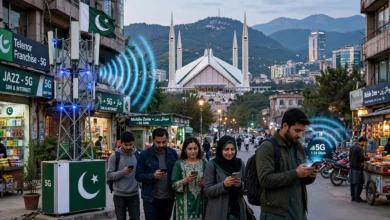
On March 10, 2026, the PTA held the country’s largest ever spectrum auction, offering close to 600 MHz on top of the roughly 274 MHz already in use. The auction raised about $510 million, and operators received their licences later that month. Zong, for example, announced plans to deploy or upgrade more than 1,000 5G in Pakistan sites during 2026.
The rollout is phased. It starts with Islamabad, Karachi, Lahore and the other provincial capitals, focusing first on commercial areas, and then expands gradually over about nine years.
Why the Spectrum Matters More Than the Label
The biggest benefit of the auction is not the “5G” icon on your phone. It is the extra spectrum. Much of the new bandwidth also eases pressure on existing 4G networks, which means users who never buy a 5G phone should still see better evening speeds as operators spread traffic across more lanes. Pakistan’s mobile ranking has already moved from 98th in 2025 to 93rd in September 2026.
What 5G Will Not Solve
The new spectrum does nothing for several of the problems above:
- It does not add new submarine cables, so cable cuts will still cause national slowdowns.
- It does not lower the 34.5 percent consumer tax burden.
- It does not bring fiber to towers or homes by itself. 5G sites need fiber backhaul to deliver real speeds.
- It does not stop filtering or shutdowns.
- It does nothing for home fixed broadband speed, where Pakistan ranks even lower.
So 5G is a real step forward, but internet speeds in Pakistan will only catch up with the region if fiber, taxes and policy move along with it.
How to Deal With Slow Internet in Pakistan at Home and on Mobile
You cannot fix a cable cut or a tax policy, but you can often get a noticeably faster internet connection with a few changes on your side.
For Home Broadband
- Switch to fiber if it is available. Fiber to the home from providers such as PTCL Flash Fiber, Nayatel, StormFiber or Transworld is far more stable than copper DSL. Check coverage on your street before signing a contract.
- Put your router on a UPS. A small UPS keeps the router and fiber terminal running through load shedding, which is often the real cause of “no internet” at home.
- Use the 5 GHz Wi-Fi band. It is faster and less crowded than 2.4 GHz, especially in apartments. Move the router to a central, open spot rather than inside a cupboard.
- Use a cable for work. For video calls, gaming or large uploads, an Ethernet cable beats Wi-Fi every time.
- Change your DNS. Public DNS services like Cloudflare (1.1.1.1) or Google (8.8.8.8) can make websites start loading faster than the default ISP servers.
For Mobile Data
- Compare networks in your area. Coverage varies a lot by neighborhood. Run speed tests on a friend’s SIM before switching. Ookla’s reports have ranked Jazz and Zong among the faster networks in recent years.
- Lock your phone to 4G or 5G. Many phones fall back to 3G in weak areas. Setting the preferred network to 4G or 5G only can keep you on the faster layer.
- Avoid peak hours for heavy tasks. Large downloads, backups and app updates go much faster late at night or early in the morning.
- Get a 5G ready phone if you live in a major city. Most mid range phones sold in Pakistan now support 5G, and early 5G users will see the biggest jump.
For Freelancers and Businesses
- Keep two connections from different providers, such as fiber plus a mobile hotspot, so one outage does not stop your work.
- Watch PTA and ISP announcements about submarine cable maintenance, and plan big deliveries around them.
- Use cloud tools that work offline and sync later, so a short drop does not cost you work.
Conclusion
Slow internet in Pakistan is not the result of one bad decision but of several weak links that stack together: too few submarine cables carrying too much traffic, years of spectrum shortage, a thin fiber optic network held back by duties and right of way costs, telecom taxes of around 34.5 percent, filtering and shutdowns, power outages, and operators with little money left to invest.
That is why Pakistan trails India, Bangladesh, Sri Lanka and the Gulf on both mobile internet speed and fixed broadband speed, and why its 143rd place for home connections is the most worrying number of all. The 2026 spectrum auction and the start of 5G in Pakistan are a genuine turning point for mobile users in big cities, but real progress across the country will depend on cheaper fiber, fairer taxes, more cable routes and a more predictable approach to internet controls, while users can soften the impact today with fiber connections, backup power and smarter network choices.