How AI Is Helping Pakistani Doctors Diagnose Diseases Faster
AI is helping Pakistani doctors detect cancer and other diseases faster, cutting wait times and improving diagnosis accuracy nationwide.
A patient walks into a crowded government hospital in Lahore at seven in the morning. By the time a doctor actually sees them, three hours have passed, and the doctor has maybe four minutes to review symptoms, order tests, and make a call. Multiply that by dozens of patients a day, across a country where the doctor-to-patient ratio is already stretched thin, and you start to understand why diagnosis in Pakistan has long been a bottleneck rather than a starting point for care.
AI in Pakistan is starting to change that picture, and not in a small or symbolic way. The federal government recently approved plans to roll out an AI-powered diagnostic system across roughly 1,110 public and private hospitals under the Prime Minister’s Health Card Programme, a move expected to reach close to 200 million people. Radiologists in Karachi are using machine learning tools to flag suspicious scans in seconds. Telemedicine platforms like DoctHERS and Marham are using AI-assisted triage to route patients to the right specialist faster. Medical schools are training the next generation of doctors to work alongside these tools rather than around them.
This article walks through how AI is helping Pakistani doctors diagnose diseases faster, which technologies are actually being used today, what the real-world results look like, and what challenges still stand in the way. Whether you’re a healthcare professional, a patient, or just curious about where Pakistan’s health system is headed, this is a grounded look at where things actually stand in 2026.
Why Faster Diagnosis Matters So Much in Pakistan
Before getting into the technology itself, it helps to understand why diagnostic speed is such a pressing issue here specifically.
Pakistan has one of the lowest doctor-to-patient ratios in the region. Public hospitals in major cities routinely see patient loads that would overwhelm facilities several times their size in other countries. Rural areas have it worse, with entire districts sometimes served by a single tertiary care hospital. When a disease diagnosis takes days or weeks instead of hours, the consequences are not abstract. Cancers get caught at stage three instead of stage one. Tuberculosis spreads because a suspected case sits in a queue for a chest X-ray review. Diabetic patients lose vision or limbs because retinopathy screening wasn’t available nearby.
Faster diagnosis in this context isn’t a convenience. It is often the difference between a treatable condition and a fatal one. That’s the backdrop against which AI-assisted diagnostics are being introduced, and it’s why the stakes here feel higher than in wealthier healthcare systems where AI is more of an efficiency upgrade than a lifeline.
The Doctor Shortage Problem
Pakistan trains a reasonable number of medical graduates each year, but retention is a persistent issue. Many young doctors emigrate for better pay and working conditions, leaving public hospitals short-staffed. The doctors who stay are often overworked, seeing far more patients per day than clinical guidelines recommend. This is one of the strongest arguments for AI in healthcare: it doesn’t replace doctors, but it can absorb some of the repetitive diagnostic screening work, freeing physicians to focus on the patients who need the most attention.
How AI Diagnostic Tools Actually Work in Pakistani Hospitals
Medical AI tools used in Pakistan generally fall into a few categories, and it’s worth breaking these down because they solve different problems.
1. Medical Imaging and Radiology AI
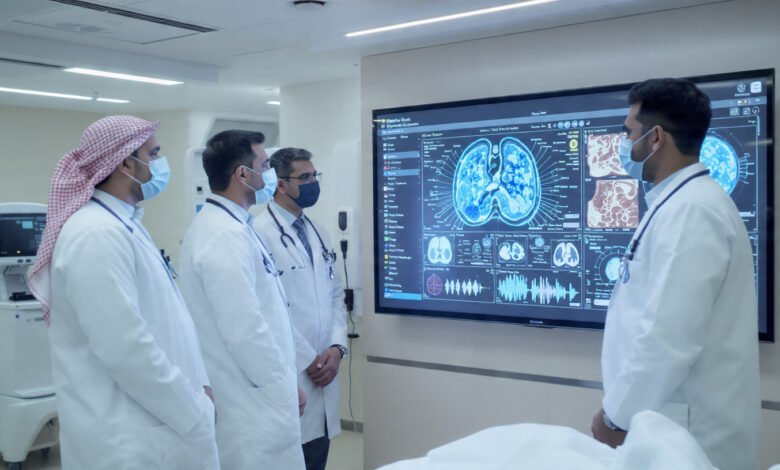
This is where AI diagnostic technology has made the most visible progress. Algorithms trained on thousands of chest X-rays, CT scans, and mammograms can flag abnormalities such as suspected tuberculosis, lung nodules, or breast masses in a matter of seconds. A radiologist still makes the final call, but the AI acts as a second set of eyes that never gets tired and never skips a scan.


In practice, this means:
- Chest X-rays for suspected TB or pneumonia get pre-screened by AI before a radiologist reviews them
- Mammograms are flagged for priority review when the software detects a likely abnormality
- CT and MRI scans are analyzed for early markers of stroke or tumors
2. AI-Powered Telemedicine and Triage
Platforms like DoctHERS and Marham use AI to support triage, meaning patients are directed to the right type of care based on their symptoms before they even speak with a doctor. This matters enormously in a country where many patients don’t know whether they need a general physician, a cardiologist, or an emergency room. AI-driven triage <cite index=”5-1″>helps improve access to care by facilitating diagnostics and triage through telemedicine</cite>, particularly for patients in areas without nearby specialists.
3. Large Language Model Tools for Clinical Reasoning
A newer development is the use of large language models to assist physicians with diagnostic reasoning, essentially acting as a clinical sounding board. Pakistani physicians trained through programs at institutions like LUMS have started using these tools to cross-check symptoms against differential diagnoses, though researchers are also studying the risk of doctors over-relying on AI output without applying their own clinical judgment.
4. National-Scale Disease Screening Systems
The most ambitious project underway is the planned deployment of an AI diagnostic platform across 1,110 hospitals nationwide. According to reporting, <cite index=”9-1″>Pakistan plans to deploy an Alibaba-backed AI diagnostic system across 1,110 hospitals under the PM Health Card Programme, targeting roughly 200 million Pakistanis for faster disease detection</cite>. The system is <cite index=”2-1″>expected to help nearly 200 million Pakistanis receive faster and more accurate diagnosis of complex diseases, including cancer and neurological disorders</cite>, and officials believe it <cite index=”2-1″>can also reduce diagnostic costs and potentially save the government billions of rupees</cite>.
This isn’t a pilot program confined to one city. It spans <cite index=”8-1″>Islamabad, Punjab, Khyber Pakhtunkhwa, Balochistan, Gilgit-Baltistan and Azad Jammu and Kashmir</cite>, which makes it one of the largest coordinated healthcare AI rollouts attempted in South Asia to date.
Real Examples of AI Improving Disease Diagnosis in Pakistan
Cancer Detection Gets a Head Start
Cancer is one of the clearest cases where speed changes outcomes. Breast cancer, in particular, is often diagnosed late in Pakistan, partly because screening rates are low and partly because awareness of risk factors is inconsistent even among healthcare workers. A recent survey of female doctors at a major teaching hospital found that while most had good knowledge of breast cancer symptoms, awareness of risk factors and appropriate screening methods was far weaker, at under 10% for risk factors and about 2% for screening protocols. AI-assisted mammography screening helps close that gap by catching suspicious patterns that a rushed or undertrained eye might miss, regardless of the reviewing doctor’s specific training background.
Separately, Punjab’s health department has announced plans for the Nawaz Sharif Institute of Cancer Treatment and Research Center, described as the province’s first fully free government cancer hospital, where AI-supported diagnostic tools are expected to play a role in early detection for patients who otherwise couldn’t afford private-sector screening.
Tuberculosis Screening at Scale
TB remains a major public health burden in Pakistan, and chest X-ray interpretation is one of the primary bottlenecks in diagnosis. AI-based X-ray triage tools, already used in various TB screening programs across South Asia, allow health workers to process large volumes of scans quickly, prioritizing the ones most likely to show active disease for urgent radiologist review. This kind of AI-powered disease screening is especially valuable in mobile health camps and rural clinics, where a specialist radiologist may not be physically present.
Reducing Diagnostic Delays in Emergency and Neurological Care
Time is critical in stroke diagnosis, where every minute of delay increases the risk of permanent damage. AI tools that analyze CT scans for signs of stroke can alert emergency teams faster than a manual read alone, particularly during night shifts or in facilities with only one radiologist on call. As part of the national rollout, officials have specifically flagged neurological disorders as one of the target areas for the new AI diagnostic system, alongside cancer.
Benefits of AI-Assisted Diagnosis for Pakistani Doctors
It’s worth being specific about what doctors on the ground actually gain from these tools, rather than treating “AI helps” as a vague claim.
- Reduced screening workload – Routine scans that would otherwise take a radiologist several minutes each can be pre-sorted by AI, letting doctors focus their time on the cases that genuinely need close attention.
- Earlier detection of complex diseases – Algorithms trained on large datasets can catch subtle patterns in imaging that are easy to miss during a rushed shift.
- Support in underserved areas – A rural healthcare AI tool can give a general physician in a small town access to diagnostic support that would normally require referring the patient hours away to a specialist.
- Lower diagnostic costs – Government officials have pointed to potential savings from reduced unnecessary testing and faster, more accurate first-pass diagnosis.
- A second opinion that doesn’t get tired – Unlike a human reviewer working a 12-hour shift, AI models apply the same level of scrutiny to the first scan of the day and the two-hundredth.
- Better triage decisions – Patients get routed to the right type of care faster, cutting down on wasted visits and repeat consultations.
Challenges Facing AI Adoption in Pakistani Healthcare
None of this is a smooth, frictionless success story yet, and it’s worth being honest about the obstacles.
Limited Funding and Infrastructure
Many public hospitals in Pakistan still struggle with basic infrastructure, let alone the servers, internet bandwidth, and digital record systems needed to run AI tools effectively. Research on AI adoption in Pakistan’s hospitals consistently points to funding gaps as one of the biggest barriers to scaling these technologies beyond flagship city hospitals.
Doctor Training and Trust
Introducing new technology into a hospital doesn’t guarantee doctors will use it correctly, or trust it at all. A cross-sectional study conducted at Mardan Medical Complex found that <cite index=”1-1″>AI integration into Pakistani healthcare remains limited due to challenges such as lack of funding, provider resistance, and inadequate training</cite>, even though interest in the technology among healthcare workers is genuinely growing.
There’s also a subtler risk on the other end of the spectrum: automation bias, where a trained physician defers too readily to an AI’s suggestion instead of applying independent clinical judgment. A recent clinical trial involving physicians who completed AI-literacy training explored exactly this tension, looking at how large language model tools influence diagnostic reasoning when doctors are already primed to trust the technology. The findings underline something important: AI works best as a second opinion, not a replacement for clinical thinking.
Data Privacy and Patient Consent
As more hospitals digitize patient records and feed data into AI systems, questions around privacy, consent, and data security become harder to ignore. Projects that have piloted AI note-taking and diagnostic tools in real clinical settings have had to build in explicit safeguards, including obtaining verbal consent from patients before recording encounters, a practice that will need to scale nationally as adoption grows.
Uneven Access Between Urban and Rural Areas
Even with an ambitious plan to reach 1,110 hospitals, there’s a real risk that AI tools land first and most reliably in well-resourced urban centers, while rural clinics wait years for the same level of support. Bridging that gap will depend on how deliberately the rollout prioritizes underserved regions rather than defaulting to easier, better-connected facilities.
What This Means for Patients
For an ordinary patient, the practical upside of AI-assisted healthcare in Pakistan should eventually look like this: shorter waits for test results, fewer missed early-stage diagnoses, and a system that catches serious conditions before they become emergencies. A mammogram flagged by AI for priority review, a chest X-ray triaged within minutes instead of days, a rural clinic that can screen for diabetic retinopathy without sending a patient four hours away for a specialist appointment. None of this replaces the value of a good doctor’s judgment. It just gives that judgment better information, faster.
Patients should also understand that AI tools are decision-support systems, not autonomous diagnosticians. A radiologist, physician, or specialist still reviews and confirms any AI-flagged result before it becomes part of a treatment plan. That human oversight remains the safeguard against both false positives and missed context that a purely automated system might not catch.
The Road Ahead for AI in Pakistan’s Health System
The national rollout under the Prime Minister’s Health Card Programme, backed by a partnership involving Alibaba-linked DAMO Academy and Sky47, represents the most significant test yet of whether AI diagnostics can work at scale in a lower-middle-income country’s public health system. According to a detailed breakdown of the program’s finances, the <cite index=”9-1″>federal government currently spends around Rs10 billion annually on the PM Health Card Programme, while Punjab, Khyber Pakhtunkhwa, and Balochistan allocate significantly more through their own provincial programs</cite>. Getting a strong return on that investment will depend heavily on how well AI tools are integrated into daily clinical workflows, not just installed and left underused.
Success will hinge on a few things: sustained funding beyond the initial rollout, structured training so doctors trust and correctly use these tools, strong data privacy protections, and a genuine push to reach rural and underserved facilities rather than concentrating benefits in major cities. Organizations like the World Health Organization have published guidance on responsible AI use in health systems that could help shape how Pakistan navigates these tradeoffs, and peer-reviewed research from institutions studying AI in low- and middle-income country health systems continues to offer useful lessons from comparable rollouts elsewhere.
Conclusion
AI is helping Pakistani doctors diagnose diseases faster by taking on repetitive screening work, flagging suspicious scans for urgent review, supporting triage on telemedicine platforms, and now, through a nationwide rollout across more than a thousand hospitals, reaching patients who previously had little access to advanced diagnostic tools at all. The technology is not a substitute for trained physicians, and it comes with real challenges around funding, training, trust, and equitable access between urban and rural areas.
But for a country where diagnostic delays have long cost patients their health and sometimes their lives, AI-assisted diagnosis represents one of the most promising shifts in Pakistani healthcare in years, provided it’s implemented with the same care and oversight that good medicine has always required.