Best Internet Providers in Pakistan Compared for 2026
Best internet providers in Pakistan for 2026 compared on speed, price, coverage and reliability, with honest notes on outages, fraud and PTA rules.
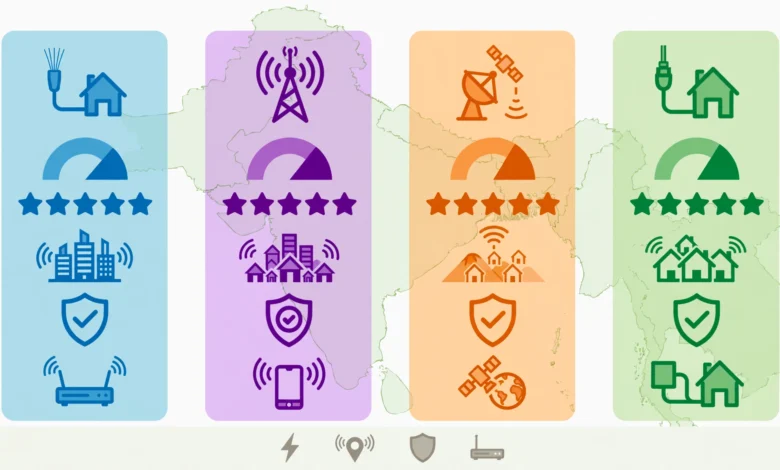
Best Internet Providers in Pakistan 2026: 7 Proven Options Compared
Introduction
Finding the best internet providers in Pakistan is harder than it should be. Every company promises “unlimited” data, “blazing” speeds and 24/7 support, yet most of us have lived through a router that blinks red for three days while the helpline plays the same tune on loop. In 2026 the choices are better than they were five years ago. Fiber has reached more neighbourhoods, mobile operators are rolling out 5G, and satellite internet is finally part of the conversation. But the gap between what is advertised and what you actually get is still wide.
This guide compares the main broadband providers in Pakistan the way a friend would: what each one is good at, where it falls short, and which cities it really serves. We look at fiber internet in Pakistan, cable and DSL connections, 4G and 5G home internet, and the satellite options people keep asking about.
We also cover something most comparison articles skip. Pakistan’s internet market has a long record of shutdowns, throttling, grey traffic, illegal cable networks and misleading “unlimited” packages. Knowing that history helps you pick a provider that is licensed, accountable and less likely to leave you stranded. By the end you should know which internet service provider fits your home, your budget and the way you use the internet, and what red flags to avoid before you sign anything.
The State of Internet in Pakistan in 2026
Before naming the best internet providers in Pakistan, it helps to understand the market they compete in. Pakistan has well over 160 million broadband subscriptions, but almost all of them are mobile. Fixed broadband, the kind of connection you plug a router into at home, is still a small slice at roughly 3.7 million subscribers as of mid-2026, according to figures compiled on the Internet in Pakistan page.
The good news is that fiber is winning. Fewer than 70,000 homes had fiber in 2018. By 2026 that number is close to 2.9 million, which means most new home connections are now fiber to the home (FTTH) rather than old copper DSL.
Fiber, DSL, wireless and mobile: what is the difference?
The type of connection matters more than the brand name. Here is how they compare in real use:
- Fiber (FTTH): Usually delivers 50 Mbps to 1 Gbps with stable upload speeds. Best for families, freelancers, gamers and anyone working from home.
- VDSL and DSL: Runs over old telephone lines. VDSL tops out around 50 Mbps, while basic DSL often gives you under 10 Mbps in real conditions.
- Cable and local wireless: Often sold by small neighbourhood operators. Quality varies wildly, and some of these setups are not licensed at all (more on that later).
- 4G and 5G home internet: Plug-and-play devices like Zong and Jazz home routers. Handy where fiber has not arrived, but speeds drop when the tower is busy.
- Satellite: Still not commercially available for homes as of October 2026. Starlink has been “coming soon” since 2025.
Speeds are improving, slowly
Pakistan’s median fixed broadband download speed sits at about 25 Mbps according to recent industry reporting. That is low by global standards, but it hides a big split. A household on a 100 Mbps fiber plan in DHA Lahore lives in a different world from a family on copper DSL in a smaller town.
In Opensignal’s Pakistan fixed broadband experience report covering January to March 2026, Nayatel won both the download and upload speed awards and was named Best Home Internet overall. The same report notes that PTCL still controls close to 60% of fixed broadband market share.


5G finally arrived
5G in Pakistan officially launched on 19 March 2026, with Zong and Jazz switching it on first in several major cities. For home users this matters because 5G fixed wireless can now reach areas where laying fiber is slow or expensive.
Best Internet Providers in Pakistan: 7 Options Compared
This list is based on independent speed reports, coverage, pricing trends and the kind of feedback you hear from real users. Prices change often, and taxes can add close to 30% to your bill, so always confirm the final amount before you sign up.
1. PTCL Flash Fiber: widest reach
PTCL Flash Fiber is the default choice for many households simply because PTCL is everywhere. It is the largest fixed broadband company in the country, and after closing its PKR 108 billion purchase of Telenor Pakistan in early 2026, it now runs a much larger combined home and mobile business.
Why people choose it:
- Available in far more cities and towns than any private fiber company
- Fiber plans range from basic home packages up to very high speeds in covered areas
- Bundles with landline, TV and now mobile services
Where it falls short: Customer support remains PTCL’s weak spot. Complaints about slow fault resolution and long helpline waits are common. Also check whether your street gets true fiber or the older copper DSL service. PTCL still has hundreds of thousands of DSL users who are being moved to fiber gradually.
Best for: People outside the big metro areas, and anyone who wants one bill for home and mobile.
2. Nayatel: best overall experience
If you live in its coverage area, Nayatel is hard to beat. It won Opensignal’s Best Home Internet award for early 2026, along with the top download and upload speed results. Users in Islamabad and Rawalpindi have praised its support for years, which is unusual in this market.
Why people choose it:
- Consistently strong speeds and stable connections
- Responsive customer service and technicians who actually show up
- Extras like smart home security and on-demand speed boosts
Where it falls short: Coverage. Nayatel is strongest in the twin cities and selected other cities. If you are in Karachi, it may not be an option yet.
Best for: Remote workers, freelancers and families in Islamabad, Rawalpindi and other covered cities.
3. StormFiber: best value in big cities
StormFiber, owned by Cybernet, has grown quickly in Karachi, Lahore, Faisalabad and other large cities. A big advantage is its link to the PEACE submarine cable, which helps with international bandwidth and lowers latency toward Europe and Africa.
Why people choose it:
- Competitive pricing, with 20 Mbps plans reported from around PKR 2,424 before tax
- Triple play bundles with broadband, TV and phone
- Good fit for streaming and everyday work
Where it falls short: Like most fiber companies, it struggles with outages when construction crews cut cables. Support quality varies by city.
Best for: Households in Karachi and Lahore who want good speed without paying premium prices.
4. Transworld Home: fastest for power users
Transworld Home targets gamers and heavy users. Ookla’s Speedtest data for the second half of 2025 put it at the top in Pakistan for median download speed (about 35 Mbps) and consistency. The company owns its own submarine cable capacity through TWA-1 and has added capacity on newer international cables.
Why people choose it:
- Strong international routing, which helps gaming ping and video calls abroad
- High-end plans, including 1 Gbps home internet (reported at around PKR 61,600 a month)
Where it falls short: Premium pricing and narrower city coverage than PTCL.
Best for: Gamers, content creators and small offices that need reliable upload speeds.
5. Connect: a solid fiber alternative
Connect is one of the four main ISPs that Opensignal tracks in Pakistan. It has built a following in Lahore and a few other cities as a fiber option that sits between budget local providers and premium brands.
Best for: Users in its coverage zones who want fiber from a licensed company but are not happy with their current provider.
6. Zong 4G and 5G home internet: best wireless option
No fiber on your street? Zong home internet devices are the most common fallback. Zong scored well in PTA’s Quality of Service survey for Q1 2026, especially on coverage and upload speeds, and it was one of the first two operators to launch 5G.
Watch out for: Fair usage limits on “unlimited” packages, and speeds that drop in the evening when everyone is online.
7. Jazz home internet: best mobile network performance
In PTA’s Q1 2026 survey across 18 cities, Jazz had the highest overall compliance at 95% and led on download speeds in most cities. Jazz also launched 5G in March 2026. Its home internet devices are a sensible choice if Jazz signal is strong where you live.
Watch out for: The same issues as any wireless option. Your experience depends heavily on your distance from the tower and how crowded it is.
What about Starlink in Pakistan?
This is the question everyone asks. Starlink Pakistan has been in the news since 2025, when it received provisional registration and officials talked about a launch by late 2025. That did not happen. As of September 2026, PTA told a Senate committee that no Starlink licence application was pending before it, while Starlink said the final licensing framework had been agreed. Satellite rules were heading to the federal cabinet in August 2026.
In plain terms: you cannot legally buy Starlink for your home in Pakistan right now. Anyone selling you a “Starlink connection” today is selling something unlicensed, and the equipment could be seized.
Quick Comparison of Internet Service Providers in Pakistan
Use this table as a starting point. Coverage changes street by street, so check availability at your exact address.
| Provider | Connection type | Strongest cities | Standout strength | Main weakness |
|---|---|---|---|---|
| PTCL Flash Fiber | Fiber, VDSL, DSL | Nationwide | Widest coverage | Slow complaint handling |
| Nayatel | Fiber | Islamabad, Rawalpindi, selected cities | Best overall experience (Opensignal Q1 2026) | Limited coverage |
| StormFiber | Fiber | Karachi, Lahore, Faisalabad | Value for money | Outages from cable cuts |
| Transworld Home | Fiber | Karachi, Lahore, Islamabad | Top speed and consistency (Ookla H2 2025) | Premium pricing |
| Connect | Fiber | Lahore and selected cities | Solid mid-range fiber | Smaller footprint |
| Zong home internet | 4G, 5G | Most cities and many towns | Coverage and upload speed | Fair usage limits |
| Jazz home internet | 4G, 5G | Most cities and many towns | Top PTA QoS score Q1 2026 | Evening slowdowns |
How to Choose the Best ISP in Pakistan for Your Needs
The best ISP in Pakistan for your neighbour may be the wrong one for you. Work through these questions in order.
Step 1: Check what is actually available at your address
Call or use the online checkers of two or three providers. Ask whether your street has fiber internet or only copper DSL. If a salesperson is vague, that usually means fiber has not reached you yet.
Step 2: Match speed to how you use the internet
- Light use (browsing, WhatsApp, YouTube on one screen): 10 to 20 Mbps is enough.
- Family streaming and online classes: 30 to 50 Mbps keeps things smooth.
- Remote work, freelancing and uploads: 50 to 100 Mbps fiber with good upload speed.
- Gaming and content creation: Focus on low latency and stable routing, not just headline speed. Transworld and Nayatel are popular here.
Step 3: Ask about the real monthly cost
Advertised internet packages in Pakistan usually exclude tax. With sales tax and other duties, your final bill can be close to 30% higher. Also ask about installation charges, router fees and whether the router is yours or on loan.
Step 4: Read the fair usage policy
Many “unlimited” packages, especially wireless ones, slow you down after a certain amount of data. Ask for the exact limit in writing.
Step 5: Ask neighbours, not ads
The most reliable review is the person living two houses away on the same network. Local Facebook and WhatsApp groups are often more honest than any ranking.
The Reality Check: Illegal ISPs, Grey Traffic and Shutdowns
Choosing among the best internet providers in Pakistan is not only about speed. It is also about who is legally allowed to sell you a connection, and what happens when the state or a bad actor interferes. Here are real examples every buyer should know.
Unlicensed internet providers are still common
In many neighbourhoods, a local “cable net” operator offers cheap internet by running fiber or wireless links from rooftops. Some are properly licensed. Many are not.
- In Lahore, PTA and the FIA’s Corporate Crime Circle raided two operators on Ghazi Road, Chabariya Internet Service and Brother Cable Net, that were distributing internet without a licence. Two people were arrested and the equipment was seized, according to the PTA statement reported by APP.
- In Gujrat district, near the AJK border, a joint FIA and PTA operation uncovered two illegal fiber networks. One had more than 100 active users and the other over 270, as reported by Dawn. Investigators suspected one network was also supplying areas across the border.
- Similar raids have hit illegal ISP setups in Chichawatni, Kot Addu and other towns, where FIA teams have even pulled down unauthorised towers loaded with dish antennas.
What this means for you: When an illegal provider is raided, every customer loses their connection overnight with no refund and no support. PTA itself warns the public to use only licensed operators for this reason, and it publishes the list of licensed operators on its website. Checking that list takes two minutes and can save you months of trouble.
Grey traffic: the illegal side of the internet business
“Grey traffic” means routing international phone calls over the internet through illegal VoIP exchanges, skipping the taxes and fees that licensed operators pay. PTA and FIA have raided such setups in Layyah, Chiniot, Sheikhupura, Lahore and Kasur, seizing gateways, laptops, modems and dozens of SIM cards.
This matters to ordinary users because grey operators often buy bulk connections and SIMs using other people’s identities. If your CNIC was ever used to register a SIM you did not buy, you may be linked to activity you know nothing about. Check the SIMs on your CNIC regularly using PTA’s official service, and never hand over your ID copy casually to street vendors.
Shutdowns and slowdowns: a risk no ISP can fully protect you from
Even the best licensed internet service provider in Pakistan has to follow government orders. Recent history shows how often that has affected users:
- May 2023: Mobile data was suspended across the country for several days during political unrest following the arrest of a former prime minister.
- February 2024: Mobile services were suspended on general election day, citing security concerns.
- February 2024 to May 2025: The social media platform X was blocked nationwide for over a year.
- 2024: Widespread slowdowns hit WhatsApp media sharing and general browsing. Many in the industry linked this to the testing of national web monitoring systems, and freelancers’ groups raised concerns about lost income.
These events hit mobile internet hardest. Fixed fiber connections usually stayed up during mobile suspensions, which is one practical reason freelancers and businesses often keep a fiber line plus a mobile backup.
Misleading “unlimited” claims
Another everyday problem is advertising that does not match reality. Packages marketed as unlimited often carry fair usage caps hidden in the fine print, and speeds labelled “up to” can be far below what you get in the evening. If a provider fails to deliver what it promised, you have the right to file a complaint with PTA through its online complaint management system after first raising it with the company.
The ethical side: what users should avoid
A realistic guide should also be honest with readers. Some shortcuts that look harmless are actually illegal or risky:
- Buying internet from an unlicensed local operator because it is cheaper
- Sharing or reselling your home connection commercially to neighbours without a licence
- Buying unregistered SIMs or using SIMs registered to someone else
- Importing and using satellite terminals before they are licensed in Pakistan
None of these is worth the risk of losing your service, your equipment or facing an FIA case.
Practical Tips to Get the Most From Your Connection
- Keep a backup. A fiber line plus a 4G or 5G device protects you from cable cuts and mobile shutdowns alike.
- Place your router well. Put it in a central, open spot. Walls and steel cupboards eat Wi-Fi signal.
- Test speeds at different times. Run tests in the morning and around 9 pm for a week. Save screenshots if you plan to complain.
- Use a UPS for your router. Load shedding knocks out more home connections than ISP faults do. A small router UPS is cheap and saves a lot of frustration.
- Document every complaint. Note your complaint number, date and time. If the company does not fix it, escalate to PTA with that record.
FAQs About the Best Internet Providers in Pakistan
Which is the fastest internet provider in Pakistan in 2026?
Based on Opensignal data for early 2026, Nayatel delivered the fastest download and upload experience. Ookla’s earlier data put Transworld Home at the top for median download speed. Both are strong choices if they cover your area.
Which ISP has the widest coverage?
PTCL, by a large margin. Its fiber and DSL network reaches far more cities and towns than any private competitor.
Is Starlink available in Pakistan?
Not yet for home users as of October 2026. Licensing is still being finalised, so avoid anyone selling unofficial connections.
How do I check if my ISP is legal?
Look it up on PTA’s official list of licensed operators. If the company is not there, think twice before paying.
Conclusion
The best internet providers in Pakistan in 2026 depend mostly on where you live and how you use the internet: Nayatel leads on overall experience in its cities, Transworld Home suits gamers and power users, StormFiber offers strong value in Karachi and Lahore, Connect is a reliable mid-range fiber option, PTCL Flash Fiber wins on reach, and Zong and Jazz fill the gaps with 4G and the new 5G service, while Starlink is still not legally available; whichever you pick, check your exact address for fiber, ask for the full price including tax, read the fair usage terms, confirm the company is on PTA’s licensed list, and keep a backup connection, because the history of illegal ISP raids, grey traffic busts and nationwide shutdowns shows that a cheap, unlicensed or single-source connection can disappear overnight.