Why Is YouTube Slow in Pakistan Common Reasons Explained
YouTube slow in Pakistan? See the real causes, from cable faults and ISP congestion to Wi-Fi issues, plus practical fixes that restore smooth playback.
YouTube Slow in Pakistan? 10 Shocking Reasons and Proven Fixes That Actually Work in 2026
Introduction
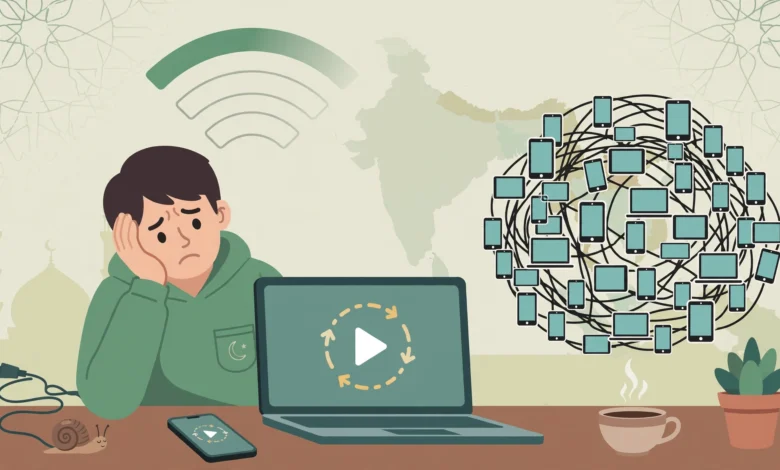
YouTube slow in Pakistan is one of the most common complaints you will hear from students, freelancers and families alike. A lecture that keeps buffering at 360p, a cricket highlight that freezes right before the wicket, or a tutorial that refuses to load past the ad. It is frustrating, and most people simply assume their internet package is to blame.
Sometimes it is. But often the real cause sits much further away. Pakistan’s internet traffic travels through a handful of undersea cables, and when one of them breaks, the whole country feels it. In 2024, PTA confirmed faults in two of the seven international submarine cables connecting Pakistan, while businesses and digital rights groups pointed at a national firewall being installed at the same time. Add evening congestion on ISP networks, crowded Wi-Fi in apartments, old phones and power outages, and the picture gets complicated.
There is also a less obvious side. Copper cable theft, unlicensed ISPs reselling thin bandwidth, and “YouTube Premium free” modded apps that carry malware have all affected real users in Pakistan.
This guide breaks down why YouTube buffers in Pakistan, separates the problems you can fix at home from the ones you cannot, and walks you through practical steps to get smoother playback. It also explains how to complain properly when the fault belongs to your provider.
How YouTube Reaches You in Pakistan
To understand why YouTube is slow in Pakistan, it helps to know the path a video takes before it reaches your screen. Every link in this chain can become a bottleneck.
- Google’s servers. YouTube videos are stored in Google data centers around the world.
- Local caches. Large Pakistani ISPs host Google caching servers inside their own networks. Popular videos are stored there, so they do not have to travel from abroad every time.
- Submarine cables. Anything not cached locally comes in through international undersea cables that land in Karachi. Pakistan relies on seven of them.
- National gateways. Traffic passes through international gateways and monitoring systems at or near the cable landing stations.
- Your ISP’s network. Your provider carries the data across the country to your area, through exchanges, fiber or copper lines, and mobile towers.
- Your home. Finally, the router and Wi-Fi deliver it to your phone, laptop or smart TV.
Why caching matters so much
When a video is served from your ISP’s local cache, it usually loads fast even if international links are under strain. That is why a viral Pakistani drama clip may play instantly while a niche tutorial from another country buffers. If your provider’s cache is small, overloaded or poorly maintained, you depend far more on international bandwidth, which is the most fragile part of the chain.
Where the YouTube slow in Pakistan problem usually starts
In practice, most YouTube buffering problems come from three places: the international link (cable faults or filtering), the ISP’s local network (congestion at peak hours), or your home setup (weak Wi-Fi, old devices). The next section goes through each one.
10 Common Reasons YouTube Slow in Pakistan Happens
These are the causes that come up again and again. Some are national, some are local, and some are sitting in your own room.
1. Submarine cable faults
This is the biggest national-level cause. Pakistan connects to the global internet through seven undersea cables, and when one fails, traffic has to squeeze onto the others. In August 2024, PTA said faults in two of them, SMW4 and AAE-1, were the main reason for the countrywide slowdown, and that SMW4 repairs would take until early October. Cable faults have hit Pakistan repeatedly over recent years, and each one shows up first as slow YouTube, blurry video calls and failed WhatsApp media downloads. These faults are a reminder that YouTube slow in Pakistan is sometimes a national problem, not a personal one.


2. Peak-hour congestion on your ISP
Between roughly 8 pm and midnight, nearly everyone in a neighborhood is streaming. If your ISP has not bought enough capacity for that area, speeds drop for everyone. A video that plays in 1080p at 2 pm may struggle at 480p at 10 pm. This is the most common reason for YouTube slow in Pakistan at night.
3. Weak or missing local caching
As explained above, ISPs with good Google caching serve popular videos locally. Smaller providers, or larger ones with overloaded caches, send more traffic abroad, so their users feel cable problems and peak congestion far more sharply.
4. Internet filtering and monitoring systems
Pakistan has a long history of filtering online content. In 2024, the government acknowledged deploying a web monitoring system for internet content management, while ISPs and business groups argued that the installation of a national firewall was slowing traffic. The government denied that it was throttling services. Whatever the exact share of blame, deep traffic inspection at national gateways can add delay, especially when systems are being installed or tested.
5. Mobile network shutdowns and restrictions
During protests, elections and security operations, mobile data has been suspended or restricted in specific cities or nationwide. In May 2023, for example, mobile internet and several social platforms were blocked for days during unrest after Imran Khan’s arrest. If YouTube suddenly stops working on mobile data in your city while Wi-Fi works, a restriction is often the reason.
6. Weak Wi-Fi at home
A surprising number of “slow internet” complaints are really Wi-Fi problems. Thick concrete walls, a router hidden in a cupboard, or ten neighbors’ routers on the same channel can cut your real speed in half before data even reaches your device.
7. Old copper lines and DSL limits
On PTCL copper DSL, speed depends on distance from the exchange and the condition of the line. Corroded joints and wet junction boxes during the monsoon can make a 10 Mbps line behave like 2 Mbps, which is not enough for smooth HD video.
8. Load shedding and router power cuts
When power goes out, the router restarts, and so does every exchange or tower without proper backup. Frequent restarts break video sessions and force YouTube to reload. Mobile towers on weak battery backup also lose capacity during long outages.
9. Device and app issues
Old phones with little free storage, outdated YouTube apps, a full browser cache or too many background apps can all cause stuttering that looks like a network problem.
10. VPNs and proxy apps
VPNs route your traffic through a server that may be in another country, which bypasses local caches and adds distance. PTA has itself said that heavy VPN use affects internet speed. If you run a VPN all day, YouTube will usually be slower than without it.
YouTube Slow in Pakistan: What the Record Shows
Pakistan’s relationship with YouTube has included outright bans, accidental global outages and long national slowdowns. Knowing this history helps you tell a technical fault from a policy decision.
2008: The block that took YouTube down worldwide
In February 2008, PTA ordered YouTube blocked over content considered blasphemous. While carrying out that order, Pakistan Telecom wrongly announced YouTube’s network routes to the wider internet. For around two hours, a large share of YouTube traffic around the world was pulled toward Pakistan and dropped. It became a textbook case in network engineering of how a local block can spill over globally.
2012 to 2016: The long YouTube ban
In September 2012, YouTube was blocked across Pakistan after an anti-Islam film sparked protests. The ban lasted more than three years. During that time, millions of Pakistanis used proxy sites and VPNs to watch videos, which taught a whole generation habits that still slow their connections today. Access returned in January 2016 after Google launched a localized version of YouTube for Pakistan that allows the government to request removal of specific content locally.
2024: Cable faults and the firewall debate
The summer of 2024 brought the most widely felt slowdown in recent memory. Some key points from the public record:
- PTA’s chairman told lawmakers the slowdown came from a damaged submarine cable and denied that the regulator had a role in it, as Dawn reported.
- PTA later said two of the seven international cables, SMW4 and AAE-1, were faulty, with SMW4 out of service due to faults near Karachi.
- Business groups and ISPs blamed government efforts to monitor traffic through a so-called firewall, and the issue was challenged in the Lahore and Islamabad high courts, according to Voice of America.
- The state minister for IT told the National Assembly that PTA had deployed a web monitoring system for content management.
- PTA also said that heavy VPN use was affecting internet speed.
Speeds reportedly dropped by up to 30 to 40 percent at the worst point. Freelancers and IT companies were hit hardest, since they rely on video calls and large uploads. Further AAE-1 problems in early 2025 caused another round of slow service before traffic was rerouted and extra bandwidth was added.
What this means for you
When YouTube slow in Pakistan becomes everyone’s problem at once, across different ISPs and mobile networks, the cause is almost never your router. Check news from PTA, PTCL and major ISPs before you spend money on a new device or package.
Illegal Activities That Make YouTube Slow in Pakistan
Not every slowdown is caused by cables or congestion. Some come from illegal activity, either by criminals on the network or by shortcuts users take themselves.
Copper cable theft
PTCL’s copper network carries DSL internet for a large number of homes, and copper has real scrap value. In June 2024, ARY News reported that Karachi police arrested a gang of 10 people for stealing underground PTCL cables, recovering cable worth around Rs 2.5 million. In Kohat, police arrested two men accused of cutting electricity wires and PTCL cables at night. For users on those lines, YouTube does not just slow down. The connection disappears until the stolen section is replaced, and patched lines often perform worse than before.
Unlicensed ISPs reselling thin bandwidth
Illegal internet providers often buy a small amount of bandwidth and stretch it across dozens or hundreds of homes. That is a recipe for evening buffering. PTA and FIA have repeatedly raided such setups:
- In Lahore and Kot Addu in June 2023, raids on unlicensed ISPs led to three arrests and seized equipment, according to a PTA press release.
- On Walton Road, Lahore, officials seized a server, a router and 30 ONTs from an unlicensed provider.
- In Toba Tek Singh in January 2024, authorities confiscated routers, ONTs and an illegal tower with 12 dish antennas.
If your cheap local Wi-Fi provider struggles every night, and you cannot find it on PTA’s list of licensed operators, poor bandwidth is likely only part of the problem. Your service can also vanish overnight after a raid.
Modded YouTube apps and “free Premium” downloads
Many users install modified YouTube apps to skip ads or get Premium features for free. The best-known of these, YouTube Vanced, shut down in 2022 after legal pressure from Google, and dozens of copies appeared in its place. Many of those copies are distributed through Telegram channels and unofficial websites. Some carry adware or spyware that runs in the background, uses your data and slows your phone, which makes YouTube feel even slower. Installing them also violates YouTube’s terms of service.
Free VPNs and “unlimited YouTube” tricks
Free VPN apps and “free net” configs promise faster or unlimited YouTube. In reality, they usually route your traffic through overcrowded servers far away, bypass your ISP’s local cache, and may log or sell your browsing data. Some exploit operator loopholes in ways that break terms of service and can get your SIM blocked. Using them almost always makes YouTube slower, not faster.
The ethical takeaway
Shortcuts that look free are usually paid for with your data, your device’s security, or someone else’s stolen infrastructure. The fastest legal fix for YouTube slow in Pakistan is a licensed provider, the official YouTube app, and a properly set up home network.
How to Fix YouTube Slow in Pakistan: Practical Steps
Start with the quick checks, then work toward the bigger changes. Most people find the cause within the first five steps.
Quick checks (5 minutes)
- Test if the problem is only YouTube. Run a speed test on a site like Speedtest or fast.com. If general speed is fine but YouTube buffers, the issue is more likely routing, caching or filtering than your package.
- Check other devices. If YouTube is slow on your phone but fine on your laptop, the problem is the device or app, not the connection.
- Restart the router and the device. It sounds basic, but it clears stuck connections and often fixes evening slowdowns.
- Turn off your VPN. Watch the same video with and without it. In most cases, YouTube is faster without the VPN.
- Ask around. Check your ISP’s social media pages or ask neighbors. If many people complain at the same time, it is a network or national issue.
Fixes for your home network
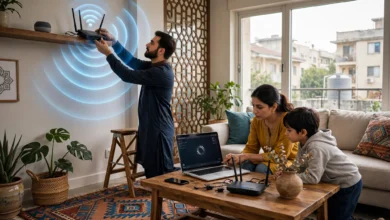
- Move the router to a central, open spot, away from walls, mirrors and the microwave.
- Use 5 GHz Wi-Fi when close to the router, since it is usually less crowded than 2.4 GHz.
- Change the Wi-Fi channel if your apartment building has many routers.
- Use a LAN cable for your smart TV or desktop where possible.
- Add a small UPS for the router and ONT so load shedding does not drop your connection.
Fixes for the YouTube app and your device
- Update the official YouTube app and your phone’s software.
- Clear the YouTube app cache, or the browser cache on a laptop.
- Free up storage, ideally keeping at least a few GB available.
- Close background apps that use data, such as cloud backups.
- Uninstall any modded YouTube apps and use only the official version.
Smart YouTube settings
- Set video quality manually instead of leaving it on Auto when your connection is unstable. A steady 480p is better than a 1080p that stops every 20 seconds.
- Use the Download feature (where available) to save lectures on Wi-Fi and watch them offline later.
- Watch heavy content outside the 8 pm to midnight peak when you can.
Bigger changes worth considering
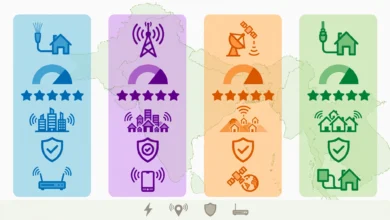
If you still find YouTube slow in Pakistan every night while other users in your city are fine, your provider is likely oversold in your area. At that point, it is worth comparing licensed fiber providers or switching mobile networks. A fiber connection from a provider with good local caching usually makes the biggest difference.
When It Is Not Your Fault: How to Complain
If you have tried the fixes above and YouTube is still slow in Pakistan on your connection while others nearby are fine, the problem probably sits with your provider. Here is how to push for a real fix.
Step 1: Collect evidence
Run speed tests at different times of day for three to five days. Take screenshots that show the date, time and result. Note the times when YouTube buffers and the video quality it drops to.
Step 2: Complain to your ISP or mobile operator
Call the helpline or use the official app and register a complaint. Always ask for a complaint or ticket number. Share your speed test screenshots and be specific, for example: “Speed drops below 3 Mbps every night from 9 pm to 12 am for the last week.”
Step 3: Escalate to PTA
If your provider does not fix the issue within a reasonable time, you can lodge a complaint with the Pakistan Telecommunication Authority through its online complaint management system or its complaint app. Include your ISP ticket number and evidence. Licensed operators are required to respond to PTA complaints, which is another reason to stay with a licensed provider. An unlicensed ISP gives you no route for escalation at all.
Step 4: Know when to switch
If complaints go nowhere and your contract allows it, switching to a better-performing licensed provider in your area is often the most practical solution. Ask neighbors which provider handles evening YouTube best on your street before you move.
Conclusion
YouTube slow in Pakistan rarely has a single cause. Sometimes the problem is national, as in 2024 when faults in the SMW4 and AAE-1 submarine cables and the debate over a national firewall left the whole country buffering. Sometimes it is local, like evening congestion on an oversold ISP, a corroded copper line, or a stolen PTCL cable in Karachi. And often it is sitting at home, in a badly placed router, an outdated app, a VPN left running all day, or a modded YouTube app quietly eating data. The history of bans, shutdowns and illegal ISP raids shows that shortcuts usually make things worse, while licensed providers, the official app and a well-set-up home network make things better. Test before you blame, fix what is in your control, complain with evidence when the fault is your provider’s, and you will spend far less time watching the loading circle and far more time watching the video.