How Pakistani Textile Exporters Are Adapting to Global Demand
Pakistani textile exporters are adapting through value addition, compliance and greener production. Real trends, past scandals and lessons for growth.
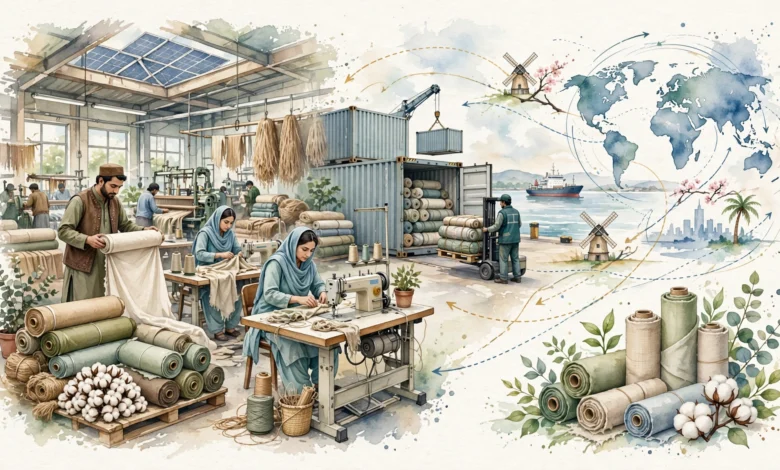
Pakistani Textile Exporters: 7 Powerful Ways They Are Winning Global Demand in 2026
Introduction
Pakistani textile exporters have carried the country’s export earnings for decades. Walk through Faisalabad, Sialkot, Lahore or Karachi’s industrial zones and you will see mills spinning yarn, factories weaving denim, and stitching units packing bedsheets and towels for stores in Europe and America. Textiles still make up the largest share of what Pakistan sells to the world.
But the world those exporters sell to has changed. Big brands now want smaller, faster orders. They want proof that cotton was not grown with forced labour, that workers are paid fairly, that fire exits are open and that wastewater is treated. European buyers watch Pakistan’s GSP+ commitments closely. Customers in the US and EU increasingly ask where their clothes came from and how they were made.
At home, exporters face their own pressures: some of the highest industrial energy costs in the region, uncertain cotton crops, tax changes and tight access to finance. Many mills have closed or cut shifts in recent years.
There is also an uncomfortable history. The Baldia factory fire, misuse of export incentive schemes and mis-declaration of goods have all damaged trust in the sector. Buyers have long memories.
This article looks at how the textile industry in Pakistan is responding: what exporters are changing, what still holds them back, and what past illegal activity teaches about building an export business that buyers can rely on.
Where Pakistan Textile Exports Stand in 2026
Pakistan textile exports reached $17.93 billion in fiscal year 2025-26, up just 0.26% from the year before, according to provisional Pakistan Bureau of Statistics data reported by Profit. Total national exports for the same year were about $30.14 billion, so textiles still made up roughly 60% of everything Pakistan sold abroad.
The headline number hides a shift inside the sector. Higher-value products grew while basic ones slipped.
| Product | FY2025-26 exports | Change vs FY2024-25 |
|---|---|---|
| Knitwear | $4.97 billion | -0.88% |
| Readymade garments | $4.29 billion | +3.87% |
| Bedwear | $3.11 billion | Flat |
| Cotton cloth | $1.67 billion | -7.55% |
| Towels | $1.06 billion | -1.93% |
| Cotton yarn | $765 million | +12.40% |
Source: Pakistan Bureau of Statistics provisional data, via Profit (July 2026).
Main export markets
The United States and the European Union are the biggest buyers of Pakistani textiles, with the UK, China and Middle Eastern markets also important. Under the EU’s GSP+ status, many Pakistani textile products enter Europe with reduced or zero duties, as long as Pakistan keeps meeting commitments on human rights, labour rights, environment and governance.


The pressures exporters face
- Energy costs: Electricity and gas tariffs for industry are higher than in competing countries like Bangladesh, Vietnam and India, which squeezes margins on every order.
- Cotton supply: Domestic cotton production has been unstable because of weather, pests and falling acreage, forcing mills to import more fibre.
- Finance and taxes: High interest rates in recent years and frequent tax changes make long-term planning difficult.
- Global shocks: Shipping disruptions, US tariff changes and slower consumer demand in Europe all hit order books.
Several mills have cut shifts or closed units. The ones still growing are those changing how they work.
7 Ways Pakistani Textile Exporters Are Adapting to Global Demand
The exporters holding their ground are not simply waiting for cheaper electricity. They are changing products, processes and how they deal with buyers.
1. Moving up the value chain
Selling yarn and grey cloth earns thin margins and faces fierce competition. More Pakistani textile exporters are shifting toward value-added textiles: finished garments, fashion denim, activewear, knitwear and branded home textiles. The FY2025-26 data shows this clearly, with readymade garments and yarn growing while basic cotton cloth fell.
This shift needs investment in stitching capacity, design teams and finishing, but each step up the chain earns more per kilogram of cotton.
2. Investing in sustainability and cleaner production
European and American brands now set targets for water use, chemicals and carbon emissions in their supply chains. Exporters are responding with:
- Solar power on factory roofs to cut energy costs and emissions
- Wastewater treatment plants and water recycling in dyeing and washing
- Certified organic, recycled and sustainable cotton sourcing
- Low-impact dyes and chemical management programmes
Large denim and home textile groups in Lahore, Faisalabad and Karachi have become known for these investments, and smaller suppliers are following because buyers increasingly require them.
3. Taking worker safety seriously
After years of criticism, more factories now go through independent safety inspections. Since 2023, the International Accord for Health and Safety has expanded to Pakistan, covering fire, electrical and building safety in participating garment and textile factories. Buyers that sign the Accord commit to working only with factories that fix the hazards found.
This is a direct response to past tragedies, covered in the next section.
4. Building traceability
Buyers increasingly want to know where cotton was grown, which mill spun it and which unit stitched it. New rules in the EU and US on forced labour and supply chain due diligence make this more urgent. Exporters are investing in traceability systems, batch tracking and third-party certifications so they can prove origin and working conditions.
5. Diversifying export markets
Relying heavily on a few markets is risky. Exporters are exploring the Middle East, Central Asia, Africa, Latin America and Australia, alongside traditional US and EU buyers. Trade fairs, virtual showrooms and online B2B platforms make it easier for mid-sized firms to reach new customers.
6. Offering smaller, faster orders
Fast fashion and online brands want smaller order quantities, quicker turnaround and frequent design changes. Exporters adapting well are adding digital sampling, flexible production lines and closer communication with buyers’ design teams. Speed has become as important as price.
7. Upgrading skills and technology
Modern looms, automated cutting, digital printing and ERP systems need trained staff. Programmes such as Punjab’s skills initiatives for women in textile jobs, industry training institutes and in-house academies are helping build a more skilled workforce. Better skills mean fewer rejections, higher productivity and better pay.
Lessons from Past Illegal Activities in Pakistan’s Textile Sector
Buyers’ strict demands today did not appear from nowhere. Several dark episodes shaped how the world sees the textile industry in Pakistan, and each one carries a lesson for exporters.
The Baldia factory fire
On 11 September 2012, a fire at Ali Enterprises, a garment factory in Karachi’s Baldia Town that made jeans for a European retailer, killed more than 250 workers. Many were trapped behind locked exits and barred windows. In 2020, an anti-terrorism court in Karachi sentenced two men to death after finding the fire was deliberately set when the factory owners refused to pay extortion money.
The case exposed two problems at once. Criminal extortion networks targeted industry, and the factory itself had serious safety failures. It had also reportedly received an international social compliance certificate only weeks earlier, which raised hard questions about how audits were done.
The lessons:
- A certificate is not safety. Fire exits, alarms, wiring and training must actually work every day.
- Workers must be able to leave. Locked gates and barred windows are never acceptable, whatever the security worry.
- Extortion must be reported, not quietly paid or ignored, and industry bodies need to stand together against it.
The tragedy is one reason Pakistan later joined the International Accord, and why buyers now insist on independent inspections.
Misuse of export incentive schemes
Pakistan offers duty and tax relief on imported inputs used to make export goods, through schemes such as the Export Facilitation Scheme. Over the years, FBR and Customs investigations have found cases where companies imported fabric, yarn or chemicals tax-free under these schemes and then sold them in the local market instead of exporting finished goods. This cheats the treasury and undercuts honest local manufacturers.
The lesson: misuse of these schemes leads to penalties, recovery of duties, blacklisting and criminal cases. It also gives the government reasons to tighten rules for everyone, which hurts honest exporters.
Mis-declaration and under-invoicing
Some exporters and importers have mis-declared product types, quantities or values on shipping documents to reduce duties or move money abroad. Customs and the State Bank treat this as a serious offence linked to tax evasion and money laundering.
Child labour and forced labour risks in cotton
International organisations and rights groups have long reported child labour and bonded labour risks in parts of Pakistan’s cotton fields and some informal textile work. As import rules in the US and EU tighten around forced labour, any link to these practices can get entire shipments blocked.
What these cases teach exporters
- Compliance is a business requirement, not paperwork for buyers.
- Shortcuts with tax schemes and shipping documents carry heavy legal risk.
- Supply chains must be checked all the way back to the cotton field.
- One scandal can hurt the reputation of every Pakistani supplier.
Challenges Still Ahead for Pakistani Textile Exporters
Adapting is underway, but several obstacles remain:
- Energy pricing. Without competitive and predictable industrial tariffs, even efficient mills struggle against regional rivals.
- Cotton revival. Better seeds, pest control and fair prices for farmers are needed to rebuild domestic cotton production.
- Policy stability. Exporters need consistent tax, refund and incentive policies so they can plan multi-year investments.
- Faster refunds. Delayed sales tax refunds lock up working capital, especially for small and mid-sized exporters.
- Heat and climate risks. Rising temperatures in Karachi and Punjab are making factory floors dangerous without proper cooling and worker protections.
- Compliance costs for small firms. Audits, certifications and safety upgrades are expensive. Small suppliers need support to meet buyer standards rather than being pushed out.
Industry groups such as APTMA and the Pakistan Textile Council regularly raise these issues with the government. Safety programmes like the International Accord for Health and Safety also give factories a structured way to meet global expectations.
Frequently Asked Questions
How much do Pakistani textile exporters earn each year?
Pakistan’s textile exports were about $17.93 billion in FY2025-26, roughly 60% of the country’s total exports, according to provisional PBS data.
Which textile products does Pakistan export most?
Knitwear, readymade garments, bedwear, cotton cloth, towels and cotton yarn are the largest categories, with value-added garments growing fastest.
What is GSP+ and why does it matter?
GSP+ is an EU trade scheme that gives Pakistan reduced or zero duties on many exports to Europe, provided the country meets commitments on human rights, labour standards, environment and good governance. Losing it would make Pakistani textiles much less competitive in Europe.
What did the Baldia factory fire change?
It pushed buyers, auditors and the government to take fire safety and worker protection far more seriously, and it is one reason independent safety inspections are now common in export factories.
Conclusion
Pakistani textile exporters remain the backbone of the country’s exports, earning about $17.93 billion in FY2025-26, but flat overall growth, high energy costs, unstable cotton supply and tougher buyer demands mean the old model of selling cheap yarn and cloth is no longer enough, so the firms doing well are moving into value-added products, investing in sustainability and solar power, improving worker safety through independent inspections, building traceability, diversifying markets, offering faster smaller orders and upgrading skills, while the Baldia factory fire, misuse of export schemes, mis-declaration and labour risks in cotton show that shortcuts and weak compliance can cost lives, markets and national reputation, making honesty, safety and transparency just as important to global demand as price and quality.
Keywords