5G in Pakistan 2026: The Ultimate Guide to Rollout Dates, Cities and the Best Networks
5G in Pakistan is live in 23+ cities after the $507m March 2026 auction. Here is where it works, what it costs, and when it reaches you.
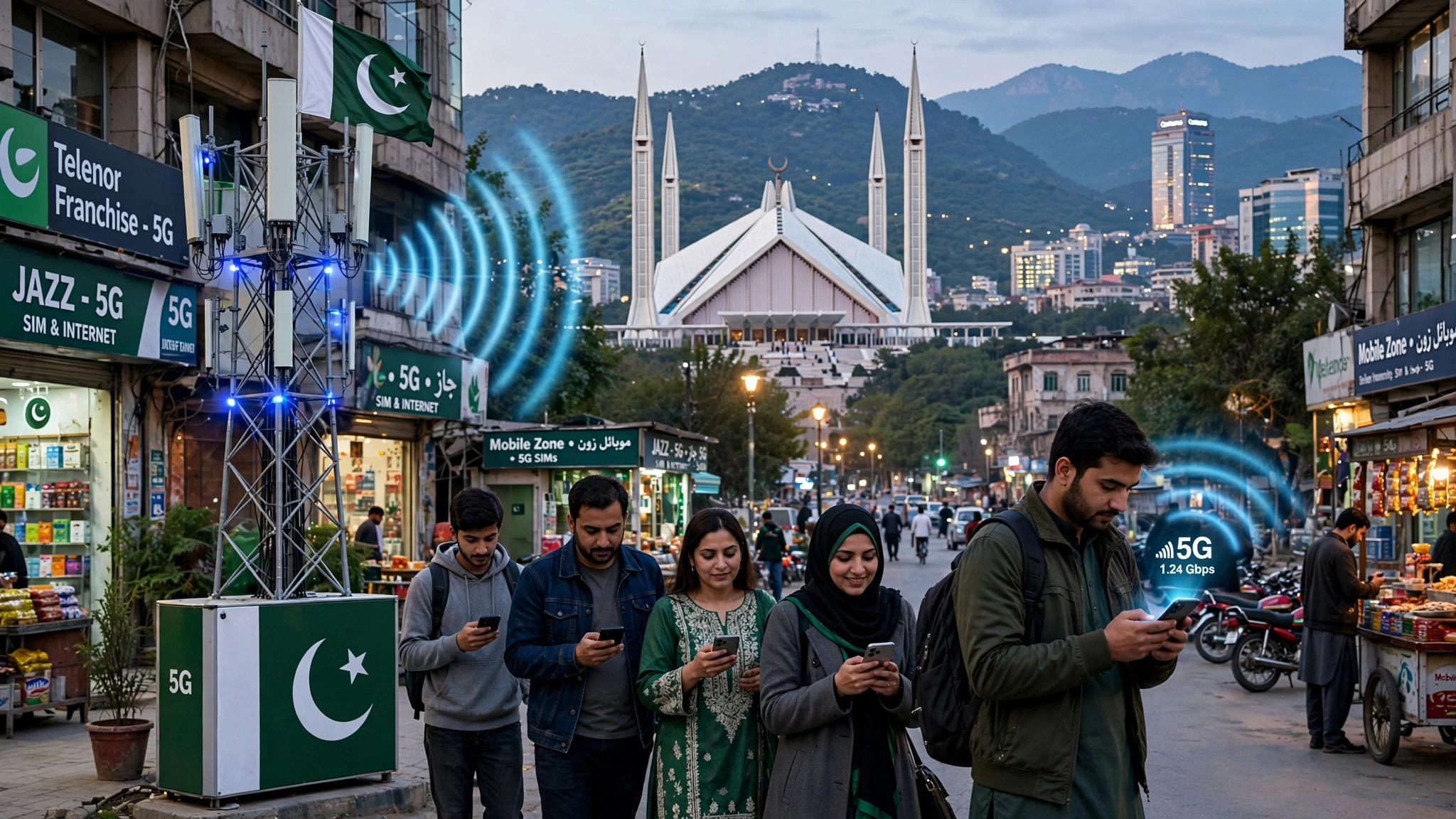
5G in Pakistan is no longer a promise on a ministry slide. After more than a decade of delays, missed deadlines and auction dates that kept sliding, the country finally sold its first 5G spectrum in March 2026, and the first commercial networks switched on within days. If you live in Karachi, Lahore or Islamabad, there is a fair chance your phone has already shown a 5G icon at least once.
But “launched” and “available everywhere” are two very different things. Coverage is still patchy, many phones in people’s pockets cannot use the new network, and one of the three operators is moving slower than the other two. So the honest answer to “Do I have 5G yet?” depends on where you live, which SIM you carry and what phone you own.
This guide breaks the 5G rollout in Pakistan into plain answers. We cover what happened at the PTA 5G auction, how much spectrum each operator won, which cities are covered today, what Jazz 5G, Zong 5G and Ufone 5G are offering, and what you need on your side to connect. We also look at the real roadblocks, from fiber shortages to phone taxes, and give a realistic view of when 5G will reach smaller cities and towns. Everything here reflects the situation as of late October 2026.
Where 5G in Pakistan Stands Today
The short version: 5G in Pakistan is commercially live, but only in parts of big cities. The groundwork was laid by one auction day in March 2026, and everything since has been about building towers fast enough.
The March 2026 Spectrum Auction
The Pakistan Telecommunication Authority (PTA) held the long-awaited 5G spectrum auction on 10 March 2026, after pushing it back from late February. According to Dawn’s report on the 5G spectrum auction, the government sold 480 MHz of spectrum for $507 million. The PTA had offered 597.2 MHz across six bands (700, 1800, 2100, 2300, 2600 and 3500 MHz), so not everything found a buyer.
Here is how the airwaves were split:
| Operator | Total spectrum won | Bands |
|---|---|---|
| Jazz | 190 MHz | 20 MHz (700), 50 MHz (2300), 70 MHz (2600), 50 MHz (3500) |
| Ufone (merged with Telenor) | 180 MHz | 60 MHz (2600), 120 MHz (3500) |
| Zong | 110 MHz | 60 MHz (2600), 50 MHz (3500) |
Two details matter for ordinary users. First, the 3500 MHz band is the main 5G band, and Ufone grabbed the biggest chunk of it. Second, Jazz was the only operator to buy 700 MHz, a low band that travels far and is meant for rural coverage.
Why This Auction Was a Big Deal
As TelecomTV noted in its auction coverage, the sale pushed the total spectrum held by Pakistani mobile operators from 274 MHz to 754 MHz. That is close to triple. For years, Pakistan’s operators were squeezing more than 200 million mobile connections through a narrow pipe, which is why 4G speeds in Pakistan often felt slow at peak hours. More spectrum means faster 5G, but it also means less congested 4G.
Licences and the First Switch-On
Licences were handed over at a ceremony on 19 March 2026 attended by the Prime Minister. Jazz did not wait long. Its CEO announced test 5G service on 180 towers the day after the auction. Zong followed with a launch across more than a dozen cities. Ufone, which was busy absorbing Telenor Pakistan, has moved more cautiously.


5G Rollout in Pakistan: Timeline and Cities
The 5G rollout in Pakistan has moved quickly by local standards, though slower than lawmakers wanted. In late October 2026, the Ministry of IT told the National Assembly that 5G now covers 24 cities through 1,782 sites (Digital Pakistan, 25 Oct 2026).
Key Milestones So Far
| Date | What happened |
|---|---|
| Oct 2026 | Ministry reports 1,782 sites in 24 cities; Karachi holds 21.5% of them |
| Sep 2026 | Karachi jumps from 90 to 279 sites in one month |
| 4 Aug 2026 | PTA counts 1,136 sites in 23 cities (Jazz 689, Zong 338, Ufone 109) |
| Jul 2026 | PTA tells a National Assembly committee 449 sites are live in 22 cities |
| 19-20 Mar 2026 | Licences signed; Jazz and Zong begin commercial 5G |
| 10 Mar 2026 | 5G spectrum auction raises $507 million |
| Aug 2019 | Zong runs Pakistan’s first 5G trial |
The jump from 449 sites in July to nearly 1,800 by October shows the pace picked up sharply over the summer. Operators reportedly set internal targets around 14 August to hit their first major deployment phase.
Which Cities Have 5G Right Now?
The biggest deployments are in the three main metros. As of the August PTA data, Karachi had 257 sites, Lahore 241 and Islamabad 192, with Faisalabad next at 131. Cities with confirmed 5G coverage include:
- Karachi, with the largest share of sites and a target of more than 1,000
- Lahore, where Jazz has the densest network
- Islamabad and Rawalpindi, starting with commercial areas like Blue Area and F-10
- Faisalabad, the strongest of the second-tier cities
- Peshawar and Quetta, the other provincial capitals
- Smaller cities such as Hyderabad, with only a few sites so far
Keep in mind that a city being “covered” usually means a handful of busy neighborhoods, not every street. Hyderabad, for example, had only three active sites in July.
When Will 5G Reach the Rest of Pakistan?
This is the question most readers care about, and the honest answer is: slowly. The licence terms only required 5G in five cities during the first year, and operators have already gone well beyond that. The ministry has said further cities will be added in phases, with stability on the current network coming first.
A realistic outlook for the 5G launch date in Pakistan by area:
- Major metros (now to mid-2027): Coverage keeps thickening across Karachi, Lahore and the twin cities.
- Large secondary cities (2027): Faisalabad, Multan, Gujranwala, Hyderabad and Sialkot should see wider coverage as operators add sites.
- Small cities and towns (2028 onward): Expect 4G improvements first, then 5G.
- Rural areas (long term): Jazz’s 700 MHz spectrum is aimed here, but mostly to improve 4G reach at first.
One PTA member warned in July that at the early pace, full national coverage might not arrive until 2035. The pace has improved since then, but nationwide 5G is still years away.
Jazz, Zong and Ufone: Who Offers the Best 5G in Pakistan?
Each operator is playing a different game with its 5G network in Pakistan. Jazz is racing for coverage, Zong is betting on its early lead and home broadband, and Ufone is sitting on the most 3500 MHz spectrum while it finishes a merger.
Jazz 5G
Jazz 5G has the biggest footprint. In the August PTA data, Jazz ran 689 of 1,136 sites, about 61% of the national total. It has since passed 1,000 sites and says it wants about 2,500 by the end of 2026 (Developing Telecoms). Jazz is also the only operator holding spectrum in all four key bands, including 700 MHz for wider reach.
Best for: people who want the widest 5G coverage in Lahore, Islamabad and Karachi right now.
Zong 5G
Zong ran Pakistan’s first 5G trial in 2019 and launched commercially in more than 16 cities within days of getting its licence, including Islamabad, Rawalpindi, Karachi, Lahore, Peshawar and Quetta. Zong 5G had 338 sites in August, second to Jazz. Zong has also pushed 5G home broadband and partnered with ZTE to bring cheaper 5G phones to market.
Best for: Karachi users (Zong’s site count there is close to Jazz’s) and anyone interested in a 5G home internet device.
Ufone 5G (Ufone and Telenor)
Ufone 5G is the slow starter. It had just 109 sites in August, partly because it spent 2026 merging networks with Telenor Pakistan, which PTCL bought in 2025. On paper, though, the merged company is strong. It won 120 MHz of 3500 MHz spectrum, more than double what Jazz or Zong bought in that band, and it has the second-largest customer base.
Best for: existing Ufone and Telenor users who are happy to wait. Once the merger settles, Ufone has the spectrum to deliver fast speeds.
Quick Comparison
| Jazz | Zong | Ufone | |
|---|---|---|---|
| Spectrum won (Mar 2026) | 190 MHz | 110 MHz | 180 MHz |
| 3500 MHz holding | 50 MHz | 50 MHz | 120 MHz |
| 5G sites (Aug 2026) | 689 | 338 | 109 |
| Rural band (700 MHz) | Yes | No | No |
What You Need to Use 5G in Pakistan
Having coverage in your area is only half the story. To actually connect to 5G in Pakistan, three things need to line up: the right phone, the right settings and a SIM from an operator that has 5G where you are.
5G Phones in Pakistan
A 4G phone cannot be upgraded to 5G with software. It needs a 5G modem and support for the bands Pakistani operators use, mainly 2600 MHz and 3500 MHz. The ministry has put the cheapest usable 5G phones in Pakistan at around Rs36,000, which is still out of reach for many households. The PTA has also pointed out that roughly 40% of mobile users still carry feature phones.
A few practical points:
- Android: Most mid-range and flagship phones from the last few years support 5G. Jazz and Zong both publish lists of approved handsets, so check yours before assuming.
- iPhone: iPhones were stuck at launch because Apple controls 5G through carrier settings. Since May 2026, Jazz and Zong have enabled 5G on compatible iPhones after the iOS 26.5 update. Support varies by model, so check your operator’s device list.
- Cheaper options: Brands like Tecno, Infinix and ZTE are pushing budget 5G models, and Zong’s partnership with ZTE is aimed squarely at this gap. A government plan to sell 5G phones on instalments has been discussed but has not moved much.
How to Turn On 5G
If your phone supports 5G and you are in a covered area, follow these steps:
- Update your phone’s software and restart it.
- On Android, go to mobile network settings and set the preferred network type to 5G (or 5G/4G/3G auto).
- On iPhone, open Settings, then Cellular, then Cellular Data Options, then Voice and Data, and choose 5G Auto or 5G On.
- On dual-SIM phones, set mobile data to the SIM whose operator offers 5G in your area.
- If 5G still does not appear, ask your operator whether you need a newer SIM card.
5G Packages and Prices in Pakistan
Good news first: you generally do not need a special 5G package in Pakistan to use the network. Jazz and Zong let customers use their existing data bundles on 5G. The less good news is that bundle prices went up across all operators in July 2026, with some packages rising by about a third. Fast 5G speeds also burn through data quicker, especially if you stream video in high quality.
For home use, Zong’s 5G home broadband is an option in some cities, though at around Rs45 per GB it costs more per gigabyte than many large mobile bundles.
What Speeds Can You Expect?
5G internet speed in Pakistan depends heavily on how close you are to a 5G site, how many people share it and which band you are on. In good conditions, 5G on the 3500 MHz band can deliver several times the speed of a typical 4G connection, with noticeably lower lag for gaming and video calls. In practice, many users report that 5G drops back to 4G indoors or between sites, because the network is still thin. Expect speeds to become more consistent as operators add sites through 2027.
Challenges Slowing the 5G Rollout in Pakistan
Spectrum was the headline problem for years, and it is now mostly solved. The obstacles left are less visible but just as stubborn. Here are the ones that matter most for the future of 5G in Pakistan.
1. Load-Shedding and Power Supply
A 5G site uses more power than a 4G site, and every outage knocks it offline. PTA officials told lawmakers in July that they track tower shutdowns daily because long power cuts keep disrupting service. Operators have to spend on batteries, generators and solar backups, which raises the cost of every new site.
2. Expensive Phones and Heavy Taxes
With the cheapest 5G handsets around Rs36,000 and a large share of users still on feature phones, demand is limited by what people can afford. The PTA has asked the government to cut taxes on phones and telecom components. High duties on imported phones are also a big reason Apple was slow to switch on iPhone 5G in Pakistan.
3. Fiber Backhaul
5G towers need fast fiber links behind them. Without fiber, a 5G site is like a wide road that narrows to one lane a few meters later. Much of Pakistan’s tower network still relies on microwave links, and laying fiber is slow and costly.
4. Right of Way Problems
Getting permission to dig trenches and install equipment on public and private land has long been a pain point. Different city authorities charge different fees and follow different rules, which delays fiber and new sites.
5. Uneven Rollout Between Cities
Lawmakers have complained that rollout follows business priorities rather than population. Karachi, the biggest city, had far fewer sites than its size deserved in the early months, and Hyderabad had only three in July. The PTA has since formed a committee to push a more balanced rollout and asked operators for one-year plans.
6. Operator Finances
Pakistani telecom companies earn some of the lowest revenue per user in the world, while paying for spectrum in dollars. A weak rupee makes that harder. This is one reason only 480 MHz of the 597 MHz on offer was sold, and why operators keep raising package prices.
How 5G in Pakistan Will Change Daily Life and Business
The biggest early benefit of 5G in Pakistan may not come from 5G itself. Because the auction nearly tripled the spectrum available to operators, 4G internet in Pakistan should also get less crowded and more reliable, even for people who never buy a 5G phone.
For Everyday Users
- Smoother streaming and video calls: Fewer buffering wheels during evening peak hours in busy areas.
- Better gaming: Lower lag makes a real difference for online multiplayer games.
- Home internet alternative: In areas where fixed broadband is weak, a 5G router can replace a slow DSL or cable line.
- Faster uploads: Useful for content creators posting videos to YouTube and TikTok.
For Freelancers and Small Businesses
Pakistan has one of the world’s largest freelancer communities. For them, stable high-speed mobile internet means fewer missed client calls and faster file transfers, even when the home connection fails. Small shops and delivery businesses also benefit from faster digital payments and real-time inventory apps.
For Industry and Government
Over the longer term, 5G technology in Pakistan opens doors that 4G cannot:
- Smart manufacturing: Connected sensors and machines in industrial zones around Karachi, Lahore and Faisalabad.
- Telemedicine: Remote consultations and diagnostics for patients far from big hospitals.
- Smart cities: Traffic management, safe city cameras and utility monitoring.
- Agriculture: Sensors for water use and crop health, especially once rural coverage improves.
- Education: Live online classes that do not freeze halfway through a lesson.
Most of these will take years. They depend on wider coverage, cheaper devices and businesses being willing to invest. Still, the foundation is now in place in a way it was not before March 2026.
Frequently Asked Questions About 5G in Pakistan
Is 5G available in Pakistan right now?
Yes. Commercial 5G in Pakistan started in March 2026. As of late October 2026, it covers 24 cities through about 1,782 sites, mostly in Karachi, Lahore, Islamabad, Rawalpindi, Faisalabad, Peshawar and Quetta.
Which network has the best 5G in Pakistan?
Jazz has the most 5G sites by a wide margin. Zong is a strong second and is competitive in Karachi. Ufone holds the most 3500 MHz spectrum but has the fewest sites so far.
Do I need a new SIM for 5G?
Usually not, but some older SIM cards may not work with 5G. If your phone supports 5G and you are in a covered area but still see 4G, ask your operator about a SIM replacement.
Will 5G cost more than 4G?
Jazz and Zong let customers use regular data bundles on 5G, so there is no separate charge right now. You may use more data, though, because everything loads faster.
When will 5G reach my small city?
There is no fixed date. Operators are focused on the big cities first, and the ministry says new cities will be added in phases. Most smaller cities should expect better 4G before they see 5G.
Conclusion
5G in Pakistan has finally moved from talk to reality, with the March 2026 auction raising $507 million, nearly tripling operator spectrum and leading to commercial launches by Jazz and Zong within days, followed later by Ufone. By late October 2026, the network reached 24 cities and about 1,782 sites, with Jazz far ahead in site count and Ufone holding the strongest 3500 MHz position for later growth.
For most people, the real constraints now are phone prices, power cuts, fiber gaps and an uneven city-by-city rollout, which means big-city users can enjoy 5G today while smaller towns will mostly see stronger 4G first and 5G over the next few years, so if you are in a major city with a compatible phone, it is worth checking your settings now, and if not, the upgrade is coming, just more slowly than the headlines suggest.