Top Gadgets to Survive Load Shedding in Pakistan
Gadgets to survive load shedding in Pakistan, from UPS and power stations to rechargeable fans, with real prices and tips to avoid fake batteries.
Gadgets to Survive Load Shedding in Pakistan: 10 Best Must-Have Picks for 2026
Introduction
The right gadgets to survive load shedding in Pakistan can turn a miserable two-hour blackout into a minor annoyance. Anyone who has sat in the dark on a June night in Karachi or Multan, phone at 4%, ceiling fan silent and children unable to sleep, knows how much that matters.
Load shedding is not going away soon. Line losses, unpaid bills and electricity theft keep some feeders on long outage schedules, while even “good” areas face sudden faults and breakdowns. So most households now plan around the power cut instead of hoping it will not happen.
The market has responded with everything from Rs. 1,600 hand fans to portable power stations that cost more than a motorcycle. Some of these products are excellent. Others are fake, overpriced or quietly dangerous, like batteries relabelled with false capacity, or cheap inverters that overheat in a cupboard.
This guide covers ten practical load shedding gadgets, from small and cheap to serious home backup. For each one you will see what it actually powers, how long it lasts, and what to watch out for. Then we look at the uncomfortable reality behind Pakistan’s power problem, including the theft and import fraud cases that have made headlines, and why the honest route is also the safest one for your family.
Whether your budget is Rs. 5,000 or Rs. 500,000, you will find something here that keeps the lights and fans on.
Before You Buy: Work Out What You Actually Need
The biggest mistake people make is buying backup by brand or price instead of by need. Two minutes with a pen saves a lot of money.
Step 1: List the Essentials
Write down only what must run during a power cut. For most homes, that is:
- Ceiling fans (old ones draw 75W to 100W each; newer DC inverter fans draw about 30W to 40W)
- LED lights (5W to 12W each)
- Wi-Fi router (about 10W)
- Phone and laptop charging (10W to 65W)
Air conditioners, irons, kettles and water pumps are a different league. Running them on battery backup needs a large, expensive system.
Step 2: Do the Backup Time Maths
Add up the watts, then use this rough rule:

Backup hours = usable battery watt-hours ÷ total load in watts
A common 12V 150Ah tubular battery holds about 1,800Wh, but you should only use around half of a lead-acid battery’s capacity if you want it to last. That gives roughly 900Wh. Three old fans and four LED lights (about 280W) would run for a little over three hours. Switch to DC fans and the same battery lasts nearly twice as long.
Gadgets to Survive Load Shedding in Pakistan: Quick Comparison
| Gadget | Powers | Typical backup | Best for |
|---|---|---|---|
| UPS or inverter with battery | Fans, lights, router, TV | 2 to 6 hours | Whole-house basics |
| Portable power station | Laptop, router, fan, small appliances | 2 to 10 hours depending on size | Renters, offices, flats |
| Rechargeable fan | Itself, sometimes a light | 1.5 to 7 hours | Bedrooms, students |
| DC inverter ceiling fan | Itself, at lower draw | Extends existing UPS | Anyone with a UPS |
| Power bank | Phones, earbuds, small fans | 3 to 5 phone charges | Everyone |
| Mini UPS for router | Wi-Fi router, ONT | 4 to 8 hours | Work from home |
| Rechargeable LED light | Room lighting | 4 to 10 hours | Kitchens, stairs |
| Small solar kit | Charges batteries in daytime | Depends on sun | Long daily outages |
| Voltage stabiliser and surge protector | Protects appliances | Not a backup | Fridges, TVs, ACs |
| Outage alerts and schedule apps | Planning | Not a backup | Everyone |
The 10 Best Load Shedding Gadgets, Explained
1. UPS or Inverter with a Good Battery
In Pakistan, “UPS” usually means a home inverter plus a battery that switches on automatically when the power goes. It is still the backbone of most homes. A UPS for home in Pakistan is worth it if you have regular two-hour cuts and want fans and lights in several rooms.
The battery matters more than the box. You have two main choices:
- Tubular lead-acid batteries are cheaper upfront and widely available. They need distilled water topping, prefer ventilated spaces and usually last a few years.
- Lithium (LiFePO4) batteries cost more but last thousands of cycles, need no maintenance, charge faster and handle deep discharge better. Over five to eight years they often work out cheaper.
Buy a pure sine wave inverter. Cheaper modified sine wave units make fans hum and can shorten the life of motors and electronics.
2. Portable Power Station
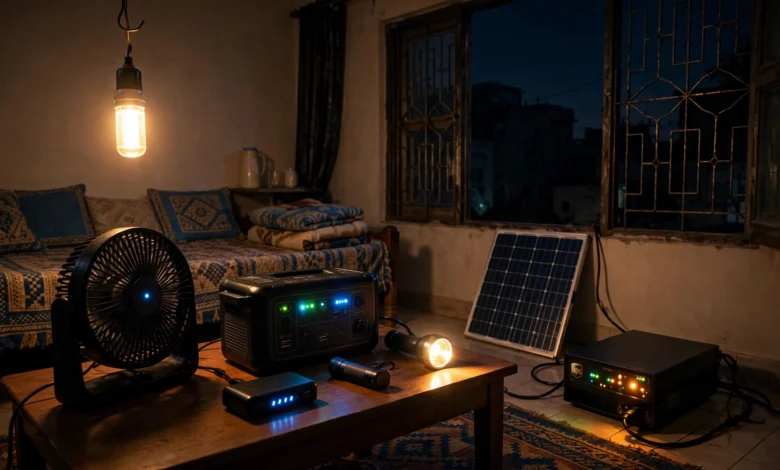
A portable power station Pakistan buyers increasingly choose is a battery, inverter and charger in one box. You plug it into the wall to charge, then plug devices into it during a cut. No wiring, no installer, and you can move it between rooms or take it to the office.
At W11stop, the EcoFlow River 2 (256Wh, 300W output) is listed at about Rs. 59,999, and the River 2 Pro (768Wh, 800W output) at about Rs. 117,999. Both use LiFePO4 batteries and can switch over quickly enough to keep a laptop or router running through a cut.
These are ideal for renters who cannot install a UPS, but they cost more per watt-hour than a traditional setup. Think of them as convenience, not the cheapest backup.
3. Rechargeable Fan
For a bedroom or a student’s room, a good rechargeable fan is the simplest fix. Prices range from small hand fans like the Sogo JPN-414 at around Rs. 1,600 (about 1.5 hours of backup) to larger 12V pedestal and table fans like the Sogo JPN-653R at about Rs. 15,500.
When comparing rechargeable fan price in Pakistan, look at battery type and size, not just blade size. A fan with a lithium battery will hold up much better over a summer than one with a small sealed lead-acid battery.
4. DC Inverter Ceiling Fan
This is not a backup device on its own, but it is one of the smartest upgrades you can make. DC or inverter ceiling fans use roughly half the power of old AC fans. That means your existing UPS battery lasts much longer, and your monthly electricity bill drops too. Replace the fans in the rooms you use most during load shedding first.
5. Power Bank
Every household needs at least one reliable power bank. A 20,000mAh model holds about 74Wh, enough for three to five phone charges, or several hours of a small USB fan. Look for a known brand, USB-C Power Delivery output and an honest rating. Heavy, well-built units are usually more truthful about capacity than light, cheap ones.
6. Mini UPS for Your Wi-Fi Router
If you work or study online, this is a must. A mini UPS for router connects between the router’s adapter and the router itself, and keeps your internet running for several hours even when the main UPS is off or overloaded. Make sure it matches your router’s voltage (usually 9V or 12V) and has enough output current. If you have fibre internet, you may need a dual-output model to power the fibre box too.
7. Rechargeable LED Lights and Solar Lanterns
LED emergency lights are cheap, efficient and last for hours. Place them in the kitchen, near stairs and in bathrooms so nobody trips in the dark. Small solar lanterns are a good extra for homes where outages run long or charging time is limited.
8. Small Solar Kit
If your area faces long daily cuts, a small solar panel with a proper charge controller can recharge your UPS battery or power station during the day. This reduces how much grid power you need to charge backups between outages. For larger rooftop systems, use a licensed installer, and if you want to sell power back to the grid, apply for net metering through your DISCO rather than wiring anything informally.
9. Voltage Stabiliser and Surge Protector
Power returning after load shedding often comes with spikes and low-voltage dips. These damage fridges, televisions, computers and AC compressors. A good stabiliser for large appliances and surge-protected extension boards for electronics are cheap insurance.
10. Outage Alerts and Schedule Apps
The most underrated gadget is information. K-Electric and the DISCOs publish load management schedules and outage updates through their apps, websites and SMS services. Knowing when a cut is coming lets you charge power banks, fill water tanks and finish important work beforehand.
How to Buy Load Shedding Gadgets Safely
- Buy from authorised dealers and ask for a written warranty with the shop’s stamp.
- Check battery capacity claims. A “30,000mAh” power bank that weighs as much as a phone is lying.
- Avoid unbranded inverters with no model number or service centre.
- Ask about after-sales service in your city, not just in Lahore or Karachi.
- Keep receipts and box serial numbers. Warranty claims fail without them.
- Let a qualified electrician install anything wired into your home’s distribution board.
The Reality Check: Theft, Fraud and Unsafe Shortcuts
Gadgets help you cope with load shedding, but they do not fix it. To be honest about the problem, you have to look at what drives it, and at the illegal shortcuts some people take.
Electricity Theft Makes Load Shedding Worse
In many areas, load shedding hours are tied to how much power is lost or unpaid on a feeder. When neighbours use a kunda (illegal hook) or tamper with meters, everyone on that line can end up with longer cuts.
The scale is huge. According to an APP report on the anti-theft drive, authorities arrested more than 44,000 people and registered 184,911 FIRs for electricity theft in fiscal year 2024-25. Detection teams found 271 million stolen units and issued Rs. 11.4 billion in bills, of which about half had been recovered. The same report put average line losses across the ten distribution companies at over 17%, with SEPCO, QESCO and PESCO above 36%.
The earlier crackdown that began in September 2023 also exposed the inside job. By November 2023, the Power Division said 20 electricity company workers were among those arrested and 272 officers had been suspended for involvement in theft.
The ethical point is simple. Stealing power is not a victimless shortcut against a greedy company. It raises bills for honest customers, lengthens their outages and kills people every year through unsafe hooks and live wires.
Solar Import Fraud: The Scandal Behind the Boom
Solar panels became popular partly because of load shedding and rising bills. That boom also attracted criminals. The FBR’s post-clearance audit found over-invoicing of about Rs. 69.5 billion by 63 solar panel importers between 2017 and 2022. Because panels came in duty-free, inflated invoices were used to move money abroad.
As the Express Tribune reported, panels were imported from China while payments went to companies in other countries, and 13 FIRs were registered. Senators asked how a firm with Rs. 2 million in paid-up capital could do Rs. 50 billion of business. Banks were fined over Rs. 200 million for their role.
For ordinary buyers, the lesson is to deal with established solar companies, ask for a proper invoice with panel model and serial numbers, and check that the brand and wattage on the panel match what you paid for.
Fake Capacity and Recycled Batteries
The backup market has its own cheats, and they are hard to spot:
- Inflated power bank ratings. A cheap “50,000mAh” bank that charges a phone twice is not 50,000mAh.
- Refurbished batteries sold as new. Old lead-acid batteries are sometimes cleaned, recharged and relabelled.
- Wrong lithium cells. Some low-cost “lithium” packs use cheaper cell types than claimed, without a proper battery management system.
- Fake brand labels on inverters that copy the look of a popular brand.
Always check weight, warranty card, serial number and the seller’s reputation. If the price is far below every authorised dealer, ask yourself why.
Fire and Electrical Safety at Home
Battery backup brings real fire risk when it is installed carelessly. Keep these rules in mind:
- Never keep a lead-acid battery in a closed cupboard or bedroom. It releases hydrogen gas while charging.
- Use the right cable thickness between battery and inverter. Thin wires overheat.
- Do not let children play near batteries or exposed terminals.
- Never mix old and new batteries in one bank.
- Replace swollen power banks immediately and never charge them overnight on a bed.
The Ethical Side of Backup Power
A few honest points that most buying guides skip:
- Generators and neighbours. Petrol generators are loud and their exhaust can be deadly in enclosed spaces. Never run one indoors, in a garage or under a window.
- Battery disposal. Lead-acid batteries contain lead and acid. Return old ones to dealers who recycle them properly instead of selling to informal smelters that poison neighbourhoods.
- Fair use. Do not run your UPS charger from someone else’s connection or a shared mosque or building supply without permission. That is also theft.
Conclusion
The best gadgets to survive load shedding in Pakistan depend on your needs and budget: a UPS or inverter with a good tubular or LiFePO4 battery remains the backbone for most homes, portable power stations suit renters and offices, rechargeable fans and LED lights cover bedrooms cheaply, DC inverter fans stretch every battery further, and a power bank, a mini UPS for the router, a small solar kit and a proper surge protector fill the gaps. Work out your load and backup time before you spend, buy from authorised dealers with written warranties, and install batteries safely away from bedrooms. Finally, remember that electricity theft and import fraud, which have led to tens of thousands of arrests and billions in recoveries, are part of why outages persist, so staying honest and buying genuine products protects both your family and your neighbours.