Local UPS Brands Tested During Long Load Shedding Hours
Local UPS brands put through long load shedding hours: real backup times, battery fraud, kunda risks and a buying checklist that protects your money.
Local UPS Brands Tested: 7 Brutal Truths From Long Load Shedding Hours
Introduction
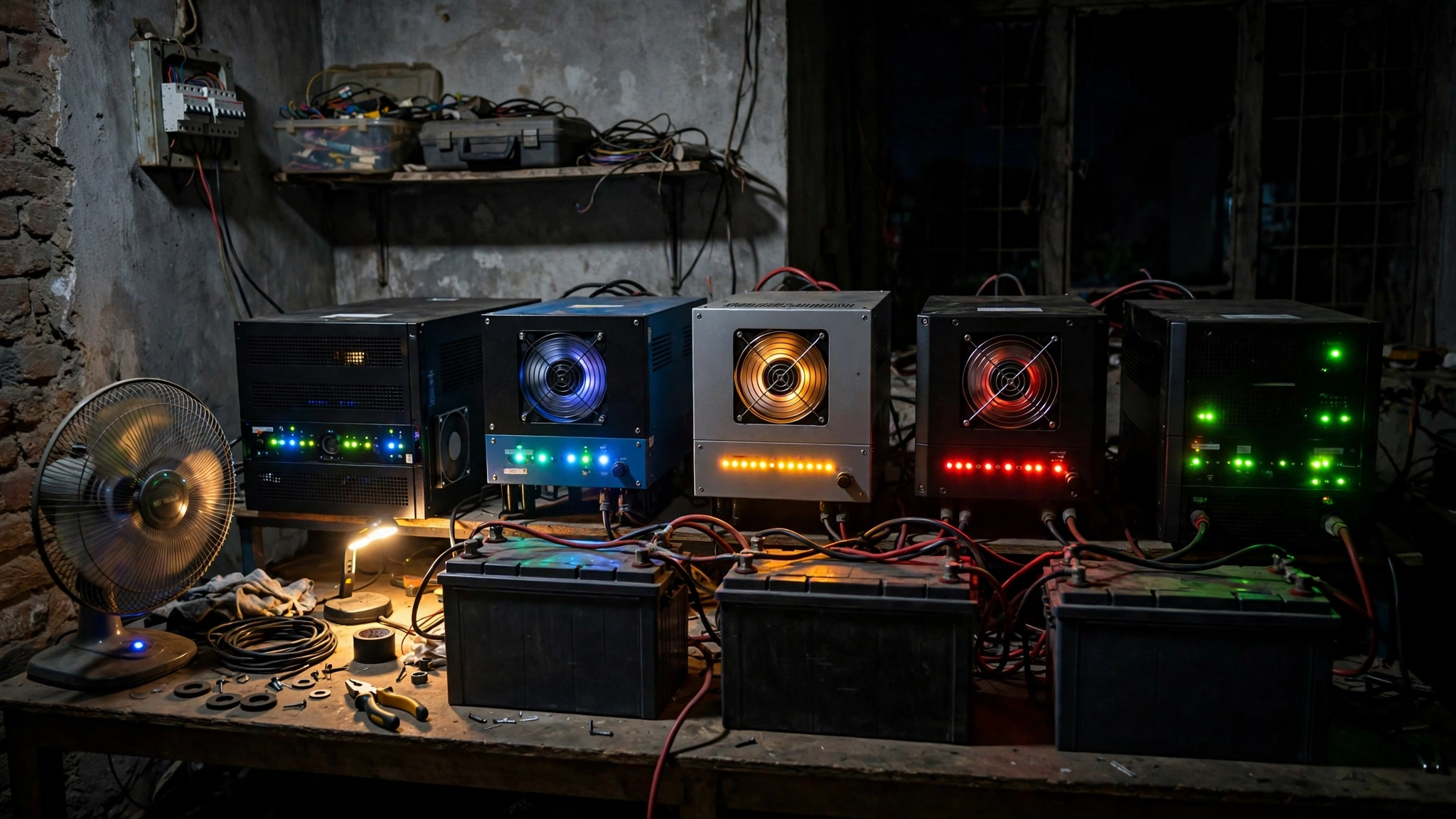
Local UPS brands face their real exam in June, not in the showroom. When the grid drops for four, six or eight hours a day, every claim printed on the box gets checked by a ceiling fan, a few LED bulbs, a Wi-Fi router and a family that just wants to sleep. Some units hold up. Many don’t, and the reason is rarely the brand name alone.
This guide looks at how local UPS brands behave during long load shedding hours in Pakistan, based on the things that actually decide UPS battery backup time: inverter design, charger strength, battery quality, wiring and the honesty of the seller. We are not publishing invented lab scores or ranking companies we never put on a bench. You get the checks that technicians and long-time owners rely on, and the patterns that show up again and again when a cheap unit gives up at 3 a.m.
We also cover the uncomfortable side of this market. Batteries get relabeled with higher amp-hour ratings. Used plates get sold as new. Dead batteries end up in illegal smelters that poison children. Some households still charge their UPS for home from a stolen kunda line, which is now a police case, not a clever hack.
If you are shopping for the best UPS in Pakistan, or trying to work out why yours dies early, this is the practical and honest version.
Why Long Load Shedding Exposes Weak Local UPS Brands
A UPS that survives a 30-minute outage can still fail a six-hour day. Short cuts hide weak chargers and tired batteries. Long, repeated cuts expose them within a week. That is why so many local UPS brands look fine in October and get blamed in July.
The scale of dependence is large. A study on UPS energy use in Pakistan published through LUMS estimated that at least 30% of commercial and residential buildings in Pakistan use a UPS, at a time when load shedding ran up to 12 hours a day. Whenever outages return, demand spikes. During this year’s shortages, Pakistan Observer reported that rising demand pushed up the price of both UPS units and batteries. High demand is exactly when weak stock and fake batteries move fastest.
The charging window problem
Under a one-hour-on, one-hour-off schedule, your battery gets roughly the same time to recharge as it spent draining. Many budget local UPS brands ship with a charger that delivers 8 to 10 amps. That is fine for a short outage. It is far too slow to refill a 150Ah or 180Ah tubular battery between back-to-back cuts. The battery starts each outage a little emptier than the last, and by evening it is running on fumes.
Heat is the silent load
Summer outages happen when rooms are hottest. A UPS packed into a cupboard under the stairs, next to a battery sitting on bare floor, runs hot all day. Heat speeds up plate corrosion in lead-acid batteries and cooks cheap capacitors and MOSFETs inside the inverter. Several local UPS brands that perform well in a ventilated corner fail early in a closed cabinet.
The low-voltage trap
In many areas the grid comes back at 160 to 180 volts instead of 220. A weak UPS either refuses to charge at that voltage or keeps switching between mains and battery. Each switch is a small hit on the battery. Good local UPS brands publish a wide input range, often 140V to 260V, and actually charge inside it.


How We Judged Local UPS Brands Under Real Outage Conditions
A quick note on honesty first. “Tested” here means judged against the conditions that long outages create, using the specs sellers publish, the checks experienced technicians run in electronics markets, and the failure patterns owners report summer after summer. It does not mean we ran a certified lab trial on every model. Anyone claiming to have crowned one single winner among dozens of local UPS brands is usually selling something.
The market in three tiers
When you walk into Hall Road in Lahore or any city electronics market, you will find roughly three kinds of product:
- Established local brands and assemblers such as Homage, Inverex and Fronus, which sell through dealer networks and usually run service centres. Quality varies by model line, so judge the model, not the logo.
- International brands like APC, which are built mainly for computers and offices. They protect electronics well but are not designed to run fans for hours.
- Unbranded or rebadged imports, often Chinese boards in a local box. Some are fine. Many have no traceable warranty at all.
The seven checks that matter
These are the criteria we used to judge local UPS brands, in order of how often they decide real-world results:
- Output waveform. A pure sine wave UPS runs fans, motors and sensitive electronics cleanly. Modified sine units are cheaper but make fans hum and run hot.
- Charging current. Look for an adjustable charger of at least 15 to 20 amps for a single 150Ah battery.
- Real watt rating. The VA number is not the watt number. More on that below.
- Input voltage range. It should charge reliably at low grid voltage.
- Idle draw and efficiency. A unit that wastes 40 watts doing nothing eats your backup.
- Protections. Overload, short circuit, deep discharge cut-off and reverse polarity.
- After-sales reality. A warranty means nothing if the dealer vanishes or the service centre is 300 kilometres away.
7 Brutal Truths Local UPS Brands Taught Us During Long Outages
These lessons apply whether you buy a well-known name or a cheap box from the corner shop. Most complaints about local UPS brands trace back to one of these seven points.
1. The VA rating on the box is not the watts you get
A “1000VA” label sounds like 1000 watts. It is not. Most home units have a power factor between 0.6 and 0.8, so a 1000VA UPS realistically delivers 600 to 800 watts. Some budget local UPS brands print the VA figure in large type and hide the watt figure, or skip it entirely. Load a unit close to its VA number and it will trip, overheat or fail early.
Rule of thumb: add up your watts, then pick a UPS whose watt rating is at least 25% higher than that total.
2. The battery decides backup time more than the brand
People blame the UPS when the battery is the real problem. UPS battery backup time comes from simple math:
- Battery energy = voltage x amp hours. A 12V, 150Ah battery holds 1,800 watt-hours on paper.
- Lead-acid batteries last much longer if you use only about half of that, so plan on 900 usable watt-hours.
- Inverter losses take another 10 to 20%, leaving roughly 750 watt-hours.
- At a 300-watt load, that is about 2.5 hours of backup.
No brand can beat that math. When a seller promises six hours from one battery for a house full of fans, the promise is wrong, whichever of the local UPS brands is printed on the front.
3. Charging current is the hidden killer
This is the point most buyers never check. Under repeated load shedding, the battery needs to refill quickly. A charger pushing 10 amps adds roughly 10 amp-hours per hour before losses, which barely dents a deep discharge. A 20-amp charger does twice the work in the same window.
Better local UPS brands let you set the charging current to match your battery size. Cheaper units often fix it at a low level to save cost on the transformer and cooling. The result: a battery that never fully recovers, then sulphates and dies in a year.
4. Pure sine wave matters more than marketing says
Ceiling fans and pedestal fans use induction motors. On a modified sine output they run warmer, hum louder and lose efficiency. Over a long summer that adds stress to both the fan and the UPS. A pure sine wave UPS costs more upfront but behaves like grid power. If your home runs mostly fans, this is not a luxury. It is the better deal over two or three seasons.
5. Weight and copper claims are easy to fake
In markets, buyers lift a unit to judge it. Heavy usually means a bigger copper-wound transformer, which handles heat better than aluminium. Sellers know this, and some boxes have been padded to feel heavier. Ask the dealer to open the case or show the spec sheet from the company website. Reputable local UPS brands publish transformer type and charging specs openly.
6. Heat and placement cut lifespan in half
The same UPS can last eight years in a ventilated corner or two years in a closed cupboard next to the kitchen. Keep at least a hand’s width of space around the vents. Keep the battery off bare floor in a dry, shaded spot, and check water levels in flooded tubular batteries every few weeks during summer.
7. The cheapest unit costs the most over three summers
A low-price unit with a weak charger quietly kills a battery that costs far more than the UPS itself. Replace one battery a year earlier than needed and your savings are gone. When you compare UPS price in Pakistan, compare the total cost over three years: the unit, the expected battery replacements, and the electricity the charger wastes. That is the comparison where good local UPS brands usually win.
The Illegal Side of the Backup Power Market: Real Examples
Any honest review of local UPS brands has to talk about what happens around them. The biggest risks to buyers often come from fraud in the battery trade and from illegal power use, not from the UPS circuit board.
Relabeled and counterfeit batteries
A battery with a fake amp-hour rating looks identical to a real one until the first long outage. Enforcement agencies have caught this repeatedly:
- In Erbil, Kurdish security forces seized 11,000 fake batteries after a company swapped the stickers on imported units, a practice that can misstate amperage and create safety risks.
- In Puerto Rico, where lead batteries are in high demand for solar backup, US customs officers seized 1,072 lead-acid batteries carrying a counterfeit safety certification mark.
- Closer to home, Pakistan Customs seized fake goods worth about Rs 7.7 billion in FY26, including consumer durables and other trademark-infringing items.
The pattern is the same everywhere: when backup power is in demand, counterfeiters follow. Pairing even the best of the local UPS brands with a relabeled battery will give you poor backup and a short life.
Used batteries sold as new
Another common trick is the “fresh” battery that is actually reconditioned. Old plates get cleaned, the acid gets topped up, and a new sticker goes on. Warning signs include:
- A manufacturing date code that is missing, scratched or more than six months old
- Scuffed terminals or acid stains around the vent caps
- A price that is well below the brand’s dealer rate
- No printed warranty card with a serial number
Kunda connections and meter tampering
Some households charge their UPS for home from an illegal hook on the overhead line. It feels like a small thing during a hot summer. It is not. Punjab Police reported 32,181 electricity theft cases and 23,439 arrests across the province by July 2026. In Karachi, K-Electric removed about 1,240 kilograms of illegal hooked connections from a single area in January 2026.
Theft also feeds the problem it tries to escape. Distribution losses push utilities to impose heavier load shedding in high-loss feeders, so honest bill payers in the same area lose power too. Kunda wiring is also a fire and electrocution hazard, and a stolen supply often arrives at unstable voltage that damages UPS chargers.
Illegal battery recycling and lead poisoning
Every UPS battery eventually dies, and where it goes matters. Informal smelters break open cases, spill acid and burn lead in open furnaces. A UNICEF-backed study reported by Health Policy Watch tested 2,175 children in Pakistan’s industrial cities and found four in ten in high-risk areas had unsafe blood-lead levels, with informal battery recycling named as the main exposure route. Sindh’s environmental regulator has said illegal units often just move to a new location after action.
The ethical move is simple: return old batteries to an authorised dealer or the brand’s exchange scheme, and ask where they go. Many local UPS brands and battery makers offer an exchange discount, and it is worth using.
Buying Checklist for Local UPS Brands in Pakistan
Use this list in the shop, not after you get home. It works for any of the local UPS brands on the market and for imported units too.
Before you visit the market
- List your load. Count fans, bulbs, the router, the TV and any laptop. Note the wattage on each label.
- Decide your backup target. Two hours of fans and lights needs a very different setup than five hours.
- Set a total budget that covers the UPS, the batteries, a proper stand and copper cable. The battery often costs more than the UPS.
- Shortlist two or three models and download their spec sheets from the company website, not from the shop’s poster.
At the shop
- Confirm the watt rating, not just VA.
- Ask for a pure sine wave UPS if fans are your main load.
- Check that the charging current is adjustable and at least 15 amps.
- Read the input voltage range and confirm it charges at low voltage.
- Check the battery’s date code, weight and warranty card before paying.
- Get a printed bill with the serial number of both the UPS and the battery.
- Ask where the nearest service centre is and call it before you buy.
Quick sizing guide for load shedding backup
These are rough estimates for load shedding backup, assuming about 50% battery use (to protect battery life) and typical inverter losses. Real results vary with battery age and room temperature.
| Home setup | Approx. load (W) | Suggested UPS size | Battery bank | Approx. backup (hours) |
|---|---|---|---|---|
| 2 fans, 4 LED bulbs, router | 210 | 1000VA, pure sine | 1 x 12V, 150 to 180Ah | 3 to 3.5 |
| 4 fans, 6 LED bulbs, LED TV, router | 465 | 2000VA, 24V system | 2 x 12V, 150Ah | about 3 |
| 6 fans, 8 LED bulbs, LED TV, router | 640 | 3000VA, 24V system | 2 x 12V, 200Ah | about 3 |
Switching to DC inverter fans, which draw around 30 to 40 watts instead of 75, can nearly double backup on the same battery. That single change often helps more than switching between local UPS brands.
When to consider a solar hybrid inverter
If your outages regularly run past six hours, no battery bank charged from a weak grid will keep up. A solar hybrid inverter charges batteries during the day without waiting for the grid. Several local UPS brands now sell hybrid models. Check that the solar controller is MPPT, not PWM, and that the installer sizes panels to your battery bank, not to a sales target.
Conclusion
Long outages are the only honest test for local UPS brands, and the results come down to a few things you can check yourself: the real watt rating, a strong and adjustable charger, a pure sine output, a genuine battery with a recent date code, good ventilation, and a dealer who will still answer the phone next summer. No brand can beat battery math, so size your system to your actual load and expect about two and a half to three and a half hours from a sensible setup rather than the six hours some sellers promise. Stay alert to relabeled and reconditioned batteries, never charge your backup from a kunda line that puts your neighbours and your own wiring at risk, and send dead batteries back to an authorised dealer instead of the scrap cart that feeds illegal smelters. Choose carefully among local UPS brands, and the one you buy will carry your home through the worst load shedding season without draining your wallet.