Top Home Workout Routines Requiring No Gym Equipment
Seven home workout routines requiring no gym equipment, with safer beginner plans, a weekly schedule and real lessons from bogus fitness gadget scams.
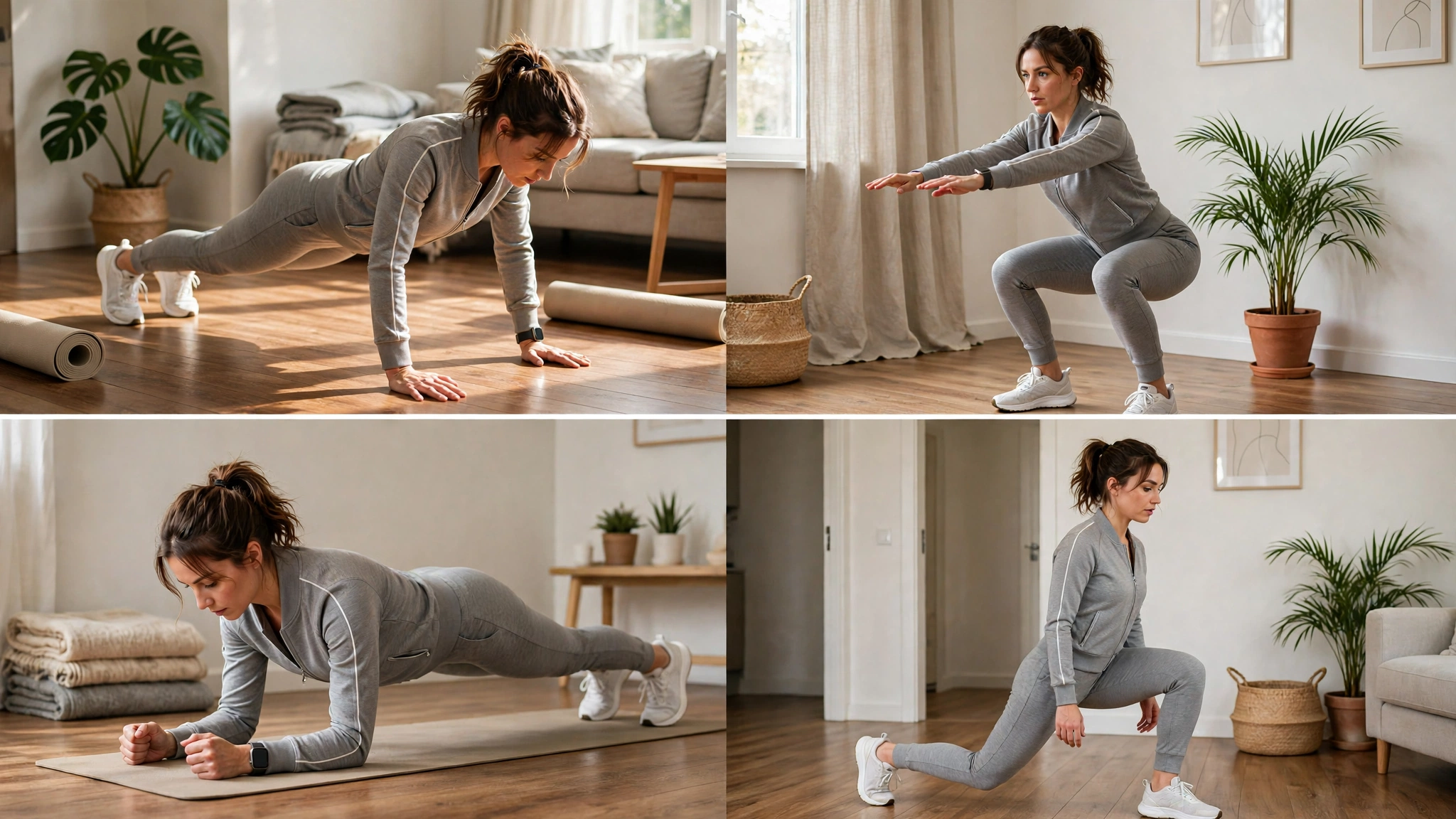
Top Home Workout Routines Requiring No Gym Equipment: 7 Proven Plans That Actually Work
Introduction
Home workout routines requiring no gym equipment are one of the most underrated tools in fitness. You do not need a membership card, a rack of dumbbells or a treadmill in the spare room. Your own bodyweight, a bit of floor space and a plan are enough to build strength, burn fat, improve stamina and feel better in your body.
The fitness industry rarely tells you this, because there is not much money in it. Instead, you see endless adverts for ab belts, fat-burning gadgets, expensive smart machines and online coaching packages that promise results in days. Some of those promises have been so false that regulators stepped in, fined companies and forced refunds. We will look at those real cases later, because they show exactly what to ignore.
This guide focuses on what genuinely works. You will get seven complete bodyweight workouts for different goals, from full body strength and fat-burning HIIT to core, legs, upper body and mobility. Each routine lists the exercises, sets and rest times, with beginner adjustments so nobody gets left behind. You will also get a weekly schedule, simple ways to make workouts harder without buying anything, and practical tips for small rooms, hot weather and busy family homes.
If you can give it 20 to 30 minutes a day, this is all you need to start.
Why Home Workout Routines With No Equipment Actually Work
Your muscles do not know whether resistance comes from a barbell or your own body. They respond to effort. A push-up loads your chest, shoulders and triceps. A squat works your legs and glutes. A plank trains your entire core. When you make these movements harder over time, your body adapts by getting stronger and fitter.
The Real Benefits of Bodyweight Training
- Zero cost. No membership, no equipment, no travel.
- No excuses about time. A 20-minute session at home replaces a 90-minute gym trip once you count the commute.
- Better control of your body. Bodyweight exercises build balance, coordination and joint stability alongside strength.
- Lower injury risk for beginners. There is no heavy weight to drop or lose control of.
- Train anywhere. Your bedroom, a hotel room, a rooftop or a park all work.
How Much Exercise Do You Need?
The WHO physical activity guidelines recommend that adults do 150 to 300 minutes of moderate activity, or 75 to 150 minutes of vigorous activity, each week, plus muscle-strengthening work on at least two days. A mix of the no equipment workouts below, done four or five times a week, covers both targets comfortably.
Before You Start: Warm-Up and Safety Basics
Skipping the warm-up is the fastest way to turn a good workout into a pulled muscle. Five minutes is enough.
A 5-Minute Warm-Up for Any Routine
- March or jog on the spot for 60 seconds.
- Arm circles, 15 forward and 15 backward.
- Hip circles, 10 in each direction.
- Bodyweight squats, 10 slow reps.
- Inchworms, 5 reps: bend forward, walk your hands out to a plank, then walk them back.
- Jumping jacks or step jacks, 30 seconds.
Simple Safety Rules
- Form first, speed second. A slow, clean rep beats three sloppy ones.
- Train on a non-slip surface. A rug or folded blanket works as a mat. Avoid wet or tiled floors for jumping moves.
- Wear proper shoes for jumping, or switch jumps for low-impact versions if you train barefoot.
- Breathe out on effort. Exhale as you push up or stand up. Do not hold your breath.
- Pain is a stop sign. Muscle burn is normal. Sharp pain in a joint is not.
- Check with a doctor first if you are pregnant, have heart problems, high blood pressure, diabetes or a past injury.
7 Top Home Workout Routines Requiring No Gym Equipment
Each routine below can be done in a space about the size of a yoga mat. Rest times are between exercises unless stated otherwise. Beginners should start with the lower number of reps or rounds.
1. Full Body Strength Routine (25 Minutes)
This is the foundation of any bodyweight workout plan. It trains every major muscle group in one session.


Do 3 rounds, resting 45 seconds between exercises and 2 minutes between rounds:
- Bodyweight squats: 12 to 20 reps
- Push-ups: 6 to 15 reps (knee or wall push-ups for beginners)
- Reverse lunges: 8 to 12 per leg
- Glute bridges: 15 to 20 reps
- Plank: 20 to 45 seconds
- Superman hold: 20 to 30 seconds, lying face down and lifting arms and legs
Best for: beginners and anyone who wants one simple routine three times a week.
2. Fat-Burning HIIT Routine (20 Minutes)
High-intensity interval training alternates hard bursts with short rest. It raises your heart rate quickly and is one of the most time-efficient fat burning workouts at home.
Work 30 seconds, rest 30 seconds, and complete 3 to 4 rounds:
- Jumping jacks
- High knees
- Squat jumps (or fast bodyweight squats for low impact)
- Mountain climbers
- Burpees (step back instead of jumping for beginners)
Best for: people with limited time who want cardio and calorie burn. Limit HIIT to two or three sessions a week, since it is demanding on joints and recovery.
3. Core and Abs Routine (15 Minutes)
A strong core supports your back, improves posture and helps every other exercise. Do 3 rounds with 20 seconds of rest between moves:
- Dead bug: 10 per side
- Forearm plank: 30 to 60 seconds
- Side plank: 20 to 40 seconds per side
- Bicycle crunches: 12 per side
- Lying leg raises: 10 to 15 reps
- Bird dog: 10 per side
Remember that visible abs come mostly from overall body fat levels, not from doing more crunches. This routine builds strength, not spot reduction.
4. Lower Body Routine (25 Minutes)
Your legs and glutes are the largest muscles in your body, so training them burns energy and builds real-world strength for stairs, lifting and walking.
Do 3 to 4 rounds with 45 seconds of rest between moves:
- Squats with a 3-second lowering phase: 12 to 15 reps
- Walking or stationary lunges: 10 per leg
- Single-leg glute bridges: 10 per leg
- Wall sit: 30 to 60 seconds
- Step-ups on a sturdy stair or low bench: 10 per leg
- Calf raises: 20 reps
5. Upper Body Routine (20 Minutes)
Without weights, the upper body is trained mainly through pushing movements and smart variations. Do 3 rounds with 45 seconds of rest:
- Push-ups: as many clean reps as you can, stopping one or two short of failure
- Pike push-ups: 6 to 10 reps for shoulders
- Chair or bench dips: 8 to 12 reps for triceps
- Plank shoulder taps: 10 per side
- Towel rows: loop a towel around a sturdy door handle or pole, lean back and pull yourself in, 10 to 12 reps
- Reverse snow angels: 12 reps, lying face down
Always check that any door, pole or chair you use is stable before putting weight on it.
6. Mobility and Stretching Routine (15 Minutes)
This is the routine people skip and later regret. It keeps joints healthy and helps recovery. Hold each stretch for 30 to 45 seconds:
- Cat-cow: 10 slow reps
- World’s greatest stretch: 5 per side
- Hip flexor stretch in a half-kneeling position
- Hamstring stretch lying on your back
- Child’s pose
- Thoracic rotations on all fours, 8 per side
Use this on rest days or after any of the other routines.
7. The 7-Minute Workout
Published in 2013 in the American College of Sports Medicine’s Health & Fitness Journal, the 7-minute workout became famous for a reason: it is short, structured and uses only bodyweight, a wall and a chair. Do each exercise for 30 seconds with 10 seconds of rest in between:
- Jumping jacks
- Wall sit
- Push-ups
- Abdominal crunches
- Step-ups onto a chair
- Squats
- Triceps dips on a chair
- Plank
- High knees running in place
- Lunges
- Push-ups with rotation
- Side plank
One round on a busy day is better than nothing. Two or three rounds make it a proper workout.
Quick Comparison of the Routines
| Routine | Main goal | Time | Sessions per week |
|---|---|---|---|
| Full body strength | Overall strength | 25 min | 2 to 3 |
| HIIT | Cardio and fat loss | 20 min | 2 to 3 |
| Core and abs | Core strength, posture | 15 min | 2 to 3 |
| Lower body | Legs and glutes | 25 min | 1 to 2 |
| Upper body | Chest, shoulders, arms | 20 min | 1 to 2 |
| Mobility | Flexibility, recovery | 15 min | 2 to 4 |
| 7-minute workout | Quick full session | 7 to 21 min | Busy days |
How to Keep Progressing Without Buying Equipment
The biggest myth about at-home workouts without equipment is that you stop improving once the basic moves get easy. You do not, as long as you keep making them a little harder. This idea is called progressive overload.
Six Ways to Make Bodyweight Exercises Harder
- Add reps or rounds. The simplest method. Go from 10 to 12 to 15.
- Slow down the lowering phase. Take three to five seconds to lower into a squat or push-up.
- Add a pause. Hold the bottom of a squat or push-up for two seconds.
- Shorten your rest. Drop from 60 seconds to 45, then 30.
- Use harder variations. Move from knee push-ups to full push-ups, then decline push-ups with feet on a chair. Move from squats to split squats, then single-leg box squats to a chair.
- Use household items. A backpack filled with books, or water bottles, adds load to squats, lunges and rows.
A Sample Weekly Home Workout Schedule
| Day | Routine | Approx. time |
|---|---|---|
| Monday | Full body strength | 25 min |
| Tuesday | HIIT + core and abs | 35 min |
| Wednesday | Mobility or a 30-minute walk | 15 to 30 min |
| Thursday | Lower body + core | 40 min |
| Friday | Upper body | 20 min |
| Saturday | HIIT or 7-minute workout x 3 | 20 min |
| Sunday | Rest and light stretching | Flexible |
Beginners can cut this to three days a week: full body on Monday, Wednesday and Friday, with walks on the other days. Track your reps in a notebook or phone so you can see your progress.
The Reality Check: Fitness Shortcuts That Broke the Law
The home fitness market is huge, and not every product in it is honest. These real cases show why simple bodyweight exercises often beat expensive gadgets, and why big promises deserve suspicion.
The Ab Circle Pro: “Three Minutes a Day”
The Ab Circle Pro was a fiberglass disc with handlebars, sold through TV infomercials for around $200 to $250. Its ads claimed that three minutes on the device equalled 100 sit-ups and that buyers could lose 10 pounds in two weeks. In 2012, the US Federal Trade Commission charged the marketers with deceptive advertising, and they agreed to pay between $15 million and $25 million in refunds. The FTC’s own summary, Phenomenal abdominals? Not so fast, Ab Circle Pro, explains how the weight loss and “three minutes a day” claims misled buyers.
The lesson: no device can replace consistent effort. Three minutes of anything will not make you lean.
Toning Shoes From Reebok and Skechers
Around the same period, the FTC settled with Reebok for $25 million and Skechers for $40 million over claims that their toning shoes would firm up legs and glutes just by walking in them. The science did not support those promises.
The lesson: if a product claims to tone you passively, be sceptical. Muscles respond to work, not shoes.
Peloton’s Tread+ Penalty
Equipment can also be physically dangerous. In January 2023, Peloton agreed to pay a $19,065,000 civil penalty to the US Consumer Product Safety Commission. According to the CPSC, Peloton had received more than 150 reports of people, pets and objects being pulled under the rear of its Tread+ treadmill, including the death of a child and 13 injuries, before it reported the problem. The settlement also covered charges that the company knowingly delivered 38 recalled treadmills after the May 2021 recall. CBS News covered the Peloton treadmill penalty in detail.
The lesson: home machines come with real risks, especially around children and pets. A floor and your bodyweight carry no such hazards.
Illegal Weight-Loss Pills Sold Alongside Workout Plans
Many social media fitness pages pair free workout routines with “fat burner” pills, teas or injections. In Pakistan, the Drug Regulatory Authority has warned that selling weight-loss medicines online without a prescription is illegal and has asked the telecom regulator to block websites and pages doing it. Regulators worldwide, including the US FDA, keep finding so-called herbal slimming products that secretly contain sibutramine, a banned drug linked to heart attack and stroke risk.
The lesson: a good workout plan never needs a pill to “work.” If a free routine comes bundled with a product pitch, the routine is the bait.
Practical Tips for Training at Home in Real Life
The routines are the easy part. Fitting them into a real home, with real distractions, is where most people struggle.
Working Out in a Small Room
Most of these home exercises need roughly two metres by one metre of space. Push the bed or a chair aside, roll out a rug and you are set. Swap jumping moves for low-impact versions, such as step jacks instead of jumping jacks, if you live upstairs or share walls.
Training in Hot Weather
In places with long, hot summers, train early in the morning or after sunset, keep a fan running and drink water before, during and after your session. Reduce intensity on very hot days. Dizziness, nausea or a pounding headache are signs to stop and cool down.
Busy Family Homes
If you live with family, pick a regular time when the room is free, such as before others wake up. Involve children or siblings in a short HIIT session. Kids love jumping jacks and squat challenges, and it turns your workout into family time.
Staying Motivated
- Lay out your workout clothes the night before.
- Start with just 10 minutes. Once you begin, you usually finish.
- Track every session on a calendar and try not to break the chain twice.
- Take a progress photo and measurements every four weeks, not every day.
- Use free guided apps or videos if you like having a coach’s voice in the room.
Common Mistakes With No Equipment Workouts
Avoid these and you will progress faster than most people who own a full home gym:
- Doing the same workout forever. If it has felt easy for three weeks, apply one of the progression methods above.
- Doing HIIT every day. Your joints and nervous system need recovery. Mix in strength and mobility days.
- Rushing reps. Fast, half-range reps feel productive but build less strength and raise injury risk.
- Ignoring the lower body. Push-ups and crunches are popular, but legs and glutes drive most of your strength and calorie burn.
- Expecting spot reduction. Crunches will not burn belly fat directly. Overall activity, food and sleep decide that.
- Ignoring nutrition. Training cannot cancel out a diet high in sugar, fried snacks and sugary drinks. Aim for enough protein, vegetables and water.
- Skipping sleep. Seven to eight hours of sleep is when your muscles actually recover and grow.
Conclusion
The top home workout routines requiring no gym equipment prove that strength, stamina and a healthier body are available to anyone with a little floor space and 20 to 30 minutes a day: start with the full body strength routine, add HIIT, core, lower body, upper body and mobility sessions as you grow, use the 7-minute workout on busy days, and keep progressing through more reps, slower tempo, shorter rest and harder variations. Warm up properly, put form before speed, and follow a realistic weekly schedule. Just as important, ignore the shortcuts, because the Ab Circle Pro refunds, the toning shoe settlements, Peloton’s $19 million penalty and the ongoing crackdowns on illegal slimming pills all show that the fitness industry’s flashiest promises are often its least honest, while patient bodyweight training remains free, safe and genuinely effective.