Why Internet Outages Keep Happening in Pakistan Explained
Internet outages in Pakistan keep returning. Here is why, from submarine cable faults and shutdowns to power cuts, cable theft and sabotage.
Internet Outages in Pakistan: 7 Shocking Reasons They Keep Happening (2026 Explained)
Introduction
Internet outages in Pakistan have become so common that many people now plan around them. Freelancers keep a second connection. Shops keep a card machine backup. Families know that a “cable fault” announcement on the news means a slow week ahead. But why does this keep happening in a country with more than 150 million internet subscribers?
The short answer is that there is no single cause. Pakistan’s connection to the world runs through a small number of undersea cables, and when one of them breaks, everyone feels it. On top of that come government-ordered shutdowns, a controversial national firewall, power failures, monsoon damage and, more often than most people realise, crime. Copper thieves dig up telecom cables. Unlicensed operators cut competitors’ fiber. Illegal signal boosters interfere with mobile networks.
This article explains each cause in plain language, using documented examples rather than rumours. We look at the 2024 slowdown that cut speeds by up to 40%, the mobile internet suspension on the February 2024 election day, the run of cable faults in 2025 and 2026, and real police and regulator cases involving cable theft, sabotage and illegal equipment.
The aim is to be fair. Some outages are no one’s fault, some are the result of policy choices, and some are crimes. Knowing which is which helps you hold the right people accountable and protect yourself the next time the internet goes down in Pakistan.
How Pakistan Connects to the Internet (and Why That Matters)
To understand why internet outages in Pakistan spread so widely, it helps to picture how the country is wired. Every website you open outside Pakistan, from Google to Netflix to your bank’s foreign servers, travels through a chain with several weak points.
The Path Your Data Takes
- Your device and home router send data over Wi-Fi or a cable.
- Your ISP’s local network carries it through copper, fiber or a mobile tower to a nearby exchange.
- The national backbone moves it between cities over long-distance fiber.
- Cable landing stations near Karachi hand it to international undersea cables.
- Submarine cables carry it across the Arabian Sea to the Gulf, Europe and Asia.
- A smaller overland link through China offers a limited alternative route.
A failure at any of these points causes an outage. The difference is scale. A broken router affects one house. A cut fiber in a street affects a neighbourhood. A fault in an undersea cable affects the whole country.
Too Few Doors to the World
Pakistan has historically relied on a handful of international cables, roughly six or seven depending on the year, landing at stations run by a small number of licence holders, mainly PTCL and Trans World Associates (TWA). When one or two cables fail, traffic is squeezed onto the rest. That is why a fault thousands of kilometres away near Jeddah or Egypt can make your evening YouTube buffer in Lahore.
Concentration of Control
Because so much traffic passes through so few gateways, those gateways are also where the government can monitor, filter or switch off access. That same concentration explains two very different kinds of outage: accidental cable failures and deliberate shutdowns. Both hit everyone at once.
Reason 1: Submarine Cable Faults Behind Internet Outages in Pakistan
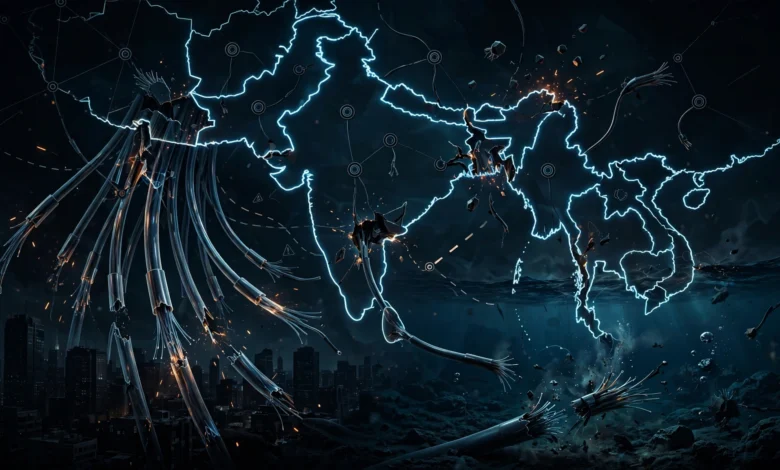
Undersea cable trouble is the single most common reason for nationwide slowdowns. These cables lie on the seabed for thousands of kilometres. Ship anchors, fishing trawlers, earthquakes, storms and simple wear can damage them, and repairs require a specialised ship to find the break, lift the cable and splice it. That can take days or weeks.


A Pattern, Not a One-Off
The record over the past few years shows how often this happens:
- 2021: Faults near Abu Talat in Egypt (February), near Fujairah in the UAE (October) and another in December all slowed services nationwide.
- 2024: The SMW4 and AAE-1 cables both suffered faults, and the AAE-1 system failed several times during the year.
- January 2025: Damage to AAE-1 near Qatar disrupted broadband again.
- October 2025: Maintenance on one cable disrupted Nayatel and PTCL for almost a day, and further faults that month left StormFiber restoring capacity through alternate routes.
- January 2026: Faults near Jeddah partly hit bandwidth on the SMW4 and IMEWE systems.
- May 2026: PTCL warned of a week of evening slowdowns from May 11 to 18 while a submarine cable was repaired.
- July 2026: A fault in the SMW5 cable caused slower speeds and connectivity problems, according to the PTA, and traffic was shifted to other links.
One report counted nine major submarine cable failures affecting Pakistan between 2021 and 2024 alone.
Why One Fault Hurts So Much
When a cable fails, ISPs reroute traffic to the remaining ones, buy emergency bandwidth from abroad and lean on the overland route through China. That works up to a point. But the remaining cables were not built to carry the extra load, so evening speeds collapse when everyone is online. Mobile data suffers too, because mobile networks use the same international gateways.
Is Anything Being Done?
Yes, slowly. Radio Pakistan reported in August 2025 that the country planned to lay three new submarine cables to expand bandwidth and support 5G. More cables, landing in more places and run by more operators, are the only real long-term cure for cable-related internet disruption in Pakistan. Until they are fully live, every fault will continue to be felt nationwide.
Reason 2: Government-Ordered Internet Shutdowns
Not every outage is an accident. Pakistan has a long history of authorities switching off mobile internet, usually citing security. Civil society groups have tracked dozens of such shutdowns over the past decade, often during protests, religious processions and elections.
Election Day 2024
On February 8, 2024, polling day for the general election, mobile phone and internet services were suspended across the country. Monitoring firms observed disruptions on major mobile networks from early morning, even though the PTA had earlier said services would stay on. Weeks later, the PTA told the Sindh High Court that the Ministry of Interior had ordered the suspension, citing a surge in terrorist activity, and that the regulator had only implemented it.
The shutdown drew strong criticism. The Human Rights Commission of Pakistan said it had happened despite a Sindh High Court direction to keep the internet running on polling day, and several political parties complained to the courts.
May 2023 and the Cost of Switching Off
After former prime minister Imran Khan’s arrest in May 2023, mobile internet was suspended for several days amid unrest. The Internet Society’s Pulse project cites a report that transactions through Pakistan’s main digital payment systems fell by around 50% during that shutdown. For delivery riders, ride-hailing drivers and small online sellers, that meant days without income.
What the Courts Have Said
The legal picture is contested. In 2018, the Islamabad High Court held that the government’s policy of ordering shutdowns on vague “national security” grounds was unlawful, although that ruling was later stayed on appeal. Petitions have continued since. The ethical question remains: blanket shutdowns punish millions of ordinary users for the actions of a few.
Reason 3: Throttling, Platform Blocks and the Firewall Controversy
Some disruptions are not full shutdowns but slowdowns and selective blocks, and these are harder to prove.
The 2024 Slowdown
From July 2024, users across the country reported sluggish internet, failing WhatsApp media downloads and unreliable VPNs. One IT association estimated networks were running up to 40% slower than normal. Official explanations shifted over time. The IT minister first blamed heavy VPN use. The PTA then pointed to faults in two of the seven international cables, SMW4 and AAE-1. At a parliamentary committee, the PTA chairman acknowledged that the government’s web management system was being upgraded, though he said it was not a firewall.
Industry bodies, including the Wireless and Internet Service Providers Association of Pakistan and the software house association P@SHA, argued that traffic monitoring was contributing to the slowdown and warned of heavy losses for freelancers and IT exporters.
Platform Blocks
The platform X (formerly Twitter) was blocked for much of 2024, a move challenged in court. Platform blocks are not technically outages, but users who rely on VPNs to reach blocked services often experience slower, less stable connections as a side effect.
Why This Matters
When outages and slowdowns are unexplained or the explanation keeps changing, trust suffers. Businesses cannot plan, and users cannot tell whether to blame their ISP, a cable ship or a policy decision. Transparency, through clear public notices and published reasons, is the minimum citizens should expect.
Reason 4: Power Failures and Load Shedding
The internet runs on electricity at every step. Your router needs power. So does the fiber cabinet on the corner, the mobile tower down the road and the exchange in your area. In a country where load shedding is routine, that is a constant weak point.
Local Outages From Load Shedding
Most exchanges and major sites have battery and generator backup, but smaller street cabinets and mobile towers in some areas have limited backup that runs down during long power cuts. When it does, the internet in that area drops even if your own home has a UPS. This is especially common in smaller cities and rural areas with long scheduled outages.
Grid-Wide Failures
When the national grid fails, the effects are larger. In January 2023, a nationwide power breakdown left much of the country without electricity for many hours, and internet and mobile services degraded in many areas as backup power ran out. Events like this show how tightly the internet down in Pakistan problem is tied to the energy sector.
What Helps
- ISPs investing in longer-lasting batteries and solar backup at towers and cabinets.
- Households using a small UPS for routers and fiber terminals, so short outages do not cut them off.
- Better coordination between power distribution companies and telecom operators during scheduled outages.
Reason 5: Weather, Floods and Construction Damage
Physical damage to cables is not always criminal. A lot of it comes from nature and careless digging.
Monsoon and Floods
Heavy rain floods underground ducts and manholes, corroding copper joints and knocking out street equipment. During major floods, entire stretches of fiber and roads can be washed away, cutting off towns for days. Storms at sea can also damage cables near the coast. In one past episode, a fault near Pakistani shores was linked to Cyclone Kyarr.
Road Works and Excavation
Utility work, road widening and new construction regularly slice through underground fiber. Contractors often do not check where telecom lines run, and repair crews then have to locate and splice the cut. These are the “fiber cut” notices many ISPs send their customers. Better utility mapping and mandatory checks before digging would prevent many of them.
Reason 6: Cable Theft and Sabotage Cause Internet Outages in Pakistan
This is the uncomfortable part of the story. A meaningful share of local outages comes from deliberate criminal acts against telecom infrastructure.
Copper Cable Theft
Copper sells well as scrap, which makes telecom cables a target. Police and news records show cases across the country:
- Karachi, June 2024: Police arrested a gang of 10 people caught stealing underground PTCL cables and recovered cable worth about Rs. 2.5 million, plus a tractor used to pull it out.
- Karachi, earlier case: Police arrested 15 suspects pulling out a 2,400-line PTCL cable near Malir Halt. Four were PTCL employees, including two linemen, showing that insiders are sometimes involved.
- Kohat: Police arrested two people for stealing electricity wires and PTCL cables at night.
- Sahiwal, 2006: Thieves stole an underground cable near Mission Chowk, cutting about 400 phone lines. It was the fifth such theft in the area in a short period, and police had not traced the earlier ones.
- Balochistan: NAB once arrested former PTCL officials over missing copper wire, after records showed far less wire in storage than had been removed.
Each theft takes out phone and DSL service for hundreds of homes, and repairs can take days.
Deliberate Fiber Cuts
Fiber has little scrap value, so cuts are usually about something else: business rivalry or vandalism.
- Multan: Unknown people cut a PTCL optical cable near the State Bank, knocking internet offline in parts of the city for hours.
- Karachi, May 2026: StormFiber’s underground cables were cut at three locations in Gulzar-e-Hijri during Eid, taking thousands of users offline. Industry sources blamed unlicensed local internet operators losing customers to licensed fiber, though no official findings were published. Such attacks reportedly tend to recur around major holidays.
Reason 7: Illegal Equipment and Unlicensed Operators
Some outages and slowdowns come not from cuts but from interference and illegal networks.
Illegal Signal Boosters
Unapproved mobile boosters and amplifiers are widely sold, but they can jam the frequencies that licensed operators use. In December 2024, the PTA and the FIA raided a Karachi retailer and confiscated 25 illegal booster sets. The PTA warned that these devices interfere with licensed spectrum and damage service quality for mobile users nearby. One person’s booster can mean dropped calls and slow data for a whole building.
Unlicensed Internet Resellers
Illegal “cable net” operators resell one connection to many homes with no licence and no accountability. The problem is decades old. In 2002, a PTA team and police raided an illegal operator in DHA Phase V, Karachi, who had been reselling a single connection to 17 subscribers. Today’s operations are larger. Their customers suffer from heavy overselling and sudden disconnections, and as the 2026 StormFiber case suggests, some operators may turn to sabotage when they lose business.
The Ethical Takeaway
Cable theft, sabotage and illegal equipment are not victimless. Students lose classes, patients lose telehealth calls and small businesses lose sales. Buying only PTA type-approved equipment, avoiding unlicensed internet resellers and reporting suspicious digging near telecom lines are small steps everyone can take.
The Real Cost of Internet Outages in Pakistan
Outages are often reported as an inconvenience. For many people they are a financial hit.
- Freelancers and IT exporters lose clients when they miss calls or deadlines. During the 2024 slowdown, industry groups warned of losses running into hundreds of millions of dollars for the IT sector.
- Digital payments fall sharply during shutdowns. The May 2023 suspension saw transactions on major payment systems drop by around half.
- Gig workers such as riders and drivers cannot take orders when mobile data is off.
- Students and patients lose online classes and telehealth appointments.
- Pakistan’s reputation as a place to outsource work suffers every time a major disruption makes international headlines.
When a country wants to grow its digital economy, reliable connectivity is basic infrastructure, as important as roads and power.
What Is Being Done to Reduce Outages
There is some progress, though it is uneven:
- New submarine cables are planned to add capacity and alternative routes.
- ISPs buy backup bandwidth on more cables and via the overland China route, reducing the impact of a single fault.
- Police crackdowns on cable theft gangs and PTA raids on illegal booster sellers continue.
- The PTA publishes quality of service surveys on fixed broadband, which add some public pressure on underperforming operators.
- Courts continue to hear petitions against shutdowns, keeping the legal limits of government power under scrutiny.
What is still missing is consistent transparency: clear, timely public notices explaining every major outage and who ordered or caused it.
How to Protect Yourself From the Next Outage
You cannot stop a cable break near Jeddah, but you can soften the blow:
- Keep a backup connection. Pair home fiber with a mobile data package from a different network, or keep two fixed providers if work depends on it.
- Use a UPS for your router and fiber terminal to ride out load shedding.
- Download offline what you need for work or study when a slowdown is announced.
- Follow official PTA and ISP accounts for outage notices, rather than relying on rumours.
- Report theft or suspicious digging near telecom lines to your ISP and local police.
- Use only legal equipment and licensed providers, so you are not contributing to the problem.
Frequently Asked Questions
Why does the internet slow down across the whole country at once?
Usually because an international submarine cable has failed. Traffic is squeezed onto the remaining cables, so speeds drop everywhere, especially in the evening.
Can the government legally shut down the internet in Pakistan?
It is contested. Authorities have ordered mobile suspensions on security grounds, and courts have questioned and challenged that power in several cases. The issue is still being argued in court.
Was the 2024 slowdown caused by a firewall?
The PTA blamed submarine cable faults, while the PTA chairman acknowledged an upgrade to the government’s web management system. Industry groups and digital rights activists believed traffic monitoring played a part. No single official explanation settled the debate.
Why does my area lose internet when others do not?
Local causes are usually to blame: a cut or stolen cable, a power cut draining backup at a nearby cabinet or tower, flood damage or road works.
How can I check if an outage is nationwide?
Check the PTA’s and your ISP’s official social media accounts, outage-tracking websites and news sites. If several providers are slow at the same time, it is likely an international or national issue.
Conclusion
Internet outages in Pakistan keep happening because several weak points overlap: the country depends on a small number of undersea cables, so a single fault near Jeddah, Egypt or Karachi slows everyone, as repeated breaks from 2021 to the SMW5 fault in July 2026 have shown; authorities have repeatedly ordered mobile shutdowns, including on the February 2024 election day, and the 2024 slowdown raised unresolved questions about throttling and the national firewall; load shedding, grid failures, floods and careless excavation knock out local equipment; and crime plays a bigger role than most people realise, from copper thieves digging up PTCL cables and alleged sabotage of StormFiber’s fiber by unlicensed operators to illegal signal boosters seized by the PTA and FIA. Some of these causes are accidents, some are policy choices and some are crimes, so the fix requires more cables and backup routes, stronger enforcement, honest public communication and, on the user side, backup connections, legal equipment and licensed providers.