How to Spot Fake Gadgets Being Sold in Pakistani Markets
How to spot fake gadgets in Pakistan: IMEI checks, red flags in mobile markets, and real cases of cloned phones and counterfeit accessories.
How to Spot Fake Gadgets in Pakistani Markets
introduction
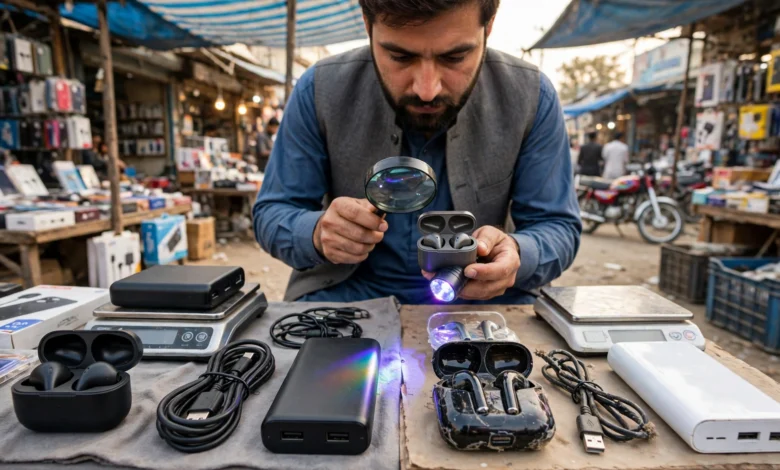
Knowing how to spot fake gadgets in Pakistan can save you far more than the price of a phone. Walk through Hall Road in Lahore, Saddar in Karachi, or any busy mobile market in Rawalpindi or Faisalabad, and you will see the same thing: sealed boxes, shiny stickers, and prices that look too good to pass up. Some of those deals are honest. Many are not.
The problem goes beyond cheap “copy” earbuds that die in a month. In the last few years, PTA and federal investigators have raided shop after shop for changing phone IMEI numbers. In Gujranwala, they found expensive Pixels and Samsung flagships reprogrammed to look like cheap handsets. In Faisalabad, they seized phones with patched identities and the software used to alter them. Buyers of these phones often had no idea until their device was blocked from every mobile network in the country.
Then there are fake chargers that overheat, “original” AirPods with no Apple chip inside, and used phones sold as new with a fresh box and a fake warranty card.
This guide is a practical checklist, not a scare piece. You will learn the red flags for each gadget type, how to verify a phone in two minutes with PTA’s free tools, what the real enforcement cases teach us, and what your rights are under Pakistani consumer law if a seller cheats you. Most fakes can be caught before you pay. You just need to know where to look.
Why Fake Gadgets in Pakistan Are So Common
Before learning the red flags, it helps to understand why the market looks the way it does. Fake gadgets in Pakistan are not just a matter of a few dishonest shopkeepers. A few structural pressures push buyers toward risky deals.
The Price Gap Created by Taxes
Importing a phone through official channels means paying customs duty and PTA registration taxes, which can add a large share to the price of a premium handset. That creates a big gap between an official, PTA approved phone and the same model sold as non-PTA or grey import. Wherever a gap like that exists, people find illegal ways to close it, such as cloning an IMEI from a cheaper phone or registering it with someone else’s passport.
Strong Demand for Big Brands
Apple, Samsung, and other global brands carry real status. Counterfeiters know many buyers want the logo more than the specs, so they copy packaging, stickers, and even boot screens. Accessories are the easiest target. A fake charger or pair of earbuds costs very little to make and can be sold at close to the original price.
Market Slang That Hides the Truth
Shopkeepers often use terms that sound harmless but mean very different things. Knowing them is your first line of defense:
- Master copy / first copy / A-grade: a counterfeit made to look like a branded product. Not original, whatever the seller says.
- Non-PTA: a phone that has not been registered with PTA. It may be genuine, but it will stop working on local SIMs after the grace period unless taxes are paid.
- JV (iPhones): a carrier-locked iPhone made to work with a SIM adapter or software bypass. It can lose network after an update.
- Kit or used-as-new: a used or refurbished phone rebuilt with new parts and repackaged.
- Box pack: should mean sealed and new, but boxes and seals can be replaced. Always verify.
Weak Paper Trails
Many market sales happen without a proper invoice. Without a receipt showing the shop’s name, the product, the IMEI or serial number, and the price, it is very hard to prove what you were sold later. Sellers who refuse to write a proper bill are telling you something.
12 Red Flags: How to Spot Fake Gadgets in Pakistan by Device Type
No single test catches every fake. The trick is to stack several quick checks. If two or three of these red flags show up together, walk away, however friendly the seller is.
Smartphones
Phones are the most expensive item on the list and the one most often tampered with, so they get the most checks.
- The price is far below every other shop. A genuine PTA approved flagship does not sell for 30 or 40 percent less than the official price. Compare prices at two or three shops and the brand’s authorized dealer. A huge discount usually means the phone is non-PTA, used, cloned, or counterfeit.
- The IMEI numbers do not match. Dial *#06#, then compare that number with the one on the box, the one in Settings, and, on many phones, the one printed on the SIM tray. Every source should show the same number. A mismatch is one of the clearest signs of a cloned IMEI or a swapped box.
- The software feels wrong. Fake Android phones often run a heavily skinned launcher that mimics another brand. Check Settings > About Phone for the model number and look it up. A free app like CPU-Z will show the real processor, RAM, and storage. If the phone claims 12 GB of RAM and the app shows 3 GB, you have your answer. For iPhones, check Settings > General > About and enter the serial number on Apple’s official coverage checker.
- The packaging and warranty card look off. Look for blurry printing, spelling mistakes, loose shrink-wrap, and stickers that peel too easily. Be careful with warranty cards from unknown “warranty services” instead of the brand’s official local warranty. A shop warranty is not the same as a manufacturer warranty.
- The parts history raises questions. On recent iPhones, Settings > General > About shows a parts and service history, and a message about an “unknown part” means a non-genuine screen, battery, or camera. On Android, check battery health with the brand’s diagnostics tool or service code where available. A “new” phone with 85 percent battery health is not new.
Chargers and Cables
These are cheap to fake and can be genuinely dangerous, because a bad charger can overheat or damage your phone’s battery.
- It feels too light and the label is sloppy. Genuine chargers contain proper transformers and protection circuits, which add weight. Fakes tend to feel hollow, have uneven seams, and show misspelled or missing certification text and model numbers.
- “Fast charging” is not fast. Plug it in and watch your phone. A genuine fast charger triggers the fast-charging message or icon on a compatible phone. If it charges at a crawl, it is either fake or not what the box claims.
Earbuds and Headphones
Fake earbuds are probably the most common counterfeit in Pakistani markets, especially copies of Apple AirPods and Samsung Galaxy Buds.
- The serial number does not check out, or tracking features fail. For AirPods, enter the serial number (shown in Bluetooth settings on an iPhone) on Apple’s coverage checker. Note that a pairing pop-up on an iPhone is not proof; many copies fake it. Real AirPods work properly with Find My and offer features like automatic ear detection. For Samsung buds, the official Galaxy Wearable app should recognize them and offer firmware updates.
Smartwatches and Fitness Bands
- It will not work with the official app. A genuine Apple Watch pairs only through the Watch app on an iPhone. A genuine Galaxy Watch or Huawei band connects through the brand’s own app. Copies usually ask you to install a little-known third-party app instead. That alone tells you it is not the real thing.
Power Banks, USB Drives, and Memory Cards
- The capacity claim does not match the size and weight. A pocket-size power bank cannot hold 50,000 mAh. Real lithium cells have weight, so a large capacity in a light, small body is a lie on the label.
- The storage size is fake. Counterfeit USB drives and memory cards are often programmed to report 256 GB or 1 TB while only holding a fraction of that. Data written past the real limit is silently lost. Test new storage with a free tool such as H2testw (Windows) or F3 (Mac and Linux) before trusting it with photos.
The Seller
- The shop will not give a proper bill. Ask for a printed or written invoice with the shop name, date, model, IMEI or serial number, price, and return policy. A seller who refuses, rushes you, or will only write “mobile phone, Rs. 85,000” is protecting himself, not you.
How to Verify a Phone with a PTA IMEI Check
The single most useful tool for any phone buyer in Pakistan is free. PTA’s Device Identification, Registration and Blocking System (DIRBS) exists to identify and block fake, sub-standard, stolen, and illegally imported phones on local networks. A PTA IMEI check takes about two minutes and should happen before any money changes hands.
Step-by-Step Check at the Shop
- Get the IMEI from the phone itself. Dial *#06#. Dual-SIM phones show two IMEIs; check both.
- Match it against the box and settings. The numbers on the box label and in Settings > About Phone must be identical to what *#06# shows.
- Send the IMEI by SMS to 8484. PTA replies with the device’s status. Do this from your own phone, not the seller’s.
- Or check online. Enter the IMEI on the DIRBS website (dirbs.pta.gov.pk) or in the official DIRBS app.
- Read the result carefully. A compliant or approved status is what you want for a phone sold as PTA approved. If it says the IMEI is invalid, not found, or non-compliant, do not buy it as a PTA phone.
PTA itself has repeatedly urged buyers to run this check before purchase, specifically so they do not end up with a handset that gets blocked later (ARY News on PTA’s DIRBS advice).
What the IMEI Check Cannot Tell You
A clean DIRBS result is necessary, but it is not the whole story. Here is why:
- A cloned IMEI can show as valid. If a seller copies the IMEI of a legitimate, registered phone onto a different device, DIRBS sees the copied number, not the hardware. That is exactly what investigators found in several raids (see the next section). This is why matching the IMEI on the box, in Settings, and on the SIM tray matters so much.
- It does not check the model. Look up the IMEI on a free IMEI lookup site to confirm the brand and model it belongs to. If the IMEI belongs to a cheap phone but you are holding a flagship, it has been tampered with.
- It does not test the hardware. A registered phone can still have a fake screen or worn-out battery.
Non-PTA Phones: Know What You Are Buying
Not every non-PTA phone is fake. Many are genuine phones brought from abroad. But if you buy one, you must pay the registration tax yourself to keep using a local SIM long term, and you should never accept a seller’s offer to “register it on a passport” for a small fee. As the next section shows, that shortcut is illegal and has led to arrests.
Real Cases: What Raids on Fake Gadgets in Pakistan Reveal
The red flags above are not theory. They come straight from what PTA, the FIA, and police have found inside real shops. Here is a timeline of documented cases, newest first:
| When | Where | What was found |
|---|---|---|
| June 2025 | Gujranwala | 19 tampered or cloned phones seized at a Model Town mobile plaza and 6 more at a Main Market shop. Pixels, OnePlus, Motorola and a Galaxy S23 Ultra had IMEIs changed to match cheaper phones. One shop owner arrested (TechJuice report). |
| 2025 | Pano Aqil, Sindh | A laptop and USB device loaded with IMEI-manipulation software seized from a mobile shop; owner arrested and FIR filed. |
| Recent | Faisalabad (Kacheri Bazar, Clock Tower) | 17 patched handsets recovered from two retail shops, plus a laptop with IMEI-tampering software from a repair shop. Five people arrested (PhoneWorld report). |
| Recent | Gilgit (NLI Market) | Four repair shops raided; laptops and CPUs taken for forensic analysis. |
| September 2020 | Sheikhupura | Raid on a mobile shop in the main mobile market; one person arrested and tampering equipment confiscated (PTA press release). |
| May 2019 | Nationwide | FIA arrests linked to sellers registering customers’ phones using the stolen passport details of overseas travelers to bypass DIRBS. |
| June 2017 | Lahore | Police arrested a nine-member gang that changed IMEIs on stolen phones for about Rs. 500 each and resold them; the software supplier was picked up from Hall Road. |
Lesson 1: Expensive Phones Are Disguised as Cheap Ones
The Gujranwala case is the clearest example. Premium phones were reprogrammed to carry the IMEIs of low-priced models. One even carried an IMEI tied to Disney Mobile, a brand not officially sold in Pakistan. To a buyer, the phone looks legitimate and may pass a quick status check. The giveaway is that the IMEI does not belong to the model in your hand. That is why red flag 2 and the IMEI model lookup matter.
Lesson 2: Tampered Phones Get Blocked, and the Buyer Loses
PTA has said that phones with tampered IMEIs can be permanently blocked from Pakistani networks. When that happens, the seller has your money and you have a phone that cannot make calls. There is usually no refund, especially if you have no proper bill.
Lesson 3: “Registration Shortcuts” Are Crimes
In 2019, sellers were found registering customers’ phones under the identities of overseas Pakistanis whose passport details were obtained through travel agents. A senior lawyer told ProPakistani that this kind of misuse, along with changing or duplicating IMEIs, can bring up to seven years in prison, a fine of up to Rs. 10 million, or both under the Prevention of Electronic Crimes Act (PECA). If a seller offers to “get it registered” cheaply, you could become part of a criminal case.
Lesson 4: Stolen Phones Feed the Market
The 2017 Lahore gang shows another side of the problem. IMEI changes are not only used to dodge tax; they are used to resell snatched phones. Buying a suspiciously cheap used phone can mean buying stolen property, which carries its own legal risk.
Lesson 5: Counterfeit Accessories Move Through Regional Supply Chains
Published Pakistani cases focus mostly on phone tampering, but counterfeit accessories travel through the same regional trade routes. Across the border, police in Kochi seized 4,975 fake Apple-branded chargers, batteries, adapters, and cases from seven shops in April 2025, and Delhi police found a full printing press and packaging setup making fake OPPO, OnePlus, and Realme goods. The same kind of goods, with the same convincing boxes, show up in Pakistani markets. Treat any branded accessory sold far below the official price as a likely copy.
Your Rights If You Are Sold a Fake Gadget
If a seller passes off a copy as original, you are not without options. Pakistan has provincial consumer protection laws and dedicated consumer courts, and selling counterfeit branded goods breaks trademark law too. This section is general information, not legal advice, so check the current rules for your province or speak to a lawyer for anything serious.
The Laws That Protect You
- Consumer protection laws exist in every province and in Islamabad, including the Punjab Consumer Protection Act 2005, the Sindh Consumer Protection Act 2014, and the Islamabad Consumer Protection Act 1995. They cover defective products, false descriptions, and misleading claims.
- Trademark law (the Trade Marks Ordinance 2001) makes it illegal to sell goods under a brand name the seller has no right to use.
- PECA covers IMEI tampering and identity misuse for phone registration, as the 2019 cases showed.
What to Do, Step by Step
- Stop using the device if it is unsafe, such as a charger that overheats or a power bank that swells.
- Gather evidence. Keep the bill, the box, photos of the product and labels, screenshots of your IMEI check, and any chat with the seller.
- Go back to the seller first and ask for a refund or replacement, ideally with a family member or friend present.
- Send a written notice. In most provinces you need to give the seller formal written notice before going to the consumer court. Keep a copy and proof of delivery.
- File in the consumer court. Consumer courts are designed for ordinary people, and many complainants appear without a lawyer. Time limits apply, so do not wait months.
- Report tampering and fraud. For phones with tampered or cloned IMEIs, file a complaint with PTA through its official complaint channels. Cybercrime and identity misuse can be reported to the national cybercrime agency.
Habits That Protect You Before You Buy
- Buy expensive gadgets from brand-authorized dealers or well-known retailers that list official warranty terms.
- On online marketplaces, check seller ratings, read negative reviews first, and prefer “open parcel” or cash-on-delivery options that let you inspect before paying.
- Never let a deal pressure you. Saying “I’ll come back after checking” is the fastest way to find out if a seller is honest.
Conclusion
Learning how to spot fake gadgets in Pakistan comes down to a few habits that take minutes but save months of frustration: compare prices before trusting a deal, match the IMEI on the phone, box, and settings, run a free PTA check by SMS to 8484 or on DIRBS, test chargers, earbuds, and storage against what the label claims, and always take a detailed bill. The raids in Gujranwala, Faisalabad, Sheikhupura, Gilgit, and Lahore show that cloned IMEIs, disguised flagships, stolen phones, and fake registrations are real and recurring, and that buyers are usually the ones left with blocked devices and no refund. Stay calm, check before you pay, walk away from offers that skip the rules, and use your rights under consumer and trademark law if a seller still cheats you.