Exclusive vs. Shared Leads: Is the Higher Price Worth It?
Compare shared and exclusive leads, understand pricing differences, and discover how lead distribution, buyer competition, and exclusivity affect value.
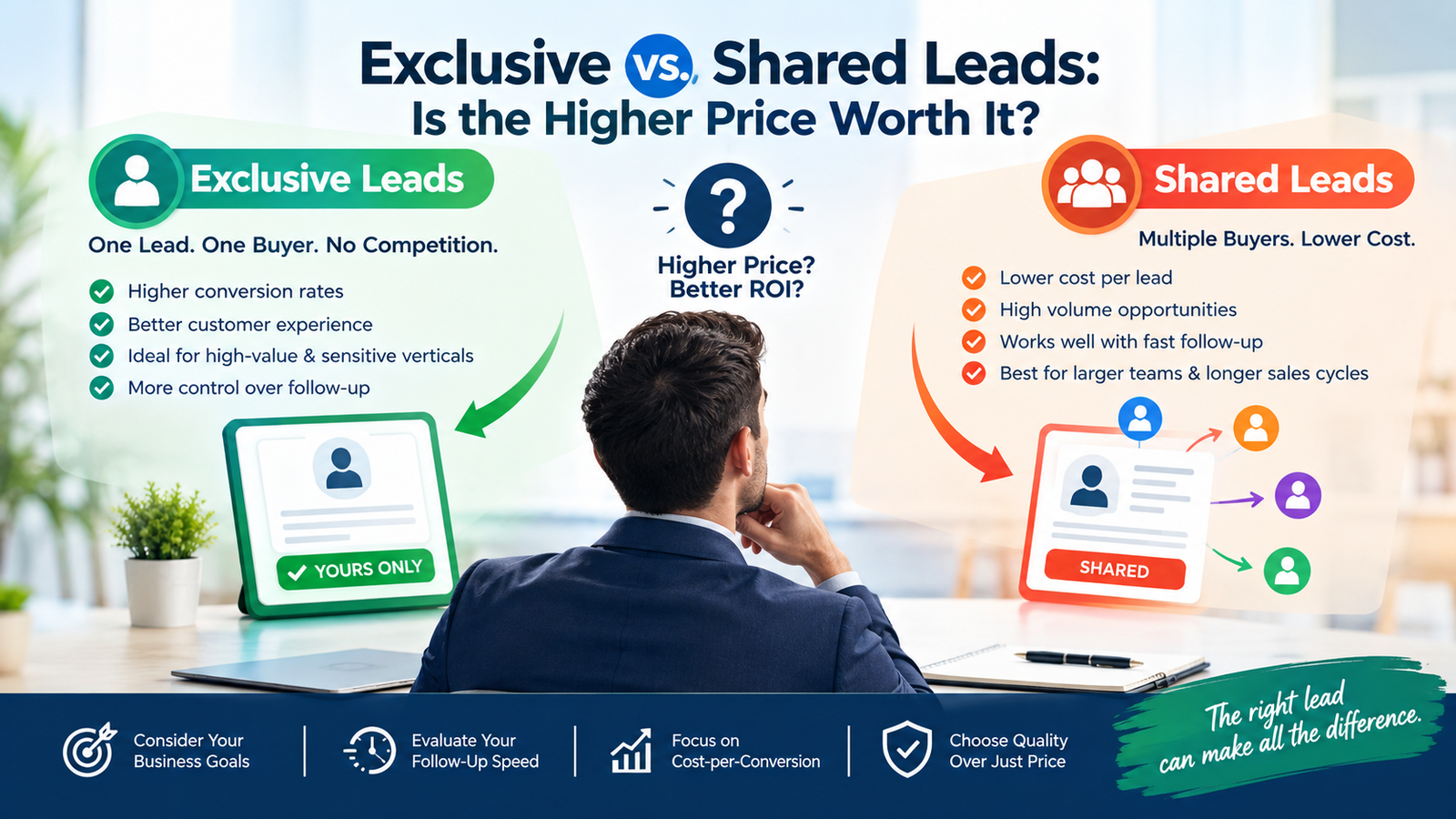
This is for the people among you who ever bought leads; those instances when you say to yourself, “Yes, I am right; this is all what you get,” as you go ahead and contact them only to find that they are already talking to two others, have already made their minds up, or hate being called at home.
The honest answer is that it depends on how you work, what vertical you are in, and how quickly your team follows up. The comparison between exclusive vs. shared leads is not simply a price question. It is a question about where your real losses are happening.
What Actually Separates These Two Lead Types
A shared lead gets distributed to multiple buyers at the same time, often through a ping-post system where the lead data is sold in real time to several competing agents or contractors simultaneously. Depending on the provider, that same lead might go to anywhere from two to five buyers at once, sometimes more.
An exclusive lead goes to one buyer only. No competition. The consumer filled out a form or initiated a call, and that inquiry routes directly to a single agent or contractor.
The price difference reflects that exclusivity. Exclusive leads are normally far more expensive on a per unit basis than shared leads within the same vertical market. The one thing that often gets overlooked here is what the difference in cost really buys.
The Hidden Cost of Shared Leads
Shared leads are not bad by definition. For high-volume operations with fast follow-up infrastructure, they can generate strong returns at lower cost per lead. But there are real costs that do not show up in the per-lead price.
Speed becomes everything. However, in case a lead is sent out to several potential buyers at once, the agent who reaches the buyer first enjoys an obvious edge. It is well known in sales studies that response rates fall dramatically after just a couple of minutes. If your operation cannot respond within that window, you’re often paying for a lead that another buyer already converted.
There is also the consumer experience to consider. The prospects who have talked to at least two other competitors before talking to you are not the same as prospects who have only entered their details and have not yet talked to anyone else. They have less patience and less willingness to talk.
When calculating exclusive leads vs. shared leads cost, the smarter comparison is not cost-per-lead. It is cost-per-conversion. An exclusive lead priced at three times the shared rate but converting at four times the rate is the better financial decision.


When Exclusive Leads Make the Most Sense
Certain situations favor exclusive leads strongly.
- High-sensitivity verticals. Final expense insurance is one such example. In these kinds of discussions, there is an issue of death planning, hence the emotional status of the prospect. For instance, if a consumer has been contacted by other agents prior to your own contact, then it becomes much less likely for there to be any productive discussion.
- Solo agents and small teams. If a single agent or a small shop is working a lead list, they cannot realistically compete on speed against a larger operation buying the same shared leads. Exclusive leads level the playing field by removing the speed race entirely.
- Verticals with high average deal value. In categories like roofing leads or HVAC leads, a single closed job can justify a substantially higher lead cost. When the margin per job is large, paying more for a lead that actually converts is straightforward math.
- Inbound call leads. A consumer who calls in is already in a different mindset than someone who filled out a form and moved on with their day. Exclusive inbound calls, such as auto insurance inbound calls, represent some of the highest-intent interactions available in lead generation. Sharing those calls with competitors would undercut much of their value.
When Shared Leads Can Still Work
Shared leads are not a compromise for buyers who cannot afford better. For the right operation, they are a deliberate volume strategy.
If there is a big agency or a call center that has a special team for following up, such an organization can process shared leads very effectively. In case there is the capability to reach out to every lead within minutes, then the speed issue is not much of an issue anymore.
Shared leads also work well when the sales cycle is longer and the first contact is not expected to close the deal. In some verticals, the initial call is about qualification, not conversion. In those cases, being one of several agents calling isn’t necessarily a problem.
The critical variable is always follow-up speed. A shared lead handled immediately outperforms an exclusive lead that sits in a queue for an hour.
What Lead Quality Actually Means Beyond Exclusivity
Exclusivity counts but is just one aspect of lead quality. Even if a lead is exclusive yet obtained from low intent traffic, incentive-based lead forms, or reused data, it isn’t a valuable lead no matter who else gets the lead.
The more important question is whether the consumer genuinely initiated contact. These leads, who have been gathered from the owned traffic sources that required active consumer input of information, would be different from leads collected using aggregators or purchased from bulk data providers. The compliance verification tools, such as TrustedForm and Jornaya, track the submission process for the consumer’s information, which is essential both for contacting quality and TCPA compliance.
For verticals like health insurance leads or life insurance leads, where regulatory context is significant and consumer intent is critical, the sourcing of the lead often matters as much as whether it is exclusive or shared.
A Practical Decision Framework
| Your Situation | Likely Better Fit | Key Reason |
| Solo agent, slower follow-up capacity | Exclusive leads | Removes speed competition entirely |
| Large team, sub-5-minute response time | Shared leads at volume | Lower cost per lead, high throughput |
| High-margin vertical (roofing, HVAC) | Exclusive leads | Single conversion justifies premium cost |
| Sensitive product (final expense, life) | Exclusive leads | Consumer experience affects conversion |
| Inbound call buyer | Exclusive by nature | Shared inbound calls lose most of their value |
The most common mistake buyers make is choosing based on per-lead cost without measuring cost-per-close. Tracking that number over a meaningful sample size, separately for exclusive and shared sources, will tell you more than any general comparison.
The Real Question to Ask Before Buying
Rather than choosing whether to make it exclusive or shared, the more important consideration should be what will happen to the lead once it is obtained. If it results in procrastination, missed phone calls, untimely entry into the CRM system, or other problems in following up, neither kind of lead will do well.
For those salespeople or contractors who are already familiar with follow-up procedures and want to get rid of the possibility of competition, exclusive leads, especially leads generated by consumers through incoming calls, would be the ideal way to go. For volume-based companies that need quick action, shared leads continue to work effectively as long as they confirm and act immediately.
Either way, the provenance of the lead is just as important as its exclusivity. The fact that an actual consumer raised their hand, on the record, for a legitimate reason is what distinguishes a lead worth buying from information that merely looks like one. Businesses looking for reliable lead generation solutions can explore Verified Consumer Leads to connect with potential customers.