AI in Pakistan’s IT Industry: 7 Powerful Ways It’s Fueling Remarkable Growth in 2026
AI in Pakistan's IT industry is driving record exports, new jobs, and global demand. Here's how the shift is unfolding in 2026.
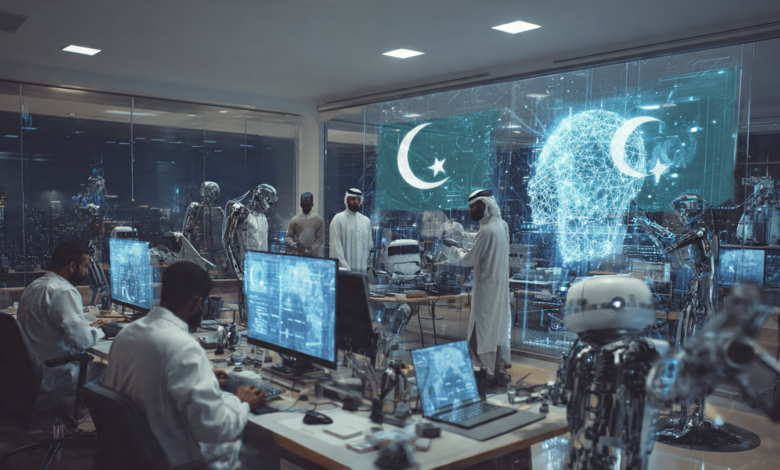
AI in Pakistan’s IT industry has stopped being a buzzword and turned into a measurable economic force. Over the past year, the country’s software houses, call centers, and freelance workforce have leaned into artificial intelligence tools not because it was trendy, but because clients started demanding it. The result shows up in the numbers: IT exports touched a record $4.6 billion in FY2025-26, freelancer remittances jumped 78%, and the government rolled out a National AI Policy backed by a billion-dollar investment plan.
This isn’t a story about a handful of Karachi startups experimenting with chatbots. It’s a broader shift across the entire tech ecosystem, from BPO firms in Lahore automating customer support, to freelancers in Islamabad using AI to deliver faster and higher-value work, to universities scrambling to update curricula that were designed for a pre-AI job market. Pakistan’s IT sector has always relied on cost-competitive labor to win global clients. Now it’s being pushed to compete on skill, speed, and specialization instead.
This article breaks down where AI is actually changing how Pakistani tech companies operate, what the government is doing to support that shift, the real obstacles standing in the way, and what the next few years are likely to look like for anyone working in or watching this space.
What’s Driving AI Adoption in Pakistan’s IT Industry
A few forces have converged at once to push AI adoption in Pakistan from experimental to mainstream.
- Global client demand. International companies outsourcing work to Pakistan increasingly expect AI-assisted delivery, whether that’s AI-powered customer support, automated QA testing, or data-driven development workflows. Firms that can’t offer this risk losing contracts to competitors in India, the Philippines, or Eastern Europe.
- Falling cost of AI tools. Cloud-based AI models and APIs have become cheap enough that even small and mid-sized Pakistani firms can integrate them without massive upfront investment.
- A young, English-speaking workforce. Pakistan has one of the youngest populations in the world, and a large share of that population is already comfortable with English-language tech tools and remote work platforms, which makes AI upskilling faster to roll out.
- Government policy alignment. The state has started treating AI in Pakistan’s IT sector as a national economic priority rather than a niche interest, which has unlocked funding, training programs, and infrastructure support.
- Freelance platform pressure. On platforms like Upwork and Fiverr, freelancers who use AI to speed up delivery or add new capabilities are winning more repeat business, which has created bottom-up demand for AI skills.
Together, these factors mean AI adoption isn’t being forced top-down by policy alone. It’s being pulled forward by market pressure, which tends to make it stick.
How AI Is Reshaping Pakistan’s IT Industry Today
This is where the shift is most visible. Pakistan’s IT industry touches several distinct sub-sectors, and AI is changing each one differently.
Software Development and Engineering
Pakistani software houses have started using AI coding assistants to speed up development cycles, catch bugs earlier, and cut down on repetitive work like writing boilerplate code or documentation. This has two effects worth noting:
- Junior developers are expected to produce more, faster, which raises the bar for entry-level hiring.
- Senior engineers are shifting toward higher-value work like AI system architecture, model fine-tuning, and integration projects, which pay significantly more than traditional custom software contracts.
Firms that have made this transition are increasingly bidding for AI consulting and implementation projects rather than just development-for-hire work, which carries thinner margins.
Business Process Outsourcing and Call Centers
The BPO and call center segment has arguably seen the fastest AI-driven transformation. Export earnings from this segment alone crossed $300 million in eleven months of FY2025-26, and industry voices point directly to AI-powered customer support tools as the reason. AI is being used for automated ticket routing, sentiment analysis during calls, real-time agent assistance, and multilingual chat support, which lets Pakistani BPO firms handle higher call volumes with the same headcount. You can read more on this trend in Business Recorder’s coverage of Pakistan’s AI-driven BPO growth.


Freelancing and Remote Work
Pakistan has one of the largest freelance workforces in the world, and AI has changed what “competitive” looks like on global platforms. Freelancers who once specialized narrowly in writing, design, or basic development are now expected to know how to use AI tools to deliver faster turnarounds and expanded service offerings. Freelancer remittances rose sharply in FY2025-26, with industry watchers attributing much of that growth to AI-adjacent work commanding higher rates per project.
Cybersecurity and Data Services
As Pakistani firms take on more sensitive outsourcing work, particularly for clients in finance, healthcare, and government-adjacent sectors, demand for AI-driven threat detection, fraud monitoring, and data analytics has grown. This is a smaller but fast-growing niche within the broader AI in Pakistan’s IT industry story, and it tends to pay better than generic development work because it requires specialized skills that are still in short supply locally.
Fintech and Digital Payments
Pakistan’s fintech sector has started applying AI for credit scoring, fraud detection, and personalized financial products, particularly as digital banking and mobile wallets expand access to previously unbanked populations. This is still an early-stage segment, but it’s one of the areas where AI could have the most direct impact on ordinary Pakistanis, not just export revenue.
Government Policy Supporting AI in Pakistan’s IT Sector
None of this growth happened in a vacuum. The government has put real policy weight behind AI adoption in Pakistan, and it’s worth breaking down what’s actually on the table.
- National AI Policy 2025. This policy framework aims to accelerate AI adoption, research, and skills development across key economic sectors including agriculture, healthcare, finance, and infrastructure.
- $1 billion AI investment commitment. The government has committed to investing roughly a billion dollars in AI research and sovereign computing initiatives through 2030.
- AI Centers of Excellence. New AI research and training centers have been established, including facilities in Haripur and at NUST, aimed at building local research capacity rather than relying purely on imported expertise.
- Mass training targets. Under national programs, the government has set a goal of training around 200,000 people annually in AI-related skills, working toward roughly one million trained professionals by 2030, supported by a growing base of certified trainers.
- Uraan Pakistan export target. The government’s broader Uraan Pakistan initiative has set an ambitious goal of pushing IT exports to $10 billion by FY2029, a target that depends heavily on Pakistani firms moving up the value chain through AI and specialized services rather than competing purely on labor cost, as detailed in PakTribune’s report on Pakistan’s IT export ambitions.
- Regulatory sandboxes and sovereignty principles. Pakistan has also floated the idea of an “Islamabad AI Declaration,” emphasizing that AI development should be sovereign, auditable, and subject to human accountability rather than unregulated.
Bodies like the Pakistan Software Export Board (PSEB) and Ignite have also rolled out AI-specific training programs, incubation support for startups, and tax incentives for exporters, all aimed at making it easier for local firms to actually use these policies rather than just read about them.
Challenges Facing AI Adoption in Pakistan’s IT Industry
It would be misleading to present this shift as a smooth success story. There are real structural problems that could slow down or cap how far AI in Pakistan’s IT industry can go.
The Skills Gap
Despite rising IT exports, much of that growth has come from volume rather than value, meaning Pakistan is doing more work rather than higher-paid work. A significant part of the reason is a mismatch between what universities teach and what the AI-driven job market actually needs. Many computer science and software engineering programs still emphasize traditional development skills over applied AI, data science, and machine learning, leaving graduates underprepared for the roles clients are now asking for.
Infrastructure Limitations
Reliable, affordable computing power and internet connectivity are not evenly distributed across the country. AI workloads, particularly anything involving model training or large-scale data processing, need infrastructure that’s still concentrated in a handful of major cities. Frequent internet disruptions and inconsistent power supply in some regions remain a real operational risk for firms trying to scale AI-driven services.
Underinvestment Relative to Ambition
Government spending commitments sound significant on paper, but analysts have pointed out that a billion dollars spread across a decade and multiple sectors is modest compared to what regional competitors are investing. Without matching grants, tax-neutral sandboxes, and stronger private-sector co-investment, there’s a real risk that policy ambition outpaces actual funding on the ground.
Global Competition
Pakistan isn’t the only country trying to reposition its IT sector around AI. India, the Philippines, Vietnam, and several Eastern European countries are making similar pushes, often with larger existing tech ecosystems and more mature AI research infrastructure. Pakistan’s edge has traditionally been cost; sustaining that edge while also competing on AI sophistication will require sustained investment, not just policy announcements.
Talent Retention
Skilled AI professionals in Pakistan are highly mobile, and many are recruited by international firms offering remote salaries far above local market rates, or they emigrate entirely. Retaining top AI talent domestically, so that the benefits of training investment actually stay in the local economy, remains an unresolved challenge.
The Future of AI in Pakistan’s IT Industry
Looking ahead, a few trends seem likely to define the next phase of AI in Pakistan’s IT industry:
- Higher-value specialization. Expect Pakistani firms to keep shifting away from generic outsourcing toward AI consulting, implementation, and managed services, which carry better margins.
- Sector-specific AI applications. Healthcare, agriculture, and financial services are likely to see more localized AI tools built specifically for Pakistani markets rather than adapted foreign products.
- Growth in AI hubs and incubators. New AI hubs are being set up to incubate startups, which should widen the base of companies working on AI beyond the current handful of well-known names.
- Continued freelancer growth. Given the scale of Pakistan’s freelance workforce, AI-assisted freelance work is likely to keep growing as a share of total IT export revenue.
- Regional partnerships. Pakistan’s involvement in international AI cooperation frameworks, including recently joining a China-led intergovernmental AI organization, signals a push to access external expertise, infrastructure, and training resources rather than build everything domestically from scratch, a shift covered in The Express Tribune’s report on Pakistan’s AI ambitions.
Whether Pakistan hits its $10 billion IT export target by FY2029 will likely come down to execution rather than ambition. The policy framework, training targets, and market demand are all pointing in the same direction. What’s less certain is whether the skills gap can close fast enough, and whether investment keeps pace with the goals the government has set.
Conclusion
AI in Pakistan’s IT industry is no longer a future possibility; it’s already reshaping how software is built, how call centers operate, how freelancers compete globally, and how the government thinks about economic growth. Record IT exports, rising freelancer earnings, and a dedicated national AI policy all point to a sector in genuine transition, moving from labor-cost competitiveness toward skill-based, AI-driven value.
At the same time, real challenges around education, infrastructure, funding, and talent retention stand between where the industry is today and where its most ambitious targets say it should be by the end of the decade. For anyone working in or watching Pakistan’s tech sector, the direction is clear even if the pace of change is still being written.