AI in Agriculture: How Pakistani Farmers Can Benefit from Smart Technology
AI in agriculture is helping Pakistani farmers cut water waste, fight pests early, and raise yields through affordable smart tools.
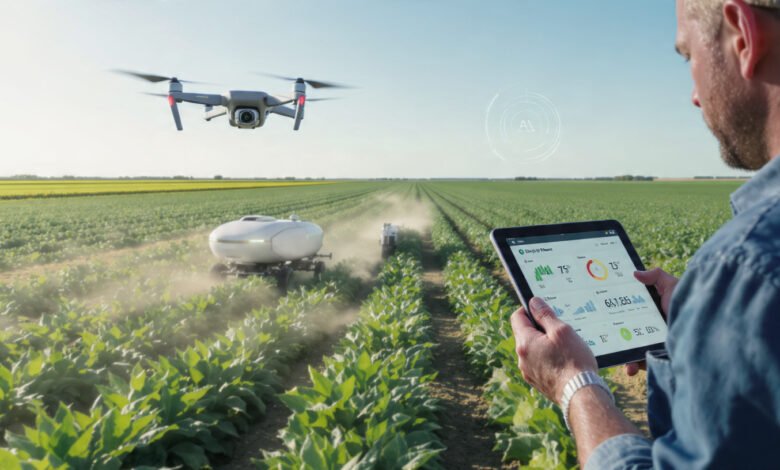
AI in agriculture is no longer a distant idea for Pakistan. It’s showing up in wheat fields in Punjab, orchards in Balochistan, and rice paddies in Sindh, often through nothing more than a smartphone app or a soil sensor buried a few inches underground. For a country where more than 60 percent of the rural population depends directly or indirectly on farming, that shift matters enormously.
Pakistan’s agriculture sector has spent decades facing the same three problems: unpredictable water supply, rising input costs, and limited access to expert advice. A farmer in a remote district often can’t just call an agronomist when his cotton crop starts showing strange spots. He has to guess, ask a neighbor, or wait for a government extension worker who may not show up for weeks. By then, the damage is often done.
That’s exactly where smart technology is starting to change the equation. AI-powered tools can now look at a photo of a diseased leaf and identify the problem within seconds. Soil sensors can tell a farmer precisely how much water his field needs instead of leaving him to guess. Weather models can warn of a heatwave or flood days before it hits. None of this is science fiction anymore, it’s already being piloted, and in some cases scaled, across the country.
This article breaks down how AI in agriculture is actually playing out in Pakistan right now, what tools and platforms are available, what the government and international partners are doing, and what farmers need to know before jumping in.
Why Pakistani Agriculture Needs Smart Technology Now
Pakistan’s farming sector isn’t struggling because of a lack of effort. It’s struggling because of structural pressure that’s been building for years.
- Water scarcity: Pakistan is one of the most water-stressed countries in the world, and its irrigation system, built decades ago, wastes a huge share of the water that flows through it.
- Climate volatility: Heatwaves, erratic monsoons, and glacial melt patterns are making planting and harvest windows harder to predict every season.
- Rising input costs: Fertilizer, pesticide, and diesel prices have climbed faster than crop prices in many years, squeezing already thin margins.
- Limited extension services: There simply aren’t enough trained agronomists to reach every village, especially in remote districts of Balochistan, interior Sindh, and southern Punjab.
Experts speaking at the 19th Agri Asia Conference in Lahore this year pointed out that AI, drones, and smart irrigation could play a genuinely transformative role in improving water efficiency and strengthening climate resilience across the sector. That’s not a small claim. Pakistan’s agriculture contributes close to a quarter of national GDP and employs a huge share of the workforce, so even modest efficiency gains translate into real income for millions of families.
What “AI in Agriculture” Actually Looks Like on the Ground
The phrase artificial intelligence in farming sounds abstract until you see the specific tools it refers to. Here’s what’s already available or being piloted in Pakistan.
1. AI-Powered Crop Monitoring
Universities and research centers, including LUMS’s Center for Water Informatics and Technology, have built AI-powered crop monitoring platforms that combine drone imagery and satellite data to track plant health across large fields. These systems flag stressed or underperforming areas of a farm long before the naked eye would catch a problem, giving farmers a chance to intervene early rather than after a yield loss has already happened.
2. Smart Irrigation and Soil Sensors
Water waste is arguably Pakistan’s biggest agricultural problem, and it’s also where smart technology is having the clearest impact. Soil moisture sensors and digital canal gauges now feed real-time data to farmers and irrigation departments, allowing water to be released only where and when it’s actually needed. Some smart agriculture platforms report that this kind of precision irrigation can cut water use by up to 60 percent while also reducing input costs by close to 30 percent, a meaningful number in a country where canal water is often rationed by turn rather than by need.


3. AI Chatbots and Mobile Advisory Tools
This is probably the fastest-growing category, because it doesn’t require any new hardware, just a basic smartphone. AI-powered mobile advisory agents let farmers type or speak a question in Urdu or a regional language, such as “when should I sow maize” or “how much urea should I apply to wheat,” and get an instant, region-specific answer based on crop stage, soil type, and local weather. For farmers with limited literacy, voice-based interaction removes a barrier that written manuals and SMS services never solved.
4. Disease and Pest Detection Through Image Recognition
A farmer can now photograph an affected leaf or fruit with a phone camera, and an AI system analyzes the image within seconds to identify the disease, pest, or nutrient deficiency causing the problem. This kind of early detection is a genuine game-changer for crops like cotton and rice, where pest outbreaks can wipe out a season’s income if they’re caught late.
5. Drones and Robotic Equipment
Autonomous tractors and agricultural drones are moving from demonstration fields into limited commercial use. Drones handle tasks like targeted pesticide spraying and aerial field mapping, while AI-guided equipment is being tested for planting and weeding, work that’s traditionally been labor-intensive and expensive to hire out.
6. AI-Based Weather and Climate Forecasting
Localized weather models, some built through international collaboration, are giving farmers earlier warnings about heatwaves, floods, and unseasonal rain. That extra lead time, even a few days, can be the difference between saving a crop and losing it.
7. Digital Supply Chain and Market Access Tools
Beyond the field itself, AI is being applied to agricultural supply chains, helping connect smallholder farmers directly to buyers and reducing the number of middlemen who typically take a cut of the final sale price. Research published in Scientific Reports found that AI-driven digitalization of agricultural supply chains has real potential to reduce rural poverty in Pakistan, though the study also flagged that farmer trust in unfamiliar technology and inconsistent rural connectivity remain genuine obstacles to wider adoption.
Government and International Backing for Smart Farming in Pakistan
Smart farming in Pakistan isn’t happening in isolation. There’s a growing amount of institutional support behind it.
- The Ministry of National Food Security and Research has proposed a Rs. 990 million project, officially called the Establishment of Digital and Precision Agriculture Mechanisation Facility, to be based at the National Agricultural Research Centre in Islamabad. It’s set to run from mid-2026 through mid-2031 and aims to support small-scale farmers, local machinery producers, and agricultural SMEs with modern precision farming equipment.
- China and Pakistan have jointly launched a Belt and Road smart agriculture laboratory focused on AI-powered farming and green intelligent technology for arid regions, with training programs planned for young researchers from partner countries.
- Pakistani officials have also expressed interest in deeper AI partnerships with China around practical applications like autonomous tractors and AI-based weather forecasting, following exchanges at international AI conferences.
- Organizations including the Punjab Irrigation Department, the Agriculture Department, and the FAO are already using AI-powered irrigation and crop monitoring tools developed by local research institutions.
This kind of backing matters because precision agriculture technology is expensive to develop from scratch. When universities, government departments, and international partners share the cost of building and testing these tools, individual farmers get access to solutions they’d never be able to afford on their own.
Real Benefits Pakistani Farmers Can Expect
It’s worth being specific about what farmers actually stand to gain, because “AI in agriculture” can sound like a vague promise if it’s not tied to concrete outcomes.
- Lower water bills and less waste, through irrigation that responds to actual soil conditions rather than a fixed schedule
- Higher yields, with some smart agriculture platforms reporting increases of 10 to 15 percent where precision farming and IoT sensors have been adopted
- Earlier pest and disease detection, cutting the crop losses that come from catching a problem too late
- Reduced dependence on expensive private consultants, since AI advisory chatbots offer free or low-cost guidance in local languages
- Better market prices, as digital supply chain tools cut out unnecessary middlemen
- Stronger climate resilience, with earlier warnings for heatwaves, floods, and erratic rainfall
None of these benefits require a farmer to overhaul his entire operation overnight. Most of these tools can be adopted incrementally, starting with something as simple as a free crop-disease identification app.
Challenges Standing in the Way
It would be misleading to present AI in agriculture as a problem-free solution. There are real barriers, and being upfront about them matters more than glossing over them.
- Connectivity gaps: Many remote farming regions still lack the reliable internet access that IoT sensors and cloud-based platforms depend on.
- Trust and awareness: Farmers who’ve spent decades relying on traditional knowledge are understandably cautious about handing decisions to an algorithm, especially without a track record they can see for themselves.
- Upfront costs: Even when the long-term savings are real, sensors, drones, and connected equipment carry an initial price tag that many smallholders can’t absorb without financing support.
- Digital literacy: Voice-based tools help, but training and outreach are still needed to get farmers comfortable with new interfaces.
- Fragmented rollout: Much of what’s happening right now is pilot projects and university partnerships rather than a single, unified national platform, which can make it harder for an individual farmer to know where to start.
Addressing these barriers is going to take a mix of subsidized financing, farmer training programs, and continued investment in rural connectivity, not just better algorithms.
How a Farmer Can Start Using Smart Technology Today
For a farmer who wants to get started without waiting for a large government rollout, there are a few practical entry points already available:
- Download a crop-disease identification app and use it the next time a plant shows unusual symptoms, most work off a single photo.
- Ask about soil testing and moisture monitoring services offered through local agriculture departments or university extension programs.
- Follow weather advisory services from FAO-backed or provincial agriculture department platforms for earlier storm and heat warnings.
- Explore financing options for smart irrigation equipment through provincial agriculture support schemes, since several are being expanded alongside the federal precision agriculture project.
- Connect with local research institutions, such as agricultural universities, that often run pilot programs looking for farmers to test new tools in real conditions.
None of these require a large upfront investment, and they give a farmer a realistic sense of what these tools can and can’t do before committing to bigger changes.
The Road Ahead for Smart Agriculture in Pakistan
The direction is fairly clear at this point. Between the federal government’s precision agriculture facility, the China-Pakistan smart agriculture laboratory, and the steady stream of AI advisory tools coming out of local universities, smart technology is moving from research labs into working farms faster than it has at any previous point. The global smart agriculture market itself is projected to keep growing sharply over the next several years, and Pakistan’s combination of water stress and a large agricultural workforce actually makes it a natural place for these tools to prove their value.
The bigger question isn’t whether the technology works, the evidence so far suggests it does. The real question is how quickly it can reach the farmers who need it most: smallholders in remote districts with limited connectivity and even less access to financing. That will depend less on the sophistication of the AI models themselves and more on the training, subsidies, and infrastructure that get built around them.
For a deeper look at how AI-powered advisory tools are already reaching Pakistani farmers, Business Recorder’s coverage of AI’s role in reshaping Pakistani agriculture breaks down several real examples in detail. And for the research side of things, the Scientific Reports study on AI-driven digitalization of agricultural supply chains offers a useful look at both the poverty-reduction potential and the adoption barriers involved.
Conclusion
AI in agriculture is steadily reshaping how Pakistani farmers manage water, detect crop disease, access expert advice, and reach buyers, and the shift is being driven by a combination of university research, government investment, and international partnerships rather than any single silver-bullet technology. The tools already exist: smart irrigation sensors that cut water waste, AI chatbots that answer farming questions in local languages, image recognition apps that catch pest outbreaks early, and digital supply chains that connect smallholders directly to markets.
What remains is closing the gap between pilot projects and nationwide access, particularly for farmers in remote and underserved regions who stand to gain the most but currently have the least exposure to these tools. As connectivity improves and financing support expands, smart farming in Pakistan is positioned to move from a promising experiment to a standard part of how the country grows its food.