Digital Pakistan Initiative What’s Actually Changed So Far
The Digital Pakistan Initiative since 2019: real changes in internet access, payments, IDs and exports, plus the shutdowns, scams and leaks that still hurt.
Digital Pakistan Initiative 2026: 10 Real Changes, Proven Wins and Painful Gaps Since 2019
Introduction
The Digital Pakistan Initiative was launched in December 2019 with big promises: internet access for everyone, paperless government, and a tech economy driven by young people. Nearly seven years later, it’s fair to ask a simple question. What has actually changed for an ordinary Pakistani?
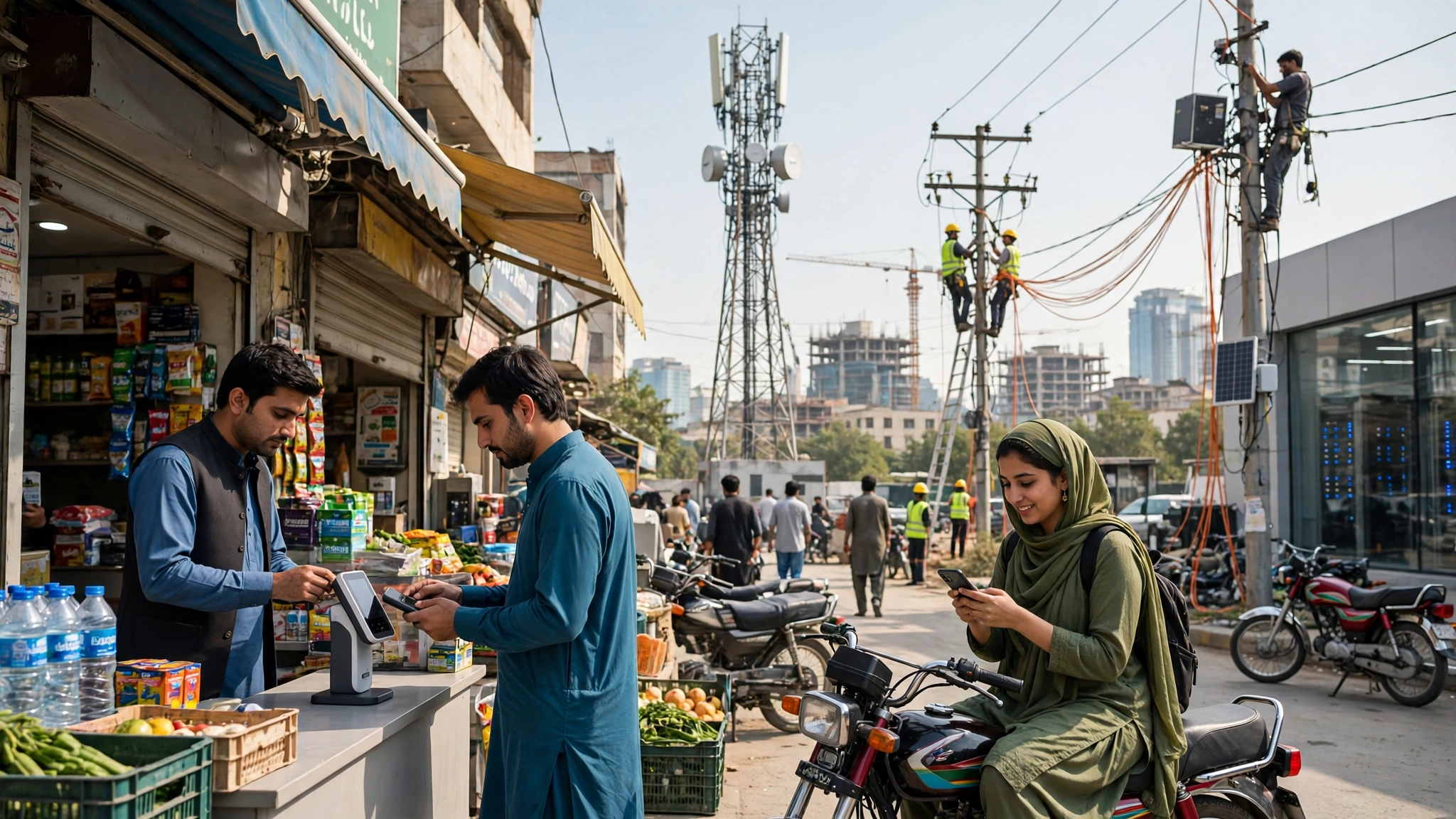
The honest answer is: a lot, but not evenly. A shopkeeper in Faisalabad today can take payment through Raast for free. A student in Swat can renew her ID card on her phone. A freelancer in Multan earns dollars that now show up in national export figures. None of that was common in 2019.
Other things have barely moved. Pakistan’s internet is still among the slowest in the world. Tens of millions of people remain offline. The state has repeatedly switched off mobile data and blocked platforms. Identity records were stolen from NADRA and sold abroad. Organised scam networks have operated from office buildings in Islamabad and Karachi. And a new cybercrime law has raised serious free-speech concerns.
This article skips the speeches and looks at the record. It compares where Pakistan stood in 2019 with where it stands in late 2026, using official figures and independent checks. It covers ten areas where the Digital Pakistan Initiative has produced visible change, the illegal activities that undercut it, and the gaps that matter most for the next phase.
What Was the Digital Pakistan Initiative Supposed to Do?
The Digital Pakistan Initiative began under the PTI government. At its launch, Tania Aidrus, who left Google to lead it, set out five pillars: access and connectivity, digital infrastructure, digital skills and literacy, e-government, and innovation and entrepreneurship. Prime Minister Imran Khan said the government would focus on digitisation to curb corruption, introduce digital payments and ease public dealings with the state.
After the change of government, the PML-N-led coalition carried the agenda forward under the name “Digital Nation Pakistan.” The policy survived a change of government, which is unusual in Pakistan. The real test, though, is outcomes, not slogans.
10 Real Changes Under the Digital Pakistan Initiative
1. Far More People Are Connected
The clearest change under the Digital Pakistan Initiative is access. According to the Economic Survey 2025-26, broadband penetration has nearly doubled from 32.6 percent in 2019, reaching 64.2 percent by March 2026. By July 2026, MoITT data showed 166.12 million broadband subscribers and penetration of 65.79 percent.
Coverage has spread too. Cellular mobile services now cover 92 percent of the population, and 3G and 4G signals reach more than 81 percent of the country’s area.
Reality check: Subscriptions are not the same as people. One person can hold several SIMs. When the IT minister told a parliamentary committee in July 2026 that 97 percent of Pakistanis use broadband, TechJuice pointed out that the Kepios Digital 2026 report puts Pakistan’s actual internet penetration at just 45.6 percent, which leaves around 139 million people offline. Both numbers can be “true” at the same time, but the second one tells you more about real lives.

The connection type matters as well. Of the 166.12 million broadband subscribers, 161.71 million use mobile broadband and only 4.41 million have fixed connections. Pakistan is online mostly through phones, which affects how well people can work, study and run businesses.
2. Internet Speed Is Still a Weak Spot
More people are online, but the experience is often poor. The Digital Pakistan Initiative hasn’t fixed speed. In late 2024, Ookla ranked Pakistan 100th out of 111 countries for mobile internet and 141st out of 158 for fixed broadband. By September 2025, Pakistan was 98th for mobile, with average download speeds of about 25 Mbps, against a global mobile average of around 60 Mbps.
The biggest structural step was the long-delayed 5G auction. In March 2026, the government sold 480 MHz of spectrum for $507 million, against a target of 597 MHz. That should help over time, but most users won’t feel the difference until networks are built out and devices become affordable.
3. Payments Moved From Cash to Phones
This is where the Digital Pakistan Initiative has changed daily life the most. The State Bank’s Raast instant payment system, launched in 2021, is now everywhere. In January to March 2026 alone, Raast processed 742.1 million transactions worth Rs23.3 trillion. Crucially, Raast person-to-person and person-to-merchant payments are required to stay free for consumers.
Merchants are joining too. More than 2.6 million merchants had registered for Raast P2M by the end of March 2026. Overall, digital channels handled 92 percent of retail transactions in that quarter. You can check the data yourself in the State Bank of Pakistan’s Payment Systems Quarterly Review.
Reality check: The SBP’s 92 percent figure only covers formal channels. The review leaves out cash transactions that happen outside the banking system, which is still a huge share of the economy.
4. Identity Services Went Mobile
In 2019, renewing a CNIC almost always meant a trip to a NADRA office. Today, NADRA’s Pak ID app has more than 10 million downloads and received over 1.2 million applications in three months. NADRA says the digital identity in the app now has the same legal status as the physical document. This is one of the most practical results of the Digital Pakistan Initiative for ordinary people.
5. Tax Filing Got Simpler and More People File
Online filing and simplified forms are bringing more people into the system. The FBR received a record 5.9 million tax returns for tax year 2025, up from 5 million the year before. The prime minister credited simplified procedures, Urdu-language forms for salaried individuals and automated clearance systems.
6. Land Records Moved Out of the Patwari’s Register
Land fraud has ruined families for generations. Punjab’s Land Record Management Information System computerised the province’s entire record of 55 million acres, and Dawn reported that the powers of the much-feared patwari had been clipped. A new Punjab law goes further. Land transfers will be fully digitised through e-registration, with patwaris limited to inheritance-related transfers.
Reality check: Gaps remain. In 2026, parts of South Punjab, including Rajanpur, Dera Ghazi Khan, Mianwali and Bhakkar, still forced citizens to make repeated visits to land record centres and revenue offices.
7. Citizens Got a Direct Complaint Channel
The Pakistan Citizen Portal, launched in 2018, is one of the longest-running pieces of the wider Digital Pakistan Initiative. It has received 6,052,791 complaints, of which 5,974,343 are marked resolved. But ProPakistani noted that the claimed 98.7 percent resolution rate reflects case closure more than citizen satisfaction, with 1,837,005 feedback entries still unresolved. The channel is real progress. The numbers deserve scepticism.
8. Tech Exports and Freelancing Took Off
For young Pakistanis, this may be the most important change. IT and telecom exports reached a record $4.6 billion in FY2025-26, up from $3.814 billion the year before, though still short of the $5 billion target. Freelancers earned more than $1 billion in export earnings for the first time in that year.
That money reaches places that big factories never did: small towns, homes and university hostels. It is a concrete payoff from wider internet access.
9. Digital Policy Now Has a Legal Framework
In 2019, the Digital Pakistan Initiative was a policy vision with no specific law behind it. In January 2025, Parliament passed the Digital Nation Pakistan Act. It creates a National Digital Commission chaired by the Prime Minister, a Pakistan Digital Authority, and an Oversight Committee. You can read the full text of the Digital Nation Pakistan Act 2025 on the National Assembly website.
There’s a detail that’s easy to miss. President Zardari signed the controversial PECA amendment bill on the same day as the Digital Nation Pakistan Bill. The law that builds the digital state and the law that polices online speech arrived together.
10. More Phones Are Made at Home
Heavy import duties pushed manufacturers to assemble phones locally. The Economic Survey reported that 161.6 million mobile handsets were manufactured locally. That has created jobs and made basic smartphones cheaper, although high taxes still keep good devices out of reach for many families.
What Hasn’t Changed: Illegal Activities That Undermined the Digital Pakistan Initiative
A fair review of the Digital Pakistan Initiative has to include the damage done by crime, insider corruption and state policies that work against it.
Identity Data Stolen and Sold
The digital state depends on NADRA. A joint investigation team confirmed that the personal information of 2.7 million Pakistanis was stolen from NADRA’s database, and the data was sent to Dubai and sold in Argentina and Romania. Investigators blamed senior officials’ negligence.
Insider fraud has also continued. In one FIA case, NADRA employees issued Pakistani CNICs to nationals and foreigners for bribes of Rs8,000 to Rs200,000. In 2026, the FIA arrested four NADRA employees at a Charsadda centre over illegally issuing CNICs to foreign nationals. Digitising a system doesn’t help much if the people running it can be bought.
Scam Call Centres Operating in Plain Sight
Better connectivity also brought organised cybercrime. In July 2025, the NCCIA arrested 149 people, including 48 Chinese nationals, in a Faisalabad call centre allegedly involved in Ponzi schemes and investment fraud. In Karachi, the agency broke up an “international cartel” behind $60 million in cyber fraud and recovered 10,000 international SIMs. These networks harm victims abroad and damage the reputation of Pakistan’s legitimate IT industry.
Welfare Money Skimmed Through Biometric Devices
Digital welfare payments were supposed to cut out middlemen. Instead, some agents found new ways to steal. In Layyah, police arrested a gang that changed device locations digitally to avoid detection while skimming BISP payments. In 2026, beneficiaries told Dawn that agents were deducting Rs1,500 to Rs2,000 from their payments.
Tampered Phones and Stolen Identities
The PTA’s device registration system has been abused as well. In Gujranwala, raids found premium phones with their original IMEIs reprogrammed to match cheaper models. PTA says such phones make untraceable communication possible for cybercrime, financial fraud and abduction.
Internet Shutdowns: The State Working Against Its Own Plan
The most expensive setbacks came from government decisions. Pakistan topped the world with $1.62 billion in losses from internet and social media shutdowns in 2024. The shutdown of X from February 18 that year was the costliest single disruption, with an estimated impact of $1.34 billion. The government cites security and misinformation as reasons. Industry groups and rights advocates argue that blanket shutdowns hurt honest earners far more than bad actors.
PECA 2025: Fighting Fake News or Restricting Speech?
The 2025 changes to the Prevention of Electronic Crimes Act added Section 26(A), with tough penalties for spreading “fake news” online. The law sets a maximum of three years in jail and fines of up to Rs2 million for intentionally sharing false information.
The government’s case is that fake news, harassment, pornography, child abuse and national security threats have spread on digital platforms. Critics, including journalist unions, worry that the law’s vague wording could be used against dissenting voices rather than disinformation. Even journalists who support regulation have said they want more precise and balanced legislation. The debate goes to the heart of the Digital Pakistan Initiative, because a digital society needs both protection from abuse and confidence that people can speak freely.
Before and After: A Quick Comparison
| Area | Around 2019 | Late 2026 |
|---|---|---|
| Broadband penetration | 32.6% | About 64–66% |
| Digital retail payments | Mostly cash | 92% of formal retail transactions |
| IT and telecom exports | Under $3.8bn (FY25 base) | $4.6bn (FY26) |
| Tax returns filed | About 5m (TY2024) | 5.9m (TY2025) |
| 5G | None | Spectrum sold March 2026 |
| Mobile internet speed rank | Near the bottom | Still near the bottom |
| Shutdowns and platform bans | Occasional | Frequent, costly |
The first column mixes 2019 figures with the most recent earlier figures available. The sources are cited in the sections above.
What Needs to Happen Next
The next phase of the Digital Pakistan Initiative should focus less on new targets and more on trust and reach:
- Count people, not SIMs. Report independent internet usage figures alongside subscription numbers.
- Pass a strong data protection law with an independent regulator and penalties for officials who mishandle records.
- Set clear legal limits on internet shutdowns, including court oversight and time limits.
- Narrow PECA’s definitions so the law targets real harm without chilling legitimate speech.
- Clean up insider corruption at NADRA and in payment agent networks with regular audits.
- Cut taxes on devices and data so the 139 million people offline can actually join.
- Finish what’s half-built, especially land records in remote districts and fixed broadband in smaller cities.
Conclusion
The Digital Pakistan Initiative has changed more than its critics admit and less than its champions claim. Since 2019, broadband penetration has roughly doubled, Raast has made free instant payments normal, CNIC renewal and tax filing have moved onto phones, land records have slipped out of the patwari’s control in much of Punjab, IT exports have hit a record $4.6 billion with freelancers earning over $1 billion, 5G spectrum has finally been sold, and the Digital Nation Pakistan Act has given the effort a legal footing. Internet speeds remain among the world’s slowest, though, and independent estimates suggest well over half the population is still offline. Stolen NADRA records, bribe-for-CNIC schemes, scam call centres, BISP skimming and tampered phones show that digitisation alone doesn’t stop crime. Repeated shutdowns and the vague “fake news” provisions in PECA 2025 raise hard questions about trust and freedom online. The next stage will be judged less by announcements and more by whether the state can protect data, keep the internet on, respect citizens’ rights and bring the unconnected majority into the digital economy.