Generative AI in Pakistani Universities: 5 Powerful Rules Reshaping 2026 Classrooms
Generative AI in Pakistani universities is now regulated by HEC policy, mandatory courses, and campus rules shaping honest learning in 2026.
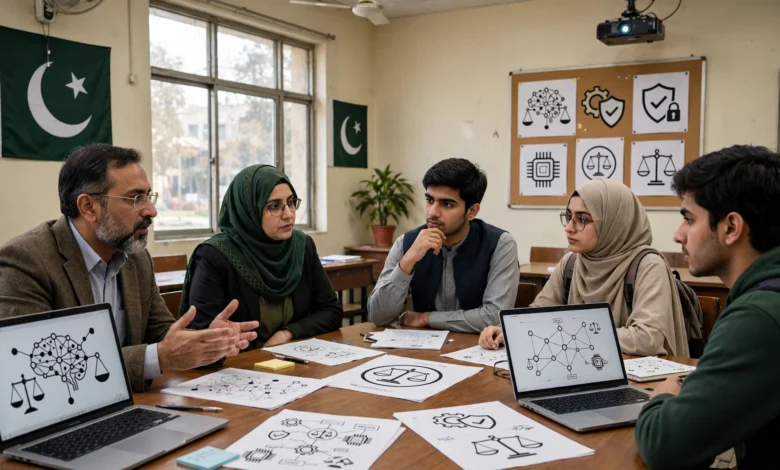
Walk into any university library in Lahore, Karachi, or Islamabad this year and you’ll notice something different. Students aren’t just cracking open textbooks. Many have ChatGPT, Claude, or Gemini open in another tab, using it to summarize readings, draft outlines, or check their code. Generative AI in Pakistani universities has gone from a quiet workaround to an official part of the academic conversation, and 2026 is the year institutions stopped pretending it wasn’t happening.
For years, professors and administrators treated AI tools the way they treated any other shortcut: as a plagiarism risk to catch and punish. That approach didn’t work particularly well, and it also missed the bigger picture. Employers now expect graduates to know how to use these tools responsibly, not avoid them entirely. So the conversation has shifted from “how do we stop this” to “how do we regulate this properly.”
This year, the Higher Education Commission (HEC) rolled out its clearest policy signals yet, universities from LUMS to NUST have started writing their own classroom rules, and faculty across the country are being asked to teach a subject many of them are still learning themselves. This article walks through exactly what’s changed, what the rules actually say, where the gaps remain, and what students and teachers need to know before the Fall 2026 semester begins.
What “Regulating Generative AI” Actually Means in Pakistan Right Now
Before getting into the specifics, it helps to be clear about what regulation looks like on the ground. It isn’t a single law. It’s a patchwork of national guidance, institutional policy, and classroom-level rules that vary from department to department.
In practice, AI regulation in higher education in Pakistan currently rests on three layers:
- National guidance from HEC, which sets broad expectations for every public and private university in the country.
- Institutional policy, where individual universities like LUMS, NUST, and public-sector institutions write their own honor codes, course syllabi language, and disciplinary procedures.
- Instructor discretion, where individual faculty members decide, often on their own, whether AI tools are allowed for a given assignment and how that use should be disclosed.
That third layer is still the messiest part of the system, and it’s where most of the confusion for students comes from. A tool that’s perfectly fine to use in one class can get you a plagiarism referral in another, sometimes at the same university.
The HEC’s National Framework and Mandatory AI Course
The biggest policy shift this year came directly from the HEC. During its 47th commission meeting, chaired by HEC Chairman Dr. Niaz Ahmad Akhtar, the commission granted in-principle approval to a national framework for the responsible use of generative artificial intelligence in higher education institutions, and returned the draft for further refinement before final notification. Alongside that framework, the commission confirmed a much more concrete and immediate change: a mandatory AI course for every degree program in the country.
The Mandatory Three-Credit AI Course
Starting Fall 2026, every public and private university in Pakistan is required to include a three-credit-hour Artificial Intelligence course in undergraduate and postgraduate degree programs, regardless of discipline. This isn’t limited to computer science or engineering students. A student majoring in literature, sociology, or business will take this course just like a student in a technical field.
Universities have some flexibility in how they deliver it. According to HEC’s own guidance, the course can be offered as:


- A standalone compulsory subject
- An interdisciplinary module woven into an existing course
- A supporting subject tailored to a specific field of study
The intended curriculum covers foundational AI concepts, practical applications relevant to different sectors, and, importantly, ethical considerations including data privacy, fairness, transparency, and accountability. HEC has described this less as an optional add-on and more as a baseline expectation for graduates entering an AI-influenced job market, similar in spirit to how digital literacy became a basic requirement over the past two decades. You can review the official policy details directly on the Higher Education Commission of Pakistan’s website.
The National Generative AI Framework for Higher Education
Separate from the mandatory course, HEC’s broader framework is meant to give universities a shared reference point for generative AI policy across the sector, covering things like acceptable use in coursework, disclosure requirements for AI-assisted work, and guardrails for research integrity. Because the draft was sent back to the HEC Secretariat for revisions, universities are currently operating in a transition period. Many institutions are drafting interim rules based on the framework’s general direction rather than waiting for the final text, which is part of why campus policies still look so different from one university to the next.
How Individual Universities Are Writing Their Own Rules
While HEC sets the national tone, the day-to-day experience of a student or faculty member depends heavily on their specific institution. A few patterns have emerged among Pakistan’s leading universities.
LUMS and the “Assistive Tool, Not a Crutch” Approach
Lahore University of Management Sciences was one of the earlier movers on this topic, hosting a faculty and student panel discussion specifically on what ChatGPT means for higher education. The conclusion from that discussion has more or less become the working philosophy at many Pakistani universities since: AI should function as an assistive tool for learning, not as a substitute for a student’s own thinking or research process. You can read more about how LUMS approached this discussion directly on the university’s site.
That framing shows up in how LUMS and similar institutions structure their plagiarism policies. Using AI to brainstorm, check grammar, or clarify a concept is generally treated differently from submitting AI-generated text as original work without disclosure. The distinction sounds simple, but enforcing it consistently across departments has proven harder in practice.
NUST, Public Sector Universities, and Emerging Guidelines
Public-sector universities and technical institutions like NUST have taken a somewhat more cautious, compliance-driven approach, largely because they’re directly bound by HEC directives as government-regulated institutions. Departments in engineering and computer science have generally been quicker to formalize rules around AI tool usage because their faculty are more familiar with the technology, while humanities and social science departments in some public universities are still working out case-by-case guidance.
A few common threads show up across most institutions regulating this space in 2026:
- Disclosure requirements for any AI-assisted content submitted for grading
- Course-specific permissions, where instructors explicitly state whether tools are allowed, restricted, or banned for a given assignment
- Faculty training sessions, often informal, to help instructors recognize AI-generated writing patterns
- Updated academic integrity clauses in student handbooks that now name generative AI specifically, rather than relying on older plagiarism language
Academic Integrity in the Age of ChatGPT and Similar Tools
Academic integrity is where most of the friction actually plays out, and it’s worth understanding why the old tools and old rules don’t map cleanly onto generative AI.
Why Turnitin and Traditional Plagiarism Checkers Fall Short
Traditional plagiarism detection software works by comparing a submission against a database of existing text and flagging matches. That method assumes the copied content already exists somewhere online or in a prior submission. Generative AI breaks that assumption, because a tool like ChatGPT can produce text that has never existed before, which means it won’t trigger a similarity match in the way copied text would.
This is a genuine, documented limitation. Research on AI detection tools in Pakistani higher education has found that while tools like Turnitin and iThenticate improve general awareness of academic integrity and do deter some unethical behavior, institutions still lean too heavily on machine-generated similarity reports and don’t pair them with enough training on how to interpret those results correctly. In other words, the software catches copy-paste plagiarism reasonably well, but it was never built to catch AI-generated writing, and treating it as if it can creates a false sense of security for both instructors and students.
HEC’s Anti-Plagiarism Policy and Where Generative AI Fits
HEC has already updated its own guidance to address this gap directly. Its anti-plagiarism policy explicitly addresses the use of ChatGPT and similar tools, stating that using AI-generated text without proper attribution counts as plagiarism, while also clarifying that researchers may use AI to help understand basic concepts as long as it doesn’t replace the core work of analysis, interpretation, and drawing conclusions. The policy places responsibility squarely on the author, meaning a student or researcher can’t shift blame to the tool if the final submission lacks proper credit or oversight. Full details are available in HEC’s official anti-plagiarism policy document.
This is a meaningful clarification for students who’ve been unsure where the line sits. Using AI as a research aid, similar to using a search engine or a study group, is treated differently from submitting AI output as your own unattributed work.
The Faculty Training Gap Nobody Talks About
Here’s the part of this story that gets less attention but matters just as much as any written policy: many faculty members are being asked to teach and enforce rules around a technology they haven’t been properly trained to use themselves.
Commentary on HEC’s rollout has pointed out a real structural problem. The AI curriculum mandate arrived without a corresponding, well-resourced program to train the faculty who now have to deliver it. Senior professors, respected in their own fields, are sometimes seen doing little more than pasting a research question into a chatbot and lightly editing the output, without necessarily understanding the tool’s limitations or how to model responsible use for their students. This isn’t a criticism of individual instructors so much as a sign that the rollout moved faster on paper than it did in preparation.
For Pakistani universities’ AI policies to actually work, faculty development can’t be an afterthought. A few things that would help close this gap:
- Structured, discipline-specific training rather than generic one-size-fits-all workshops
- Clear internal guidelines instructors can point to when deciding what counts as acceptable AI use in their own courses
- Regular updates as the tools themselves keep changing, since a policy written around 2023-era ChatGPT doesn’t necessarily hold up against 2026-era models
- Peer support networks so newer faculty aren’t figuring this out entirely alone
What Students Need to Know Before Fall 2026
If you’re a student trying to stay on the right side of these evolving rules, a few practical habits go a long way:
- Read the syllabus for every course, not just one. AI permissions can differ by instructor even within the same department.
- Ask before assuming. If a syllabus doesn’t mention AI tools at all, don’t guess; email the instructor directly.
- Disclose AI assistance when required. A short note on how you used a tool for brainstorming or editing is far better than silence if the policy calls for it.
- Treat AI output as a draft, not a final answer. Fact-check anything a chatbot gives you, especially citations, statistics, or historical claims, since these tools can generate confident-sounding errors.
- Take the mandatory AI course seriously. It’s not just a box to tick; the ethical and practical content is directly relevant to how you’ll be expected to use these tools professionally.
Challenges Ahead: Infrastructure, Equity, and Enforcement
Even with a national framework taking shape, a handful of practical challenges remain unresolved.
Access isn’t equal. Students at well-resourced private universities often have institutional subscriptions to premium AI tools, reliable internet, and updated devices. Students at smaller public universities, particularly in less-connected regions, don’t always have the same access, which raises fairness questions about a mandatory course that assumes a baseline level of digital access.
Enforcement is inconsistent. Without a unified national policy yet finalized, disciplinary outcomes for the same kind of AI misuse can look very different depending on which university or even which department a student belongs to.
The technology keeps moving. Any policy written this year risks looking outdated within a year or two as new models and tools emerge. Universities that build flexibility and regular review cycles into their policies will likely handle this better than those that treat their current rules as a finished product.
Detection tools remain imperfect. As covered above, current plagiarism software wasn’t designed for this problem, and universities that rely on it as their primary line of defense are likely to keep missing cases while occasionally flagging innocent students unfairly.
None of these challenges are unique to Pakistan. Universities around the world are working through very similar questions. What’s specific to Pakistan’s situation is the speed of the rollout, moving from voluntary guidance to a mandatory national course in a relatively short window, which puts real pressure on institutions to catch up on training and infrastructure at the same pace.
Conclusion
Generative AI in Pakistani universities has moved well past the experimental phase and into formal policy territory, driven largely by HEC’s mandatory AI course and its developing national framework, alongside individual rules set by institutions like LUMS and NUST. The direction is clear: AI is being treated as a tool students need to learn to use responsibly rather than something to simply ban or ignore. What’s still being worked out is the harder part, closing the faculty training gap, building fair enforcement across very different institutions, and making sure detection methods actually match the technology they’re meant to catch. Students heading into Fall 2026 will find a system that’s more organized than it was even a year ago, but still very much a work in progress, which makes reading your syllabus and asking questions more important than ever.