How to Import Products From China to Sell in Pakistan
Import products from China to Pakistan legally with steps on suppliers, payment, customs duties and real smuggling cases that cost traders dearly.
Import Products From China to Pakistan
Introduction
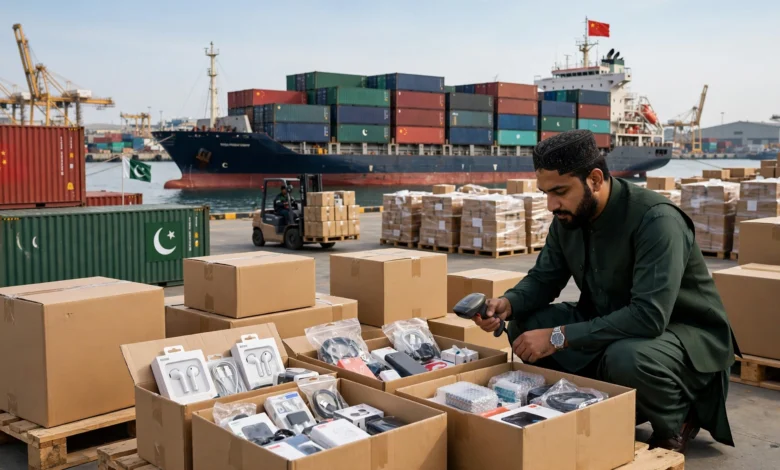
If you want to import products from China to Pakistan and sell them for a profit, you are joining one of the busiest trade routes in the country. China is Pakistan’s largest source of imports by a wide margin. Mobile accessories, kitchen gadgets, solar panels, LED lights, toys, garments, machinery parts, and almost everything sold in Karachi’s Saddar or Lahore’s Hall Road started its journey in a Chinese factory.
The opportunity is real. Factory prices in China are often a fraction of local wholesale prices, and online platforms have made it easy to contact suppliers from your phone. Many Pakistani traders have built solid businesses this way, starting with a single carton and growing into full containers.
But the import trade also has a dark side that most YouTube guides skip. For years, under-invoicing, misdeclaration of goods, smuggling through the Afghan transit route, and informal “door-to-door cargo” deals have cost the country billions of rupees in lost taxes and hurt honest traders who pay full duty. New importers sometimes get pulled into these practices without realising how risky they are.
This guide explains the full process step by step: registering as an importer, finding reliable suppliers, paying safely, shipping, clearing customs, and calculating your real landed cost. It also covers real cases of import fraud from the past, so you can build a business that lasts and stays on the right side of the law.
Why Traders Import Products From China to Pakistan
Pakistan imported goods worth about $16.3 billion from China in fiscal year 2025, up from $13.5 billion the year before, making China the top source of imports by far. Behind those numbers are thousands of small and medium traders, not just big industrial buyers.
The main reasons China dominates
- Low factory prices: Large-scale production means lower unit costs than most local manufacturers can match.
- Huge product range: From phone cases to industrial pumps, there is a supplier for almost everything.
- Flexible order sizes: Many suppliers accept small trial orders, especially on wholesale platforms.
- Trade agreement: The China-Pakistan Free Trade Agreement reduces customs duty on many tariff lines, though not all.
- Fast shipping: Sea freight from southern Chinese ports to Karachi usually takes a few weeks, and air cargo takes days.
The realities new importers face
The picture is not all easy profit. Before you place your first order, understand these challenges:
- Duties and taxes are high. Customs duty, additional customs duty, regulatory duty on some items, sales tax, and advance income tax can add a large percentage on top of the product price.
- Exchange rate risk. You pay in dollars or yuan but sell in rupees. A sudden fall in the rupee can wipe out your margin.
- Quality problems. Photos online can look perfect while the actual goods are poor. Without samples and inspections, you may receive unusable stock.
- Competition. Popular products on Daraz and Facebook are often imported by dozens of sellers, so prices get pushed down fast.
- Rules for specific products. Mobile phones, cosmetics, medicines, food items, and electrical goods often need extra approvals or registrations.
- Unfair competition from smugglers. Goods that enter illegally without duties can sell cheaper than yours, which is frustrating but not a reason to copy them.
If you go in with realistic expectations, importing can be profitable. If you go in expecting overnight riches, you are more likely to lose money or get trapped by a dishonest agent.
How to Import Products From China to Pakistan: 9 Proven Steps
The process looks complicated from the outside, but it follows a clear order. Here is how most small and medium importers do it legally.
Step 1: Register your business and get an NTN
You need a National Tax Number (NTN) from the FBR before you can import commercially. A sole proprietorship is enough to start, though many importers later register a company with the SECP. Make sure you are on the Active Taxpayers List, since non-filers face higher advance tax at import.

Step 2: Register on the Pakistan Single Window
Import documentation, including goods declarations and electronic import forms, is now handled through the Pakistan Single Window (PSW). You register as a trader with your NTN, CNIC, and bank details. Your customs clearing agent will also work through this system on your behalf.
Step 3: Check whether your product is allowed
Not everything can be imported freely. The Ministry of Commerce’s Import Policy Order lists banned items, restricted items, and products that need special conditions. Common examples that need extra care:
- Mobile phones, which must be registered with the PTA
- Cosmetics and skincare, which may need compliance with PSQCA standards
- Medicines, medical devices, and supplements, which fall under DRAP
- Food items, which need health and labelling compliance
- Used goods, weapons-related items, and certain chemicals, which are restricted or banned
Step 4: Research the product and your margins
Before contacting suppliers, check local market prices on Daraz, Facebook Marketplace, and wholesale markets. Find the product’s HS code in the FBR’s customs tariff to estimate duties. A product that sells for Rs 2,000 locally is only worth importing if your full landed cost is well below that, leaving room for platform fees, delivery, returns, and profit.
Step 5: Find reliable Chinese suppliers
The most common sourcing channels are:
- Alibaba: The main English-language B2B platform. Look for verified suppliers and Trade Assurance.
- Made-in-China and Global Sources: Similar B2B marketplaces with many manufacturers.
- 1688.com: China’s domestic wholesale site, often cheaper but in Chinese, so many buyers use a sourcing agent.
- Trade fairs: The Canton Fair in Guangzhou and the Yiwu market are popular with Pakistani traders who can travel.
- Sourcing agents: Useful for small buyers, but choose one with a track record and clear written terms.
Check how long the supplier has been operating, whether they are a factory or a trading company, and ask for business licence details.
Step 6: Order samples and agree on quality terms
Never skip samples. Order from two or three suppliers, compare quality, and put your agreed specifications in writing: material, size, colour, packaging, labelling, and acceptable defect rate. For larger orders, a pre-shipment inspection by a third-party company is worth the cost.
Step 7: Pay through legal banking channels
Pay your supplier through your bank account, not through hawala, hundi, or someone’s personal wallet. Depending on the order size and State Bank rules, common methods include advance payment by bank transfer and a letter of credit (LC) for bigger shipments. Your bank will link the payment to an electronic import form on PSW. Keep invoices, contracts, and payment proofs for every order.
Step 8: Choose shipping and Incoterms
- Sea freight LCL (less than container load): Your goods share a container with others. Good for small orders.
- Sea freight FCL (full container load): You book a whole 20 or 40 foot container. Cheaper per unit for large orders.
- Air freight: Fast but expensive. Best for light, high-value, or urgent goods.
Agree on Incoterms with your supplier, such as FOB (supplier delivers to the Chinese port) or CIF (supplier pays freight and insurance to Karachi). Get freight quotes from licensed forwarders.
Step 9: Clear customs and receive your goods
When goods arrive at Karachi Port, Port Qasim, or an airport, your licensed customs clearing agent files a goods declaration on PSW with the correct HS code, value, and documents. Customs may assess the value, examine the goods physically, and then calculate duties and taxes. Once you pay, the goods are released and transported to your warehouse.
Honest, accurate declarations at this stage protect you from penalties, seizures, and delays later.
Import Duty in Pakistan: Calculating Your Real Landed Cost
The biggest mistake new importers make is comparing the Chinese factory price with the Pakistani selling price and assuming the difference is profit. Your real cost is the landed cost: the product price plus freight, insurance, duties, taxes, and local charges.
The main duties and taxes at import
- Customs duty (CD): Set by HS code, often reduced under the China FTA for eligible goods.
- Additional customs duty (ACD): An extra percentage on many tariff lines.
- Regulatory duty (RD): Applied to certain products, often luxury or non-essential items.
- Sales tax: Charged on the value plus duties.
- Value addition tax: An extra sales tax charge for commercial importers who resell goods.
- Advance income tax: Collected at import, with higher rates for non-filers.
Rates change with every budget, so always confirm current rates for your exact HS code in the FBR’s customs tariff or with your clearing agent.
A worked example
The numbers below are illustrative only, using assumed rates and an exchange rate of Rs 280 per dollar. They show how costs stack up, not what you will actually pay.
Imagine you import 500 units of a kitchen gadget at $2 each, FOB.
| Cost item | Basis | Amount (Rs) |
|---|---|---|
| Product value | $1,000 | 280,000 |
| Freight and insurance | $150 | 42,000 |
| CIF value paid | $1,150 | 322,000 |
| Customs duty (assumed 20%) | On assessed value incl. 1% landing charge | 65,044 |
| Additional customs duty (assumed 2%) | On assessed value | 6,504 |
| Sales tax (18%) | On value plus duties | 71,418 |
| Value addition tax (assumed 3%) | On value plus duties | 11,903 |
| Advance income tax (assumed 6%) | On value plus duties and taxes | 28,805 |
| Clearing agent, port charges, local transport | Estimate | 25,000 |
| Total landed cost | 500 units | 530,674 |
That works out to about Rs 1,061 per unit, almost double the factory price of Rs 560 per unit. If similar products sell for Rs 1,200 on Daraz, after platform commission, delivery, and returns, there may be little or no profit left. If they sell for Rs 2,000, the business looks much healthier.
Registered sales tax payers may be able to adjust part of the sales tax paid at import against later sales, and advance income tax is adjustable against final tax liability. Speak to a tax adviser to understand what applies to you.
Illegal Import Practices and Real Cases to Learn From
The high duties in the example above explain why some traders cut corners. But the history of Pakistan’s import trade shows that these shortcuts eventually catch up with people, and they hurt every honest importer along the way.
Under-invoicing of Chinese imports
Under-invoicing means declaring a lower value to customs than what you actually paid, so you pay less duty and tax. The difference is usually settled through hawala or hundi. For years, Pakistan’s recorded imports from China were far lower than the exports China reported to Pakistan. In 2018, customs authorities estimated that imports from China were undervalued by at least $4 billion a year, with Pakistani records showing around $10 billion while Chinese figures put it closer to $14 billion, according to The Express Tribune.
To close this gap, Pakistan and China launched an Electronic Data Exchange system in 2019, allowing the FBR to compare Chinese export data with Pakistani import declarations. This means customs can now spot mismatches far more easily than before. An importer who under-declares today is taking a much bigger risk than a decade ago.
The missing Afghan transit containers scam
Goods meant for Afghanistan can pass through Pakistan without paying Pakistani duties under transit trade rules. Between 2007 and 2010, this facility was abused on a massive scale. The FBR later identified 28,802 commercial Afghan transit containers and 3,542 NATO and ISAF containers whose border crossing could not be confirmed, meaning the goods had likely been sold inside Pakistan. As Business Recorder reported, the FBR handed cases to the National Accountability Bureau for criminal proceedings against customs officials, clearing agents, importers, and others. The revenue loss from the commercial containers alone was estimated at around Rs 55 billion.
The Supreme Court took notice of the scandal, and the law was later amended so that pilferage of transit goods is treated as smuggling under the Customs Act. Local traders who bought these cheap goods also faced unfair competition for years.
Misdeclaration of goods
Some importers declare goods under a different, lower-duty HS code, for example declaring finished products as parts or raw materials, or listing branded items as generic. Customs regularly catches these cases during examination or post-clearance audits. Penalties can include fines, confiscation of goods, and in serious cases, criminal proceedings.
Risky “door-to-door cargo” deals
Many small buyers use cargo services that promise “all-inclusive” delivery from China to your doorstep at a fixed rate per kilo. Some of these are legitimate consolidators. Others group many buyers’ goods under one name with under-declared values. If that consignment is caught, the goods can be seized, and you have no import documents in your name to prove ownership or claim anything back. Before using such a service, ask exactly how goods are declared and whose name appears on the goods declaration.
Smuggled phones and counterfeit goods
Mobile phones that enter without proper duty and PTA registration get blocked on Pakistani networks through the PTA’s device registration system, leaving buyers with useless handsets. Similarly, importing fake branded products, from shoes to electronics, can lead to seizures and intellectual property cases. Selling them also damages your reputation with customers.
Paying through hawala and hundi
Informal money transfer channels are often used to settle under-invoiced amounts. Beyond being illegal, they leave you with no payment proof, no protection if a supplier disappears, and possible exposure in money laundering investigations.
The honest importer’s rules
- Declare the true value and correct HS code.
- Pay suppliers only through your bank.
- Keep complete records: contracts, invoices, packing lists, bills of lading, and payment proofs.
- Use licensed clearing agents and forwarders.
- Stay away from goods that need approvals you do not have.
Selling Imported Chinese Products in Pakistan the Right Way
Getting goods through customs is only half the job. How you sell them decides whether the import turns into a business.
Pick products that are easy to import and sell
For a first import, choose products that are:
- Light and compact, so freight costs stay low
- Not regulated, avoiding phones, cosmetics, medicines, food, and anything needing special approval
- Hard to break, reducing damage and returns
- Not dominated by big brands, so you are not competing with counterfeits or established players
- Priced in the middle, typically products that sell for a few thousand rupees, where margins can cover all costs
Popular starting categories include home organisation items, kitchen tools, car accessories, fitness gear, stationery, and phone accessories that do not require PTA approval.
Where to sell
- Daraz: The largest marketplace in Pakistan, with built-in traffic but commission and fee costs.
- Your own website: More control and higher margins, but you must bring your own traffic.
- Facebook and Instagram: Good for niche products and building a brand.
- WhatsApp Business: Useful for repeat customers and wholesale buyers.
- Wholesale markets: Selling in bulk to shopkeepers gives faster cash turnover at lower margins.
Build trust with honest selling
- Use real photos of your own stock, not only supplier images.
- Describe materials, sizes, and limitations honestly.
- Offer a clear return or exchange policy.
- Do not call products “original” or “branded” if they are not.
- Issue proper invoices and keep sales records for tax purposes.
Practical tips from experienced importers
- Start small. Test the market with a trial order before committing to a full container.
- Build a relationship with one or two good suppliers. Reliable suppliers are worth more than the cheapest price.
- Watch the exchange rate. Price your products with a buffer for currency movements.
- Join trade groups and chambers. Other importers share supplier warnings, freight rates, and customs updates.
- Reinvest profits carefully. Many importers grow too fast and get stuck with unsold stock and no cash.
Conclusion
Learning how to import products from China to Pakistan can open the door to a profitable trading business, but only if you treat it as a real business rather than a shortcut. The legal path is clear: register for an NTN and on the Pakistan Single Window, check the Import Policy Order for restrictions, research products and margins, source carefully through verified suppliers and samples, pay only through banks, choose the right shipping method, and clear customs with accurate declarations through a licensed agent. Always calculate your full landed cost, because duties and taxes can nearly double the factory price. The history of under-invoicing, the missing Afghan transit containers, misdeclared goods, risky cargo deals, smuggled phones, and hawala payments shows that cheating the system costs the country billions and often ends in seizures, penalties, or prosecution for those involved. Importers who stay honest, start small, and build strong supplier relationships are the ones still in business years later.