How to Build Customer Trust as a New Online Seller in Pakistan
Build customer trust online in Pakistan with honest listings, clear returns and fast delivery. Practical steps and fraud lessons for new online sellers.
Build Customer Trust Online in Pakistan: 9 Proven Tips for Successful New Sellers
Introduction
If you want to build customer trust online in Pakistan, you start with a handicap that has nothing to do with you. Your buyer has probably been burned before. Maybe they ordered a lawn suit from an Instagram page and got cheap fabric in a different colour. Maybe they paid advance through JazzCash for a phone that never arrived. Maybe a friend told them about the page that disappeared after collecting payments from hundreds of people.
That history is why so many Pakistani shoppers still insist on cash on delivery, ask for “real pictures” in the DMs, and read every comment before ordering. It is not stubbornness. It is self-protection.
For a new online seller in Pakistan, this creates a real challenge. You have no reviews, no brand name and no track record. Bigger stores can absorb returns and fake orders. You probably cannot. Yet trust is the only thing that turns a one-time buyer into a repeat customer who tells their family about you.
The good news is that trust can be built on purpose, and honesty is a competitive advantage in a market full of shortcuts. This guide explains why trust is so low in Pakistani e-commerce, what we can learn from past scams and legal cases, and nine practical ways new sellers can earn buyers’ confidence, keep it, and grow a business that lasts.
Why E-Commerce Trust in Pakistan Is So Low
Before you can build customer trust online, it helps to understand where the distrust comes from. E-commerce trust in Pakistan has been shaped by years of bad experiences, and buyers bring all of them to your page.
The “what I ordered vs what I got” problem
This phrase has become a running joke on Pakistani social media, but it reflects real anger. Sellers post studio photos, sometimes stolen from foreign brands, and deliver something cheaper, smaller or a different colour. Once a buyer has been through this a few times, every new seller is guilty until proven innocent.
Advance payment fraud
Many scams start with “please send advance, only then we dispatch”. After payment through a mobile wallet or bank transfer, the page blocks the buyer or vanishes. This is why cash on delivery still dominates Pakistani online shopping, even as digital payments grow.
Weak return and refund culture
Many small sellers either have no return policy or write one they do not honour. Buyers who try to return a faulty item get ignored, blocked or told “no return on sale items” after the fact.
Fake reviews and paid followers
Bought followers, fake comments and recycled testimonials are common. Savvy buyers now check whether comments look real, whether the page is new, and whether the follower count matches engagement.


Delivery and courier issues
Late deliveries, damaged parcels and couriers who mark orders “delivered” when they were not all reduce trust, even when the seller did nothing wrong. To the buyer, your brand owns the whole experience.
Why this is an opportunity
In a market where many sellers cut corners, the seller who is consistently honest stands out quickly. Pakistani buyers are loyal to sellers who treat them fairly, and they talk about those sellers in family WhatsApp groups. That word of mouth is worth more than any paid ad.
Lessons from Past Online Scams in Pakistan
Looking at real cases helps new sellers understand exactly what buyers fear, and what kind of behaviour ends with a business shut down or an owner arrested.
Saqiscity: when unpaid refunds become a criminal case
Saqiscity was a Pakistani e-commerce store that drew a wave of complaints about failed orders and refunds that never came. Even after the site went offline, angry customers kept posting. As TechJuice reported, the FIA eventually arrested the store’s owner.
The lesson: a store does not have to start as a scam to end up treated like one. Taking orders you cannot fulfil, and then ignoring refund requests, can cross the line from bad service into fraud. If you cannot deliver, refund quickly and say so honestly.
Fake parcel, prize and “verification” scams
Scammers regularly pose as courier companies, banks or online stores to trick people into sharing OTPs or paying fake “parcel clearance” charges. In July 2026, Dawn reported that the National Cyber Crime Investigation Agency arrested 14 suspects in Lahore and Multan, including some who cheated citizens through fake prizes, gifts, bank verification and parcel clearance tricks.
The lesson for honest sellers: buyers have been trained to fear unexpected calls and payment requests. Never ask customers for OTPs, PINs or passwords, and keep your payment instructions consistent and in writing.
Copycat pages using stolen photos
A common pattern is a page that copies photos from a well-known brand or another seller, then ships low-quality copies. Using someone else’s photos without permission can breach copyright, and selling copies as originals can amount to trademark infringement and deceptive marketing. The Competition Commission of Pakistan can act against misleading marketing under the Competition Act, and brand owners can take legal action too.
Investment and “earn online” schemes posing as e-commerce
Some schemes dress up as online stores or digital marketing companies but actually make money from new members’ deposits. The FIA has raided several of these in Karachi and Lahore. Their collapse made many Pakistanis suspicious of any online business asking for money upfront.
What these cases teach new sellers
- Buyers fear advance payments, so give them safe ways to pay.
- Buyers fear fake photos, so show real ones.
- Buyers fear being ignored after paying, so respond fast and keep your word.
- Regulators and police are more active than before, so shortcuts carry real legal risk.
9 Proven Ways to Build Customer Trust Online as a New Seller
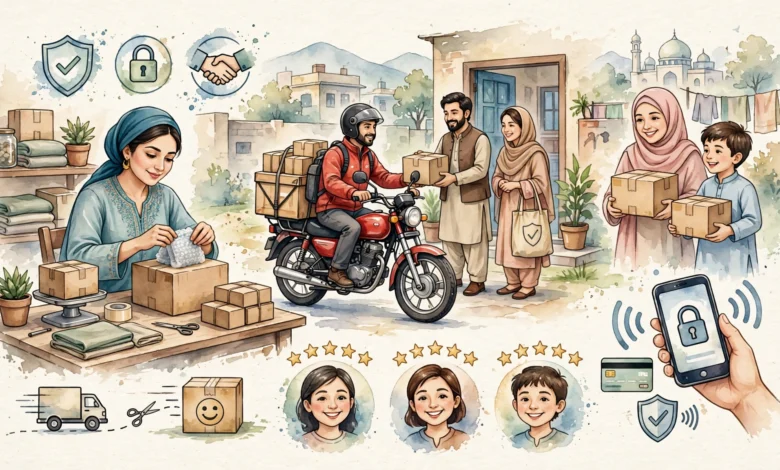
These tips work whether you sell on Daraz, run an Instagram store, take orders on WhatsApp, or have your own website. None of them need a big budget. They need consistency.
1. Show real photos and honest descriptions
The fastest way to build customer trust online is to make sure the product that arrives matches the product on the screen.
- Take your own photos in natural light, on a plain background.
- Add a short video showing fabric texture, size or the product in use.
- Mention exact measurements, material, weight and colour differences.
- Write clearly when something is a copy, inspired design or non-branded item.
If a lawn suit’s colour looks slightly different in daylight, say so. Buyers forgive small differences they were warned about. They do not forgive surprises.
2. Offer cash on delivery, then earn digital payments
For a new seller, refusing cash on delivery often means losing the sale. Offer COD from day one, even if it means dealing with some fake orders. Over time, encourage digital payments with a small discount or faster dispatch, but never force them.
To reduce fake COD orders:
- Confirm each order by call or WhatsApp before dispatch.
- Ask for a small delivery charge in advance only from repeat no-shows, and explain why.
- Keep a simple list of numbers that repeatedly refuse parcels.
3. Write a clear return and refund policy, and honour it
A visible, simple return policy tells buyers you stand behind your products.
A good policy states:
- How many days the buyer has to request a return
- Which items can and cannot be returned, and why
- Who pays return delivery charges
- How and how fast refunds are paid
Then follow it every time, even when it costs you. One honoured refund often brings back a loyal customer.
4. Respond fast and stay reachable
Many Pakistani buyers message before ordering, and they read silence as a warning sign. Use WhatsApp Business with quick replies, a catalogue and business hours. Aim to reply within a few hours. Share a working phone number and, if possible, a physical address or city of operation.
5. Collect real customer reviews
Customer reviews are social proof, but only if they are real.
- After delivery, ask buyers for feedback with a photo.
- Share screenshots of real messages, with names hidden for privacy.
- Reply politely to negative reviews and explain how you fixed the problem.
- Never buy fake reviews or followers. Buyers spot them, and platforms penalise them.
A few honest reviews, including one or two mixed ones, look more trustworthy than a wall of five-star praise.
6. Use reliable couriers and share tracking
Choose an established courier service and share the delivery tracking number with every order. Pack products securely, especially glass, electronics and cosmetics. If a parcel is delayed, message the buyer before they ask.
7. Register your business and be transparent about who you are
An anonymous page with no name, number or location feels risky. Show who is behind the store.
- Add an “About us” section with your name or brand story.
- Get an NTN and, as you grow, register your business formally.
- If you sell on Daraz or other marketplaces, keep your seller profile complete and verified.
Registration also protects you, because it gives you access to business bank accounts, payment gateways and formal courier contracts.
8. Price fairly and avoid fake “sale” tricks
Inflating a price and then showing a “70% off” tag is common, and buyers increasingly see through it. It can also count as misleading marketing. Set honest prices, run real discounts occasionally, and explain what makes your product worth its price.
9. Protect customer data
Buyers share names, phone numbers and home addresses with you. Treat that information with care.
- Do not share order lists in public groups or with third parties.
- Do not add customers to marketing groups without permission.
- Never ask for CNIC copies, OTPs or bank logins.
Respecting privacy is part of being an honest online seller in Pakistan, and it is a growing legal expectation too.
Common Mistakes That Destroy Trust Quickly
Even honest sellers can lose buyers’ confidence through careless habits. Avoid these:
- Deleting negative comments instead of answering them
- Going silent after payment or when a problem comes up
- Changing prices in DMs depending on who asks
- Overpromising delivery times you cannot control
- Copying another brand’s photos or name to look bigger
- Blocking buyers who ask for refunds
Each of these feels small in the moment. Online, one screenshot can undo months of good work.
Frequently Asked Questions
How long does it take to build customer trust online in Pakistan?
Most new sellers start seeing repeat orders and referrals within three to six months of consistent, honest service. There is no shortcut. Each order delivered as promised adds to your reputation.
Should a new seller accept only advance payment?
It is usually a mistake. Many Pakistani buyers will not pay in advance to an unknown seller. Offer cash on delivery, confirm orders before dispatch, and introduce digital payment options gradually.
Are fake reviews illegal in Pakistan?
Fake reviews and misleading claims can count as deceptive marketing, which the Competition Commission can act against. Platforms such as Daraz and Meta also remove fake reviews and can suspend sellers who use them.
What should I do if a customer falsely claims a wrong product?
Ask politely for photos or an unboxing video, check your packing records, and respond calmly. Keeping your own packing photos or videos for each order protects both you and honest buyers.
Conclusion
To build customer trust online in Pakistan, a new seller has to work against years of bad buyer experiences shaped by misleading photos, advance payment fraud, ignored refunds and fake reviews, and cases like Saqiscity, fake parcel clearance scams and copycat pages show how quickly dishonest shortcuts turn into criminal cases and public outrage, so the practical path is to show real photos with honest descriptions, offer cash on delivery, write and honour a clear return policy, reply fast, collect real reviews, use reliable couriers with tracking, register your business, price fairly and protect customer data, because in a market where so many cut corners, steady honesty is what turns first-time buyers into loyal customers who recommend you to others.