How AI Is Reshaping Pakistan’s IT Export Industry
Pakistan IT exports hit a record $4.6 billion as AI reshapes the industry. What's driving growth, why junior jobs are shrinking, and the risks ahead
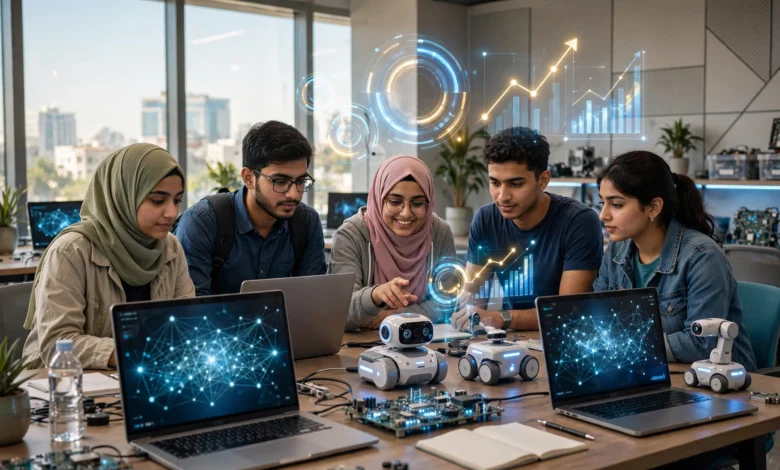
Pakistan IT Exports: 7 Powerful Ways AI Is Driving Record Growth and Painful Job Cuts
Pakistan IT exports have just had their best year ever, and at the same time, many young developers are finding it harder than ever to get hired. Both things are true, and artificial intelligence sits at the centre of both.
On the positive side, the numbers look strong. Software houses in Lahore, Karachi, and Islamabad are selling more services abroad, freelancers are earning more in dollars, and Pakistani firms are finding clients in new markets like Japan and Singapore. The IT sector has become one of the country’s most important sources of foreign exchange at a time when Pakistan badly needs it.
But look closer and the picture gets complicated. AI is taking over the routine work that used to train fresh graduates: basic websites, simple apps, manual testing, and entry-level writing. Some software houses have cut large parts of their delivery teams. The World Bank has warned that educated young people in countries like Pakistan face the biggest risks from AI-driven automation.
There’s also a darker side that the industry doesn’t like to talk about. Illegal call centres, phishing operations, rented freelancing accounts, and informal money transfers have all damaged Pakistan’s reputation with foreign clients and regulators.
This article looks at how AI is reshaping Pakistan’s IT export industry, with current data, real examples of growth and job losses, the illegal activities that hurt the sector’s credibility, and what companies, workers, and policymakers can do next.
Pakistan IT Exports in 2026: The Numbers
Before looking at AI’s role, it’s worth understanding where Pakistan IT exports stand today.
A Record Year
According to State Bank of Pakistan data, IT and IT-enabled services receipts climbed to $4.6 billion in fiscal year 2025-26, up about 21% from $3.814 billion a year earlier. The sector is now the largest services export category, accounting for close to half of all services earnings. Monthly performance ended strongly too, with IT exports reaching a new monthly high of $416 million in June 2026, up 12% from May and 23% from June the previous year. tribunedailytimes
You can check the official figures on the State Bank of Pakistan website, which publishes monthly balance of payments data.
Still Short of the Target
The record doesn’t tell the full story. The sector still missed the government’s $5 billion target by roughly $400 million, and the longer-term Uraan Pakistan goal remains $10 billion by FY2028-29. Industry groups also point to familiar obstacles: persistent slow internet speeds and frequent power outages continued to constrain growth and prevented the sector from meeting its export target. tribunepropakistani


Where the Growth Came From
- Software development and outsourcing remain the backbone.
- Freelancers are a growing share. Pakistani freelancers generated more than $1 billion in export earnings for the first time during FY2025-26. dailytimes
- New markets are opening up. Pakistani IT companies boosted export revenues by expanding into Asia-Pacific markets, including Japan and Singapore, beyond the traditional base in North America, Europe, and the Gulf. dunyanews
7 Ways AI Is Reshaping Pakistan IT Exports
Here’s how AI in Pakistan IT industry is changing the way work gets done, sold, and priced.
1. AI Is Making Delivery Faster and Cheaper
Software houses now use AI coding assistants to write boilerplate code, generate tests, fix bugs, and document projects. Work that took a team of five a month can sometimes be done by two people in two weeks.
For exporters, this means higher margins on fixed-price projects and the ability to take on more clients without hiring as many people. It also means clients expect lower prices, because they know AI is doing part of the work.
2. Routine Work Is Disappearing
This is the hardest change. Routine work such as basic website development, app development, graphic design, and manual software testing is increasingly being automated, while demand is rising for professionals with expertise in AI engineering, cybersecurity, cloud computing, AI integration, and advanced software development. propakistani
Much of Pakistan’s export growth in the past decade came from exactly this kind of routine, lower-cost work. That model is under pressure now.
3. Entry-Level Jobs Are Shrinking
The impact on young people is sharp. According to the Pakistan Software Houses Association (P@SHA), hiring for entry-level positions at major technology companies has declined by around 25 percent, while employment among software developers aged 22 to 25 has fallen by nearly 20 percent since 2024. propakistani
Some companies have made dramatic cuts. One Islamabad software house has said it cut as much as 80% of delivery-side roles after replacing routine work with AI. Another software house in NASTP Silicon Valley in Karachi, which built websites for clients in the Middle East, reportedly reduced its staff from around 150 to about 35. tribune
This is the paradox of AI job displacement: exports rise while junior positions disappear.
4. Freelancing Is Splitting Into Two Markets
Pakistani freelancers are feeling the same shift. Entry-level freelance listings have dropped from about 15% of the market to below 9%. Basic writing and translation work is down 32% year-on-year as clients switch to AI tools. tribune
At the same time, freelancers offering AI automation, chatbot development, data engineering, and AI integration are finding more demand and higher rates. The market is splitting into a shrinking low end and a growing high end.
5. New AI Services Are Becoming Export Products
Pakistani firms are starting to sell AI itself, not just traditional software:
- Building custom chatbots and AI agents for foreign businesses.
- Data labelling and model evaluation for AI companies.
- AI integration into existing client systems like CRMs and ERPs.
- AI-powered BPO services, where human agents work alongside AI tools.
This is where the future of Pakistan software exports likely lies: higher-value services that use AI rather than compete with it.
6. Government and Industry Are Betting Big on AI
The government has made AI central to its export strategy. During Indus AI Week in Islamabad in February 2026, Prime Minister Shehbaz Sharif outlined a plan to invest $1 billion in artificial intelligence by 2030, and the summit set targets including funding 1,000 PhD scholarships in AI and a federal mandate to train one million non-IT professionals in advanced tech skills. arabnewspropakistani
The IT Minister has framed this as a transition. Shaza Fatima Khawaja said AI should be viewed as a transition rather than a threat, adding that the National AI Policy 2025 aims to create 3 million AI-related jobs by 2030 through investment, training, and scholarships. propakistani
Industry has backed the push. The Pakistan Software Houses Association has publicly endorsed the government’s AI framework and positioned itself as a partner in implementation.
7. Clients Are Asking Harder Questions
Foreign clients are more demanding now. They ask where their data is stored, which AI tools will touch their code, whether outputs are original, and whether the vendor complies with laws like the EU’s GDPR and AI Act. Data protection compliance has become a selling point, and firms that can’t answer these questions lose contracts.
The Warning From the World Bank
It’s important not to treat AI as purely good news for Pakistan’s economy.
The World Bank’s latest World Development Report focuses on AI, and its warning is direct. The report says Pakistan is among the countries in its region that are particularly vulnerable because of high youth unemployment and limited private-sector job creation, and that educated young people entering the labour market face the greatest risks as AI automates knowledge-intensive tasks. brecorder
The report also points out the scale gap. It notes that the projected 2026 capital spending of five US AI hyperscalers, Alphabet, Amazon, Meta, Microsoft, and Oracle, will reach $775 billion, far more than Pakistan’s nominal GDP of $408 billion. brecorder
In simple terms, Pakistan can’t compete by building the biggest AI models. It has to compete by being skilled, trustworthy, and useful at applying AI for clients.
The Dark Side: Illegal Activities That Hurt Pakistan’s IT Reputation
Any honest discussion of Pakistan IT exports has to include the criminal and unethical practices that damage trust. Foreign clients, payment platforms, and regulators notice these cases, and legitimate businesses pay the price.
The HeartSender Phishing Network
In early 2025, US and Dutch authorities took down a network of websites linked to a group known as “HeartSender,” which they said was run from Pakistan and sold phishing kits and scam tools to criminals worldwide. US authorities linked the tools to millions of dollars in fraud losses against American victims. Pakistani authorities later arrested suspects connected to the operation.
The group reportedly presented itself online as an ordinary software business, even posting tutorial videos. Cases like this make foreign banks and platforms more suspicious of legitimate Pakistani tech companies.
Lesson: Cybercrime operations disguised as software businesses hurt the entire industry’s credibility.
Illegal Scam Call Centres
Pakistani authorities have raided multiple illegal call centres over the years in cities including Islamabad, Karachi, Lahore, and Faisalabad, which were accused of defrauding foreign citizens through fake investment schemes, tech support scams, and impersonation. Some raids have involved arrests of foreign nationals alongside Pakistanis.
These operations often hire young graduates who can’t find legitimate work, sometimes without telling them the full nature of the job. As AI cuts entry-level jobs, the risk that desperate young people end up in such operations could grow. AI voice and chat tools also make these scams more convincing.
Lesson: Legitimate BPO and call centre work is a real export industry. Scam operations threaten it directly.
Freelancing Account Renting and Identity Fraud
Renting, buying, or selling freelancing accounts has been a common practice in Pakistan. Some people use others’ identities to get around platform restrictions, and some sell verified accounts to foreigners. Platforms respond by banning accounts, holding earnings, and tightening verification for everyone in the country.
Globally, this issue has become a national security matter. US authorities have prosecuted schemes where overseas workers used stolen or rented identities to get remote IT jobs at American companies, with some linked to North Korea. Clients now screen remote contractors more strictly, which affects honest Pakistani freelancers too.
Lesson: Identity fraud in freelancing isn’t a harmless shortcut. It hurts everyone’s access to international work.
Informal Money Transfers
Some freelancers and small firms receive payments through hundi, hawala, or personal accounts abroad to avoid taxes or bank fees. This is illegal under Pakistan’s foreign exchange rules, exposes people to fraud with no legal protection, and means their earnings don’t count in official export figures.
The government has tried to push payments into formal channels through tax incentives and easier dollar accounts. Every dollar that moves through formal channels strengthens Pakistan’s export record and the industry’s case for better policy support.
Software Piracy and Shared AI Tool Accounts
Pakistan has long had high rates of pirated software use. Today, the same problem appears with AI tools: shared or resold premium accounts sold through Facebook and WhatsApp groups. These violate terms of service, can be cut off without warning, and can expose client code and data to strangers.
Lesson: Using pirated tools or shared AI accounts on client projects is a data security risk that can end a business relationship instantly.
AI Washing in Outsourcing
Globally, there are warnings about companies exaggerating their AI capabilities. Builder.ai, a London-based startup that marketed itself as an AI-driven software development platform, collapsed into insolvency in 2025 amid reports of inflated revenue and questions about how much of its work was actually done by AI versus human developers. The US Securities and Exchange Commission has also fined firms for false AI claims.
Pakistani firms marketing “AI-powered” services should be careful. Overstating AI capabilities to foreign clients can lead to contract disputes and, in some jurisdictions, legal action.
What AI Means for Different Parts of the Industry
The impact of AI varies across the sector.
Large Software Houses
Big firms have the resources to adopt AI tools, retrain staff, and sell new AI services. They’re likely to grow revenue even while reducing junior hiring. Their challenge is keeping a pipeline of talent when the traditional training ground, junior roles, is shrinking.
Small Software Houses
Smaller firms that built businesses on basic websites and apps for foreign clients are the most exposed. Many will need to specialize, move up the value chain, or merge.
BPO and Call Centres
Outsourcing Pakistan in customer service faces direct competition from AI chatbots and voice agents. The survivors will likely offer human-plus-AI services, handling complex cases that AI can’t manage, and work in languages and time zones clients need.
Freelancers
Freelance remittances are growing overall, but the gains are concentrated among skilled freelancers. Writers, translators, and basic designers are losing work, while AI developers and specialists gain.
What Pakistan Needs to Do Next
Turning AI into an opportunity rather than a threat will require action from several directions.
For the Government
- Fix the basics. Reliable internet and electricity are still the biggest constraints on exports.
- Pass a strong data protection law so foreign clients trust Pakistani firms with their data.
- Make AI training practical, focused on skills employers actually need, not just certificates.
- Crack down consistently on cybercrime operations, including scam call centres and phishing networks.
- Keep payment channels simple and affordable to discourage informal transfers.
For Companies
- Invest in upskilling existing staff rather than only cutting jobs.
- Create new junior roles around AI, such as AI output reviewers, prompt engineers, and quality testers, to keep a talent pipeline.
- Be transparent with clients about AI use in projects.
- Use licensed tools and secure setups for client work.
- Build compliance capacity for GDPR, HIPAA, and the EU AI Act.
For Workers and Students
- Move beyond routine skills. Learn cloud, cybersecurity, data engineering, and AI integration.
- Build real portfolios that show problem-solving, not just certificates.
- Use AI tools daily so you’re faster and more valuable than someone who doesn’t.
- Stay on the right side of the law. Avoid account renting, scam jobs, and informal payment channels.
- Specialize in a domain, such as fintech, healthcare, or logistics, where AI knowledge plus industry understanding is rare.
Ethics: Growth That Doesn’t Leave People Behind
AI upskilling and export growth shouldn’t come at the cost of basic fairness.
- Honest layoffs. When jobs are cut because of AI, workers deserve notice, fair severance, and where possible, retraining.
- No exploitation. Young graduates shouldn’t be pushed into unpaid “internships” or scam operations disguised as IT jobs.
- Transparency with clients. Clients have a right to know how their projects are built and where their data goes.
- Fair credit for freelancers. Freelancers should be paid properly when their work is used to train or evaluate AI systems.
- Inclusion. Training programs should reach women, smaller cities, and less privileged students, not only graduates from top universities in major cities.
The Road to $10 Billion
Can Pakistan reach the $10 billion target by FY2028-29? It’s possible, but not by doing more of the same. The path runs through higher-value AI services, better infrastructure, stronger data protection, a cleaner reputation, and a workforce trained for the jobs AI creates rather than the ones it removes.
The record $4.6 billion year shows the sector’s resilience. The shrinking entry-level job market shows the risk. How Pakistan handles both will decide whether AI becomes the engine of its IT exports or the reason its young graduates look elsewhere.
Conclusion
Pakistan IT exports reached a record $4.6 billion in FY2025-26, powered by software development, outsourcing, freelancers earning over $1 billion, and expansion into new markets, yet the same year saw entry-level tech hiring fall by around 25 percent as AI automated routine coding, testing, design, and writing work. AI is making delivery faster, opening new high-value services, and drawing major government investment through the $1 billion AI plan and the National AI Policy, while the World Bank warns that educated young Pakistanis face serious displacement risks. The industry’s credibility is also threatened by illegal activities such as the HeartSender phishing network, scam call centres, freelancing account renting, informal money transfers, pirated tools, and exaggerated AI claims. Pakistan’s path to its $10 billion target depends on fixing internet and power problems, passing strong data protection laws, retraining workers for higher-value roles, cracking down on cybercrime, and building an honest, trusted IT sector that uses AI to grow without leaving its young talent behind.