AI vs Traditional Software What’s the Real Difference
AI vs traditional software explained in plain terms: how each works, where each fails, real legal cases, and how to choose the right tool for the job
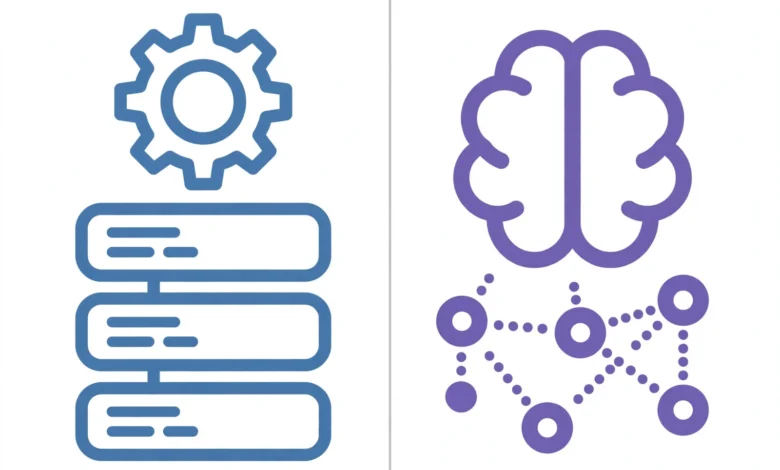
AI vs Traditional Software: 9 Surprising Differences, Hidden Risks and Real Benefits
AI vs traditional software is a question more people are asking, and for good reason. Every app now seems to call itself “AI-powered,” from photo editors to accounting tools to banking apps. Some of these products genuinely use machine learning. Others are ordinary software with a new label stuck on for marketing. For business owners, students, and developers, telling the two apart has become an important skill.
The difference isn’t just technical. It changes how a system behaves, how it fails, who is responsible when something goes wrong, and how much you should trust it. Traditional software follows rules that a programmer writes. AI learns patterns from data and makes its best guess. That one difference explains why a calculator never gets your sums wrong, while a chatbot can confidently invent a court case that doesn’t exist.
Both approaches have caused real harm when used carelessly or dishonestly. Volkswagen wrote traditional code to cheat emissions tests. The UK Post Office relied on faulty accounting software to prosecute hundreds of innocent people. On the AI side, a Dutch government algorithm wrongly labelled thousands of families as fraudsters, and lawyers have been fined for filing fake cases generated by chatbots.
This article explains the real difference between AI and traditional software in plain language. We’ll cover how each works, nine key differences, real legal cases, and practical advice on when to use each. No hype, just a clear picture.
What Is Traditional Software?
Traditional software is built on explicit instructions. A programmer decides exactly what the program should do in every situation and writes those rules as code.
How It Works
Think of a recipe. If the input is X, do Y. If the balance is below zero, show a warning. If the user enters a wrong password three times, lock the account. This is often called traditional programming or rule-based systems.
Common examples include:
- Calculators and spreadsheets.
- Accounting and payroll systems.
- Banking transaction software.
- Operating systems like Windows or Android.
- Most websites and mobile apps for booking, ordering, or form filling.
The Key Feature: Predictability
Traditional software is deterministic software. Give it the same input, and it produces the same output every time. If it’s wrong, it’s wrong consistently, which makes errors easier to find and fix.
What Is AI Software?
AI software, especially modern machine learning, works differently. Instead of writing every rule, developers give the system large amounts of data and let it learn patterns on its own.


How It Works
To build a spam filter the traditional way, a programmer might write rules like “block emails containing the word ‘lottery.'” To build it with machine learning, you show the system millions of emails labelled as spam or not spam. It figures out the patterns itself, including ones no human would think to write down.
Common examples include:
- Chatbots like ChatGPT, Gemini, and Claude.
- Face recognition on your phone.
- Netflix and YouTube recommendations.
- Voice assistants and speech-to-text.
- Fraud detection in banks.
The Key Feature: Probability
AI doesn’t “know” answers. It predicts the most likely answer based on its training data. That makes it flexible and powerful with messy real-world problems, but it also means it can be wrong in unpredictable ways.
AI vs Traditional Software: 9 Key Differences
Here’s where the real contrast becomes clear. Understanding these differences helps you judge any product, whatever its marketing says.
1. Rules vs Learning
Traditional software follows rules written by people. AI learns rules from examples.
This is the root of every other difference. With traditional code, the logic lives in the programmer’s head and the source code. With AI, much of the logic lives inside millions or billions of numbers the system adjusted during training, which no human wrote directly.
2. Certainty vs Probability
A traditional program either works correctly or has a bug. AI gives outputs with degrees of confidence. A face recognition system might be “92 percent sure” it’s you.
That’s fine for recommending a song. It’s much riskier for deciding who gets a loan, a job, or arrested.
3. Transparency vs the “Black Box”
With traditional software, a developer can read the code and explain exactly why the program made a decision. With large AI models, even the people who built them often can’t fully explain why a specific output was produced. This is why explainable AI has become an important research field.
For regulators and courts, this matters. If a system denies someone a benefit, people have a right to understand why.
4. How They Handle New Situations
Traditional software breaks or refuses when it meets a situation its programmers didn’t plan for. AI can handle new, messy inputs, such as a blurry photo, a sentence with spelling mistakes, or a mix of Urdu and English.
The downside is that AI may handle a new situation confidently but wrongly, while traditional software would at least show an error.
5. Types of Errors
Traditional software fails through bugs: mistakes in the code. AI fails in different ways:
- AI hallucinations: Confidently producing false information, like fake facts, quotes, or sources.
- Bias: Repeating unfair patterns found in its training data.
- Drift: Becoming less accurate as the real world changes from the data it learned on.
6. Testing and Quality Control
Software testing for traditional programs checks whether the code does what it should across defined cases. You can often test every important path.
AI can’t be tested this way because the range of possible inputs and outputs is enormous. Instead, teams test on sample datasets, measure accuracy, and look for failure patterns. There’s always some uncertainty left.
7. Updates and Maintenance
To change traditional software, a developer edits the code. To change an AI system, teams often need new data, retraining, and fresh testing. A model that worked well last year may need retraining as language, markets, or user behaviour shift.
8. Cost and Resources
Traditional software is usually cheaper to run once built. AI, especially large models, needs expensive computing power, large datasets, and specialised staff. Using AI through an API may seem cheap per request, but costs rise quickly at scale.
For many small businesses in Pakistan and elsewhere, a well-designed traditional system is more affordable and reliable than a flashy AI tool.
9. Accountability
When traditional software fails, responsibility is fairly clear: the company that built it or the organization that deployed it. With AI, companies sometimes try to blame “the algorithm.” Courts are increasingly rejecting that excuse, as we’ll see below. AI accountability is becoming one of the biggest legal questions of this decade.
Quick Comparison: AI vs Traditional Software at a Glance
Here’s a summary of the difference between AI and traditional software:
- Logic: Traditional uses written rules; AI learns patterns from data.
- Output: Traditional is consistent and exact; AI is probabilistic and can vary.
- Explainability: Traditional is readable; AI is often hard to explain.
- Flexibility: Traditional is rigid; AI adapts to messy inputs.
- Errors: Traditional has bugs; AI has hallucinations, bias, and drift.
- Best for: Traditional suits exact tasks like accounting; AI suits pattern tasks like language, images, and predictions.
Real Cases: When Traditional Software Was Misused or Failed
It’s easy to assume AI is the dangerous one and traditional software is safe. History says otherwise. Some of the worst technology scandals involved ordinary, rule-based code.
Volkswagen Dieselgate
In 2015, US regulators revealed that Volkswagen had installed software in millions of diesel cars that detected when the car was being tested for emissions. During tests, the engine ran cleanly. On real roads, the cars emitted pollutants far above legal limits.
This was traditional software doing exactly what it was programmed to do: cheat. Volkswagen pleaded guilty to criminal charges in the US and has paid more than $30 billion in fines, settlements, and buybacks worldwide, and several executives faced criminal charges.
Lesson: Deterministic code isn’t automatically honest. It does whatever its makers intend, including breaking the law.
The UK Post Office Horizon Scandal
Between 1999 and 2015, the UK Post Office prosecuted hundreds of branch managers, known as subpostmasters, for theft and false accounting based on data from the Horizon accounting system built by Fujitsu. The software had bugs that created false shortfalls. Innocent people went to prison, lost homes, and some took their own lives.
In 2024, the UK Parliament passed a law quashing most of these convictions. A public inquiry examined how the Post Office defended the software while evidence of its errors existed.
Lesson: The danger was blind trust in software and the assumption that “the computer is always right.”
Australia’s Robodebt Scheme
From 2016, Australia’s government used an automated system to calculate welfare overpayments by averaging people’s yearly income across fortnights. The method was flawed, and hundreds of thousands of people received incorrect debt notices. A court found the scheme unlawful, the government agreed to a settlement worth about A$1.8 billion, and a Royal Commission in 2023 strongly criticised officials involved.
Robodebt wasn’t sophisticated AI. It was simple automated rules applied without human checks.
Lesson: Automation without oversight can harm vulnerable people at massive scale.
Software Piracy and Cracked Programs
Traditional software also has a long history of illegal copying. Pakistan has historically been among the countries with high software piracy rates, according to industry surveys. Using cracked Windows, Office, or design software exposes businesses to legal action and, more commonly, to malware hidden in the cracked files that steals data and passwords.
Lesson: Pirated software is both illegal and a security risk.
Real Cases: When AI Software Was Misused or Failed
AI brings its own set of problems, often harder to detect because the system’s reasoning is hidden.
The Dutch Childcare Benefits Scandal
In the Netherlands, the tax authority used risk-profiling systems, including a self-learning algorithm, to flag childcare benefit claims as potentially fraudulent. Tens of thousands of families were wrongly accused and forced to repay large sums, pushing many into debt and hardship. Dual nationality was used as a risk factor, which discriminated against families from immigrant backgrounds.
The Dutch government resigned in January 2021 over the scandal, and the country’s data protection authority fined the tax administration for unlawful and discriminatory data processing.
Lesson: Algorithmic bias in government systems can destroy lives and bring down governments.
Clearview AI and Illegal Face Scraping
Clearview AI built a face recognition database by scraping billions of photos from the internet without people’s consent. Data protection authorities in several European countries fined the company, including a fine of about €30.5 million from the Dutch regulator in 2024, and ordered it to stop processing their citizens’ data.
Lesson: Training AI on personal data without consent can be illegal, even if the photos were publicly visible.
Air Canada’s Chatbot
In 2024, a Canadian tribunal ruled that Air Canada had to honour incorrect refund information its website chatbot gave a grieving customer about bereavement fares. The airline argued that the chatbot was responsible for its own statements. The tribunal rejected that argument and said the company is responsible for all information on its website.
Lesson: Companies can’t blame AI for AI’s mistakes. The business that deploys it is accountable.
Lawyers Citing Fake Cases
In 2023, in the US case Mata v. Avianca, lawyers submitted a legal brief citing court cases that turned out to be completely invented by ChatGPT. The judge fined the lawyers and their firm $5,000. Similar incidents have since happened in several countries, including sanctions against lawyers in the UK, Canada, and Australia.
Lesson: AI hallucinations have real legal consequences for professionals who don’t verify.
Amazon’s Biased Hiring Tool
Amazon developed an experimental AI tool to screen job applicants, trained on resumes submitted over ten years, mostly by men. The system learned to penalise resumes that included the word “women’s,” such as “women’s chess club captain.” Amazon scrapped the tool, according to a 2018 Reuters report.
Lesson: AI learns the bias in its data, even when no one intends it to.
AI Washing
Some companies have been penalised for claiming to use AI when they didn’t, or exaggerating what their AI could do. In 2024, the US Securities and Exchange Commission fined two investment advisers for making false AI claims. This is sometimes called “AI washing,” and it’s a reminder that not every “AI-powered” label is honest.
The Legal and Ethical Picture
The law is catching up to both kinds of software, but especially to AI.
Global AI Regulation
AI regulation is developing quickly:
- European Union: The EU AI Act sets rules based on risk, with strict requirements for high-risk uses like hiring, credit scoring, and law enforcement, and bans on some practices.
- United States: There’s no single federal AI law, but agencies like the FTC and SEC use existing consumer protection and fraud laws against misleading AI claims.
- Frameworks: The US NIST AI Risk Management Framework and the OECD AI Principles give organizations practical guidance on building trustworthy AI.
Pakistan’s Position
Pakistan approved a National AI Policy in 2025 focused on skills, research, and responsible use. Existing laws like PECA 2016 cover cybercrime, identity misuse, and fraud regardless of whether AI is involved. A comprehensive data protection law, which would directly affect how AI systems use personal data, has been in draft for years. Pakistani businesses exporting software abroad also need to follow the rules of their clients’ countries, such as the EU’s GDPR and AI Act.
Core Ethical Principles
Whether you build traditional or AI software, the same principles apply:
- Honesty: Don’t claim AI capabilities you don’t have, and don’t hide cheating logic in code.
- Human oversight: Keep people involved in decisions that affect lives, jobs, money, or freedom.
- Fairness: Test systems for bias, especially in hiring, lending, and public services.
- Transparency: Tell users when they’re dealing with AI and explain important decisions.
- Privacy: Collect data with consent and protect it properly.
- Accountability: Accept responsibility when your system causes harm.
When to Use AI and When to Use Traditional Software
Choosing between AI vs traditional software isn’t about which is “better.” It’s about which fits the job.
Choose Traditional Software When
- The rules are clear and stable, such as tax calculations, payroll, or inventory.
- You need exact, repeatable results every time.
- Mistakes are costly and must be explainable, such as banking transactions.
- Your budget is limited and the problem doesn’t need pattern recognition.
Choose AI When
- The task involves language, images, audio, or messy data.
- The rules are too complex or unclear to write by hand, like spotting fraud patterns.
- Some error is acceptable and can be checked by humans.
- You have good-quality data and the resources to monitor the system.
Use Both Together
Most real systems today are hybrids. A bank may use traditional software to process transactions and AI to flag suspicious activity for a human to review. A hospital might use AI to highlight possible problems on scans, while doctors make the final call and traditional software manages records and billing.
This combination often gives the best of both: the reliability of rules and the flexibility of learning.
What This Means for Pakistani Businesses and Developers
Pakistan’s software industry, including the many software houses and freelancers serving foreign clients, is feeling this shift directly.
For Businesses
- Don’t buy a product just because it says “AI.” Ask what the AI actually does and how accurate it is.
- For core operations like accounts and payroll, reliable traditional systems remain the right choice.
- Use AI for tasks where it clearly saves time, like customer support drafts, document summaries, or data analysis, with human review.
- Use licensed software. Pirated tools are a legal and security risk.
For Developers and Students
- Learn both. Strong traditional programming skills are still the foundation, and AI tools work best in the hands of people who understand code.
- Understand AI’s limits, including bias, hallucinations, and data privacy.
- Clients abroad increasingly ask about compliance with laws like GDPR and the EU AI Act. Knowing these gives you an advantage.
Common Myths About AI and Traditional Software
Myth 1: AI Will Replace All Traditional Software
It won’t. Most of the world’s critical systems, like banking cores, flight control software, and government databases, rely on traditional code because they need predictability. AI is being added to these systems, not replacing them.
Myth 2: AI Is Always Smarter
AI is better at certain tasks, like recognizing speech or images. For exact calculations, simple logic, and rule-following, a basic program is faster, cheaper, and more reliable.
Myth 3: Traditional Software Is Always Safe
As Dieselgate, Horizon, and Robodebt show, traditional software can cause massive harm when it’s badly built, deliberately dishonest, or trusted blindly.
Myth 4: If a Computer Said It, It Must Be True
This is the most dangerous myth of all. Both kinds of software reflect the choices, data, and intentions of the people behind them.
Conclusion
The real difference in AI vs traditional software comes down to rules versus learning: traditional software follows exact instructions written by programmers and gives predictable, explainable results, while AI learns patterns from data and gives flexible but probabilistic answers that can include hallucinations, bias, and hard-to-explain decisions. Neither is automatically safe, as shown by Volkswagen’s emissions-cheating code, the UK Post Office Horizon scandal, and Australia’s Robodebt on one side, and the Dutch childcare benefits scandal, Clearview AI’s fines, Air Canada’s chatbot ruling, and fake ChatGPT legal citations on the other. The smart approach is to choose the right tool for each task, often combining both, while keeping humans in charge, testing for fairness, respecting privacy and the law, and never assuming that a computer’s output is true just because a computer produced it.