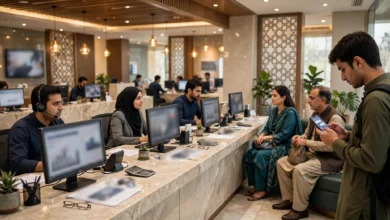
How to Spot and Avoid AI Job Scams Targeting Pakistani Youth
AI job scams are targeting Pakistani youth with fake remote work, task apps, and overseas IT offers. Real cases, red flags, and how to stay safe

AI Job Scams: 9 Dangerous Red Flags Pakistani Youth Must Know to Stay Safe
AI job scams are spreading fast in Pakistan, and they’re aimed squarely at the people who can least afford to lose money: young graduates looking for their first job. The pitch usually sounds exciting. “Work from home training AI models.” “Earn $50 a day rating products.” “Remote AI data job, no experience needed.” “Digital marketing role in Bangkok, salary $1,200, visa paid.”
Behind many of these offers are organized fraud networks. Some want a “registration fee.” Some want your CNIC and bank details. Some pull you into task apps where your fake balance grows until you’re asked to deposit your own money. And the most dangerous ones lure young Pakistanis abroad, where passports are taken and victims are forced to scam others.
The timing isn’t an accident. Entry-level tech jobs in Pakistan are harder to find as AI automates routine work, and many young people are desperate for any income, especially in dollars. Scammers know this, and they use the language of AI because it sounds modern, legitimate, and full of opportunity.
This guide explains how these scams work, with real cases from Pakistan and abroad, including illegal call centres raided by the NCCIA and Pakistanis rescued from scam compounds in Cambodia and Myanmar. You’ll learn the warning signs, how to check whether a job is real, and what to do if you’ve already been targeted. The goal is simple: help you find real opportunities without losing your money, your data, or your freedom.
Why Pakistani Youth Are Prime Targets
To understand AI job scams in Pakistan, it helps to understand why young people are so exposed right now.
A Tougher Job Market
AI is changing Pakistan’s tech industry. According to P@SHA, hiring for entry-level positions at major technology companies has fallen by around 25 percent, while employment among developers aged 22 to 25 has dropped by nearly 20 percent since 2024. Freelancing is tighter too. Entry-level freelance listings have fallen from about 15% of the market to below 9%.
When real entry-level jobs shrink, fake ones fill the gap.
The Appeal of “AI Work”
AI jobs sound like the future. Young people hear that AI companies need data labellers, prompt writers, and model testers, and some of these jobs are real. Scammers borrow this language to make fake offers sound believable.
Pressure to Earn in Dollars
With inflation and a weak rupee, remote work paid in dollars is extremely attractive. Scammers promise dollar earnings to make small “fees” or “deposits” seem like a reasonable investment.


Heavy Use of WhatsApp and Telegram
Most Pakistani job seekers use WhatsApp, Telegram, Facebook, and TikTok daily. These platforms make it easy for scammers to reach thousands of people with fake offers and fake group chats full of “successful” members.
How AI Job Scams Work
AI job scams come in several forms, but they follow similar patterns. Knowing these patterns is your best protection.
The Basic Structure
- The hook: An attractive offer arrives through a message, ad, or social media post.
- Fast trust building: You’re “hired” quickly, often with no real interview.
- Small wins: You may receive a small payment early to build confidence.
- The ask: You’re told to pay a fee, make a deposit, share personal documents, or travel abroad.
- The trap: Money disappears, your data is misused, or in the worst cases, you’re trapped abroad.
How AI Makes These Scams Worse
Scammers now use AI tools to make their operations more convincing:
- Polished job ads and emails without the spelling mistakes that used to give scams away.
- Fake company websites created in minutes.
- AI-generated profile photos of fake HR managers and recruiters.
- Chatbots that answer questions around the clock.
- Fake video interviews using deepfake faces or voices in some cases.
The Most Common AI Job Scams Targeting Pakistanis
Here are the main types of fake online jobs Pakistan is seeing, and how each one works.
1. Task Scams (Like, Rate, and Review)
Task scams are among the most common online earning scams. You’re offered money for simple tasks like liking YouTube videos, rating products, or “optimizing apps.” The pattern is well documented: after small early payouts, you’re told to deposit money, often in cryptocurrency, to unlock the next set of tasks or withdraw your earnings, and that money is lost.
Some scammers now call this “AI training work,” claiming your ratings help train AI systems.
2. Fake AI Data Labelling and Annotation Jobs
Real AI companies do hire people to label data and evaluate AI responses, usually through established platforms with proper verification. Scammers copy this idea, asking for “training fees,” “software licence fees,” or “account activation charges” before you can start.
Rule: Legitimate employers pay you. They don’t charge you to work.
3. Fake Remote Jobs With Registration Fees
These fake remote jobs promise positions as virtual assistants, AI content writers, or data entry workers. After a quick “interview,” you’re asked to pay for registration, a laptop, a background check, or training materials. Once you pay, the recruiter vanishes. Data entry scams have followed this pattern for years, and AI branding has simply refreshed them.
4. Identity Theft Disguised as Hiring
Some fake recruiters don’t want your money directly. They want your CNIC copy, selfie, bank details, and phone number “for onboarding.” This information can be used to open bank accounts, register SIMs, create fake freelancing accounts, or take loans in your name. You may later find yourself linked to crimes you didn’t commit.
5. Money Mule Recruitment
Some “jobs” ask you to receive money in your bank or mobile wallet account and transfer it onward, keeping a small commission. This is called being a money mule. You’re actually helping criminals launder stolen money, and your account, not theirs, is the one investigators will trace. This can lead to frozen accounts and criminal charges.
6. Overseas IT and Digital Marketing Job Scams
This is the most dangerous category of overseas job scams. Young people are offered well-paid jobs in IT support, call centres, or digital marketing in Thailand, Cambodia, Myanmar, Laos, or elsewhere. Visas and tickets are sometimes “arranged,” or victims pay large sums themselves. On arrival, they’re taken to guarded scam compounds and forced to defraud people online.
We’ll look at real Pakistani cases of this below.
7. Fake Gambling and “Trading” Apps Promoted as Earning Opportunities
Some apps are marketed to young people as easy ways to earn using “AI trading bots” or prediction games. Many are illegal gambling or binary trading platforms. Pakistani authorities have taken action against influencers accused of promoting them.
8. Job Scams Run From Illegal Call Centres
Organized call centres run many of these frauds at scale, using scripts, fake companies, and multiple payment accounts. Some are in Pakistan itself.
Real Cases: AI Job Scams and Related Crimes in Pakistan
These cases show that the threat is real and growing.
NCCIA Raids on Illegal Call Centres
In July 2025, the National Cyber Crime Investigation Agency raided a building in Islamabad’s G-10 Markaz and arrested more than 65 people, including five foreign nationals, accused of running a call centre that lured victims through fake online job offers and investment opportunities. Investigators said frontline agents targeted people on Facebook, WhatsApp, and Telegram, promising returns for small investments or task-based work, while other team members, some reportedly abroad, extracted money often through cryptocurrency.
According to the Digital Rights Foundation, the operation used fake online earning platforms, AI-generated images, and social media to trick victims into sharing personal data, and followed NCCIA crackdowns in Faisalabad, Karachi, Multan, and Lahore involving over 200 arrests.
Lesson: Some of the people working in these centres are young Pakistanis who took what they thought was a normal call centre job. Being employed by a scam operation can lead to arrest, even if you didn’t plan the fraud.
Fake Prize and Welfare Scheme Scams
Scammers also target people with fake government schemes. In one case, NCCIA arrested two suspects in Dera Ghazi Khan who allegedly posed as representatives of government prize schemes and welfare programmes, demanding money for registration, taxes, or release of prize money. Authorities recovered 120 SIM cards and more than 100 ATM cards from them. That many SIMs and ATM cards usually means other people’s identities were being used, which is exactly why you should never hand over your documents to strangers.
Influencers Charged Over Gambling and Trading Apps
In 2025, the NCCIA filed cases against YouTubers Rajab Butt, Anas Ali, and Hurairah in Lahore under PECA and fraud-related laws, accusing them of promoting illegal gambling and betting apps. The FIR stated that many viewers, already under financial strain, lost savings on these schemes. Another YouTuber, Saadur Rehman, known as Ducky Bhai, was also booked for allegedly promoting betting apps. These are allegations under investigation, not convictions, but the cases show how young audiences are being pushed toward risky “earning” platforms.
Lesson: A famous influencer promoting an app doesn’t make it legal or safe.
Real Cases: Pakistanis Trapped in Overseas Scam Compounds
The overseas version of fake job offers has had the most devastating consequences.
The Cambodia Rescues
In one recent case, 54 Pakistanis were rescued from a scam compound in Cambodia after being detained during a raid in Siem Reap province. Investigators found most had travelled after receiving fake job offers for call centre, IT support, and digital marketing work, and on arrival their passports were confiscated and they were forced into online scams. Reports suggest more than 200 Pakistanis may be held in Cambodian detention centres linked to similar cases, and Pakistan’s FIA has launched investigations into recruitment networks in Karachi and Lahore.
A Digital Marketing Job That Became a Trap
The International Justice Mission shared the story of two Pakistani men, Ali and Ahmad, who answered an ad for digital marketing jobs. One of them said he was promised a monthly salary of $1,200 with visa fees and air tickets refunded. They borrowed around $4,000 each from their families for tourist visas. Once there, they were confined with 60 to 80 other victims and had to surrender their passports and phones.
Myanmar Scam Centres
Pakistanis have also been found in Myanmar’s scam centres. When thousands of workers were freed from Myanmar border compounds in 2025, 14 Pakistanis were among the 7,000 rescued. Many workers there say they were trafficked or tricked into the work and suffered beatings and abuse. The scale is enormous: the UN Human Rights Office has estimated that at least 120,000 people in Myanmar have been trafficked into online scam compounds.
Lesson: An overseas “IT job” arranged through WhatsApp, on a tourist visa, with no licensed recruiter, can be a trafficking trap.
9 Red Flags of AI Job Scams
Here are the job scam red flags every young Pakistani should memorize.
Red Flag 1: You Have to Pay to Start
Registration fees, training charges, deposits, “software licences,” and “account activation” payments are the clearest sign of a scam. Real employers don’t charge you to work.
Red Flag 2: The Pay Is Too Good to Be True
$50 a day for liking videos, or $1,200 a month abroad with no experience, should raise alarm immediately.
Red Flag 3: You’re Hired With No Real Interview
If someone offers you a job after a few WhatsApp messages without checking your skills, they’re not hiring you for your skills.
Red Flag 4: Contact Only Through WhatsApp or Telegram
Legitimate companies use official email domains and proper hiring platforms. WhatsApp job scams usually avoid any traceable, official channel.
Red Flag 5: They Want Your Documents Early
Requests for CNIC copies, selfies with your ID, bank account details, or OTP codes before any contract are a warning sign of identity theft.
Red Flag 6: Payments Through Personal Accounts or Crypto
Fees or deposits going to personal JazzCash, Easypaisa, or bank accounts, or requests to pay in crypto, point to fraud.
Red Flag 7: Pressure and Urgency
“Only 5 seats left.” “Offer expires tonight.” Scammers rush you so you don’t have time to check.
Red Flag 8: Overseas Jobs on Tourist Visas
Legitimate overseas employment requires proper work visas and, in Pakistan, registration through official channels. Travelling on a tourist visa for a “job” is a major danger sign, especially to Southeast Asian countries linked to scam compounds.
Red Flag 9: Vague Company Details
No clear company address, no real website, no LinkedIn presence, or a website that was created only recently are all red flags.
How to Verify a Job Offer
Before accepting any offer, run through these checks.
For Online and Remote Jobs
- Search the company name along with words like “scam,” “fraud,” or “reviews.”
- Check the company website and email domain. A Gmail or Hotmail address for a large company is suspicious.
- Look up the recruiter on LinkedIn. Check whether the profile is real and has a history.
- Ask for a written contract before sharing documents or starting work.
- Apply through official channels, like the company’s own careers page or recognized freelance platforms.
- Never pay any fee. If they insist, walk away.
For Investment-Style “Earning” Platforms
If a job requires you to invest money, it’s not a job. Check whether the company is licensed with the Securities and Exchange Commission of Pakistan, which regularly warns the public about unlicensed investment and earning schemes.
For Overseas Jobs
- Use only licensed Overseas Employment Promoters. Pakistan’s Bureau of Emigration and Overseas Employment regulates foreign employment and licenses recruitment agencies.
- Get proper registration through the Protector of Emigrants before leaving.
- Insist on a proper work visa, not a tourist or visit visa.
- Verify the employer through the Pakistani embassy in that country.
- Tell family where you’re going, share contact details, and agree on check-in times.
- Be extremely cautious about jobs in Cambodia, Myanmar, Laos, and Thailand’s border areas offered through social media.
What to Do If You’ve Been Scammed
If you’ve already paid money or shared documents, act quickly.
Immediate Steps
- Stop all contact and don’t send any more money, whatever balance the app shows.
- Contact your bank or mobile wallet provider right away and ask them to block or reverse transfers if possible.
- Save evidence: screenshots, chat logs, phone numbers, account details, and payment receipts.
- File a complaint with the NCCIA through its official portal or helpline listed on the government website.
- Report the number to PTA and the platform where the scam happened.
- Warn friends and family, especially if the scammer had access to your contacts.
If Your CNIC Was Shared
- Check which SIMs are registered in your name using PTA’s official SIM check service and block unknown ones.
- Inform your bank to watch for unusual activity.
- Report the misuse to the NCCIA so there’s a record if your identity is later used in a crime.
Beware of Recovery Scams
After being scammed, you may be contacted by someone offering to recover your money for a fee. This is almost always a second scam. Only work with official authorities.
If Someone Is Trapped Abroad
- Contact the Ministry of Foreign Affairs and the Pakistani embassy in that country immediately.
- Share every detail: location, employer name, recruiter contacts, and travel documents.
- Report the recruiter in Pakistan to the FIA, as human trafficking is a serious crime.
The Ethical Side: Don’t Become Part of the Scam
Some young people start as victims and end up as participants. This happens when:
- A “call centre job” turns out to be fraud, and they stay because the pay is good.
- They’re offered commission to recruit friends into task apps.
- They rent out their bank accounts or CNIC for a fee.
- They promote earning apps on TikTok or YouTube without checking them.
Each of these can lead to criminal charges under PECA and the Pakistan Penal Code. If you discover your job involves deceiving people, leave and report it. Short-term money isn’t worth a criminal record or harming other families.
Finding Real AI Jobs and Opportunities
The good news is that real AI-related opportunities exist. Here’s where to look safely.
Safer Paths
- Established freelance platforms, using your own verified identity.
- Company career pages of known software houses and tech firms.
- LinkedIn, after checking recruiters and companies carefully.
- Government and university programs for AI training, applied through official websites only.
- University career offices and alumni networks.
Build Skills Scammers Can’t Fake
Free, reputable AI courses from Google, Microsoft, Harvard’s CS50, and Kaggle can help you build real skills. A strong portfolio of projects gives you access to real jobs that don’t require paying anyone.
A Simple Rule to Remember
Real jobs test your skills and pay you. Scams skip the test and ask you to pay them.
Conclusion
AI job scams are exploiting Pakistan’s tough job market and young people’s hopes for remote, dollar-earning work through task apps, fake AI data labelling jobs, registration fee scams, identity theft, money mule schemes, illegal gambling and trading apps, and dangerous overseas job offers. Real cases, from NCCIA raids on Islamabad call centres using fake earning platforms and AI-generated images, to fake prize scheme arrests in Dera Ghazi Khan, influencers charged over betting apps, and Pakistanis trapped in scam compounds in Cambodia and Myanmar, show how serious the risks are. The best protection is simple: never pay to get a job, never share your CNIC or bank details with unverified recruiters, avoid offers that come only through WhatsApp or Telegram, use licensed channels for overseas work, verify every company, and report scams quickly to your bank, the NCCIA, and the PTA so fewer young Pakistanis fall into the same trap.
Keywords: