How Biometric Verification Is Used Across Pakistani Services
Biometric verification in Pakistan now covers SIMs, banks, BISP, passports and more. See 9 key uses, real fraud cases and how to protect your identity.
How Biometric Verification Is Used Across Pakistani Services
Introduction: Why Biometric Verification in Pakistan Touches Almost Everyone
Biometric verification in Pakistan has become part of everyday life. Buying a new SIM, opening a bank account or mobile wallet, collecting a Benazir Income Support Programme payment, transferring a car or applying for a passport online all depend on proving that you are who your CNIC says you are. Behind most of these checks sits the National Database and Registration Authority (NADRA), which matches your fingerprints or, increasingly, your face against its national records.
The system has expanded quickly. Since October 2025, the State Bank of Pakistan has required biometric verification as the primary identity check for bank accounts and digital wallets. In January 2026, amended identity card rules formally recognized facial and iris scans as biometrics, and NADRA began issuing facial recognition verification certificates for people whose fingerprints have faded with age or illness.
These changes make services faster and harder to cheat. But biometric systems are not foolproof. Gangs have used thousands of silicone fingerprints to activate SIMs in other people’s names, some payment agents have taken illegal cuts from BISP beneficiaries during biometric payouts, and NADRA’s own records were breached between 2019 and 2023.
This guide explains nine key services that rely on biometric checks, how each one works, and what has gone wrong in real cases. It ends with practical steps you can take to protect your fingerprints, face and identity.
How Biometric Verification in Pakistan Works
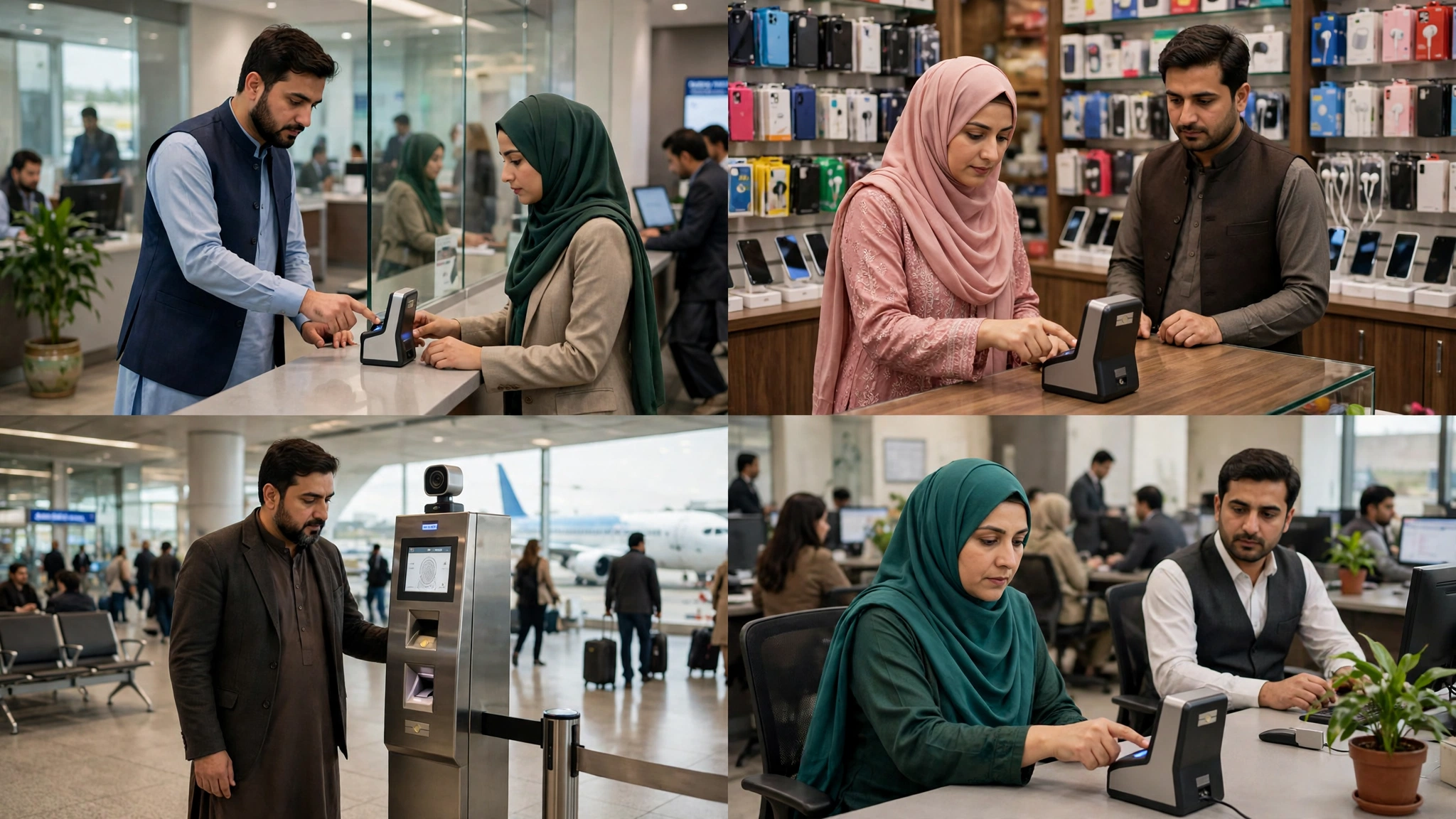
Most checks follow the same basic steps. A service provider, such as a bank branch, telecom franchise or payment agent, uses a NADRA-approved device or app to capture your fingerprint or face. The data is sent to NADRA, which compares it with the record linked to your CNIC and returns a match or no match. Businesses can also confirm basic CNIC details through NADRA Verisys, and citizens can use NADRA’s e-Sahulat franchises for many services.
The legal definition of biometrics widened in late 2025. Amended National Identity Card rules now recognize facial recognition and iris scans, as well as fingerprints. Since 20 January 2026, NADRA registration centers have issued facial recognition verification certificates, for a fee of about Rs20 and valid for seven days, for citizens whose fingerprints cannot be read. NADRA says more than six million people got identity documents through its Pak ID app in 2025.
9 Vital Services That Use Biometric Verification
1. Mobile SIM Issuance
Every SIM in Pakistan must be issued through the Biometric Verification System (BVS) at an authorized franchise or retailer. Biometric SIM checks became mandatory nationwide in 2015 after security agencies linked unregistered SIMs to terrorism and extortion.
What it protects: It ties each SIM to a real, verified person, making it harder to use anonymous numbers for fraud, threats or militancy.
Tip: You can check how many SIMs are registered to your CNIC through the Pakistan Telecommunication Authority’s SIM information service. Block any number you do not recognize.
2. Bank Accounts and Mobile Wallets
Under the State Bank of Pakistan’s BPRD Circular No. 1 of 2025, biometric verification became the primary identity check for opening accounts and wallets at banks, microfinance banks, digital banks and electronic money institutions, including services such as JazzCash and Easypaisa. Under the earlier 2022 rules, a NADRA Verisys check was enough at account opening, with biometric verification allowed up to 60 days later. From 25 October 2025, accounts and wallets without completed biometric checks faced restrictions.
What it protects: Stronger identity checks make it harder for criminals to open “mule” accounts in other people’s names to receive stolen money.
3. BISP and Social Protection Payments
The Benazir Income Support Programme pays millions of low-income women through biometric checks at bank agents, ATMs and temporary campsites. The beneficiary places her finger on a device, and the payment is released only if NADRA confirms a match.
What it protects: It stops payments from being collected by someone else using a beneficiary’s CNIC. But as the fraud section below shows, it has not stopped every abuse at payment points.
4. NADRA Identity Services and the Pak ID App
Applying for or renewing a CNIC, NICOP, family registration certificate or other NADRA documents requires fingerprint and facial capture. Through the Pak ID app, citizens can complete many of these steps from a smartphone, including face-based verification.
What it protects: Prevents someone from obtaining identity documents in another person’s name.
5. Passports
Passport applications rely on NADRA biometric data, and online passport applications now support facial verification through the Pak ID system.
What it protects: Helps stop identity fraud in international travel documents, which are a high-value target for traffickers and fraudsters.
6. Vehicle Registration and Transfers
Several provincial excise departments use biometric verification for vehicle ownership transfers, so both buyer and seller must confirm their identity. NADRA has said facial recognition through Pak ID can now support vehicle registration transfers.
What it protects: Makes it harder to sell stolen vehicles or transfer cars using fake documents.
7. Property and Land Records
Land record authorities, particularly in Punjab, use biometric checks at service centers when ownership changes hands.
What it protects: Land fraud through impersonation and forged documents has long been a serious problem. Biometric checks add a strong barrier, especially for owners living abroad who might otherwise be targeted.
8. Pensions and Proof of Life
Pensioners often need to prove they are alive to keep receiving payments. Biometric and facial verification lets elderly citizens do this without long queues, and facial recognition is especially useful for people whose fingerprints no longer scan.
What it protects: Stops payments to deceased pensioners or to people collecting pensions fraudulently.
9. Verification for Employers, Landlords and Businesses
Employers, landlords, schools and businesses commonly verify CNICs through NADRA services and e-Sahulat franchises before hiring staff, renting property or onboarding customers.
What it protects: Helps prevent fraud and supports police registration of tenants and workers in many cities.
Watch out: Every time you hand over your CNIC copy or allow a scan, your data travels further. Only share it with trusted organizations and ask how it will be stored.
The Hidden Risks: Real Fraud Cases Involving Biometric Verification in Pakistan
Biometric systems are strong, but criminals target the people and devices around them. These documented cases show where the weak points are.
Silicone Fingerprints and Illegal SIMs
The best-known abuse is the use of fake fingerprints to activate SIMs in other people’s names. Gangs collect fingerprints, often from unsuspecting people who think they are signing up for aid or a job, then copy them onto X-ray film and make silicone fingerprint molds.
- In November 2021, the Federal Investigation Agency (FIA) arrested two suspects from Bhakkar and recovered more than 7,000 fake silicone thumbs, 8,000 SIM cards and 15 BVS devices. In a related raid in Toba Tek Singh, it arrested six people, including four owners of a cellular franchise, and seized about 1,600 silicone thumbs and 3,000 SIMs.
- In 2021, the FIA also broke up a gang in Islamabad that collected fingerprints from women under the pretense of the Ehsaas aid program and turned them into silicone thumbs to activate SIMs.
- In February 2024, the FIA arrested suspects in a bank fraud case and seized hundreds of silicone thumbprints, 11,000 digital thumbprints and thousands of active SIMs across all four major networks.
- In February 2025, the Pakistan Telecommunication Authority and FIA raided a franchise in Sahiwal district and recovered 650 paper fingerprint sheets holding 6,500 impressions, 1,500 digital fingerprints, silicone finger sets and BVS devices.
Why it matters: SIMs registered in your name can be used for financial fraud, extortion or impersonation, and investigators may knock on your door first. Fraudsters commonly use these SIMs to impersonate bank staff or officials and steal account details.
Illegal Deductions From BISP Payments
Biometric checks confirm who is collecting a payment, but they cannot stop a dishonest agent from handing over less than the full amount. Beneficiaries interviewed by Dawn in 2026 said some agents were deducting Rs1,500 to Rs2,000 from each payment. In 2026, the FIA arrested suspects in Lahore, Hyderabad and Kot Addu over illegal deductions and fraud against beneficiaries. In a separate case, the Public Accounts Committee was told that Rs13.72 million had been paid out through fake biometric verifications across several tehsils.
BISP has responded by blacklisting agents, filing cases and introducing a Social Protection Wallet to reduce dependence on cash agents.
Data Breaches at the Source
A biometric system is only as safe as the database behind it. A government Joint Investigation Team found that personal data of about 2.7 million Pakistanis was stolen from NADRA records between 2019 and 2023 and sold abroad, and several officials were dismissed. Unlike a password, a fingerprint or face cannot be changed if it leaks, which is why strong security around biometric data matters so much.
Exclusion of People Whose Biometrics Fail
Elderly people, laborers and people with certain medical conditions often have faded fingerprints. For years, failed scans meant repeated trips and lost payments. NADRA’s facial recognition option, introduced in January 2026, is a direct response, but institutions must update their systems to accept it.
How to Protect Your Biometric Identity
- Never give fingerprints on paper or to unofficial people, including anyone promising aid, jobs, loans or prizes.
- Check SIMs registered to your CNIC regularly through PTA’s official service, and block any you do not recognize.
- Only use authorized franchises and agents for SIMs, BISP payments and bank services.
- Count your money before leaving a payment point and report deductions to BISP through its official complaint channels.
- Limit CNIC copies. Write the purpose and date across any photocopy you hand over.
- Use only the official Pak ID app from NADRA, not look-alike apps.
- Report fraud to the FIA’s cybercrime wing, now the National Cyber Crime Investigation Agency, or to PTA for illegal SIMs.
For official guidance, use NADRA’s website for identity services, and the State Bank of Pakistan’s Consolidated Customer Onboarding Framework for the rules banks and wallets must follow when checking your identity.
Conclusion
Biometric verification in Pakistan now sits behind almost every important service, from SIM cards, bank accounts and mobile wallets to BISP payments, CNICs, passports, vehicle transfers, land records and pensions, and recent changes such as the State Bank’s biometric-first onboarding rules and NADRA’s January 2026 facial recognition certificates have made the system both stricter and more inclusive, yet the real cases of silicone fingerprints used to activate thousands of illegal SIMs, agents taking illegal cuts from BISP beneficiaries, fake biometric verifications in payment programs and the theft of 2.7 million NADRA records show that the weakest points are people, devices and databases rather than the technology itself, so citizens should guard their fingerprints and CNIC copies, check SIMs registered in their name and use only authorized agents, while institutions must invest in stronger security, oversight and a proper data protection law to keep public trust.