Top Health Insurance Options Available in Pakistan
Health insurance in Pakistan compared: Sehat Card, employer plans, private insurers and Takaful, with real fraud cases and claim tips for families.
Health Insurance in Pakistan: 7 Best Options and Costly Scams to Avoid
Health insurance is one of those things most Pakistani families think about only after a hospital bill arrives. A single angioplasty in a private hospital in Karachi or Lahore can wipe out years of savings, and a week in an ICU can push a middle-class household into debt. Yet most people in the country still pay for treatment out of pocket, borrow from relatives, or sell gold when an emergency hits.
The good news is that you have more choices than you might think. There is the government’s Sehat Card, group plans from employers, individual and family policies from private insurers, Islamic Takaful health plans, and international cover for expats and frequent travelers. The bad news is that the market has a messy history. Government schemes have been suspended for weeks at a time, auditors have flagged billions of rupees in irregular payments, and regulators have punished companies for selling policies under false promises.
This guide gives you a realistic picture. We compare the best health insurance options in Pakistan, explain how each one works, and look at real cases of fraud and mis-selling so you know what to watch for. You will also get a practical checklist for choosing a plan, filing a claim, and protecting yourself from agents who care more about commission than your family’s health.
Whether you are a salaried professional, a freelancer, a small business owner or someone buying cover for elderly parents, this article will help you make a smarter, safer decision.
Why Health Insurance in Pakistan Matters More Than Ever
Medical costs have climbed sharply over the last few years. Imported medicines, equipment and consumables are priced in dollars, so every drop in the rupee shows up in your hospital bill. At the same time, public hospitals are overcrowded, and many families turn to private care even when they can barely afford it.
Here is why health insurance in Pakistan has moved from “nice to have” to essential:
- Out-of-pocket spending is high. Without health insurance, most Pakistani households still pay for treatment directly, which means one serious illness can become a financial crisis.
- Lifestyle diseases are rising. Diabetes, heart disease and kidney problems are showing up in younger people, and these conditions need long and expensive care.
- Government cover is uneven. Free health insurance schemes exist, but what you get depends heavily on which province you live in and which year it is.
- Private hospitals want guarantees. Many large hospitals ask for a deposit before admission. A cashless health insurance card avoids that stress.
How Health Insurance Works in Pakistan
Before comparing health insurance providers, it helps to understand the basic structure. Every health insurance policy in the country is regulated by the Securities and Exchange Commission of Pakistan (SECP), which licenses insurers and handles complaints from policyholders.
Key Terms You Should Know
- Inpatient (IPD) cover: Pays for hospitalization, surgery, room charges, medicines and tests during admission. This is the core of most health insurance plans.
- Outpatient (OPD) cover: Pays for doctor visits, routine tests and medicines without admission. Usually limited and costs extra.
- Maternity cover: Normal delivery and C-section costs, often with a waiting period of several months.
- Panel hospitals: Hospitals that have agreements with your insurer for cashless treatment.
- Reimbursement: You pay first, then submit bills and get money back later.
- Pre-existing conditions: Illnesses you had before buying the policy. Many plans exclude them or cover them only after a waiting period.
- Sum insured or annual limit: The maximum amount the policy will pay in a year.
Conventional Insurance vs Takaful
Conventional health insurance works on a premium-for-cover basis. Takaful is the Shariah-compliant alternative, where participants contribute to a shared fund and the operator manages it for a fee. For the patient, the day-to-day experience is similar: panel hospitals, a card, and a claims process. The difference is in how the money is structured behind the scenes.
7 Best Health Insurance Options in Pakistan
There is no single “best” plan for everyone. The right health insurance depends on your income, job, family size, province and health history. Below are the seven main health insurance routes available today.


1. Sehat Card (Sehat Sahulat Programme)
The Sehat Card is the government’s free health insurance scheme for families. It began in Khyber Pakhtunkhwa in 2015 and was later expanded nationally. State Life Insurance Corporation has managed the insurance side since the start.
The current picture varies by region:
- Khyber Pakhtunkhwa: Residents can use the card at both public and private hospitals, and the province has been expanding the package to cover more costly treatments.
- Punjab: Coverage has been narrowed. Since July 2025, Punjab cardholders can no longer use the card in other provinces, and access within Punjab has shifted toward public hospitals and specific programmes. Check your eligibility before relying on it as your only health insurance.
- Islamabad, AJK and Gilgit-Baltistan: Services were suspended from March 2024 and relaunched on January 16, 2026, with the contract running until June 2027. You can read more in Dawn’s report on the Sehat Card relaunch.
Pros: Free, cashless, and covers major procedures such as cardiac surgery, dialysis and cancer care. Cons: This health insurance policy changes with every government, funding gaps have caused suspensions, and panel hospitals can be crowded.
2. Employer Group Health Insurance
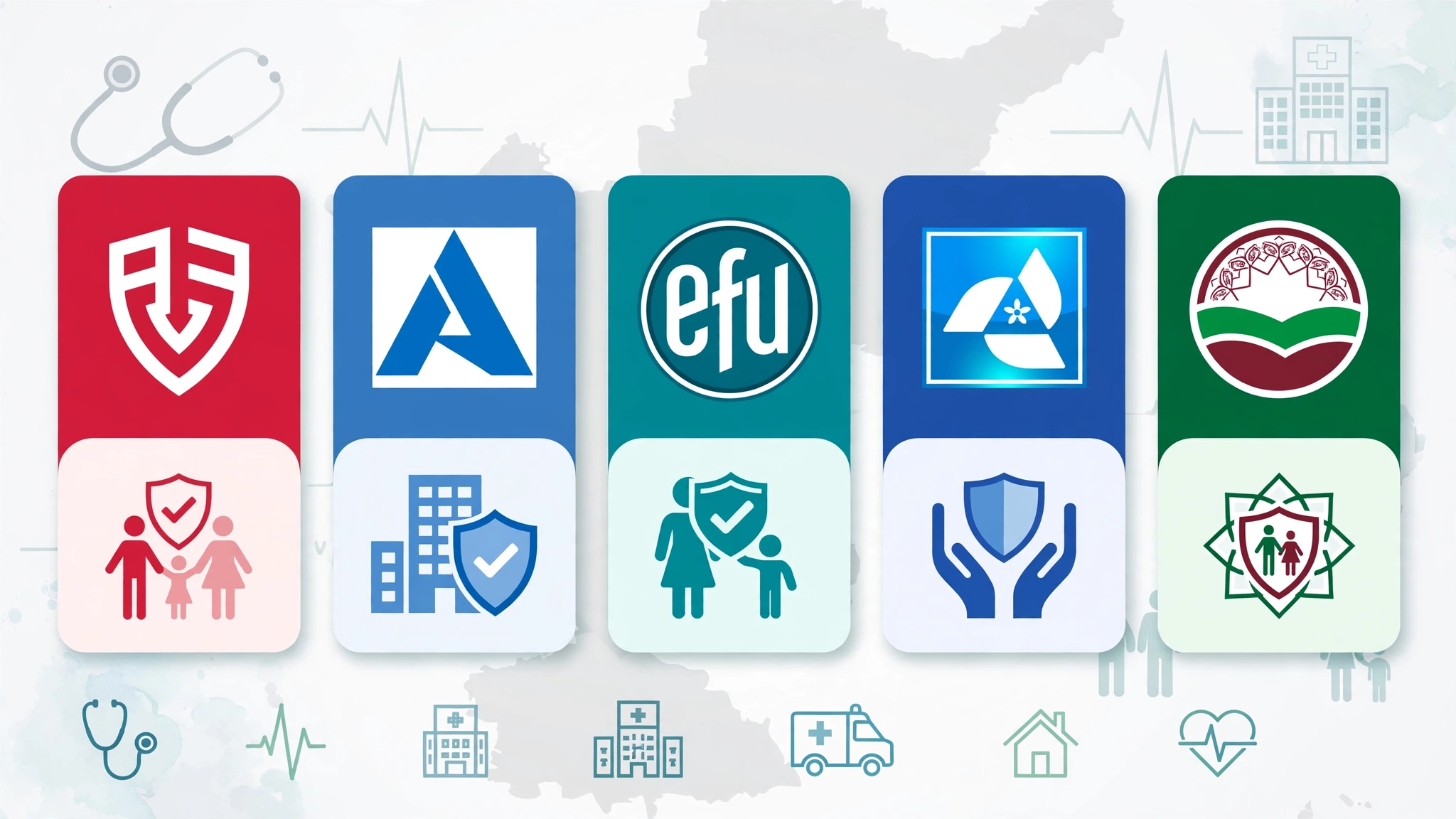
For salaried people, group health insurance through an employer is the most common and often the best value. Companies negotiate bulk rates with insurers such as EFU, Jubilee General, Adamjee, IGI and others, and usually cover the employee, spouse and children.
What to check: Room entitlement, maternity limits, whether parents can be added for an extra fee, and what happens to your cover when you change jobs. Most group health insurance plans end the day you leave, so do not rely on them alone if you have a health condition.
3. Jubilee Health Insurance
Jubilee is one of the largest names in private health insurance in Pakistan, with individual, family and corporate plans. Its panel hospital network is wide in major cities, which makes cashless admission easier. Jubilee health insurance plans usually focus on inpatient cover, with OPD and maternity as add-ons.
4. EFU Health Insurance
EFU is another established insurer with family health insurance plans and strong corporate business. It is a common choice for families looking for hospitalization cover with a recognizable brand. As with all insurers, read the exclusion list carefully, especially for pre-existing conditions.
5. Adamjee, State Life and Other Established Insurers
Adamjee Insurance, State Life and The United Insurance Company (UIC) all offer health insurance products or health riders attached to life policies. State Life’s experience running the Sehat Card gives it a very large hospital network. Health riders on life policies can be useful, but be careful: some of these products are mainly investment plans with a small health benefit attached, which is a classic mis-selling trap.
6. Takaful Health Plans
If you prefer Islamic finance, Takaful health plans from operators such as Pak-Qatar Family Takaful, Salaam Takaful and the window Takaful operations of larger insurers are worth comparing. Benefits are similar to conventional health insurance, including hospitalization, panel hospitals and family cover.
7. Digital, Micro and International Plans
- Digital and micro plans: Several insurers now sell low-cost health insurance through mobile apps, banks and mobile wallets. These are affordable but usually come with small limits, such as a fixed daily cash benefit during admission.
- International plans: Expats and high-income families often choose international health insurance from global insurers such as Cigna, AXA, Bupa or Allianz Care, which offer treatment abroad. These are expensive but give the widest choice of hospitals.
The Reality: Fraud, Mis-Selling and Illegal Practices
This is the part most comparison articles leave out. Health insurance only works if insurers pay honestly, hospitals bill honestly and customers claim honestly. In Pakistan, all three have failed at different times. Knowing these health insurance fraud cases helps you avoid becoming a victim.
Irregularities in the Sehat Card Scheme
- Rs28 billion flagged by auditors. The Auditor General of Pakistan pointed to alleged financial irregularities of more than Rs28 billion in KP’s health card scheme between 2017-18 and 2021-22, including payments to 17 unregistered hospitals. See Profit’s coverage of the KP health card audit.
- Patients steered to private hospitals. In Punjab, a patient from Okara reported that doctors at a government hospital told her to get her operation at a private facility, where her card balance was used. Steering patients this way drains the scheme and can be a conflict of interest.
- Reused supplies billed again. A 2026 audit report alleged that drugs and equipment under the health card scheme were sometimes reused for other patients while still being billed.
- Hospitals removed from the panel. KP suspended 48 hospitals in 2022 after service quality was found unsatisfactory.
Mis-Selling of Insurance Through Banks
The SECP has repeatedly acted against insurance mis-selling, including policies sold as health insurance, especially through bank branches (bancassurance).
- In 2019, the SECP ordered an insurer to refund the full premium to 19 policyholders and claw back commissions paid to banks.
- In another case, it fined a leading insurer Rs400,000 after its bank-based agents kept promising customers that their investment would double in a few years.
- Between 2018 and 2020, the SECP received 3,565 complaints about life, general and health insurance and helped secure about Rs591 million in relief for policyholders.
The common pattern: a customer walks into a bank for a simple transaction and walks out with a “savings plan” that is actually a long-term insurance policy with heavy deductions.
Fake Companies and Forged Claims
- Fake insurance firm in Karachi. The FIA raided a house in the Mochko area near Saeedabad and arrested a man running a fake insurance company that had been selling policies for months.
- Re-insurance scam. The FIA’s corporate crime circle uncovered a scam worth over Rs950 million in which forged re-insurance guarantees were used by more than a dozen private insurers.
- Fake death certificate. In a Karachi case investigated by the FIA, a brother and sister allegedly declared their living mother dead with a forged certificate to collect an insurance payout.
Ethical Lessons for Policyholders
Health insurance fraud is not only something big companies do. Ordinary customers also cross lines, sometimes without realizing it:
- Never hide a pre-existing condition. Non-disclosure is the number one reason health insurance claims are rejected, and deliberate concealment is misrepresentation.
- Never inflate bills. Asking a hospital to add items you did not receive is fraud, and it raises premiums for everyone.
- Never lend your card. Letting a relative use your Sehat Card or company card is illegal and can get your cover cancelled.
- Report wrongdoing. If a hospital pressures you to pay cash for a covered procedure, or an agent lies about a policy, report it.
How to Choose the Right Health Insurance Plan
Use this checklist before you sign any health insurance contract.
- Confirm the company is licensed. Check the health insurance company’s name on the SECP website.
- Look at the panel hospital list. Make sure hospitals near your home are on it.
- Read the exclusions. Pay attention to pre-existing conditions, waiting periods, cosmetic procedures and maternity.
- Compare annual limits, not just premiums. A cheap plan with a tiny limit may not cover a single surgery.
- Check room entitlements and sub-limits. Some plans cap room rent, which reduces what they pay for everything else.
- Ask about age limits and renewal. Many plans stop at a certain age, which matters for health insurance for parents.
- Get everything in writing. If an agent promises something verbally, ask them to show it in the policy document.
- Separate insurance from investment. If someone is selling you “health insurance” that mostly talks about returns, walk away.
How to File a Health Insurance Claim Without Stress
- For cashless treatment: Show your card at the hospital’s insurance desk at admission. The hospital requests approval from the insurer.
- For reimbursement: Keep original bills, prescriptions, test reports and the discharge summary. Submit within the deadline in your policy.
- For the Sehat Card: Carry your CNIC. Go to the Sehat Card desk at the panel hospital before admission.
- If a claim is rejected: Ask for the reason in writing. Complain to the insurer first, then to the SECP or the Federal Insurance Ombudsman if needed.
Common Health Insurance Mistakes People Make
- Buying the cheapest health insurance plan without reading what it covers
- Depending entirely on employer health insurance and losing it when changing jobs
- Not adding elderly parents until they are past the age limit
- Signing bank “insurance” or savings documents without reading them
- Assuming the Sehat Card works the same way in every province
Conclusion
Choosing health insurance in Pakistan means weighing free but changeable government cover through the Sehat Card against employer group plans, private policies from insurers like Jubilee, EFU, Adamjee and State Life, Shariah-compliant Takaful options, low-cost digital plans and pricier international cover, while staying alert to a real history of audit irregularities, bank mis-selling, fake companies and forged claims; the safest approach is to buy only from SECP-licensed providers, check panel hospitals, exclusions and annual limits, disclose your health history honestly, keep insurance separate from investment, and use the SECP and the Federal Insurance Ombudsman if you are treated unfairly, so that your family gets genuine protection when it matters most.