Top Tips Before Buying a Laptop From Hafeez Center or Similar Markets
Hafeez Center laptop buying made safer: 10 tips for testing, warranty, receipts, and spotting stolen or scheme laptops before you hand over your cash.
Top Tips Before Buying a Laptop From Hafeez Center or Similar Markets
Introduction
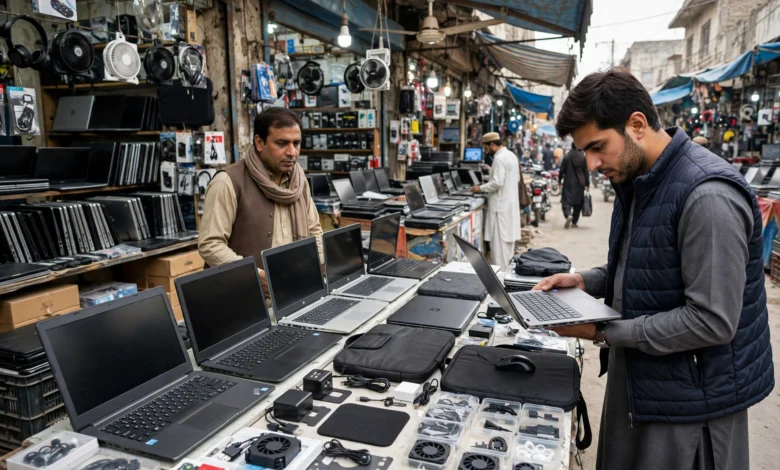
Hafeez Center laptop shopping is almost a rite of passage in Pakistan. Students, freelancers, and small business owners from across Punjab head to this busy building on Lahore’s Main Boulevard Gulberg because it has more laptops, more sellers, and more bargaining room than anywhere else. Karachi’s Saddar and Rawalpindi’s Saddar markets play the same role in their cities. You really can find excellent deals in these places.
You can also lose a lot of money in a very short time. The same corridors that sell honest used business laptops have, at different times, sold government scheme laptops that students were never meant to sell, smuggled stock with no paperwork, stolen machines, and used laptops dressed up as new. Just this month, cybercrime officers raided an illegal call centre operating inside the building itself. None of this means you should avoid these markets. It means you should walk in prepared.
This guide is for that walk. It explains how Hafeez Center and similar markets actually work, which kinds of stock you will be offered, what has gone wrong in the past, and ten practical tips that protect you before, during, and after the sale. You will learn how to check a laptop’s identity, test it properly at the counter, negotiate a fair price, and keep the paperwork that gives you legal rights later. Whether you are buying new, open box, or used, the goal is a good laptop at a fair price, with nobody else’s crime attached to it.
How the Hafeez Center Laptop Market Works
Before you start shopping, it helps to understand what you are walking into. The Hafeez Center laptop trade is not one business. It is hundreds of separate shops, stalls, repair counters, and middlemen, each with its own standards.
Who You Will Meet
- Authorised dealers and brand partners that sell new laptops with official local warranty.
- Importers and bulk sellers that bring in used business laptops, usually from the US, Europe, and the UAE.
- Small resellers who buy a few units from importers or individuals and resell them.
- Repair counters that also sell repaired or rebuilt machines.
- Touts and agents in the corridors who bring customers to shops for a commission. Their cut is added to your price.
Types of Stock
Knowing these labels helps you understand what you are actually being offered.
| Label you will hear | What it usually means | Typical warranty |
|---|---|---|
| New with local warranty | Brand new, imported through official channels | 1 year from the brand’s distributor |
| Box pack | Sealed box, but source and warranty vary | Shop warranty only, unless proven otherwise |
| Open box | Opened or returned unit | Often 7 to 30 days |
| Used or refurbished import | Ex-corporate laptop, cleaned and tested | Often 7 to 30 days check warranty |
| Personal use | Sold by an individual or claimed to be | Usually none |
Similar Markets in Other Cities
The same structure appears in other major tech markets. In Karachi, Saddar and the area around Regal Chowk have sold electronics for decades. In Rawalpindi, the Saddar area is the main hub for computers. Hall Road in Lahore focuses more on electronics and parts but also trades laptops. Every tip in this guide applies to these markets as much as to Hafeez Center.
Why Prices Vary So Much
The same used ThinkPad can differ by Rs 10,000 or more between two shops on the same floor. Condition, battery health, RAM and SSD size, and the shop’s overheads all play a part. So does how experienced you look. Buyers who ask the right questions get better prices.
The Reality Check: What Has Gone Wrong Before
Most Hafeez Center laptop sellers are ordinary traders trying to make an honest living. But the market’s size makes it attractive to people who are not. These real cases explain why the tips later in this guide matter.
1. Government Scheme Laptops Sold Openly
Punjab’s free laptop scheme was meant for high-achieving students. Soon after distribution, Business Recorder reported that Hafeez Centre and Hall Road were openly selling these laptops for around Rs 18,000 to Rs 20,000 each, while the government said it had paid about Rs 35,000 per unit. Later, the Higher Education Commission warned that students who sold Prime Minister’s scheme laptops could have their degrees held back, and that serial numbers would be used to trace units sold illegally.

With a fresh round of free laptops announced for students, these units may show up again. Buying one means buying public property that was never the seller’s to sell.
2. Stolen Laptops Recycled Into Resale
In Islamabad, police arrested two members of a gang that stole from private hostels, recovering 16 laptops along with master keys. Stolen laptops are usually wiped and sold quickly, often to small resellers who do not ask questions. Once a stolen laptop is traced, the buyer can lose both the machine and the money.
3. Smuggled Stock With No Paper Trail
Customs regularly intercept laptops brought in without duty. At Islamabad airport, officials stopped passengers carrying 12 MacBooks and 37 other laptops, along with more than 100 iPhones, worth over Rs 50 million in total. Smuggled stock is often sold as “imported” or “Dubai stock”, without invoices or valid brand warranty.
4. Fraud Operations Inside the Market
In October 2026, the National Cyber Crime Investigation Agency raided an illegal call centre running inside Hafeez Centre itself and arrested its owner and an employee for allegedly defrauding American citizens, as 24NewsHD reported. That came days after a separate NCCIA raid in Lahore’s Johar Town led to 37 arrests and the seizure of 40 laptops. This does not make the shops guilty of anything, but it shows that illegal operators use the same buildings and buy the same equipment.
5. Used Laptops Sold as New
A quieter but common problem is repacking. Used or refurbished laptops are placed in fresh boxes and sold as “box pack” or new. Some buyers only discover it when the brand rejects their warranty claim. Under Punjab’s Consumer Protection Act, false or misleading representation about a product is an unfair practice.
6. Pirated Software as a “Free Bonus”
Many shops install Windows and Office for free on laptops sold with DOS. Unless you receive a genuine license key, that software is pirated. It is illegal, and cracked activators are a common way malware ends up on new machines.
10 Tips Before Buying a Hafeez Center Laptop
These ten tips follow the order of a real shopping trip, from research at home to the moment you walk out with a receipt.
Tip 1: Research Prices Online Before You Go
Check listings on Pakistani retailer sites and seller pages for the exact model you want, so you know the fair range for a Hafeez Center laptop before anyone quotes you. Note the processor generation, RAM, SSD size, and condition, because a small spec difference can change the price a lot.
Tip 2: Decide Your Must-Haves in Advance
Write down your budget and minimum specs: for example, a 12th Gen Core i5, 16 GB RAM, 512 GB SSD, and a Full HD IPS screen. Sellers are skilled at steering buyers toward whatever is in stock. A written list keeps you focused.
Tip 3: Choose Established Shops, Not Corridor Agents
Prefer shops that have a fixed counter, a visible name, a business card, and ideally an online presence with reviews. Politely ignore people who approach you in the corridors offering “the best deal”. They take a commission, and you may end up at a shop with no reputation to protect.
Tip 4: Ask Where the Laptop Came From
Ask directly whether it is new with local warranty, an imported used unit, open box, or personal use. Honest sellers answer clearly. If a laptop is described as “personal use, one owner” but looks like a typical corporate import, be cautious, because this is a common way to charge extra.
Tip 5: Check the Laptop’s Identity
This is the single most important step for avoiding stolen, smuggled, or scheme stock.
- Read the serial number on the bottom sticker.
- Restart into the BIOS and confirm the serial number matches.
- Look up the serial on the brand’s official warranty website, using your phone. It shows the model, original configuration, region, and warranty status.
- Look for government logos, university or company asset tags, custom boot screens, or scraped-off stickers. If you see any, walk away.
Tip 6: Inspect the Body Carefully
Check hinges for looseness, look for cracks near the corners, and check that all screws are present. Uneven gaps, mismatched colours, or a lid that does not quite fit can mean a re-cased or rebuilt laptop. Shiny, worn keys suggest heavy use, which should lower the price.
Tip 7: Test Everything at the Counter
Do not let anyone rush you. Bring a USB drive and earphones, and take 15 to 20 minutes.
- Battery: run
powercfg /batteryreportin Command Prompt and compare full charge capacity with design capacity. Below 70% means a replacement is coming. - Storage: use CrystalDiskInfo to check SSD health and size.
- Screen: view full white and full black images to spot dead pixels, uneven backlight, and bleed.
- Keyboard and touchpad: test every key, including function keys.
- Ports: test every USB port, HDMI, the charging port, and the headphone jack.
- Wi-Fi, webcam, microphone, and speakers.
- Heat: play a video for ten minutes and listen for loud fans.
Tip 8: Inspect the Charger
Many used laptops come with cheap replacement chargers. Check that the brand, wattage, and connector match the laptop. Very light, poorly printed chargers are often counterfeit and can damage the laptop or overheat.
Tip 9: Ask About Windows and Software
Ask whether Windows is genuine and licensed. If the seller “installs Windows for free”, it is almost certainly pirated. Budget for a genuine license, or use a free legal alternative such as Linux.
Tip 10: Get the Warranty and Receipt in Writing
Never leave without a printed or written receipt that includes the shop name and phone number, date, price, laptop model, serial number, and warranty period with what it covers. A Hafeez Center laptop sold with only a verbal promise has no warranty you can enforce