Understanding Data Caps and Fair Usage Policies in Pakistan
Fair usage policy in Pakistan explained: how data caps work on PTCL, Nayatel and mobile bundles, what "unlimited" means, and your consumer rights.
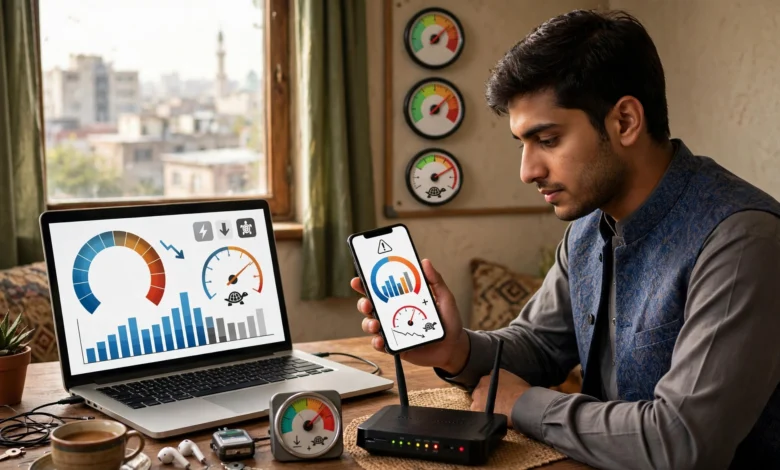
Fair Usage Policy in Pakistan: 7 Shocking Truths About Data Caps You Must Know
Introduction
The fair usage policy in Pakistan is one of the most misunderstood parts of any internet package. You sign up for an “unlimited” broadband plan, stream a few series, let the kids play online games, and then, near the end of the month, the speed suddenly crawls or an extra charge shows up on the bill. The word “unlimited” was in large letters. The limit was in small print.
This gap between advertising and reality is not new. Back in 2011, some wireless broadband packages were sold as unlimited while carrying a cap of around 50 GB a month. In 2014, the Competition Commission of Pakistan (CCP) issued an inquiry report against Wi-Tribe and other internet providers over “unlimited” packages that were actually subject to fair usage limits, saying such marketing could mislead consumers. In November 2025, the Islamabad High Court dismissed petitions by Jazz, Telenor, Zong, Ufone, Warid, PTCL and Wi-Tribe and confirmed that the CCP can investigate deceptive telecom marketing.
This guide explains what data caps and fair usage policies actually are, how major providers apply them, and why they exist in the first place. It also covers the illegal side of the story, from unlicensed operators reselling home connections to grey traffic setups that drain bandwidth, and finishes with practical advice on tracking your usage, choosing the right plan and complaining effectively when a provider crosses the line.
What a Fair Usage Policy in Pakistan Actually Means
Three terms get mixed up constantly. Understanding the difference is the first step to choosing the right package and spotting when something is wrong.
Data Cap
A data cap is a fixed amount of data included in your package, for example 100 GB, 500 GB or 1 TB per month. Once you use it, one of three things happens: the internet stops until you renew, you pay for extra gigabytes, or your speed drops. Mobile data bundles in Pakistan almost always work this way, with daily, weekly and monthly volumes.
Fair Usage Policy (FUP)
A fair usage policy is a cap attached to a package that is marketed as unlimited. The provider promises that normal users will not notice any limit, but heavy users who cross a threshold will face reduced speed or extra charges. In other words, the fair usage policy in Pakistan is often the hidden data cap inside an “unlimited” plan.
Providers defend FUPs on reasonable grounds. Bandwidth, especially international bandwidth, is expensive, and a small number of extremely heavy users, sometimes running commercial operations on home connections, can slow the network for everyone else in the area. The problem is not that FUPs exist. It is when they are hidden, too low for the speed being sold, or changed without clear notice.
Throttling
Throttling, or speed reduction, is what usually happens after you cross an FUP. Your connection keeps working but at a much lower speed, sometimes as low as 1 Mbps. That is enough for WhatsApp messages but frustrating for video calls, streaming or online classes. Some providers restore full speed if you buy extra data, while others wait until the next billing cycle.
Download, Upload or Both?
Providers count usage differently. Some count only downloads, while others count both downloads and uploads. If you upload large files, run cloud backups, or work with video, ask your provider exactly what counts toward the limit before you sign up.

How Providers Apply the Fair Usage Policy in Pakistan
Every operator sets its own rules, and they change over time. The table below summarizes examples from published package terms and reporting. Always check the latest terms on your provider’s website before relying on them.
| Provider or package | How it is marketed | Fair usage or cap detail |
|---|---|---|
| PTCL broadband (2019 policy) | Unlimited | 1 TB allowance for connections under 20 Mbps and a higher allowance for faster plans; extra charges capped at Rs 5,000, after which usage becomes unlimited |
| PTCL 100 Mbps package | Unlimited, Rs 10,999 plus tax | Package listing states that a fair usage policy and taxes apply |
| Nayatel unlimited packages | Unlimited | 1 TB under FUP; speed drops to 1 Mbps until extra GBs are bought; no carry forward and no volume transfer |
| Transworld 1,000 Mbps FTTH | High-speed fiber, Rs 61,600 per month | 8 TB monthly limit, according to PTA tariff data |
| Optix packages | High-speed broadband | Subject to a fair usage policy, per PTA tariff data |
| Mobile data bundles | Daily, weekly, monthly or “unlimited” social bundles | Fixed GB volumes; “unlimited” offers usually carry their own limits or app restrictions |
A useful snapshot of current tariffs comes from the PTA’s own comparison of fixed-line packages, summarized in TechJuice’s report on PTA broadband tariff data. It shows that faster speeds do not automatically mean unlimited usage, and that several plans across PTCL, WorldCall, Wateen, Optix, StormFiber, Transworld and Brainnet carry caps or fair usage conditions.
Reading the Small Print
When comparing packages, look for these phrases in the terms and conditions:
- “Fair Usage Policy applies” or “FUP” with a volume in GB or TB.
- “Speed will be reduced to” followed by a figure such as 1 Mbps or 2 Mbps.
- “Additional charges” or “per GB” pricing after the limit.
- “No carry forward” for unused data.
- “Residential use only” or a ban on sharing, which matters later in this article.
7 Truths About the Fair Usage Policy in Pakistan
Once you look past the advertising, a few patterns show up again and again.
1. “Unlimited” Rarely Means Unlimited
Most unlimited internet packages in Pakistan come with an FUP. This has been true for well over a decade. Early wireless broadband offers in 2011 carried caps of around 40 to 50 GB a month while being sold as unlimited, and customers at the time asked a simple question: why not just say 50 GB? That question is still fair today.
2. Caps Have Not Always Kept Pace With Speeds
In 2019, when PTCL updated its policy to a 1 TB allowance for connections under 20 Mbps, some customers pointed out that years earlier a 4 Mbps plan had a 300 GB limit. As speeds rise, people naturally use more data, especially for HD and 4K streaming. A cap that seemed generous at 10 Mbps can be reached quickly at 100 Mbps.
3. What Happens After the Limit Varies a Lot
Some providers charge extra up to a ceiling, as in PTCL’s 2019 model where usage became unlimited after Rs 5,000 in additional charges. Others, like Nayatel’s unlimited packages, drop speed to 1 Mbps until you buy more data. Mobile bundles simply stop or switch to expensive pay-as-you-go rates. The same “FUP” label can mean very different costs.
4. Unused Data Usually Disappears
“No carry forward” clauses mean that if you use 300 GB of a 1 TB allowance this month, the remaining 700 GB is gone. You pay for a ceiling, not for a bank of data.
5. Taxes Change the Real Price
Advertised prices often exclude taxes. Customers have long complained that the tax portion on broadband bills adds a substantial amount on top of the package price. When comparing plans, always compare the final, tax-inclusive monthly cost.
6. Misleading Marketing Has Been Legally Challenged
The CCP’s 2014 inquiry against Wi-Tribe and other ISPs, and its notices to PTCL over “unlimited” packages, show that regulators have treated hidden limits as a potential consumer protection issue. The Islamabad High Court’s 2025 ruling cleared the way for those investigations to move forward. That matters for every subscriber, because it confirms that marketing claims can be tested in law.
7. Sharing or Reselling Your Package Is Not Allowed
Many packages ban transferring volume or using a residential plan for commercial distribution. Nayatel’s terms, for example, state that customers cannot transfer or receive volume on unlimited packages. Going further and selling your connection to neighbors turns a terms breach into illegal, unlicensed internet provision, as the next sections explain.
The Legal Side of the Fair Usage Policy in Pakistan
Two regulators matter here, and they play different roles.
PTA and CCP: Who Does What
- Pakistan Telecommunication Authority (PTA): Licenses operators, sets quality of service standards, publishes tariff information, and handles consumer complaints about telecom services.
- Competition Commission of Pakistan (CCP): Enforces the Competition Act 2010, including Section 10, which prohibits deceptive marketing practices such as advertising that hides important terms from consumers.
For years, telecom operators argued that only the PTA could regulate their sector. In November 2025, the Islamabad High Court rejected that argument. In a 19-page judgment, Justice Inaam Ameen Minhas held that the CCP’s powers extend across all sectors, including telecom, and that the two laws operate in distinct but complementary areas. You can read a summary in Profit’s report on the IHC ruling.
Past Cases That Shaped the Debate
- Hidden fees on prepaid cards (2013). The CCP issued show-cause notices to Mobilink, Ufone, Telenor, Zong and Warid over deductions of 1 to 5 percent on prepaid reloads, labeled as service, administrative or operational charges, which it classified as deceptive marketing.
- “Unlimited” internet packages (2014). The CCP’s inquiry report against Wi-Tribe and other ISPs found that promoting unlimited packages subject to fair usage limits could mislead consumers. PTCL and Wi-Tribe challenged related notices in court.
- Misleading call rates. The CCP also issued a show-cause notice to Warid over a “minute package” advertisement that, it alleged, did not disclose the actual rates and conditions, as described in this CCP press release on deceptive advertising.
These were allegations and inquiries, and companies had the right to contest them. But together they show that hidden limits and unclear pricing are treated as legal issues, not just customer service problems.
Your Basic Rights as a Subscriber
- The right to clear information about your package, including any fair usage limit, before you buy.
- The right to a bill that matches the advertised and agreed terms.
- The right to complain to your provider and, if unresolved, to the PTA.
- The right to raise misleading advertising with the CCP.
Illegal Activities That Explain Why Data Limits Exist
Providers are not always the villains in this story. Some of the heaviest and most damaging data use on Pakistani networks comes from illegal operations, and fair usage policies are partly a response to them. Knowing these examples also helps ordinary users avoid crossing the line by accident.
Unlicensed Reselling of Home Connections
In many neighborhoods, small operators buy one or a few broadband connections and split them among dozens of homes for a monthly fee, without a license. The PTA, working with the FIA, has raided such setups repeatedly:
- In Lahore, raids on two operations near Ghazi Road found unauthorized internet distribution without a valid license. Two people were arrested and equipment was seized.
- In Gujrat district, raids at Karianwala and Sarai Alamgir found operators supplying internet over fiber and point-to-point links without a license, with optical line terminals, routers and authentication servers seized.
These operations can push huge volumes of traffic through connections meant for single households, which is exactly the kind of use FUPs try to catch. For customers, unlicensed providers offer no quality guarantees and can disappear overnight after a raid.
Grey Traffic Operations
Grey traffic setups route international phone calls over the internet and into local networks through banks of SIM cards, avoiding legal charges. PTA and FIA raids have found these setups running on ordinary broadband and mobile data connections. In one raid in Gulshan-e-Iqbal, Karachi, officials seized gateway equipment, SIMs, wireless routers and broadband connections. Such operations use data around the clock and cost the national exchequer revenue that could support network investment.
Using Other People’s Wi-Fi
When packages run out, some people connect to a neighbor’s Wi-Fi without permission or try apps that claim to crack passwords. Accessing a network without authorization can be an offence under the Prevention of Electronic Crimes Act (PECA) 2016. Many “Wi-Fi hacker” apps are also malware designed to steal the user’s own data.
“Free Internet” and “Unlimited Data” Scams
Messages promising free monthly data, unlimited packages for a small fee, or secret codes to bypass FUPs are common on WhatsApp and Facebook. They are usually phishing attempts to capture OTPs, mobile wallet details or personal information. Genuine offers come only through your operator’s official app, website, or short codes. Financial fraud is the most reported category of cybercrime in Pakistan, so treat these offers with suspicion.
The Ethical Takeaway
It is fair to criticize hidden limits and misleading marketing. It is not fair, or legal, to resell your connection, use someone else’s, or try to cheat the system. Responsible users hold providers accountable through complaints and regulators, not through workarounds that harm other customers.
How Much Data Do You Actually Need?
Before worrying about a cap, it helps to know how quickly your household really uses data. The figures below are approximate and vary by app, settings and device.
| Activity | Approximate data per hour |
|---|---|
| Web browsing, WhatsApp messages, email | 0.05 to 0.1 GB |
| Music streaming | 0.05 to 0.15 GB |
| Online multiplayer games (gameplay only) | 0.05 to 0.1 GB |
| Video calls on Zoom, Meet or Teams | 0.5 to 1.5 GB |
| Video streaming in standard definition | 0.7 to 1 GB |
| Video streaming in full HD (1080p) | About 3 GB |
| Video streaming in 4K | About 7 GB |
Game downloads and updates are the hidden giants. A single large console or PC game can be 50 to 100 GB or more, and one update can consume as much data as weeks of browsing.
A Typical Household Example
Consider a family of five where two adults work from home with three hours of video calls a day each, and the family watches four hours of HD streaming every evening:
- Video calls: about 1 GB per hour × 6 hours × 22 working days ≈ 130 GB
- HD streaming: about 3 GB per hour × 4 hours × 30 days ≈ 360 GB
- Phones, browsing, social media, and background updates: roughly 100 to 200 GB
That adds up to around 600 to 700 GB a month, comfortably under a 1 TB FUP. Add 4K streaming on a large TV, a gamer downloading new titles, or cloud backups of family photos, and the same household can cross 1 TB well before the month ends. This is why knowing your actual usage matters more than the headline speed of your package.
Managing Your Data Under a Fair Usage Policy in Pakistan
A little planning goes a long way toward avoiding throttled speeds and surprise charges.
Track Your Usage
- Use your provider’s app or customer portal. Most broadband and mobile operators show current usage and remaining volume. Check it weekly, not only at the end of the month.
- Check your router. Many modern routers and mesh systems show usage per device, which helps you find which phone, TV or console is using the most data.
- Set alerts on phones. Android and iPhone both let you set mobile data warnings and limits in settings.
Reduce Usage Without Losing Quality
- Set streaming apps to HD instead of 4K on smaller screens, where the difference is hard to see.
- Schedule large game downloads and system updates carefully, and avoid downloading the same game twice on different devices.
- Turn off autoplay on YouTube and social media.
- Limit cloud photo backups to Wi-Fi only and review whether every video needs to be backed up in full resolution.
- Check for unknown devices on your Wi-Fi and change the password if needed, since a neighbor using your connection also uses your data allowance.
Choose the Right Plan
When comparing packages, ask every provider the same questions:
- Is there a fair usage limit, and exactly how many GB or TB?
- Do uploads count toward the limit?
- What happens after the limit: reduced speed, extra charges, or a cap on extra charges?
- What is the total monthly price including all taxes?
- Can I see my usage in an app or portal?
A slightly slower plan with a higher or no fair usage limit may serve a heavy-use household better than a very fast plan with a tight cap.
How to Complain Effectively
- Start with your provider. Call the helpline or use the app, explain the issue clearly, and note your complaint number.
- Keep records. Save screenshots of the package advertisement, your bill, usage records and any messages from the provider.
- Escalate to the PTA. If the provider does not resolve the issue, file a complaint through the PTA’s online complaint system on the PTA website. The PTA forwards complaints to operators and tracks responses.
- Report misleading advertising to the CCP. If you believe a package was advertised in a misleading way, for example as unlimited with a hidden cap, the Competition Commission accepts complaints about deceptive marketing.
Conclusion
The fair usage policy in Pakistan is, in most cases, the hidden data cap inside an “unlimited” package: PTCL, Nayatel, Optix, Transworld and others apply limits ranging from 1 TB to several terabytes, with consequences that vary from extra charges to speeds as low as 1 Mbps, while mobile bundles work on fixed volumes. These limits have a real purpose, since bandwidth is costly and illegal operations such as unlicensed resellers in Lahore and Gujrat and grey traffic setups like the one raided in Karachi push enormous traffic through home connections, but they also have a history of being poorly disclosed, which led the Competition Commission to question “unlimited” marketing by Wi-Tribe and PTCL and the Islamabad High Court in 2025 to confirm the CCP’s power to investigate deceptive telecom practices. The smart response is to know your actual usage, read the small print, compare tax-inclusive prices and post-limit rules, manage heavy activities like 4K streaming and game downloads, avoid illegal shortcuts like reselling connections or using others’ Wi-Fi, and use the provider, the PTA and the CCP to hold operators accountable when limits are hidden or bills do not match what was promised.