How Internet Shutdowns Impact Pakistan’s Digital Economy
Internet shutdowns in Pakistan cost $1.62 billion in 2024. How blackouts hurt freelancers, Pakistani startups, e-commerce, banking and investor trust.
Internet Shutdowns in Pakistan: 7 Alarming Ways They Cripple the Digital Economy
Introduction
Internet shutdowns in Pakistan have become so routine that many people now plan around them. Freelancers check the news before accepting a deadline. Delivery riders keep cash on hand in case the app stops working. Families in Quetta know that a security alert can mean days without mobile data. What used to be an emergency measure has turned into a recurring feature of life online.
The cost is not small. According to Top10VPN, an independent internet monitor, Pakistan lost an estimated $1.62 billion in 2024 because of internet outages and social media blocks, the highest figure in the world that year and more than countries at war. Industry groups such as the Pakistan Software Houses Association (P@SHA) warn that each hour of disruption costs the economy more than a million dollars.
This article looks at the issue honestly. Governments usually order shutdowns in response to real events: violent riots, militant attacks, election-day threats and protests that turned unlawful. Those dangers are real and deserve a fair hearing. But courts have also ruled that some shutdowns were themselves illegal, and the economic damage lands on people who had nothing to do with the original trouble. Below, we walk through what a shutdown actually is, the major incidents behind them, the measurable cost to the digital economy of Pakistan, seven specific ways businesses get hurt, what the courts have said, and what could reduce the damage.
What Counts as Internet Shutdowns in Pakistan
When people hear “shutdown,” they imagine the whole internet switched off. In practice, internet shutdowns in Pakistan come in several forms, and the less dramatic ones often last longer and cost more.
- Mobile data suspensions. The most common type. The Pakistan Telecommunication Authority (PTA) instructs mobile operators to cut 3G and 4G data in a city, district or province, usually at the request of the interior ministry or a provincial home department. Fixed broadband may keep working.
- Full mobile service suspensions. Calls and SMS are cut along with data. These are often used on religious occasions such as Muharram processions or during major security operations.
- Platform blocks. A single service, such as X (formerly Twitter), YouTube or TikTok, is blocked nationwide while the rest of the internet works. Many users switch to VPNs, which brings its own problems.
- Throttling. Speeds are reduced, or particular apps like WhatsApp slow down, without an official announcement. This is the hardest to prove and the most frustrating for businesses, because nobody knows when it will end.
Why the Type Matters for the Economy
A full blackout is visible and usually short. A platform block or unexplained slowdown can drag on for months. That is why the most expensive single disruption in Pakistan’s recent history was not a total shutdown at all, but the long block on X that started in February 2024. For a freelancer in Pakistan or a software house serving foreign clients, a slow and unreliable connection for weeks can be worse than a clean two-day outage.
Major Internet Shutdowns in Pakistan and the Incidents Behind Them
Most internet shutdowns in Pakistan follow a specific trigger. In several cases that trigger was unlawful activity: violent riots, militant attacks, or protests that turned destructive. Listing the incidents next to the shutdowns helps explain why authorities acted, and also shows how often the cost spread far beyond the trouble spot. The table below runs newest first.
| Date | What was shut down | Trigger cited |
|---|---|---|
| Nov 2025 | Mobile internet in rural Balochistan (Nov 10 to 16), after a 24-hour Quetta suspension on Oct 31 | Rising militant attacks and security threats |
| Aug 2025 | Mobile internet across all 36 districts of Balochistan, ordered until Aug 31 | Security concerns; restored in Quetta by court order on Aug 21, then suspended again on Aug 30 |
| Mar 2025 | Further mobile shutdowns in Balochistan | Militants briefly seized Machh town and hijacked the Jaffar Express passenger train |
| Jul to Aug 2024 | Mobile internet in parts of Balochistan for about 864 hours | Protests by the Baloch Yakjehti Committee in Gwadar |
| Feb 2024 | Nationwide block on X, lasting more than a year | Government cited national security and the platform’s non-compliance |
| Feb 8, 2024 | Nationwide mobile service on general election day | Security threats following deadly bombings in Balochistan the day before |
| May 2023 | Nationwide mobile data for several days, plus social media restrictions | Violent attacks on military and public property after the arrest of former prime minister Imran Khan |
| Nov 2017 | Social media platforms during the Faizabad sit-in operation | A long road blockade of Islamabad and clashes during the clearance operation |
What the Pattern Shows
Two things stand out. First, the unlawful acts behind many shutdowns were real and serious. The May 2023 riots involved arson and attacks on sensitive installations, and the Jaffar Express hijacking was a terrorist attack on civilians. Second, the response was usually much broader than the threat. A riot in a few cities led to a nationwide data cut. Attacks in specific districts led to suspensions across an entire province. That gap between the size of the threat and the size of the shutdown is where most of the economic damage comes from.
The Economic Cost of Internet Shutdowns in Pakistan
Putting a number on a shutdown is difficult, but several independent estimates point in the same direction. The most widely cited figures come from Top10VPN’s annual report on the cost of internet shutdowns, as covered in Profit’s report on Pakistan’s $1.62bn losses.
- $1.62 billion in estimated losses in 2024, the highest in the world that year.
- 9,735 hours of disruption, affecting about 82.9 million users.
- 18 intentional shutdowns tracked in 2024, driven by elections, protests and what the report called information control.
- $1.34 billion of the total came from the X block alone.
- $11.8 million from the 864-hour Balochistan shutdown during the Gwadar protests.
Industry voices add their own estimates. P@SHA’s chairman said Pakistan loses more than a million dollars per hour because of shutdowns, and the association has warned of losses of up to $150 million a year from slow internet and VPN restrictions. A 2025 analysis in Aurora, citing P@SHA, put the IT sector’s loss at about $8 million for each day of slowdown, with the wider economy losing at least $24 million per day. Jazz CEO Aamir Ibrahim told Arab News that shutdowns and platform blocks were costing telecom companies and online businesses hundreds of millions of dollars.

A Fair Word on the Methodology
These numbers are estimates, not audited losses. Top10VPN uses the Cost of Shutdown Tool developed by NetBlocks, which applies models based on Brookings Institution and CIPESA research to a country’s GDP and internet use. Critics point out that such tools can overstate losses, since some activity simply moves to another day or another channel. Others argue they understate the damage, because they miss long-term effects like lost clients and investors who quietly go elsewhere. The honest conclusion is that the exact figure is uncertain, but the direction is clear: internet shutdowns in Pakistan cost the economy far more than they appear to on the day they happen.
7 Ways Internet Shutdowns in Pakistan Hurt the Digital Economy
The headline numbers hide very different kinds of damage. Here is how the losses actually land on people and businesses.
1. Freelancers Lose Clients, Not Just Hours
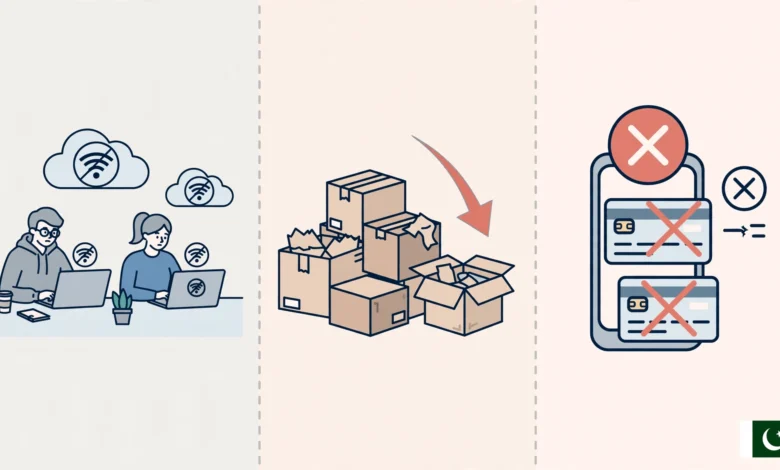
Pakistan has one of the largest freelance workforces in the world, with the Pakistan Freelancers Association putting the number at more than 2.37 million. Most work for clients abroad on platforms like Upwork and Fiverr, where ratings and response times decide who gets the next job. A missed deadline during a shutdown does not just cost a day’s pay. It can mean a bad review, a lower ranking, and a client who quietly moves to a freelancer in another country. Many Pakistani freelancers now keep two or three connections and still lose work when a national mobile shutdown hits.
2. IT Exports and Software Houses Take a Reputation Hit
IT exports are one of Pakistan’s few fast-growing sources of foreign exchange. Software houses sell reliability as much as code. When a foreign client hears that their development team in Lahore or Islamabad is offline because of a government order, it raises a simple question: can this country be trusted with critical work? Former P@SHA leaders have warned about long-term damage to Pakistan’s global reputation, which is much harder to rebuild than a lost week of billing.
3. Startups Struggle to Raise Money and Keep Talent
Investors price risk. A startup ecosystem where connectivity can disappear without notice looks riskier than one where it cannot. Analysts writing in Aurora warned that prolonged disruptions could push startups to relocate to more stable digital environments, adding to brain drain. For young founders, the risk is not only lost revenue but also lost credibility at exactly the moment they are trying to prove themselves.
4. E-Commerce and Digital Payments Stall
Online stores, food delivery apps and digital payments through JazzCash, Easypaisa and Raast all depend on mobile data. During a mobile data shutdown, orders stop, payments fail, and customers fall back on cash. Small sellers on Instagram and Facebook, many of them women running businesses from home, have no backup channel at all. Each shutdown also nudges people back toward cash, slowing the push for financial inclusion that the State Bank and the government have spent years promoting.
5. Gig Workers and Riders Lose Daily Income
Ride-hailing drivers, delivery riders and other gig workers earn by the trip. Without mobile data, the app does not work, and neither do they. For workers living on daily earnings, even a two-day shutdown can mean borrowing to cover food and rent. These are among the people least able to absorb the loss and least connected to whatever event caused the shutdown.
6. Telecom Revenue and Tax Collection Fall
Telecom operators lose data revenue every hour services are suspended, and the government loses the taxes attached to that usage. Jazz’s CEO linked shutdowns and platform blocks directly to losses for the sector. Lower revenue also feeds into investment decisions. Operators weighing expensive upgrades like 5G have to factor in the risk that the networks they build may be switched off.
7. Regional Inequality Gets Worse
The heaviest burden falls on regions that were already behind. Mobile internet arrived late in much of Balochistan, and some districts have gone years with little or no service. Reporting by Global Voices described the Panjgur district as being without mobile internet for four years. Students there struggle to attend online classes, small businesses cannot reach customers, and young people cannot join the freelance economy that is lifting incomes elsewhere. Repeated mobile internet suspension turns a regional security problem into a long-term development problem.
Are Internet Shutdowns in Pakistan Legal? What the Courts Have Said
The legal basis for internet shutdowns in Pakistan has been challenged more than once, and courts have at times sided with citizens.
The 2018 Islamabad High Court Ruling
On February 26, 2018, the Islamabad High Court, in a judgment by Justice Athar Minallah, declared mobile network shutdowns, including mobile internet suspensions, illegal. The court held that the federal government and the PTA could not suspend mobile services on national security grounds except as provided under Section 54(3) of the Pakistan Telecommunication (Re-organization) Act, 1996, which ties such action to the proclamation of an emergency by the President. Digital rights groups called it a landmark decision. You can read the Digital Rights Foundation’s summary of the IHC ruling for more detail.
The federal government challenged the ruling before the Supreme Court, and suspensions on security grounds have continued in the years since. In practice, the IHC judgment set an important principle but did not end the practice.
Recent Court Interventions
Courts in Balochistan have pushed back on long suspensions. In August 2025, after a legal petition, the Balochistan High Court ordered mobile internet in Quetta to be restored within two hours, stressing that prolonged shutdowns affect public access to information and essential services. Services were suspended again days later. In May 2026, a Balochistan court ordered mobile internet restored in areas with no security threats, a sign that judges increasingly expect shutdowns to be targeted rather than blanket.
Why Legality Matters for Business
For investors and companies, the question is not only whether a shutdown is lawful, but whether it is predictable. A clear legal process, with written orders, defined limits and a way to challenge them, gives businesses something to plan around. Repeated orders that courts later question create exactly the kind of uncertainty that pushes capital elsewhere.
The Security Argument and Its Limits
Any honest discussion has to take the government’s reasoning seriously. Authorities frame shutdowns as a security necessity, and there are real arguments behind that view.
The Case for Shutdowns
- Stopping coordination of attacks. Militants can use mobile phones to coordinate operations or trigger remote-controlled explosive devices. Cutting mobile service around sensitive events, such as religious processions, is meant to reduce that risk.
- Slowing the spread of violence. During the May 2023 unrest, officials argued that cutting mobile data helped stop crowds from organizing further attacks on public and military property.
- Limiting incitement and misinformation. Officials have said that viral rumors and inflammatory content during tense moments can lead to real-world harm, and that temporary restrictions buy time.
- Protecting elections. On election day in 2024, the interior ministry pointed to deadly bombings the previous day as justification for suspending mobile service nationwide.
The Case Against
- Effectiveness is doubtful. As Global Voices reported on Balochistan’s shutdowns, militant operations have continued despite repeated blackouts, which raises real questions about whether the shutdowns achieve their goal. Organized groups often have satellite phones, radios or other channels.
- Disproportionate impact. A threat in a few districts is often met with a province-wide or nationwide cut, punishing millions of people who had nothing to do with it.
- Emergency access suffers. People cannot call for help, check on relatives or get accurate information during a crisis, which can make a dangerous situation worse.
- Rights and accountability. Digital rights groups argue that shutdowns restrict freedom of expression and access to information, and that blocking platforms like X during political events looks more like information control than security.
Reasonable people disagree on where the line should sit. What most economists and business groups agree on is that the current approach, frequent, broad and often unexplained, carries a very high economic price for an uncertain security benefit.
How Businesses and Freelancers Can Prepare for Internet Shutdowns in Pakistan
Nobody can stop a government order, but preparation can turn a disaster into an inconvenience. These steps come from what Pakistani freelancers and software houses have learned the hard way.
- Keep a fixed broadband line. Most shutdowns target mobile data. A fiber or DSL connection from a licensed provider often keeps working when 4G goes dark.
- Use two providers on different networks. A backup line from a separate company reduces the chance that one fault or one order takes you fully offline.
- Watch the calendar. Elections, major protests, Muharram and high-tension political dates carry a higher risk. Finish urgent deliverables early during those windows.
- Tell clients in advance. A short, professional note explaining possible disruptions protects your reputation far better than silence followed by a missed deadline.
- Work offline where possible. Sync files locally, download documents and tools ahead of time, and keep work that does not need a live connection for outage days.
- Use VPNs only through legal channels. The PTA has asked businesses and freelancers to register VPNs used for work. A registered, reputable service is safer than a free app that may be blocked or compromised.
- Have a payment backup. Keep some cash and more than one payment method available so a data cut does not stop you from buying essentials or paying staff.
- For companies, write a continuity plan. Decide in advance who works from which location, which clients get notified, and how teams communicate if apps are down.
These measures cost money, which is itself part of the economic damage. Every rupee spent on backup lines and continuity planning is a rupee not spent on growth.
Policy Changes That Would Reduce the Damage
If Pakistan wants to become a serious IT and digital services hub, the way shutdowns are decided needs to change. Industry bodies, digital rights groups and economists have suggested a number of practical reforms:
- Make shutdowns the last resort, not the first. Targeted policing, intelligence work and platform cooperation can address many threats without cutting off millions of people.
- Keep them narrow and short. Limit suspensions to the smallest area and shortest time needed, with automatic expiry unless renewed through a documented process.
- Publish written orders. Every shutdown should come with a public notification stating the legal basis, area, duration and reason. This lets businesses plan and lets courts review.
- Protect fixed broadband and essential services. Keeping home and office broadband running during mobile suspensions would protect most freelancers and software houses without undermining security goals.
- Create a business continuity channel. Registered IT companies, banks, hospitals and payment providers could be given priority access during emergencies.
- Measure and report the cost. The government could publish its own estimates of economic loss for each shutdown, so decision makers see the full price of their choices.
- Respect court rulings. Following the principles set out by the Islamabad High Court and recent Balochistan court orders would rebuild confidence that the rules are stable.
None of this requires Pakistan to ignore real security threats. It simply asks that the response be proportionate to the threat, and that the people paying the economic price are considered before the switch is flipped.
Conclusion
Internet shutdowns in Pakistan are usually a response to real and sometimes unlawful events, from the violent riots of May 2023 to militant attacks like the Jaffar Express hijacking, but their economic cost has grown far larger than the threats they target. Top10VPN estimated $1.62 billion in losses in 2024 alone, with the long block on X accounting for most of it, while industry groups put the hourly cost at more than a million dollars. That damage reaches freelancers who lose foreign clients, software houses whose reliability is questioned, startups that struggle to attract investment, online sellers and gig workers who lose daily income, telecom operators and tax collectors, and whole regions like Balochistan that fall further behind. Courts, from the Islamabad High Court in 2018 to recent Balochistan rulings, have pushed for shutdowns to be lawful, limited and justified, and businesses can soften the blow with backup connections and continuity plans, but lasting protection for Pakistan’s digital economy depends on making shutdowns rare, targeted, transparent and proportionate.