AI in Agriculture How Smart Farming Is Helping Pakistani Farmers
AI in agriculture is changing how Pakistani farmers plant, spray and sell. A realistic look at smart farming, past fraud and the gaps still left.
AI in Agriculture: 7 Powerful Ways Smart Farming Is Helping Pakistani Farmers Succeed
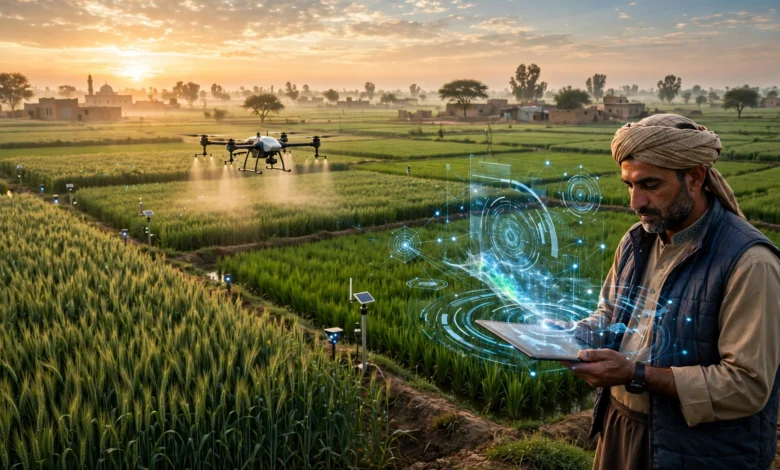
AI in agriculture is no longer a topic reserved for conferences in Islamabad or research labs abroad. It is slowly showing up in the places that matter most: a cotton field in Vehari, a wheat farm near Sahiwal, a small vegetable plot outside Hyderabad. A farmer with a basic phone can now call a number, speak in Urdu, and get weather-based advice on when to irrigate or spray. That was hard to imagine ten years ago.
But let’s be honest about the context. Pakistani farmers have spent decades dealing with fake pesticides, counterfeit seed, hoarded fertilizer, stolen canal water, and middlemen who set prices behind closed doors. Many of these problems were not bad luck. They were illegal activities that went on because nobody was tracking them properly. Technology alone did not cause those problems, and technology alone will not fix them.
This article looks at smart farming in Pakistan with both eyes open. We will cover what AI in agriculture actually does, where it is already helping Pakistani farmers, and how data and monitoring tools can make it harder to repeat some of the frauds of the past. We will also talk about what is not working yet: poor connectivity, low trust, farm data privacy, and the risk that big farms benefit while small farmers get left behind.
If you are a farmer, a student, a policymaker, or just curious about where Pakistan’s food is headed, this is a realistic picture of where things stand in 2026.
Why AI in Agriculture Matters for Pakistan Right Now
Agriculture is not a side sector in Pakistan. It is the backbone of the rural economy. Pakistan’s agriculture sector contributes nearly 23 percent to the national GDP and remains a vital source of livelihood for millions in rural communities. Other estimates put the share of the workforce involved in farming well above a third of all workers. arabnews
At the same time, the pressures on farming keep growing:
- Water scarcity is getting worse, and groundwater tables are falling in many districts.
- Climate change brings heatwaves, erratic rain, and floods like those of 2022 that wiped out crops across Sindh and Balochistan.
- Input costs for fertilizer, diesel, and electricity have risen sharply.
- Yields per acre for wheat, cotton, and rice remain below those of neighbouring countries.
This is where AI in agriculture earns its place. It does not replace the farmer’s experience. What it can do is take information that used to be expensive or unavailable (satellite images, soil readings, weather forecasts, market rates) and turn it into simple advice a farmer can act on.
What “Smart Farming” Actually Means
Smart farming is a broad term. In practice, it usually includes:
- Sensors in the field that measure soil moisture, temperature, and humidity.
- Satellite and drone imagery that shows crop health across large areas.
- Machine learning models that predict disease, pest attacks, or yield.
- Mobile apps and voice services that deliver advice in local languages.
- Digital records for land, subsidies, and input sales.
AI in agriculture sits in the middle of all this. It is the part that reads the data and says “your field is likely to face a pest attack this week” or “irrigate in two days instead of today.”


How AI in Agriculture Is Helping Pakistani Farmers: 7 Real Examples
Here are the areas where AI in agriculture is already making a practical difference, along with honest notes on how far each one has actually spread.
1. Voice-Based Crop Advisory in Urdu
Literacy is one of the biggest barriers for digital farming tools in Pakistan. An app full of English menus is useless to a farmer who never finished school. That is why voice services matter.
In April 2026, Telenor launched “Kissan Dost Bashir,” which it described as the country’s first AI-powered conversational agriculture voice bot, available in Urdu around the clock by dialing 7272 or through the 7272.pk portal. The bot offers real-time rates, weather-based crop advisory and livestock guidance to farmers who face literacy and connectivity challenges. You can read the full announcement in Arab News coverage of Telenor’s AI farming voice bot. arabnewsarabnews
This builds on older services like Khushaal Zamindar that sent recorded advisories to millions of phones. The difference now is that the farmer can ask a question in their own words and get a response, rather than just listening to a fixed message.
Reality check: a voice bot is only as good as the agronomy behind it. If the advice is generic or wrong for a specific district, farmers will stop calling. Trust takes years to build and one bad season to lose.
2. Crop Disease and Pest Detection
Crop disease detection is one of the most useful applications of AI in agriculture. A farmer takes a photo of a leaf, and a computer vision model identifies whether it is whitefly damage, leaf curl virus, rust, or a nutrient deficiency.
This matters a lot for cotton. Pakistan’s cotton output crashed badly in 2015 partly because of pink bollworm and whitefly, and pest pressure has remained a serious problem since. Early detection means a farmer sprays the right chemical at the right time instead of spraying blindly and wasting money.
Benefits include:
- Lower pesticide use, which saves money and reduces health risks
- Faster response before an infestation spreads to neighbouring fields
- Better records for extension workers tracking outbreaks by district
3. Weather-Based Farming Decisions
Pakistan’s weather has become harder to predict. A weather-based crop advisory uses forecast data plus crop models to tell farmers when to sow, irrigate, spray, or harvest.
Back in 2020, the Punjab Information Technology Board took an early step here. PITB signed an MoU with Sync & Secure Technologies and visited the Adaptive Research Center in Vehari to deploy agro-stations that use AI to adapt to climate change and help farmers take timely actions. That project was small, but it showed that local weather stations combined with AI could give field-level advice rather than broad regional forecasts. pitb
For a wheat farmer, knowing that heavy rain is coming two days before harvest can save an entire season’s income.
4. Precision Irrigation and Water Management
Water is Pakistan’s most precious farm input, and a huge amount of it is wasted through flood irrigation. Precision agriculture tools use soil moisture sensors and satellite data to estimate exactly how much water a field needs.
Some farms in Punjab and Sindh now use sensor-based systems that tell them when the soil is actually dry, rather than irrigating on a fixed schedule. Combined with drip or sprinkler systems, this can cut water use significantly while keeping yields stable.
AI in agriculture also helps at the canal level. Satellite data can show which areas are receiving water and which are not, which leads directly to one of the most sensitive topics in Pakistani farming: water theft.
5. Satellite Crop Monitoring and Yield Estimates
Satellite crop monitoring lets government departments and private companies estimate how much wheat, rice, sugarcane, or cotton is growing across the country before harvest.
Why does that matter? Because bad estimates have led to bad decisions. When the government does not know how much wheat the country actually has, it may export too much, import too late, or fail to spot hoarding. Accurate yield estimates from AI in agriculture tools make those decisions more grounded in facts.
Private agritech startups in Pakistan now offer satellite-based field reports to farmers, banks, and insurers. A bank can check whether a field actually has a crop on it before approving a loan, and an insurer can verify flood damage without sending someone out to every village.
6. Market Price Information and Fairer Selling
For generations, many Pakistani farmers sold their crops at whatever price the local arhti (commission agent) offered. The farmer often had no idea what the same produce was selling for in Lahore, Karachi, or Multan that morning.
Mobile farming apps now show daily mandi rates. Some platforms go further and connect farmers directly with buyers. AI models can also predict price trends, helping a farmer decide whether to sell now or store for a few weeks.
This does not remove middlemen entirely, and many arhtis provide credit that farmers depend on. But information shifts the balance of power a little toward the farmer.
7. Research, Hydroponics, and Controlled Farming
Pakistani universities are also experimenting with AI in agriculture in controlled settings. One university project aims to create a test bed based on hydroponics that integrates IoT and AI to create an effective, controlled, and autonomous environment for plant growth. The project described in Dawn’s analysis of AI for agriculture in Pakistan uses an IoT interface to measure total dissolved solids, pH, humidity, and temperature. indepthnewsdawn
This kind of farming will not replace wheat fields in Punjab, but it can matter for urban vegetable production near big cities, where land is expensive and water is limited.
Learning from the Past: Illegal Activities That Hurt Pakistani Farmers
Any honest discussion of AI in agriculture in Pakistan has to deal with the history of fraud and illegal practices that farmers have suffered. These are not abstract risks. They have cost farmers billions of rupees and, in some cases, entire harvests.
Fake and Adulterated Pesticides
For years, provincial agriculture departments have run raids on shops and warehouses selling fake or substandard pesticides. Farmers who bought these products sprayed their crops, saw no effect, and lost their harvest to pests. Many never even knew the product was fake. They simply blamed the weather or their own luck.
How AI and digital tools can help:
- Barcode and QR verification systems let a farmer scan a product and confirm it is registered
- Digital sales records make it easier to trace which dealer sold a bad batch
- Pattern detection can flag areas where many farmers report “pesticide not working” at the same time, which may signal a fake batch in circulation
Counterfeit and Uncertified Seed
Fake or uncertified seed, especially for cotton, has been a long-running problem. Seed sold as a particular variety often turned out to be something else, with poor germination or no pest resistance. Farmers only found out months later, when it was too late to replant.
Digital seed certification and traceability, combined with crop disease detection that spots unexpected plant behaviour early, can reduce this. But it only works if enforcement follows the data.
Fertilizer Hoarding and Urea Smuggling
During the 2021 and 2022 urea shortages, farmers queued for hours outside dealers, only to be told there was no stock. Meanwhile, reports and official crackdowns pointed to hoarding and urea smuggling across the western border, where prices were higher. Farmers ended up paying well above the official rate on the black market.
Digital tracking of fertilizer from factory to dealer to farmer, including systems linked to a farmer’s CNIC, makes it much harder to divert large quantities without leaving a trail. AI can flag dealers whose sales patterns look abnormal, such as huge stock received and very few verified sales to farmers.
Canal Water Theft
Water theft from canals has been a problem in Punjab and Sindh for decades. Influential landowners at the head of a canal install illegal outlets or widen their share, and the farmers at the tail end get little or nothing. Irrigation departments have registered cases and run anti-theft drives, but enforcement has always been patchy.
Satellite imagery and water management models can show which fields are green and which are dry along a canal system. When tail-end fields are consistently dry while head-end fields flood, that data is hard to argue with. It will not stop a powerful landlord on its own, but it gives officials and affected farmers evidence they did not have before.
Wheat and Sugar Crises
The 2020 wheat and sugar crises led to official inquiries that pointed to hoarding, poor export decisions, and profiteering. Better satellite crop monitoring and real-time stock tracking could have given decision-makers a clearer picture of actual supply, and made hoarding more visible.
Land Record Fraud
Before land records were digitized in Punjab, the local patwari controlled the paper records, and forged ownership or disputed boundaries were common. Digitization has reduced this, though it has not ended it. Combining digital land records with satellite mapping adds another layer of verification.
Illegal Crop Residue Burning
Burning rice stubble is banned in Punjab during the smog season, yet it continues because it is the cheapest way to clear a field. Satellite fire detection now allows authorities to identify burning locations quickly. This is a clear example of AI in agriculture being used for enforcement, though the fairer long-term fix is giving farmers affordable alternatives like residue management machinery.
The Ethical Side of AI in Agriculture
Technology is not neutral. How AI in agriculture is designed and used decides who benefits and who gets hurt.
Farm Data Privacy and Ownership
When a farmer uses an app, the company collects data on their land, crops, yields, finances, and location. Important questions follow:
- Who owns that data?
- Can it be sold to banks, input companies, or traders?
- Could it be used against the farmer, for example, to deny a loan or push up input prices?
Pakistan’s data protection framework is still developing. Until clear rules exist, farm data privacy depends largely on the goodwill of the companies involved. Farmers deserve plain-language explanations of what happens to their information.
The Risk of Leaving Small Farmers Behind
Most farms in Pakistan are small, often under 12.5 acres. Many small farmers do not own smartphones, have weak mobile signals, and cannot afford sensors or drones. If smart farming in Pakistan mainly helps large commercial farms, it could widen the gap between rich and poor farmers.
Voice services, shared equipment through cooperatives, and government-subsidized advisory services are some ways to keep small farmers included.
Digital Scams Targeting Farmers
As more farming moves onto phones, scammers follow. Fake SMS messages claiming to offer subsidies, fake “Kissan package” registrations, and fraud calls asking for CNIC details or bank information have all been reported. Farmers who are new to digital services are especially vulnerable.
Any rollout of agritech in Pakistan needs to include basic digital safety awareness. A farmer should know that a real government scheme will not ask for their PIN over the phone.
Overpromising and Hype
Some companies market “AI” products that are little more than a basic weather app. Overpromising damages trust. When a farmer is told an app will double their yield and it doesn’t, they may reject all digital tools, including the useful ones. Honest, modest claims backed by field results serve everyone better.
Challenges Slowing Down Smart Farming in Pakistan
Even with good intentions, several practical barriers slow the adoption of AI in agriculture:
- Connectivity: many rural areas still have weak 3G or 4G coverage, which limits real-time apps.
- Cost: sensors, drones, and precision equipment are expensive for small farmers.
- Local data gaps: AI models trained on data from other countries may not fit Pakistan’s soils, crop varieties, or climate.
- Weak extension services: there are too few agriculture officers per farmer, so technology often lacks human follow-up.
- Trust: farmers who have been cheated before by fake inputs or middlemen are naturally cautious about new systems.
- Electricity and power supply: unreliable power affects both sensors and charging devices.
- Policy follow-through: projects often start with announcements and fade when funding or political attention shifts.
The Food and Agriculture Organization’s work in Pakistan has repeatedly highlighted that building farmer capacity and institutions matters as much as the technology itself.
What Needs to Happen Next
For AI in agriculture to truly help Pakistani farmers, a few things need to line up:
- Build local datasets. Universities, provincial agriculture departments, and startups should share anonymized data on soil, pests, and yields specific to Pakistan.
- Keep it in local languages. Urdu, Punjabi, Sindhi, Saraiki, and Pashto voice support will reach far more farmers than text apps.
- Link data to enforcement. Tracking fake pesticides, fertilizer diversion, and water theft only helps if authorities act on what the data shows.
- Protect farmer data. Clear consent rules and limits on data selling are essential.
- Support cooperatives. Groups of small farmers can share drones, sensors, and machinery they could never afford alone.
- Train young people. Pakistan’s large young population can become field technicians, data collectors, and local digital advisers.
- Measure real results. Pilot projects should publish yield, cost, and income results so farmers can see what actually works.
Is AI in Agriculture Worth It for the Average Farmer?
This is the question that actually matters. For most small farmers today, the most useful forms of AI in agriculture are the cheap and simple ones: weather advisories, pest identification by photo, mandi price updates, and input verification. These cost little or nothing and can prevent expensive mistakes.
Sensors, drones, and full precision agriculture setups make more sense for larger farms or for groups of farmers who pool resources. Over time, as costs fall and connectivity improves, these tools should become more accessible.
The biggest gains may not come from any single app. They will come from a farming system where fake inputs are harder to sell, water is harder to steal, prices are easier to check, and decisions are based on real information rather than guesswork.
Conclusion
AI in agriculture is helping Pakistani farmers in real but uneven ways, from Urdu voice bots and pest detection apps to satellite crop monitoring and precision irrigation, while also giving authorities better tools to track the illegal practices that have hurt farmers for decades, such as fake pesticides, counterfeit seed, urea smuggling, canal water theft, and crop hoarding. The technology works best when it stays simple, speaks the farmer’s language, protects their data, and is backed by honest enforcement, and it fails when it is oversold, ignores small farmers, or opens new doors for digital scams. Smart farming in Pakistan is still in its early stages, but if it is built with fairness and ground reality in mind, it can make farming more profitable, more transparent, and more resilient for the millions of families who depend on it.
Keywords: