Best Car Gadgets to Improve Your Driving Experience
Car gadgets that make driving safer and easier in 2026: dash cams, OBD2 scanners, HUDs and more, plus the illegal devices that cost drivers thousands.
Best Car Gadgets to Improve Your Driving Experience
Introduction: Why Car Gadgets Matter More Than You Think
Car gadgets used to mean a fuzzy dice set and a tape adapter. Today they can record a crash, warn you about a slow puncture, read your engine’s error codes and put directions in front of your eyes so you never glance down at your phone. That is a real upgrade, and you do not need a new car to get it.
But there is a catch most buying guides skip. Not every gadget sold online is legal to use, and some of the cheapest ones have landed ordinary drivers in serious trouble. One Florida commuter was fined $48,000 for a device he thought made the roads safer. A New Jersey truck driver lost his job after a $100 plug-in gadget interfered with a navigation system at a major airport.
This guide covers the best car gadgets worth your money in 2026, grouped by what they actually do for you: safety, navigation and connectivity, maintenance, and comfort. For each one, you will get a plain explanation of how it helps, who it suits, and what to watch for before you buy. Then we will look at the gadgets you should avoid entirely, using real enforcement cases, so you can upgrade your car without breaking the law or putting anyone at risk.
The goal is simple. Spend less time fighting your car and more time enjoying the drive, safely and legally.
Safety Car Gadgets That Can Save Your Life (and Your Wallet)
If you only buy one or two car gadgets this year, start here. Safety gadgets earn their place the first time something goes wrong, and they often pay for themselves through avoided repair bills or a settled insurance dispute.
The stakes are real. According to the NHTSA’s distracted driving data, 3,308 people were killed and about 289,310 were injured in 2022 in crashes involving distracted drivers. Good car gadgets reduce the reasons you take your eyes off the road. Bad ones add to them.
1. Dash Cam
A dash cam is the most useful of all safety car gadgets because it works even when you do nothing. It records the road continuously and saves the clip automatically when it senses an impact.
Why it matters in practice:
- Insurance disputes: When two drivers tell different stories, video settles it quickly.
- Fraud protection: Staged “crash for cash” collisions, where a driver brakes hard on purpose so you rear-end them, are a known insurance scam in several countries. Dash cam footage is one of the main reasons many of these claims fall apart.
- Parking incidents: Models with a parking mode record bumps and break-in attempts while you are away.
What to look for: at least 1440p front resolution, a supercapacitor instead of a lithium battery (it handles heat far better in a parked car), and a rear camera if your budget allows. Mount it behind the rear-view mirror so it does not block your view, since some regions restrict windshield-mounted devices.
2. Tire Pressure Monitoring System (TPMS)
Older cars often lack a built-in tire pressure monitoring system. An aftermarket kit uses small sensor caps or internal sensors and shows live pressure and temperature on a dashboard screen or your phone.
Low pressure hurts fuel economy, wears tires unevenly and raises the risk of a blowout at highway speed. A TPMS is one of those car gadgets you forget about until it warns you of a slow leak before you are stuck on the shoulder.
3. Blind Spot Detection Kit
Aftermarket blind spot kits use radar sensors behind the rear bumper and small warning lights near the side mirrors. They are especially helpful in older cars, SUVs with thick pillars and anyone driving on busy multi-lane roads. Professional installation is worth it here, because a badly placed sensor gives false alerts and you will start ignoring it.
4. Wireless Backup Camera
A backup camera helps you see children, pets, bollards and low walls that are invisible from the driver’s seat. Wireless versions mount on the license plate and send video to a small monitor or your phone. If your car has a screen already, a wired camera that plugs into it usually gives a cleaner, more reliable picture.
5. Portable Jump Starter
A portable jump starter is a compact lithium battery pack that can start your car without another vehicle. Most also double as a power bank with USB-C ports. Choose one rated for your engine size (diesel and large V8 engines need more peak current) and keep it charged every few months.
6. Emergency Escape Tool
This is the cheapest item on the list and the one you hope never to use. A small tool with a seatbelt cutter and window breaker, mounted within reach of the driver, can matter in a flood or rollover. Note that many breakers cannot shatter laminated side glass, which some newer cars use, so check your car’s glass type first.
Navigation and Connectivity Car Gadgets for Hands-Free Driving
The second group of car gadgets solves the biggest daily problem for most drivers: the phone. You need it for maps, music and calls, but holding it is dangerous and illegal in many places. These gadgets keep the phone useful without keeping it in your hand.
7. Phone Mount with Wireless Charging
A solid phone mount is the simplest fix for distracted driving. Magnetic MagSafe-style mounts and clamp mounts with built-in Qi charging keep the screen at eye level and topped up. Good placement means a quick glance, not a head turn. Avoid mounts that sit in the middle of the windshield, and skip cheap vent clips that drop your phone on the first pothole.
8. Wireless CarPlay or Android Auto Adapter
If your car supports Apple CarPlay or Android Auto only through a cable, a wireless CarPlay adapter removes the cable. Plug the small dongle into the USB port once, and your phone connects automatically every time you start the car. It is among the most satisfying car gadgets for daily commuters. Expect a small audio delay on some models, and check compatibility with your car before buying.
9. Head-Up Display (HUD)
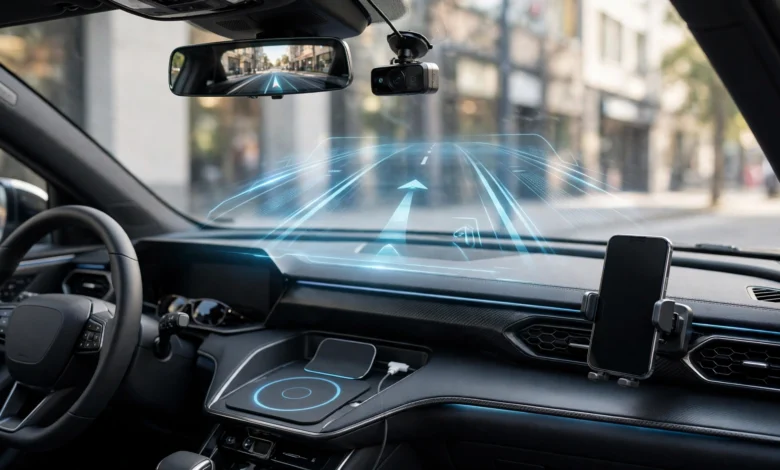
A head-up display projects speed, navigation arrows and sometimes warnings onto the windshield or a small transparent panel. The point is to keep your eyes up and forward. Aftermarket HUDs vary a lot in brightness, so read reviews about daylight visibility. Simple models that only show speed through the OBD2 port are cheap and work well.
10. Bluetooth Hands-Free Kit or FM Transmitter
Older cars without Bluetooth can still go hands-free. A visor speakerphone or a Bluetooth FM transmitter that plugs into the 12V socket lets you take calls and stream audio through your speakers. Of all the car gadgets for older vehicles, this one does the most for the least money. Pick one with a physical answer button you can find without looking.
Maintenance Car Gadgets That Help You Avoid Big Repair Bills
Some car gadgets are less exciting but save real money. These help you understand what your car is telling you before a small issue becomes an expensive one.
11. OBD2 Scanner
Every car sold in the US since 1996 (and most cars elsewhere from the early 2000s) has an OBD2 port under the dashboard. A Bluetooth OBD2 scanner plugs into it and shows engine fault codes, live sensor data and readiness for emissions tests on your phone.
How it helps in real life:
- Your check engine light comes on.
- The scanner reads the code, for example a loose gas cap or a failing oxygen sensor.
- You decide whether to tighten the cap, book a repair or keep driving carefully.
- When you visit a mechanic, you already know what to ask about, which makes it harder for anyone to overcharge you.
One caution: some apps let you clear codes. Clearing a code does not fix the fault, and resetting codes right before an emissions inspection to hide a problem is not allowed in many places.
12. Portable Tire Inflator
A cordless tire inflator sets a target pressure and stops automatically. It is faster than hunting for a working air pump at a petrol station and pairs well with a TPMS. Choose one with a USB-C rechargeable battery and an accurate gauge.
13. GPS Tracker for Your Own Vehicle
A small GPS tracker hidden in your own car can help police recover it after theft. Some insurers even reward it. This is one of the legitimate car gadgets that has a dark side, which we cover in the legal section below. The short version: track your own property, never another person.
Comfort and Convenience Car Gadgets for Everyday Driving
Comfort matters more than people admit. A tired, uncomfortable or annoyed driver makes worse decisions. These car gadgets make long commutes and road trips easier on your body and your mood.
14. Multi-Port USB-C Fast Charger
Most cars still have too few charging ports, and the built-in USB-A ports are often slow. A 12V USB-C car charger with power delivery can fast-charge a phone and a laptop at once. Buy from a known brand. Cheap chargers can overheat, and a burnt-out 12V socket is an annoying repair.
15. Cordless Car Vacuum
A compact car vacuum keeps sand, crumbs and pet hair under control. Cordless USB-C models fit in the glovebox or door pocket. A clean cabin feels calmer to drive in, and it helps resale value.
Honorable Mentions
These did not make the main list, but they are worth considering depending on how you drive:
- Seat cushion and lumbar support: Helpful on long drives if your seat lacks adjustable lumbar support.
- Trunk organizer: Stops groceries and tools from sliding around and becoming projectiles in a hard stop.
- Sunshades for side windows: Useful for families with young children in hot climates.
- Car air purifier: Helpful in heavy traffic and dusty cities, though results vary a lot between models.
Quick Comparison of the Best Car Gadgets
| Gadget | Main benefit | Best for | Typical price (USD) |
|---|---|---|---|
| Dash cam | Evidence in crashes and disputes | Every driver | 60 to 300 |
| TPMS kit | Early warning of tire problems | Older cars | 30 to 100 |
| Blind spot kit | Lane-change safety | Older cars, SUVs | 100 to 400 plus fitting |
| Backup camera | Safer reversing | Families, large vehicles | 40 to 200 |
| Portable jump starter | Start without help | Everyone, cold climates | 60 to 200 |
| Emergency escape tool | Exit in an emergency | Every driver | 10 to 25 |
| Phone mount | Hands-free navigation | Every driver | 15 to 60 |
| Wireless CarPlay adapter | No cables | Commuters | 50 to 120 |
| Head-up display | Eyes stay on the road | Highway drivers | 30 to 200 |
| Bluetooth kit or FM transmitter | Hands-free calls | Older cars | 20 to 60 |
| OBD2 scanner | Diagnose faults yourself | DIY owners | 20 to 120 |
| Tire inflator | Fix pressure anywhere | Road trippers | 40 to 100 |
| GPS tracker (own car) | Theft recovery | High-theft areas | 30 to 150 |
| USB-C fast charger | Faster charging | Families, remote workers | 20 to 50 |
| Car vacuum | Clean cabin | Parents, pet owners | 30 to 100 |
Prices are approximate ranges from common retailers and will vary by region and brand.
Illegal Car Gadgets: Real Cases Every Driver Should Know
This is the part most lists of car gadgets leave out. Online marketplaces sell plenty of devices that are illegal to use on public roads. The sellers rarely mention that, and the buyer carries the risk. Two real cases show how fast a cheap gadget can turn into a life-changing fine.
Case 1: The Florida Commuter and His Cell Phone Jammer
Jason Humphreys of Seffner, Florida, carried a cell phone jammer in his Toyota Highlander during his daily commute along Interstate 4 near Tampa. He told investigators he wanted to stop other drivers from talking on their phones. In his mind, it was a safety gadget.
The reality was different. Mobile carrier MetroPCS noticed its towers suffering interference at the same times every weekday and reported it. The Federal Communications Commission and the local sheriff’s office tracked the signal to his car. The jammer did not only block chats. It could also block 911 calls and interfered with police radio. In its official news release on the case, the FCC warned that his jamming could have had disastrous consequences by preventing people from reaching emergency services.
The FCC confirmed a $48,000 penalty in 2016, the maximum for the three violations it found. Because he used the device for up to two years, the agency noted the fine could have gone much higher.
The lesson: Good intentions do not make an illegal device legal. In the United States, it is illegal to market, sell or use a signal jammer at all.
Case 2: The Truck Driver Who Jammed an Airport
In August 2012, Gary Bojczak was driving a company pickup truck near Newark Liberty International Airport in New Jersey. His employer had installed a GPS tracker in the truck, and he did not want his boss following his movements. So he bought a cheap GPS jammer, reportedly around $100, and plugged it into the cigarette lighter.
That little device interfered with a new satellite-based landing guidance system being tested at the airport. The FAA reported the problem, and an FCC agent used direction-finding equipment to trace the signal to his red Ford F-150. He admitted to using the jammer and handed it over. According to a CBS New York report, he faced a fine of about $32,000 and lost his job. The FCC later reduced the amount he had to pay under a settlement, on the condition that he stay out of trouble.
The lesson: A gadget meant to protect your privacy from one employer can endanger aircraft carrying hundreds of people. Jammers do not stay inside your car.
Other Car Gadgets That Can Get You in Trouble
Jammers are the most extreme example, but they are not the only risky car gadgets. Check local law before you install any of these:
- Radar and laser jammers: Radar jammers are illegal under US federal law, and many states also ban laser jammers. Most other countries prohibit both.
- Radar detectors: Legal for passenger cars in most US states, but banned in Virginia, Washington DC and in commercial vehicles over 10,000 pounds. Many countries ban them outright.
- GPS trackers on someone else’s car: Tracking your own car is fine. Hiding a tracker on a partner’s, ex’s or neighbor’s vehicle can be a crime in many places, and courts have treated covert tracking as stalking. Apple and Google added unknown tracker alerts to their phones after widespread reports of small Bluetooth trackers being misused this way.
- Number plate covers and anti-camera sprays: Products sold to hide plates from speed or toll cameras are illegal in most jurisdictions.
- Dash cams with audio: Recording video of the road is generally allowed, but recording passengers’ conversations without consent can break wiretap laws in some places. Tell passengers, or turn audio off.
- Screens in the driver’s view: Playing video where the driver can see it while moving is illegal in many regions, even through an otherwise legal head unit.
Ethical Rules of Thumb for Car Gadgets
If a gadget fails any of these tests, skip it:
- Does it interfere with anyone else’s signals or devices? If yes, it is almost certainly illegal.
- Does it track or record someone without their knowledge? If yes, it can be a crime.
- Does it help you hide from police, cameras or tolls? If yes, the fine will cost more than the ticket you were avoiding.
- Does it pull your eyes or hands away from driving? If yes, it makes you less safe, whatever the box says.
How to Choose the Right Car Gadgets for Your Car
With hundreds of car gadgets on sale, it helps to have a simple filter before you spend anything.
Start With Your Biggest Problem
List what actually annoys or worries you when you drive. If it is phone handling, start with a mount and a wireless adapter. If it is breakdowns, an OBD2 scanner and jump starter come first. If it is other drivers, get a dash cam. The best car gadgets solve a problem you really have, not one an advert invented.
Check Compatibility First
Many returns happen because the gadget does not fit the car. Before buying:
- Confirm your car’s model year supports the adapter or scanner.
- Measure the space for mounts and screens.
- Check whether your 12V socket stays powered when the engine is off, since this affects dash cam parking mode and battery drain.
Buy From Brands That Stand Behind Their Products
Safety-related car gadgets should come from sellers with a real warranty, clear certifications and reviews that mention long-term use. A no-name dash cam that fails on the one day you need it is worth nothing.
Install Neatly and Safely
Route cables along trim panels, never across airbags or the driver’s view. If a gadget needs wiring into the fuse box, use a fuse tap or a professional installer. Loose wires and overloaded sockets are a common cause of electrical faults.
Keep Distraction to a Minimum
Set up navigation, playlists and gadget settings before you move. Even legal car gadgets become dangerous if you fiddle with them at 100 km/h.
Conclusion
The right car gadgets can make your drive safer, cheaper and far less stressful: a dash cam to protect you in disputes, a TPMS and OBD2 scanner to catch problems early, a phone mount and wireless adapter to keep your hands on the wheel, and a jump starter and tire inflator to get you moving again when something goes wrong. Just as important is knowing what not to buy, because the cases of Jason Humphreys and Gary Bojczak show that a cheap jammer can cost tens of thousands of dollars, a career and possibly someone’s life, so stick to legal, well-made gadgets that keep your attention on the road and respect other people’s safety and privacy.