How to Import a Car Into Pakistan Complete Guide
Import a car into Pakistan under the 2026 rules: Gift and Transfer of Residence schemes, duties, documents, and the scams that cost buyers their cars.
Import a Car Into Pakistan: 7 Simple Steps for a Hassle-Free 2026 Import
Introduction
If you want to import a car into Pakistan in 2026, the first thing to know is that the old playbook no longer works. For years, most used Japanese cars on Pakistani roads came in through the Personal Baggage scheme, often using the passport of an overseas worker who never drove the car. In January 2026, the government closed that route completely and tightened the rules on the two schemes that remain.
That change didn’t come from nowhere. It came after years of commercial dealers renting passports, routing cars through third countries and treating schemes meant for families as a business. Officials openly cited this misuse when they explained the new policy. So the system you face today is stricter, slower and more paperwork-heavy, and it’s built to catch exactly the shortcuts that used to be normal.
The good news is that a legitimate import is still very possible. Overseas Pakistanis can use the Gift or Transfer of Residence schemes, new cars can be imported on payment of duties, and commercial imports of used cars have opened up with extra conditions. This guide walks through each route, the steps from purchase to registration, the main costs, and the illegal practices that have cost buyers money and cars in the past. Read it before you pay anyone a deposit.
Legal Ways to Import a Car Into Pakistan in 2026
There are now three main legal routes, and which one you use depends on who you are and whether the car is new or used. The rules below reflect SRO 61(I)/2026, issued on January 15, 2026, which amended the Import Policy Order 2022 (PakWheels, Profit). Policy can change again, so confirm with customs or a licensed clearing agent before you buy.
The Personal Baggage Scheme Is Gone
The Personal Baggage scheme used to be the easiest way to bring in a used car, and by some estimates it carried the vast majority of personal used car imports. It has been removed from the Import Policy Order entirely. Any agent who still offers to bring a used car in “on baggage” is either out of date or planning something you don’t want to be part of.
The Gift Scheme
Under the Gift scheme, an overseas Pakistani can send a used car to a family member in Pakistan. Key conditions under the 2026 rules:
- The car must be no more than three years old.
- It must meet the same minimum safety and environmental standards as commercial imports.
- The car can’t be sold or transferred for one year after arrival.
- Anyone who has already imported or gifted a car must wait 850 days before doing so again.
The Transfer of Residence Scheme
The Transfer of Residence scheme (TR) is for Pakistanis moving back home after living abroad. It follows the same age limit, safety standards, 850-day gap and one-year resale ban. One new condition matters a lot: the car must come from the same country where you actually lived. You can no longer live in Saudi Arabia and ship a car from Japan under your name.
Importing a New Car
Anyone can import a brand new car into Pakistan by paying the applicable duties and taxes. This route is mostly used for luxury and specialist models not sold by local dealers. Costs are high, but the process is straightforward.
Commercial Used Car Imports
The government has opened commercial used car imports as the formal alternative to the old loopholes. Reports say these have been allowed since September 2025 for used vehicles under five years old, with an extra regulatory duty and strict requirements on the importing company. For most individuals, this means buying from a registered importer rather than importing yourself.

How to Import a Car Into Pakistan: 7 Steps
The process below applies mainly to the Gift and Transfer of Residence schemes, since those are what most families use. Each step has its own paperwork, so keep copies of everything.
Step 1: Confirm Your Eligibility and Route
Check which scheme you qualify for before looking at cars. Ask yourself:
- Am I an overseas Pakistani with valid residence abroad, or am I moving back?
- Have I or the recipient imported or gifted a car in the last 850 days?
- Will the car come from my country of residence (required for TR)?
If the answers don’t fit, don’t try to bend them. Mismatches are exactly what customs now checks for.
Step 2: Choose and Verify the Car
Pick a car that is within the vehicle age limit of three years from manufacture and meets Pakistan’s safety and environmental standards. For Japanese cars, ask for the original auction sheet and verify it independently. Check the chassis number, mileage and accident history before paying.
Step 3: Buy the Car and Collect Documents
You’ll typically need:
- Passport and NICOP or CNIC of the sender (and recipient for the Gift scheme)
- Proof of residence and stay abroad, such as a residence permit or work visa
- The purchase invoice and export or deregistration certificate from the country of origin
- A gift deed or affidavit for the Gift scheme
- The bill of lading from the shipping company
Customs and your clearing agent will confirm the exact list, which can vary by case.
Step 4: Ship the Car to Pakistan
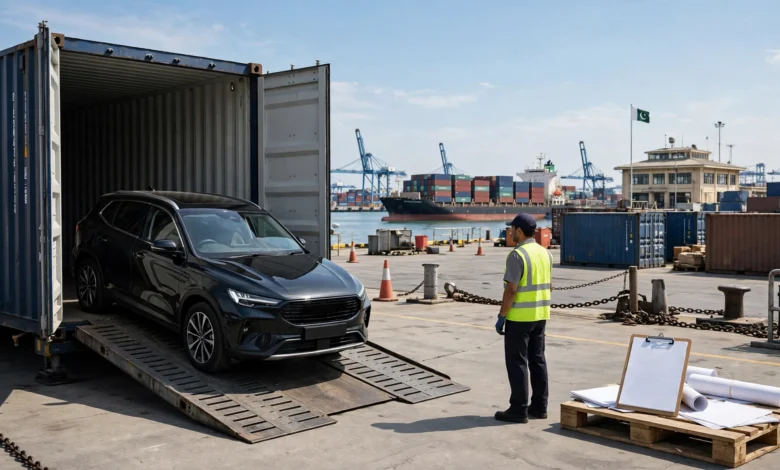
Most cars arrive at Karachi, through Karachi Port or Port Qasim. You can ship by roll-on roll-off (RoRo) vessel, which is usually cheaper, or in a container, which offers more protection. Get marine insurance, especially for longer routes.
Step 5: Hire a Licensed Clearing Agent
A licensed customs clearing agent files your goods declaration through the customs system (WeBOC, now part of the Pakistan Single Window) and handles Karachi port clearance. Choose an agent with a verifiable licence and a track record, and never hand over original documents without a receipt.
Step 6: Assessment and Payment of Duties
Customs examines the car, checks its age, engine size and documents, and calculates the customs duty on cars and other taxes. You pay through authorised banking channels and get official receipts. Once paid, the car is released from the port.
Step 7: Register the Car
Take the customs documents to your provincial excise and taxation department to register the car and get number plates. Remember that under the 2026 rules, cars brought in under the Gift or TR schemes can’t be sold or transferred for one year.
What It Costs to Import a Car Into Pakistan
The purchase price abroad is often the smaller part of the bill. Duties and taxes on imported cars in Pakistan are among the highest in the region, and they change with almost every budget. Here are the main cost heads to plan for.
Duties and Taxes
For used cars under the Gift and TR schemes, duty has usually been charged as a fixed amount based on engine size, payable in foreign currency or its rupee equivalent. Bigger engines pay far more. On top of that, there may be regulatory duty, sales tax, withholding tax and, for commercial imports, an additional regulatory duty. Exact rates are set in the Customs Tariff and budget SROs, so check the latest figures on the Federal Board of Revenue website or with your clearing agent.
Other Costs
- Shipping: Varies by country, vessel type and season
- Insurance: Marine cover for the voyage
- Port and terminal charges: Storage fees rise quickly if clearance is delayed
- Clearing agent fee: Agree on it in writing before you start
- Registration and token tax: Paid to your provincial excise department
A Practical Tip
Before buying, ask a licensed agent for a full landed-cost estimate for the exact make, model, year and engine size. Compare that with the price of the same car already in Pakistan. Sometimes buying locally from a registered importer works out cheaper and saves months of waiting.
Illegal Practices That Changed How You Import a Car Into Pakistan
The strict 2026 rules make more sense once you know what they were built to stop. These are the patterns that pushed the government to act.
Renting Passports Under the Baggage Scheme
The Personal Baggage scheme was meant for overseas Pakistanis bringing their own car home. In practice, commercial dealers widely paid overseas workers to use their passports, then sold the cars in local showrooms. The worker often never saw the car. Officials described the scheme as being frequently exploited by dealers, and the commerce ministry said the new rules aim to keep benefits for genuine overseas Pakistanis and discourage misuse. That is why the scheme was abolished rather than just tightened.
Third-Country Routing
Under the old TR rules, someone living in the Gulf could ship a car bought in Japan. Dealers used this to move cars through any convenient market. The new requirement that a TR car must come from your country of residence closes that gap.
Quick Flipping of “Gift” Cars
Many cars imported as gifts were sold within days of clearance, showing they were never gifts at all. The one-year resale ban now makes this harder and less profitable.
Under-Invoicing and Misdeclaration
Some importers declared lower engine capacity, an older model year or a lower value to cut duty. Customs has caught many such cases over the years, and every one of them leads to tighter checks for honest importers.
Smuggled and Non-Custom-Paid Cars
Outside the formal system, non-custom-paid vehicles have long entered through border areas without paying any duty. Some are stolen abroad. Buying one can mean losing the car in a seizure and facing legal trouble, whatever the seller promised.
Fake Clearing Agents and Online Import Scams
As rules get more complex, more people turn to agents, and some of those agents are fake. Common tricks include taking advance payment for a car that never ships, charging “extra duty” in cash with no receipt, or promising clearance under a scheme that no longer exists.
How to Stay on the Right Side of the Law
- Use only the schemes you genuinely qualify for. Never lend your passport or use someone else’s.
- Hire a licensed clearing agent and check their licence with customs.
- Pay duties only through official bank channels and keep every receipt.
- Declare the car’s real value, age and engine size.
- Don’t buy a car within a year of its import under the Gift or TR scheme. Its transfer may not be legal.
Conclusion
To import a car into Pakistan in 2026, you now have to work within a narrower and stricter system: the Personal Baggage scheme is gone, the Gift and Transfer of Residence schemes allow used cars up to three years old with an 850-day gap between imports, a one-year resale ban and commercial safety standards, new cars can be imported on payment of duties, and commercial used car imports are open through registered companies with extra duty. The process runs from confirming eligibility and verifying the car, through documents, shipping, a licensed clearing agent and duty payment, to registration with your provincial excise office, and the total cost often depends more on duties than on the car’s price abroad. These tighter rules exist because of years of passport renting, third-country routing, quick flipping, under-invoicing and smuggling, so the safest and cheapest import in the long run is an honest one done with real documents, official payments and a licensed ag