PM Youth Free Chromebook Scheme 2026: Eligibility, Registration & Apply Online
PM Youth Free Chromebook Scheme 2026 guide: who qualifies, how to register on the IBCC portal, quota details, how to avoid fake laptop scheme scams.
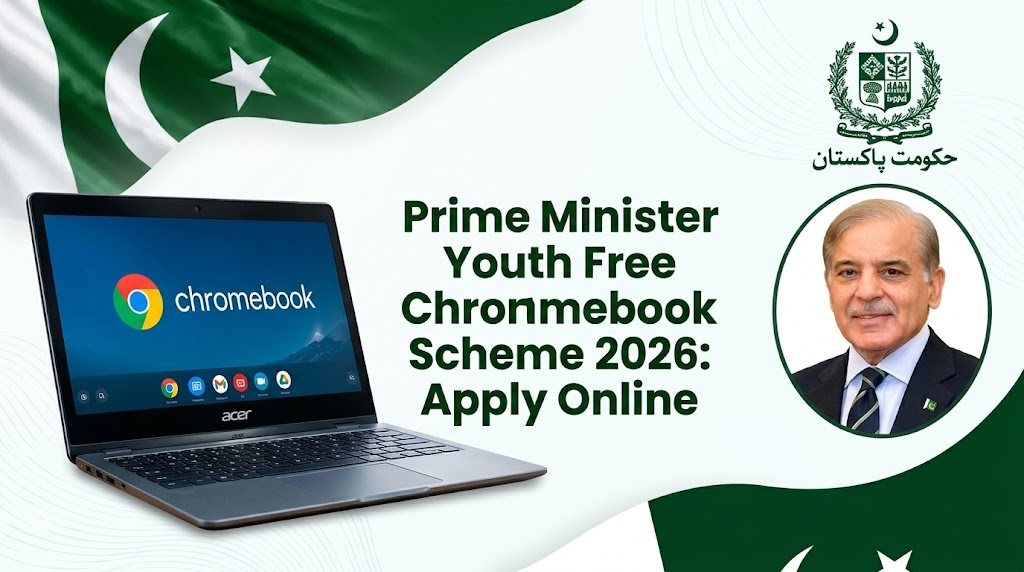
The PM Youth Free Chromebook Scheme 2026 is now officially live, and thousands of Class 9 students and their parents are trying to figure out the same three things: who qualifies, how to apply, and which websites can actually be trusted. Prime Minister Shehbaz Sharif launched the scheme on Sunday, October 25, to distribute 500,000 refurbished Chromebooks and internet devices to students across the country.
That is a big number, and it is also a big opportunity for scammers. Every time Pakistan has announced a free laptop program, fake links have spread on WhatsApp within days, and some of the real laptops have ended up in second-hand markets instead of in students’ school bags. So this guide does more than list the eligibility criteria and registration steps. It also walks through what went wrong in earlier schemes, so you know what to watch for this time.
Here is the short version. Selection is merit-based, it depends on your 2026 board exam results, and applications go through one official portal run by the Inter Boards Coordination Commission (IBCC). You do not pay anyone, you do not need an agent, and you should never share your B-Form details on a site you found through a forwarded message.
Below, we cover the full PM Youth Chromebook Scheme eligibility rules, the province-wise quota, the online application process, documents you need, past fraud cases, and practical tips to protect your data.
What Is the PM Youth Free Chromebook Scheme 2026?
The PM Youth Free Chromebook Scheme 2026 is a federal program under the Prime Minister’s Youth Programme that gives free Chromebooks to high-performing school students. Unlike the older PM Laptop Scheme, which focused on university students, this one targets students at the secondary school level, mainly Class 9.
At the launch ceremony, the prime minister also handed laptops and internet devices to high-performing Grade 9 students and students of seminaries. He compared the pace of this program with earlier efforts, noting that his party had distributed about 600,000 laptops over 10 years, while 500,000 Chromebooks are now planned within two years.
Who Is Running the Scheme?
Several bodies share responsibility here, and knowing who does what helps you figure out where to go if something goes wrong.
- Ministry of Federal Education and Professional Training and the Prime Minister’s Youth Programme lead the scheme.
- IBCC handles verification of student records and runs the application portal.
- Devices are supplied through a foreign charitable partner. The project involves the TT Care Foundation, which has committed to supplying the devices under a formal letter of understanding. Youth Programme Chairman Rana Mashhood said at the launch that the Tokyo Technology Care Foundation had taken steps to provide digital facilities to 500,000 Pakistani students.
- Your education board sends the names of shortlisted students to IBCC.
Refurbished, Not Brand New
This is a detail many viral posts leave out. The devices are refurbished Chromebooks, not new laptops. That is not a bad thing. A refurbished Chromebook is perfectly fine for online classes, Google Docs, research, and basic coding practice. But it is worth setting realistic expectations. A Chromebook runs ChromeOS, not Windows, so it will not run heavy software like full versions of AutoCAD or most PC games. It is a learning tool, and that is exactly how it should be treated.
PM Youth Free Chromebook Scheme 2026 Eligibility Criteria
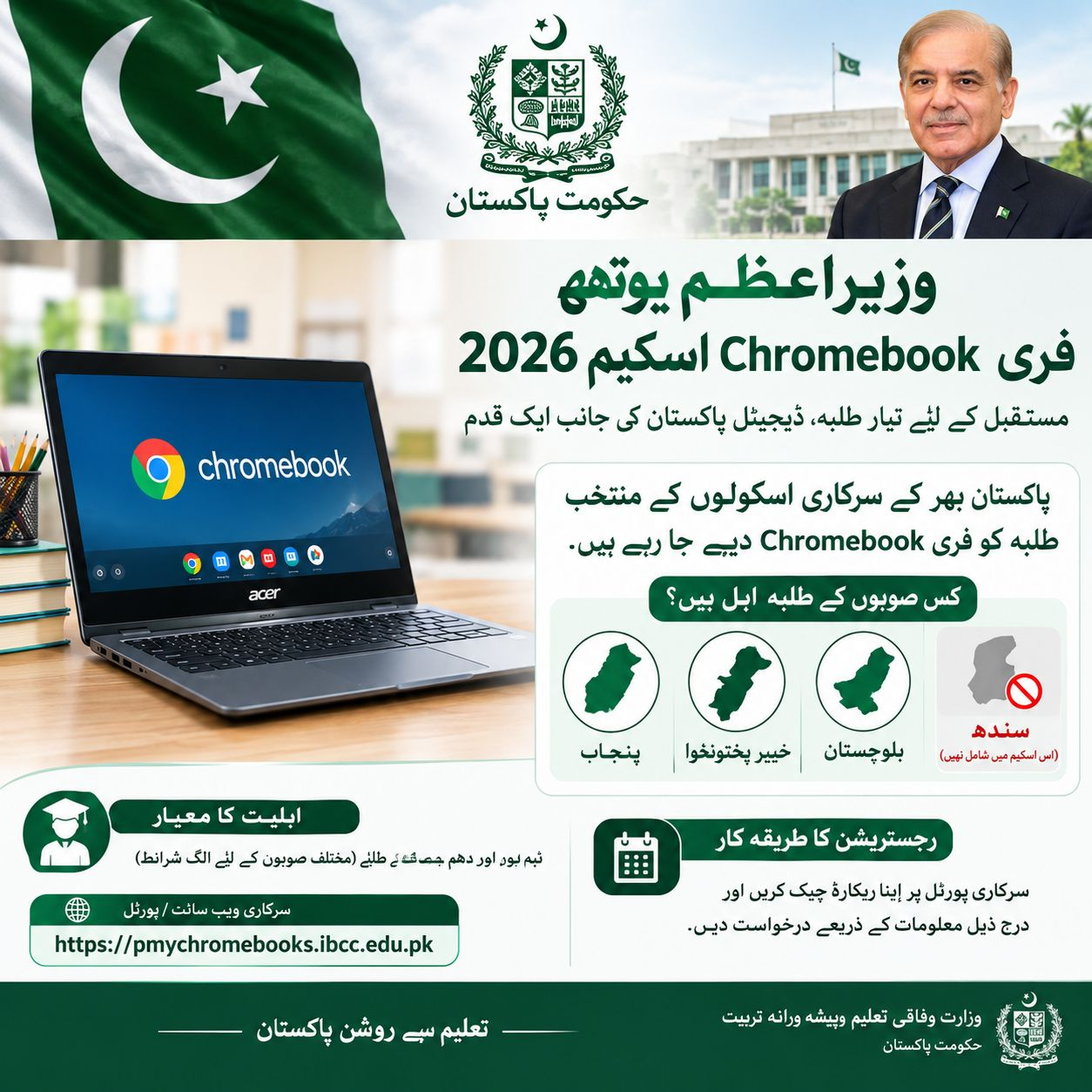


The eligibility criteria depend on where you study, what class you are in, and how you scored in your board exams. Here is how it breaks down.
Class Requirements by Region
The rules are slightly different across regions:
- Punjab, Sindh, Khyber Pakhtunkhwa and Balochistan: high-performing Class 9 (SSC-I) students are eligible.
- Islamabad, AJK and Gilgit-Baltistan: high-performing students of both Class 9 (SSC-I) and Class 10 (SSC-II) are eligible.
So if you are a Class 10 student in Lahore or Karachi, you are not covered under the current criteria. If you are a Class 10 student in Muzaffarabad or Gilgit, you are.
Minimum Marks Requirement
A minimum score of 50 percent in the latest SSC-I (Grade 9) exams is required to be eligible for selection, and IBCC will validate the results.
Keep in mind that 50% is the floor, not a guarantee. With 500,000 devices spread across the whole country, competition will be tight in some districts. For context, when the federal university laptop scheme opened in 2022-23, 652,155 students from 143 universities applied for laptops while only 100,000 laptops were to be awarded. Scoring just above 50% may not be enough everywhere.
Government Schools, Madaris and the Private School Question
This is where reports differ, so read carefully.
- Government schools: clearly eligible.
- Madaris: clearly eligible. The prime minister said selection would be merit-based, with students from both schools and religious seminaries eligible.
- Private schools: this is the unclear part. ProPakistani reported that private school students are not included in the eligibility criteria currently published on the official portal. However, Ilmkidunya reported that private schools officially registered and supported by provincial education foundations are also covered.
The safest reading is this: if you study at a regular fee-paying private school, assume you are not eligible unless the portal says otherwise. If your school is supported by a body like the Punjab Education Foundation (PEF), check with your school administration and your board directly. Do not trust a Facebook page that claims to know for sure.
Province-Wise Quota Under the PM Youth Chromebook Scheme
The government has divided the 500,000 devices among provinces and regions. According to the published breakdown, the allocation is:
| Region | Chromebooks |
|---|---|
| Punjab | 181,090 |
| Islamabad Capital Territory | 100,000 |
| Sindh | 85,925 |
| Khyber Pakhtunkhwa | 51,170 |
| Balochistan | 31,815 |
| Azad Jammu and Kashmir | 25,000 |
| Gilgit-Baltistan | 25,000 |
Islamabad’s share stands out at 100,000 devices, which is far higher than its population share. No official explanation for this has been published yet, so it is a fair question for parents and journalists to ask.
School vs Madrasa and Science vs Arts Split
Within each region, devices are split further:
- 80% of devices are reserved for school students, and 20% for students of registered madaris.
- Among the school share, 70% go to Science stream students and 30% to Arts and Humanities students.
This means a strong Arts student competes for a smaller pool than a Science student with similar marks. If you are in the Arts group, it is still worth applying, since your competition is also limited to your own stream.
How to Register: PM Youth Free Chromebook Scheme 2026 Online Application
The online application is simple, and it is completely free. The only official place to apply is the IBCC portal: PM Youth Chromebook Scheme official IBCC portal.
Step-by-Step Registration Process
Based on the steps published for the portal, here is how the registration works:
- Open the official site at pmychromebooks.ibcc.edu.pk. Type the address yourself instead of tapping a link from WhatsApp.
- Select your relevant educational board.
- Enter your B-Form number, CNIC number, roll number or registration number, as applicable.
- Type the number without dashes or special characters.
- Enter your date of birth as requested.
- Check your name, school information and exam marks carefully.
- Upload the required documents and submit your application.
Documents You Should Keep Ready
Applicants can check their records on the portal, upload required documents such as a photograph, mark sheet, and B-Form or CNIC copies, and then submit their applications. Before you sit down to apply, keep these ready on your phone or computer:
- A recent passport-size photograph
- Your Class 9 (or Class 10, where applicable) result card or mark sheet
- A clear copy of your B-Form (or CNIC if you have one)
- Your board roll number or registration number
What If Your Record Does Not Show Up?
This will happen to some students, usually because of a spelling mismatch or a missing entry at the board level. If your information is wrong or your record cannot be found, contact your educational board or school administration. Do not pay any “agent” who promises to fix your record. Boards fix these issues for free.
Last Date to Apply
There is no single national deadline. The last date for registration varies by educational board, so check your own board’s notice on the portal. Apply early. Portals in Pakistan often slow down in the final days before a deadline, and you do not want to miss out because of a server error.
Delivery, Tracking and Complaints
According to published details, verified students will receive Chromebooks through courier services, either directly or at designated institutional points. The government also says a digital dashboard will track each device from the warehouse to the student, and regional and provincial complaint cells are being set up for merit errors, verification delays, and delivery problems.
At the launch, the prime minister pledged that there would be no discrimination in how the Chromebooks are distributed. That is a good promise. Whether the tracking system and complaint cells actually work will only become clear once deliveries start. Parents should keep screenshots of every step of the application in case they need to file a complaint later.
Learning From the Past: Fraud and Misuse in Earlier Laptop Schemes
Free laptop programs in Pakistan have a mixed record. Many students genuinely benefited. But there is also a long history of misuse, both by fraudsters outside the system and by some recipients inside it. Knowing these cases is the best way to protect yourself in 2026.
Scheme Laptops Sold in Lahore’s Markets
During an earlier Punjab government laptop scheme, Business Recorder reported that computer markets like Hall Road and Hafeez Centre were openly selling the laptops for around Rs 18,000 to Rs 20,000 each, while the Punjab government said it had paid about Rs 35,000 per unit. One shopkeeper told the reporter that a student selling his laptop at nearly half price said he already owned a better one.
That is public money changing hands at a loss, and a seat that could have gone to a student who had no device at all.
HEC Tracking Sold Laptops by Serial Number
The federal government noticed the same pattern with the university scheme. In 2014, ProPakistani reported that HEC was tracing people who had posted ads selling scheme laptops, and that officials held serial numbers for every laptop distributed, which would be used to track illegal sales. With a tracking dashboard planned for the Chromebook scheme, the same approach is likely this time.
Fake “PM Laptop Scheme” Registration Links
In early 2025, a fake link spread online claiming registrations had opened for the PM Laptop Scheme. Geo News fact-checked it and found that the link took users to a page asking for personal details such as name, education background, and laptop preferences. The message had also spread across WhatsApp, TikTok and Instagram. You can read the full Geo News fact-check on the fake laptop scheme link for screenshots and details.
Expect copies of this trick to appear around the Chromebook scheme. The domain is the giveaway. The real portal sits on IBCC’s own ibcc.edu.pk address. Anything ending in .top, .xyz, .online, or a random string of letters is fake.
People Pretending to Work for the PM Office
Scammers also impersonate officials. In 2021, the FIA arrested a man named Mustafa Ansari who allegedly took money from people by posing as a section officer at the Prime Minister’s House. He took money and issued fake NOCs for green number plates. In another case, the FIA cybercrime cell arrested a man from Faisalabad for allegedly running a fake Ministry of Interior website and issuing bogus permits.
The lesson for Chromebook applicants: anyone who calls claiming to be from the “PM Office” or “IBCC” and asks for a processing fee, a bank transfer, or an OTP code is a fraud.
The Same Pattern Across the Border
This is not only a Pakistani problem. In India in 2019, a 23-year-old IIT graduate was arrested for allegedly running a fake website using pictures of Prime Minister Modi and promising a free laptop scheme. Police said over 1.5 million people saw the con within two days, and the site spread widely through WhatsApp. He also allegedly planned to collect personal data of millions of people in the name of registration and use it for illegal profit.
That last point matters. Many fake scheme sites do not even ask for money. They collect data: names, dates of birth, B-Form numbers, phone numbers. That data gets sold or used later for SIM fraud, loan scams, or identity theft.
How to Spot a Fake PM Youth Free Chromebook Scheme 2026 Link
Use this checklist before you enter any information:
- Check the address bar. The official portal is pmychromebooks.ibcc.edu.pk. Nothing else.
- No fees, ever. The scheme is free. Any request for “registration charges,” “courier charges,” or “verification fees” is a scam.
- Never share OTP codes. No government official needs the code sent to your phone.
- Ignore urgency. Messages saying “only 2 hours left” or “last 500 seats” are pressure tactics.
- Be careful with forwards. If a link came through a WhatsApp group, close it and type the official address yourself.
- Watch for “laptop preference” forms. The real scheme gives a Chromebook. A form asking you to choose between brands is a red flag.
- Report it. Fake sites and calls can be reported to the National Cyber Crime Investigation Agency (NCCIA), which took over cybercrime work from the FIA.
The Ethical Side: Why Gaming the System Hurts Real Students
It is easy to focus only on outside scammers, but a scheme can also be damaged from the inside. Here are a few things that are both unethical and, in many cases, illegal:
- Selling the Chromebook. It was given for your education. Selling it defeats the purpose and, with serial number tracking, can come back to you.
- Faking records. Tampering with marks or using someone else’s B-Form is fraud. IBCC cross-checks results directly with boards.
- Paying “sifarish” or agents. If someone claims they can get you a device outside merit, they are either lying or doing something illegal. Either way, you lose.
- Applying from an ineligible school. Submitting a private school student’s details as a government school student can get the application rejected and cause trouble for the school too.
Every device that is sold or obtained through a shortcut is a device that did not reach a bright student in Tharparkar, Kech, or Kohistan who has never owned a computer. That is the real cost.
Realistic Expectations: What This Scheme Can and Cannot Do
A fair look at the free Chromebook scheme means being honest about its limits.
- Not everyone will get one. 500,000 devices is a large number, but Pakistan has millions of secondary school students. Many eligible students will miss out.
- Delivery will take time. The government itself has spoken of a two-year timeline.
- Internet access matters. A Chromebook depends heavily on internet connectivity. The scheme mentions internet devices, but students in areas with weak signals may still struggle.
- Teachers need to catch up. A device helps most when teachers assign online work and guide students. Without that, many Chromebooks may end up used mainly for entertainment.
None of this makes the scheme pointless. For a student who has never had a personal computer, a working Chromebook can open up free online courses, coding practice, and research that was impossible before. Just go in with clear eyes.
Frequently Asked Questions
Is the PM Youth Free Chromebook Scheme 2026 really free?
Yes. There is no application fee, processing fee, or delivery charge. Anyone asking for money is not connected to the official scheme.
Can Class 10 students apply?
Only in Islamabad, AJK, and Gilgit-Baltistan. In Punjab, Sindh, KP, and Balochistan, the scheme currently covers Class 9 students.
What is the minimum percentage required?
Reported criteria set the minimum at 50% in the latest SSC-I exams. Higher marks improve your chances, since selection is merit-based.
Can madrasa students apply?
Yes. Students of registered madaris are eligible, and 20% of the devices in each region are reserved for them.
Where do I check my application status?
Use the same official IBCC portal. Your school and education board can also guide you.
What should I do if someone asks me for money to “confirm” my Chromebook?
Do not pay. Save the number and messages, and report it to the NCCIA.
Conclusion
The PM Youth Free Chromebook Scheme 2026 offers 500,000 refurbished Chromebooks to high-performing Class 9 students (and Class 10 students in Islamabad, AJK and Gilgit-Baltistan) from government schools and registered madaris, with a minimum of 50% marks, a province-wise quota, an 80/20 school and madrasa split, and a 70/30 Science and Arts split within schools; the online application runs only through the official IBCC portal, costs nothing, and has deadlines that vary by board, while past experience, from scheme laptops being sold cheaply at Hall Road and Hafeez Centre to fake registration links and people posing as PM Office officials, shows that students and parents need to apply early, guard their B-Form details, ignore anyone asking for money, and treat the device as the education tool it was meant to be.