How to Avoid Getting Scammed When Buying a Used Car in Pakistan
Buying a used car in Pakistan? Spot fake papers, stolen and NCP cars, tampered meters, and accident repairs before you pay with these simple checks.
Buying a Used Car in Pakistan: 11 Proven Ways to Avoid Costly Scams
Introduction
Buying a used car in Pakistan is often the only realistic option for families and first-time owners. New car prices have climbed sharply, delivery times have stretched at various points, and a well-kept second-hand Corolla, City or Alto can give years of good service for far less money. The problem is that the used car market is also where many people lose their savings.
The scams are not new, and most follow familiar patterns. Stolen cars are sold with forged registration books. Smuggled, non-custom paid vehicles are passed off as legal. Odometers are rolled back, accident damage is hidden under fresh paint, and cars still financed by a bank are sold as if they were free and clear. Online, fake sellers post attractive listings and disappear once the buyer sends an advance.
What makes these frauds so painful is that the buyer often carries the loss. If police later recover a stolen car from you, you lose the vehicle and the money, and you may have to prove you were not involved.
The good news is that nearly every one of these scams can be caught with patience and a few simple checks. This guide explains the most common used car scams in Pakistan, how to verify documents and the car itself, how to pay safely, and how to complete the transfer properly, so your money goes into a car that is genuinely yours.
The Most Common Scams When Buying a Used Car in Pakistan
Knowing how fraudsters work is the first step to staying safe. These are the patterns that keep showing up in police cases, court disputes and buyer complaints.
Stolen Cars With Forged Documents
This is the most damaging scam. Organised gangs steal or snatch cars, change or re-stamp chassis and engine numbers, and prepare fake or duplicate registration books. Police in Karachi, Lahore and other cities have repeatedly arrested groups running exactly this business, often recovering dozens of vehicles at a time. Many of those cars had already been sold to ordinary buyers who had no idea.
Non-Custom Paid (NCP) and Smuggled Vehicles
NCP cars are imported without paying customs duty. They are common in parts of Khyber Pakhtunkhwa and Balochistan and are sometimes moved to other provinces with fake registration. Customs operations have confiscated large numbers of these vehicles over the years. If you buy one, the car can be seized at any checkpoint.
Odometer Rollback
A car showing 60,000 km may have done 200,000 km. Meter tampering is cheap and quick, especially on imported Japanese cars and older digital clusters. Buyers end up paying more for a worn car that will soon need expensive repairs.
Hidden Accident and Flood Damage
After the 2022 floods, many water-damaged cars were cleaned up and returned to the market. Accident-repaired cars with bent chassis or poorly fixed pillars are also sold as “total genuine”. These cars can be unsafe in a crash and suffer endless electrical faults.
Cars Still Under Bank Finance
Some sellers try to sell cars that are still leased from a bank. Until the loan is cleared and the bank issues a No Objection Certificate (NOC), the car legally belongs to the bank, not the seller.
Open Letter and Unpaid Dues Traps
Buying on an “open letter” (a signed transfer letter with no buyer named) is common, but risky. The car stays in the previous owner’s name, and any unpaid token tax, e-challans or past crimes linked to it can come back to you. Fraudsters have also used open-letter cars in street crimes because the trail leads to someone else.
How to Verify Documents Before Buying a Used Car in Pakistan
Paperwork is where most frauds can be caught. Never let a seller rush you through this part.
Check the Registration Book or Smart Card
Ask for the original registration book or smart registration card, not a photocopy. Look for:
- Clean printing, correct stamps and no signs of overwriting
- The seller’s name matching their CNIC, or a clear chain of transfer letters if the car has changed hands
- Registration number, chassis number and engine number written clearly
Be wary of “duplicate” books. A duplicate is legal when the original is lost, but it is also a favourite tool of fraudsters.
Verify Online With the Excise Department
Each province’s Excise and Taxation Department lets you check a vehicle’s registration details online or by SMS. For Punjab-registered cars, use the Punjab Excise, Taxation and Narcotics Control Department verification service. Confirm that the owner’s name, make, model, colour and year match the car in front of you. Any mismatch is a reason to walk away.
Get a Police or CPLC Clearance
In Karachi, the Citizens-Police Liaison Committee (CPLC) offers vehicle verification to check whether a car has been reported stolen or snatched. In other cities, you can request verification through the local police or the vehicle verification desks set up in some markets. This single step protects you from the worst-case scenario of a stolen car.
Match Chassis and Engine Numbers Physically
Compare the numbers on the documents with the numbers stamped on the car. Look for scratches, welding marks, uneven fonts or fresh paint around the chassis plate. Re-stamped numbers are a classic sign of a stolen vehicle.
Confirm Token Tax and E-Challans
Check that token tax is paid up to date and search for pending e-challans. Unpaid dues stay with the vehicle, and you will have to clear them before transfer.
Ask for the Bank NOC if the Car Was Financed
If the registration book mentions a bank, ask for the bank’s No Objection Certificate and loan clearance letter. Call the bank yourself to confirm they are genuine.
Physical Inspection Tips for Buying a Used Car in Pakistan
Clean papers do not guarantee a good car. A careful used car inspection tells you what the documents cannot.
Look for Accident Damage
- Check panel gaps around the bonnet, doors and boot. Uneven gaps suggest repair work.
- Look for colour differences between panels in daylight, not under showroom lights.
- Open the doors and boot and check the pillars and rubber seals for paint overspray or welding marks.
- Use a paint thickness gauge. Many inspectors carry one, and it quickly shows which panels have been repainted.
A repainted bumper is no big deal. A repaired chassis, airbag light or bent pillar is a serious problem.
Spot Flood-Damaged Cars
Flood cars often smell musty or of strong air freshener. Look under the carpets and seats for silt, rust on seat rails, water lines inside lamps, and corrosion on wiring connectors. Electrical faults that come and go are another warning sign.
Check for Odometer Tampering
Compare the mileage with the car’s overall wear. A worn steering wheel, shiny gear knob, sagging driver’s seat and tired pedal rubbers don’t match a low reading. For imported cars, ask for the Japanese auction sheet and verify it through a reliable service. Service records and old oil change stickers also help.
Inspect the Engine and Underbody
- Start the engine cold. Look for blue or thick black smoke, knocking and rough idling.
- Check for oil leaks, coolant mixed with oil, and signs of an engine swap.
- Look under the car for rust, leaks and damage to the suspension.
Hire a Professional Inspector
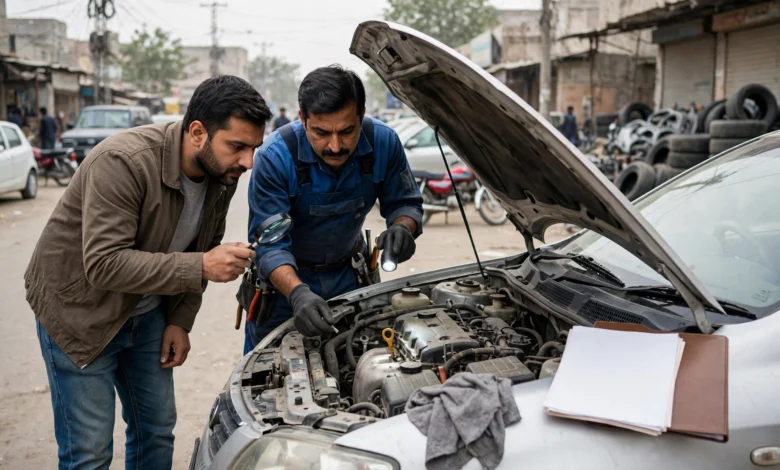
If you are not confident, pay for a professional car inspection. Several companies and experienced independent mechanics offer this in major cities for a modest fee. It is a small cost compared to the price of a bad car, and a good inspector will catch things most buyers miss.
Test Drive Checks You Should Never Skip
A proper used car test drive should last at least 20 to 30 minutes on different kinds of roads. A seller who only allows a quick spin around the block may be hiding something.
What to check while driving:
- Gear changes: smooth shifting with no slipping, jerking or grinding. For automatics, watch for delayed engagement.
- Brakes: the car should stop straight without vibration or squealing.
- Steering: no pulling to one side and no heavy play. Pulling can point to alignment issues or past accident damage.
- Suspension: drive over a speed breaker or rough patch and listen for knocks.
- AC performance: in Pakistan’s heat, a weak AC can mean an expensive compressor repair.
- Warning lights: all dashboard lights should switch on at start-up and go off after. A light that never comes on may have been disconnected to hide a fault.
- Engine temperature: it should stay steady, even in traffic.
If possible, take the car to a highway or bypass to check how it performs at higher speeds. After the drive, open the bonnet again and look for fresh leaks or smoke.
Online Used Car Scams in Pakistan and How to Spot Them
Online car portals and social media groups have made it easier to find good deals, and easier for fraudsters to find victims. These are the online car scams buyers report most often.
The “Army Officer on Transfer” Scam
This one has been circulating for years. A seller claims to be an army officer or government employee who has been transferred and needs to sell quickly. The price is well below market. The car is supposedly parked in a cantonment or secure area, so you are asked to send an advance or a “gate pass” fee before viewing. Once the money is sent, the seller stops answering. Genuine officers do not sell cars this way.
Advance Payment and Token Money Fraud
Any seller who asks for money before you have seen the car, checked the papers and verified ownership is a red flag. Common excuses include “many buyers are interested”, “I’m abroad and my cousin will deliver it”, or “pay a small booking amount to hold it”. Do not send money for a car you have not physically inspected.
Fake Listings With Stolen Photos
Scammers copy photos from real listings and post them at lower prices. A reverse image search often shows the same car listed elsewhere with a different seller, city or price.
Warning Signs at a Glance
- Price far below similar cars in the same condition
- Seller refuses a video call or in-person meeting
- Pressure to decide within hours
- Requests for payment to a third party’s account
- No original documents available to see before payment
If you come across such a scam, report the account to the platform and to the FIA’s cybercrime wing so others are warned.
Safe Payment and Ownership Transfer When Buying a Used Car in Pakistan
Even a genuine deal can go wrong at the payment and transfer stage. Treat this part as carefully as the inspection.
Pay Safely
- Avoid carrying large amounts of cash. Robberies after car deals are a real risk, especially when the meeting place was chosen by the other party.
- Use a bank pay order or bank transfer in the registered owner’s name, not a relative’s or agent’s account.
- Meet at a bank or excise office for the final handover where possible.
- Get a written sale agreement with both parties’ CNIC copies, the car’s details, price, date and signatures of two witnesses.
Sellers should be careful too. Fake pay orders and bounced cheques have been used to drive away with cars, so sellers should confirm payment with their bank before handing over keys.
Complete the Transfer, Don’t Rely on an Open Letter
The safest car ownership transfer in Pakistan is done in person at the provincial Excise office, with both buyer and seller present. Provinces have introduced biometric verification for vehicle transfers to cut down on fraud, which means the registered owner’s fingerprints confirm the sale.
Why this matters:
- The car is legally in your name
- Old challans or crimes linked to the car can’t be blamed on you after the transfer date
- You can resell it later without paperwork headaches
Keep Records
Store copies of the sale agreement, payment proof, transfer documents, verification slips and inspection report together. If a dispute ever comes up, these records will protect you.
11-Step Checklist for Buying a Used Car in Pakistan Safely
Print this out or save it on your phone before you go car hunting. If any step fails, pause the deal until it is resolved.
- Research the market price for the same model, year and mileage on major car portals.
- Meet the seller in person in a safe, public place, ideally during the day.
- See the original registration book or smart card and match the seller’s CNIC.
- Verify the registration online with the provincial Excise department.
- Get a stolen-vehicle check through CPLC or local police.
- Match chassis and engine numbers on the car with the documents.
- Confirm token tax, e-challans and bank NOC if the car was financed.
- Inspect the body, interior and engine for accident, flood and meter tampering signs.
- Take a proper test drive of at least 20 minutes.
- Pay through a bank in the registered owner’s name, with a written sale agreement.
- Complete the biometric transfer at the Excise office instead of relying on an open letter.
Following these steps takes a little time, but it is the most reliable way to avoid used car fraud in Pakistan.
Frequently Asked Questions About Buying a Used Car in Pakistan
How can I check if a used car is stolen in Pakistan?
Get a vehicle verification from CPLC in Karachi or from the local police in other cities, verify the registration online with the Excise department, and physically match the chassis and engine numbers with the documents.
Is it safe to buy a car on an open letter?
It is legal in practice but risky. The car stays in the previous owner’s name, and any dues, challans or crimes linked to it can create problems for you. A proper biometric transfer is much safer.
How do I know if the odometer has been tampered with?
Compare the reading with interior wear, service records and old oil change stickers. For imported cars, verify the auction sheet. A professional inspector can also check for signs of tampering.
Should I buy a non-custom paid car because it is cheap?
No. NCP vehicles can be confiscated, cannot be legally registered in most of the country, and some have stolen or forged histories.
What documents should I get from the seller?
The original registration book or smart card, a copy of the seller’s CNIC, the token tax record, transfer letters if the car has changed hands before, the bank NOC if it was financed, and a signed sale agreement.
Conclusion
Buying a used car in Pakistan can be a smart financial decision, but only if you treat every deal with healthy suspicion and check everything yourself: the most damaging scams, from stolen cars with forged registration books and smuggled NCP vehicles to rolled-back odometers, hidden accident and flood damage, cars still owned by banks, and fake online sellers asking for advances, have all left real buyers without their money or their car. Verify documents with the Excise department, get a stolen-vehicle check through CPLC or the police, match chassis and engine numbers, inspect the car thoroughly or hire a professional, take a proper test drive, pay only through a bank in the registered owner’s name, and finish with a biometric transfer instead of an open letter, and you will drive away in a car that is safe, legal and truly yours.