Top E-Learning Initiatives Supported Under Digital Pakistan
E-learning initiatives in Pakistan now reach millions, from DigiSkills to free laptops. Here is what works, what failed, and how fraud has hurt students.
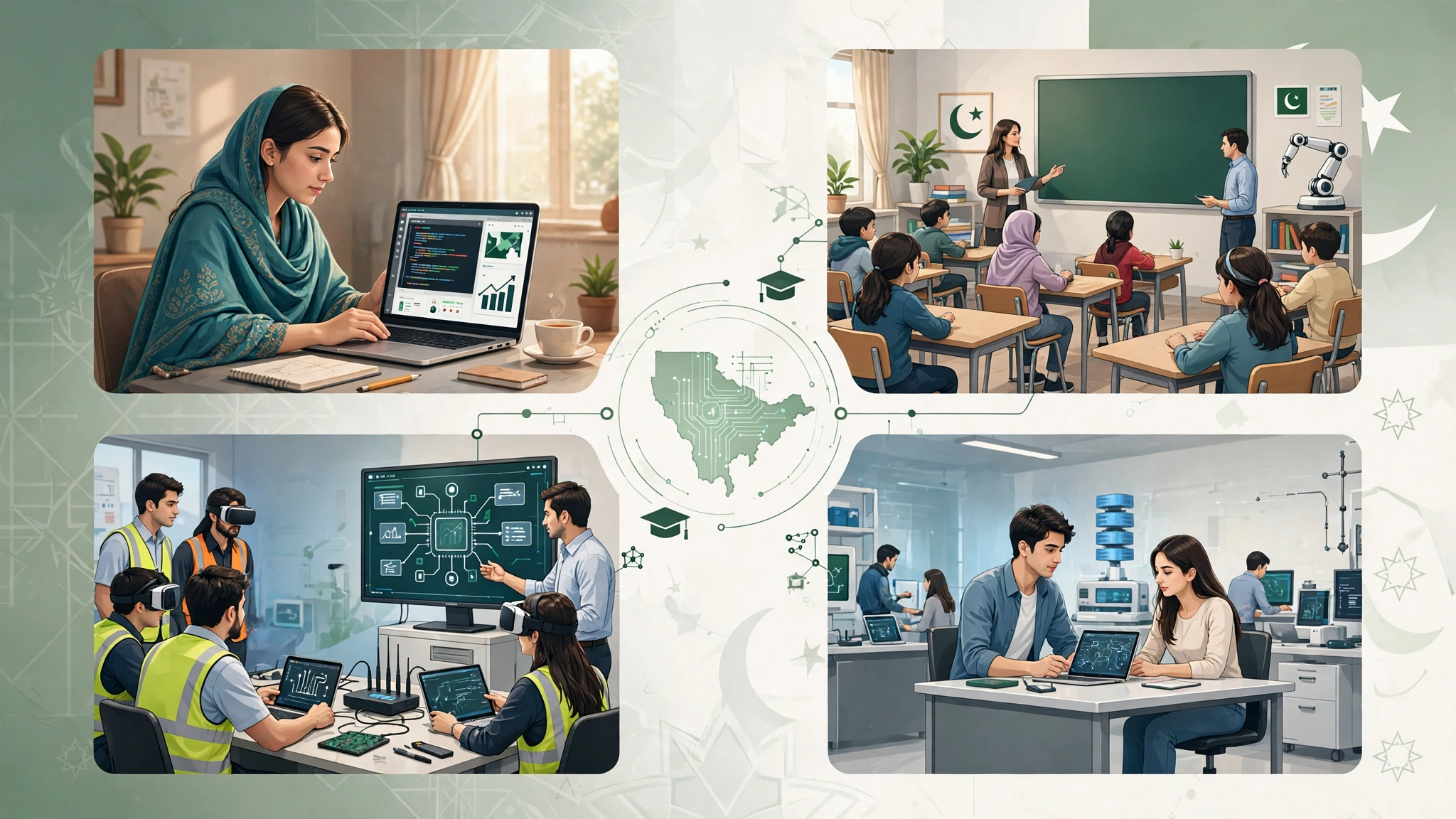
.E-Learning Initiatives in Digital Pakistan: 7 Proven Programs and Hard Lessons for 2026
Introduction
E-learning initiatives in Pakistan have moved from pilot projects to national programs that millions of people use. A young woman in Hyderabad can learn digital marketing for free and sell her services to clients abroad. A student in Gwadar can earn a university degree without moving to Lahore. During the pandemic, children in remote villages kept studying through lessons broadcast on state television. These changes are real, and they matter in a country with so many young people.
The picture isn’t all good, though. Pakistan’s education sector also produced one of the world’s largest fake degree operations. A computer-based licensing exam was compromised so badly that hundreds of pilots were grounded. Students today keep receiving fake links promising free laptops, and fake training “programs” charge registration fees for certificates that don’t exist. Every time online education in Pakistan grows, people looking to exploit it follow.
This article reviews seven major e-learning initiatives supported under the Digital Pakistan agenda: what each one offers, how many people it reaches, and where it falls short. It then goes through the frauds and scandals that damaged trust in digital education, and what learners, parents and policymakers can do about them. The goal is a balanced view: credit for what works, honesty about the gaps, and practical guidance so the next wave of digital skills programs serves learners instead of scammers.
What “Digital Pakistan” Means for Education
Digital Pakistan is the umbrella term for the government’s effort to bring technology into public services, the economy and education. In learning, it covers free online skills training, distance degrees, digital devices for students, research access, and emergency remote schooling.
These e-learning initiatives fall into four broad types:
- Skills training for freelancing and the digital economy.
- Formal degrees delivered online or through blended learning.
- Devices and connectivity, such as laptop and Chromebook schemes.
- Content and research access, from school lessons to academic journals.
Each type serves a different group, and each runs into a different version of the same problem: access, quality and trust.
7 Top E-Learning Initiatives Supported Under Digital Pakistan
1. DigiSkills.pk: Pakistan’s Largest Free Online Training Program
DigiSkills is the best-known of Pakistan’s e-learning initiatives. The Ministry of IT and Telecom conceived it, Ignite funds it and the Virtual University runs it, offering Free Online Courses in freelancing Skills with E-Certificates issued by VU and Ignite.
The program is large. Since its launch, the program has enrolled more than 4.87 million individuals nationwide. Each new batch fills quickly: Batch-03 of DigiSkills 3.0 offered a total of 300,000 seats on a first-come, first-served basis. Courses include Creative Writing, Virtual Assistant, E-Commerce Management, Digital Marketing and QuickBooks, updated to follow freelancing trends.
The reality check: reach isn’t the same as results. The gender split is lopsided. Ministry figures show the total trainees comprise 73% males and 27% females. Ignite has also launched an independent third-party assessment of the DigiSkills.pk program to measure its overall impact on Pakistan’s digital skills and freelancing ecosystem, which is a sensible step. Before calling the program a success, the public should know how many trainees actually earn income afterwards.
2. Virtual University of Pakistan: Degrees Without Distance
The Virtual University (VU) is a public university built around online delivery. It supports students through a nationwide network of campuses spanning nearly 140 cities, from Skardu to Gwadar, including AJK and Gilgit-Baltistan. Admission is fully digital: The university has made the admission process fully online, allowing students to complete all requirements from home.
VU also reaches Pakistanis living abroad. Thousands of overseas Pakistanis are currently enrolled at the Virtual University and are pursuing higher education through its online learning system. Beyond degrees, it runs short free courses. With Cisco Networking Academy, VU is offering free online courses in Artificial Intelligence (AI) and Cybersecurity to help students and professionals develop in-demand digital skills.
The reality check: online degrees depend on reliable internet and self-discipline, and those are unevenly distributed. A support campus nearby helps, but students in low-connectivity districts still struggle with recorded lectures and online exams.
3. Allama Iqbal Open University: Distance Learning Goes Digital
Allama Iqbal Open University (AIOU) is one of the oldest distance learning institutions in the region, and it has moved much of its system online. During the pandemic, upgradation of servers of the university helped it to conduct online classes of 145,000 students simultaneously, and the university signed agreements with telecom operators for subsidised student internet packages.
The reality check: the move online hasn’t gone smoothly for everyone. Internal figures reported by Dawn show the university had enrolled over 1.41 million students in both spring and autumn sessions in 2019 and the number has now come down to less than a million in 2023. The same report noted that the university accepted online applications for all BS and MS programmes, with no option for manual submission of forms, and that students often complained about faults in the online system. Several factors probably explain the drop, but it is a reminder that going digital-only can push away the rural and low-income learners that distance education was created to serve.
4. TeleSchool and Taleem Ghar: Emergency Learning on Television
When schools closed in 2020, Pakistan relied on the most widely available screen: the television. In April 2020, Punjab rolled out the education TV program Taleem Ghar to support remote learning for its students. This was immediately followed by a roll-out of the federal education TV program TeleSchool across Pakistan. PTV was chosen because, according to the ministry, 95% of the population had access to its services.
It was a good example of public-private cooperation. TeleSchool worked in collaboration with leading EdTech providers such as Knowledge Platform, Sabaq.pk, Sabaq Muse, and Taleemabad to broadcast free learning content to grades 1-12. Taleemabad, an EdTech app, saw demand jump: after schools closed in late March, Haroon saw a spike in activity — downloads rose 600%.
The reality check: TV lessons kept children connected, but one-way broadcasts can’t replace teachers. The World Bank warned that at least 1 million children in Pakistan are expected to drop out of school owing to COVID-19’s socioeconomic impact. Among e-learning initiatives, TeleSchool proved that television works as an emergency tool. Making it a permanent part of how children learn is still unfinished work.
5. PM Youth Laptop and Chromebook Schemes: Putting Devices in Students’ Hands
E-learning doesn’t work without a device. The PM Youth Laptop Scheme has been running for more than a decade. In August 2025, Prime Minister Shehbaz Sharif announced the distribution of 100,000 free laptops among talented students across Pakistan based on merit. The allocation includes quotas, with 18% reserved for students in Balochistan’s higher education institutions and 5% for distance learning students.
In October 2026 the government went further. At the launch of a new scheme, the prime minister said “500,000 Chromebooks will be distributed in two years,” covering high-performing Grade 9 students and seminary students as well.
The reality check: merit-based schemes reward students who already perform well, and those students often already have some access to technology. A laptop without affordable internet, training and content does little. Device schemes also keep producing fake registration links, which are covered below.
6. HEC National Digital Library: Research Access for Universities
For university students and researchers, the HEC Digital Library is one of the most valuable e-learning initiatives Pakistan has. The HEC says the programme provides researchers within public and private universities/institutions and non-profit research & development organizations in Pakistan with access to international scholarly literature. Running since 2003, it gives access to peer-reviewed journals, databases and e-books across many disciplines.
The reality check: access is uneven. Premium databases are expensive resources whose access is given to limited public and private sector universities / institutions based on demand and availability of licenses. Smaller colleges and students at unrecognised institutions miss out. It also matters ethically that Universities/ DAIs not recognized/ blacklisted by the HEC are excluded, which ties access to legitimate, recognised education.
7. Free Short Courses in AI, Cybersecurity and Digital Safety
A newer group of free online courses focuses on emerging skills. VU’s training batches, for example, include courses that focus on digital awareness, programming, online safety, entrepreneurship and emerging technologies. Under its Learn-A-Thon 2026, the program offers 100% free enrollment, while participants can earn Cisco digital badges and certificates after meeting the relevant course requirements.
The reality check: digital safety courses matter more than they might seem, because Pakistani learners are frequently targeted by scams. Teaching people to spot phishing and fake offers protects every other e-learning program on this list.
The Dark Side: Fraud and Scandals That Damaged Trust in Digital Education
Any honest review of e-learning initiatives in Pakistan has to look at how digital education has been abused. These cases aren’t meant to discourage learners. They explain why verification, transparency and caution are essential.
Case 1: The Axact Fake Degree Empire
The biggest education fraud linked to Pakistan came to light in 2015. The Axact scandal surfaced in May 2015, when The New York Times published a report claiming the company sold fake diplomas and degrees online through hundreds of fictitious schools. The FIA investigated the company for preparing and selling degrees of fake online educational institutions with fake accreditation bodies.
The scale was global. The BBC reported that more than 3,000 fake Axact degrees were purchased by UK nationals in 2013 and 2014. The case also exposed problems in the courts: a judge who had acquitted the accused in 2016 was sacked due to his admission of receiving Rs5 million bribe for acquitting the accused persons. In 2018, Axact CEO Shoaib Sheikh and 22 others were sentenced by a district and sessions court to 20 years in prison in total and fined Rs1.3 million each.
The lesson: online education is only as credible as the systems that verify it. Accreditation checks, HEC degree attestation and public lists of recognised institutions protect learners and Pakistan’s reputation abroad.
Case 2: The Pilot Licence Exam Scandal
This case shows what happens when computer-based testing isn’t secure. In 2020, the aviation minister told Parliament that 262 pilots had not taken the aviation exam themselves, alleging that they had paid someone else to take the exam on their behalf. The CAA later told the Supreme Court that the suspected pilots have made unauthorised access to the CAA’s computerised technical examination system for pilot licensing. During one hearing, Chief Justice of Pakistan Gulzar Ahmed remarked that CAA computers were not secure.
The outcome was more complicated than the first headlines. After scrutiny, an inquiry committee declared that 82 of these pilots had fake licences. The panel has, however, cleared the remaining 180 pilots. Some lawmakers later disputed the original claims altogether. The damage was done anyway: the case hurt the reputation of the whole industry and of Pakistani credentials worldwide.
The lesson: online exams and digital certificates need strong identity checks, proctoring, secure servers and audit logs. A shortcut in testing can do more harm than having no test at all.
Case 3: Fake Laptop Scheme Links
Every genuine device scheme brings a wave of fakes. Geo’s fact-check team examined one viral website and concluded that it is a fraudulent website that uses a fake offer to collect users’ information and encourage them to share the link with others. Another fact-check reminded students that the federal government’s official websites end in .gov.pk. In fact, the HEC tells selected students to collect laptops through their own universities, asking them to visit their universities, submit the required documents to the designated focal person and collect their laptops.
The lesson: genuine schemes never ask for payment, and they work through official channels and university focal persons, not WhatsApp forwards.
Case 4: Fake Training Programs Charging Fees
Scammers also copy free training programs. In 2026, Pakistan’s National CERT began investigating a suspected fake online campaign operating under the name “Cyber Secure Pakistan” that advertised cybersecurity training on LinkedIn. The campaign was allegedly asking applicants to pay Rs. 5,000 as a registration fee for the so-called “Cyber Hero Card”.
The lesson: DigiSkills, VU’s free courses and similar e-learning initiatives are free. Any “program” that asks for a registration fee, a card fee or a certificate fee should be treated as suspicious until verified.
Case 5: Fake Results Websites and Grade-Changing Offers
Exam boards are targets too. In Karachi, a scam surfaced when a fake results website appeared in Google search results, directing students to a WhatsApp helpline where they were allegedly offered the chance to have their examination results changed or cleared in exchange for money.
The lesson: students should only trust the board’s official website. Any offer to change results is both a scam and an invitation to commit a crime.
Ethical Questions Pakistan Must Answer About E-Learning
Who is left behind?
The e-learning initiatives above reach millions, but not equally. Women make up only about a quarter of DigiSkills trainees. Students in areas with poor connectivity struggle with online-only systems. Merit-based device schemes skip learners who are struggling. Ethical digital education should be designed for the hardest-to-reach learner, not the easiest.
Are we measuring outcomes or just enrolments?
Headlines count seats, enrolments and laptops. The questions that matter more are: did learners gain skills, find work, stay in school, or earn more? Independent evaluations like the one Ignite has started for DigiSkills should become standard for every major program.
Who protects learners’ data?
Online programs collect CNIC numbers, phone numbers and education records. Fake laptop websites are built to harvest exactly this data. Official platforms need clear privacy policies, and learners need to know what they are sharing and with whom.
How do we keep credentials credible?
After Axact and the pilot exam scandal, Pakistani credentials face extra scrutiny abroad. Verifiable digital certificates, for example certificates with QR codes that link to an official registry, would protect honest learners.
How Learners Can Use E-Learning Initiatives Safely
- Register only on official websites. Use DigiSkills.pk for freelancing courses and the Virtual University’s official admissions page for degrees.
- Never pay for “free” programs. Genuine government e-learning initiatives don’t charge registration or card fees.
- Check the domain. Federal government sites end in .gov.pk, and university sites usually end in .edu.pk.
- Collect devices through your university. Laptop scheme devices come through your institution’s focal person, not through couriers or online forms.
- Verify your institution. Check that a university is HEC-recognised before enrolling, and use the HEC Digital Library only through your institution’s legitimate access.
- Report scams. Report fake links and fee demands to the NCCIA cybercrime portal and warn your classmates.
What Policymakers Should Prioritise Next
- Close the gender gap with women-only cohorts, female mentors and offline support centres for DigiSkills and similar programs.
- Pair devices with data. Every laptop or Chromebook should come with an affordable student internet package.
- Keep offline options. Distance universities should keep paper or in-person routes for learners who can’t manage online-only systems.
- Publish outcome data. Report employment, income and completion rates, not just enrolment.
- Secure online assessments. Learn from the pilot exam scandal by investing in proctoring and audit trails.
- Fight fakes proactively. Run public awareness campaigns each time a scheme opens, before scammers fill the gap.
Conclusion
Pakistan’s e-learning initiatives under the Digital Pakistan agenda have achieved a lot. DigiSkills has enrolled close to five million learners, the Virtual University and AIOU have brought degrees to students across the country and abroad, TeleSchool kept children learning during the pandemic, laptop and Chromebook schemes are putting hundreds of thousands of devices in students’ hands, and the HEC Digital Library connects researchers to world-class literature. The record also has hard lessons: a gender gap in skills training, falling enrolment where online-only systems pushed out struggling learners, the Axact fake degree empire, the compromised pilot licensing exams, and constant fake laptop links and fee-charging training scams. The path forward is to measure real outcomes, design for the learners who are hardest to reach, secure online assessments and credentials, and teach every learner to tell a genuine program from a fake one. Done honestly, online education in Pakistan can become one of the country’s best investments in its young people.