Is Pakistan Ready for an AI Revolution? Experts Weigh In
AI revolution in Pakistan: what experts say about policy, internet, skills, jobs and data laws, plus misuse cases that show how ready we really are.
AI Revolution in Pakistan: 6 Critical Questions Experts Are Asking in 2026
Introduction
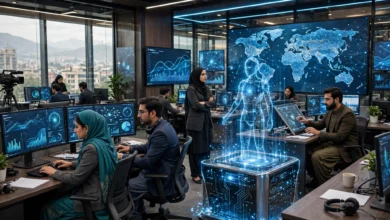
The AI revolution in Pakistan is already happening, just not in the way the speeches promised. It is happening in a Multan college hostel where students use ChatGPT for assignments, in a Karachi software house where half the code is now AI-assisted, and in a Lahore bank where a chatbot answers customers at midnight. It is also happening in fraud call centres in Islamabad, in deepfake videos that land people in police cases, and in scam compounds abroad where trafficked Pakistanis are forced to run online cons.
So the real question is not whether AI is coming. It is whether Pakistan is ready to steer it.
On paper, there is progress. The federal cabinet approved Pakistan’s first National AI Policy in July 2025, with targets to train a million people and build a national AI fund. IT exports hit a record $4.6 billion in FY2025-26. Freelancers are earning more than ever.
But economists, industry bodies, digital rights groups and international lenders kee
keep raising the same concerns: unreliable internet, weak data protection laws, a skills gap, and a job market where AI could squeeze educated graduates hardest.
This article pulls together what these experts and institutions are actually saying, looks honestly at Pakistan’s track record with digital misuse, and asks six critical questions that will decide whether this revolution lifts the country or leaves it further behind.
Where the AI Revolution in Pakistan Stands in 2026
Before judging readiness, it helps to see what has actually been done.
The National AI Policy 2025
The federal cabinet approved Pakistan’s first National AI Policy 2025 on 30 July 2025. According to the Ministry of IT’s own document and media coverage, it rests on six pillars: an innovation ecosystem, public awareness and readiness, a secure AI ecosystem, sector-by-sector transformation, national infrastructure, and international partnerships.
Key commitments include:


- A National AI Fund, financed by setting aside 30% of the R&D fund managed by Ignite.
- Centres of Excellence in AI in major cities.
- Training for one million people and 10,000 trainers, with some targets set for 2027 and others for 2030.
- A goal of 90% public awareness of AI by 2026.
- Plans for a national compute grid, curated public datasets, and support for a local language model.
The Islamabad AI Declaration followed in February 2026, signalling Pakistan’s intent to build sovereign AI capability and join global governance forums.
The economic bright spot
Pakistan’s IT and IT-enabled services exports reached a record $4.6 billion in FY2025-26, and freelancer earnings hit about $1.76 billion, according to State Bank figures reported in the national press. Many freelancers now use AI to deliver work faster and win larger contracts.
How Pakistan ranks
International rankings are more sobering. A blog by the International Growth Centre notes that Oxford Insights’ Government AI Readiness Index placed Pakistan eighth of 17 countries in South and Central Asia, behind India, Bangladesh and Sri Lanka, and that Pakistan ranked 97th of 133 on digital infrastructure, skills and usage and 149th of 197 on open government data in 2024
In short: the plan is ambitious, the private sector is moving, but the foundations are still weak.
Is Pakistan Ready for AI? 6 Critical Questions Experts Are Asking
Across think tanks, industry associations, rights groups and international lenders, the same six questions come up again and again. Here is what each one means and what the evidence says.
1. Can Pakistan’s internet and power carry an AI economy?
AI runs on reliable connectivity and electricity. In 2024, internet slowdowns hit the country hard. The Wireless and Internet Service Providers Association of Pakistan said speeds had dropped by 30 to 40 percent, and the Pakistan Software Houses Association (P@SHA) estimated losses could reach $300 million, while freelancers complained that global clients were losing trust The government said the new firewall was meant to improve cybersecurity rather than censor content, and that it had not deliberately slowed the internet.
Whatever the cause, the lesson for AI readiness in Pakistan is clear: an economy that depends on cloud AI tools cannot afford unpredictable connectivity. Policy analysts have also pointed to energy costs, load-shedding and slow data digitisation as gaps the AI policy must fix before its targets become realistic.
2. Are we building AI skills fast enough?
The policy aims to train one million people. That is a big number, but training alone does not build expertise. Many university programmes still teach AI as theory, and digital rights researchers have warned that universities have been slow to update courses on AI-driven misinformation, with no uniform curriculum even for journalism students
There is also brain drain. Skilled Pakistani engineers often move abroad for better pay and stable internet, which makes it harder to build deep local expertise.
3. What will AI do to jobs?
This is the question most families care about. The World Bank’s World Development Report 2026 names Pakistan among the most exposed countries in its region, warning that educated young graduates face the greatest risk as AI automates knowledge-heavy tasks, unless job creation and reskilling keep pace
At the same time, freelancers and IT firms using AI well are earning more. The likely outcome is not mass unemployment overnight but a widening gap between those who adapt and those who do not.
4. Are our laws ready for AI?
Pakistan does not yet have a dedicated AI law. According to legal trackers, a Regulation of Artificial Intelligence Bill and a Personal Data Protection Bill are still pending, which means AI is currently governed through a patchwork of sector guidelines, cybersecurity policies and the amended PECA (Regulations.AI).
PECA has been used against deepfakes and cyber fraud. But rights groups have long criticised parts of it for being used against dissent. Experts across the spectrum agree that clear, balanced AI rules would help investors, protect citizens and reduce arbitrary enforcement.
5. Who protects our data?
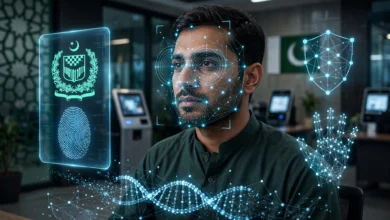
AI systems learn from data, and Pakistan’s data environment is weak on both ends. Government data is hard to access for researchers and startups, reflected in the low open-data ranking. At the same time, personal data is poorly protected, with no comprehensive data protection law in force yet. Citizens routinely share CNIC copies over WhatsApp, and businesses often paste customer information into free AI tools without thinking.
6. Will the benefits reach everyone?
The AI economy is concentrated in Lahore, Karachi and Islamabad. Researchers have noted that awareness of AI-driven misinformation is especially low in rural areas. Women face extra barriers, from lower phone ownership to online harassment, including deepfake abuse.
The Pakistan Institute of Development Economics has argued that the AI policy could meaningfully lift growth if it is implemented properly (PIDE). The phrase that matters is “if implemented properly”.
Reality Check: Pakistan’s Track Record With Digital Misuse
Readiness is not only about fibre cables and training targets. It is also about whether a country can prevent, detect and punish misuse. Pakistan’s recent history offers hard lessons for the AI revolution in Pakistan.
Industrial-scale online fraud
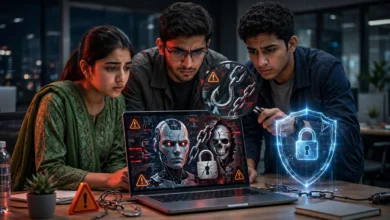
In September 2026, the NCCIA raided three call centres in Islamabad and took 212 Pakistani and Chinese nationals into custody over alleged international fraud involving Google-related scams, loan and dating schemes, and fake trading offers, seizing hundreds of phones and computers ). AI tools make such operations cheaper to run, with polished scripts, fake profiles and translated messages produced in seconds. OpenAI has reported banning accounts linked to scam operations in Cambodia and Myanmar that used ChatGPT for exactly these tasks.
When enforcers are accused of protecting fraud
In late 2025, a case was filed against around ten NCCIA officers accused of taking bribes to protect illegal call centres in Rawalpindi and Islamabad, many run by foreign nationals . If the agency meant to fight cybercrime can be compromised, AI-powered fraud will be even harder to control. Institutional integrity is part of AI readiness.
Deepfakes and the law
In February 2025, Punjab police registered three cases under PECA 2025 over AI-generated deepfake videos and images of the Punjab Chief Minister, along with defamation charges . Women journalists, students and ordinary citizens have also been targeted with fake sexual content, and many victims never report it because of stigma. Deepfakes are one area where AI’s harms in Pakistan are already visible.
Exam leaks and fake credentials
The 2023 MDCAT was cancelled and retaken in Sindh after an inquiry confirmed the paper had been leaked, while candidates in Khyber Pakhtunkhwa were caught cheating with Bluetooth devices. Years earlier, the 2015 Axact scandal exposed a Karachi-based company accused of selling fake degrees worldwide. With AI able to write essays and generate convincing documents, education and credentialing systems face even greater pressure.
Pakistanis trapped in scam compounds
In July 2026, authorities said trafficking networks were luring Pakistanis to Cambodia, Myanmar and Thailand with fake job offers and forcing many into cyber scam centres, with more than 3,300 who travelled to Cambodia on visit visas over three years not returning A large pool of unemployed, tech-literate youth is an asset for the AI economy, but also a target for criminal networks if legitimate jobs do not appear.
What these cases tell us
- Pakistan already has laws that cover much AI misuse, but enforcement is uneven.
- Institutions tasked with enforcement need stronger oversight themselves.
- Victims, especially women, need safer ways to report abuse.
- Unemployment and weak verification systems create openings for fraud.
Making the AI Revol
ution in Pakistan Work: What Needs to Happen
The experts and institutions quoted above rarely disagree on the destination. They disagree on speed and priorities. Here is what their combined recommendations point to.
For the government
- Guarantee stable, fast internet, especially in software technology parks and for registered freelancers, and be transparent about any network security measures.
- Pass the Personal Data Protection Bill and a balanced AI law with clear rules, independent oversight and protections for free expression.
- Publish more government data in usable formats, with privacy safeguards, so local startups can build useful AI for Urdu, agriculture, health and public services.
- Fix enforcement integrity at cybercrime and tax agencies, so rules are applied fairly and cannot be bought.
- Report progress on AI policy targets publicly, including how much of the National AI Fund has been spent and on what.
For businesses and universities
- Train existing staff before replacing them, and share productivity gains with workers.
- Update degree programmes to include hands-on AI use, ethics, and verification skills.
- Use AI tools responsibly: protect customer data, keep humans in charge of important decisions, and avoid fake content in marketing.
- Build partnerships between universities and industry so graduates learn skills employers actually need.
For citizens
- Learn at least one AI tool well enough to use it in your studies or work.
- Verify before you share. Assume viral videos and voice notes can be fake.
- Protect your personal data, and never send CNIC copies or OTPs to unknown numbers.
- Report deepfakes, fraud and harassment to the NCCIA, and support victims instead of blaming them.
- Reject “easy money” offers that involve deceiving others, at home or abroad.
A realistic readiness scorecard
| Area | Status in 2026 |
|---|---|
| National AI strategy | In place since July 2025 |
| IT exports and freelancing | Record highs |
| Internet reliability | Improved but still a concern |
| AI and data protection laws | Pending |
| Skills pipeline | Targets set, delivery uneven |
| Enforcement against misuse | Active but inconsistent |
| Rural and gender inclusion | Weak |
FAQs About the AI Revolution in Pakistan
Does Pakistan have an official AI policy?
Yes. The federal cabinet approved the National AI Policy 2025 on 30 July 2025. It sets out six pillars, a National AI Fund, Centres of Excellence and large training targets.
Is there an AI law in Pakistan?
Not yet. An AI regulation bill and a personal data protection bill are pending. For now, AI misuse is handled through PECA, the Pakistan Penal Code and sector rules.
Will AI take jobs in Pakistan?
The World Bank warns that educated young graduates are most exposed, because AI can do many entry-level knowledge tasks. People who combine real skills with AI tools are likely to do better.
What is the biggest barrier to AI in Pakistan?
Experts point to several: unreliable internet and power, weak data protection, a skills gap, and uneven enforcement. No single fix will solve all of them.
How can ordinary Pakistanis prepare?
Learn to use AI tools for your studies or work, protect your personal data, verify online content before sharing, and avoid any job or scheme that involves deceiving people.
Conclusion
The AI revolution in Pakistan has clearly begun, with a National AI Policy approved in July 2025, record IT exports of $4.6 billion, and millions of students and freelancers already using AI every day, but the experts and institutions weighing in, from the World Bank and PIDE to P@SHA, the International Growth Centre and digital rights groups, agree that readiness is still uneven: internet reliability, data protection and AI laws, skills, and inclusion all lag behind the ambition, while real cases of fraud call centres, officers accused of protecting them, deepfake PECA cases, exam leaks, fake degrees and trafficked job seekers show how quickly technology is misused when enforcement and opportunity are weak, so whether this revolution lifts Pakistan or deepens its problems will depend less on the technology itself and more on stable infrastructure, fair and clear laws, honest institutions, and citizens who use AI to learn and build rather than to deceive.