How Rural Broadband Expansion Is Helping Bridge the Digital Divide
Rural broadband expansion is bringing millions of Pakistanis online. Here is what it has achieved, what still holds it back, and how crime slows progress.
Rural Broadband Expansion: 7 Powerful Ways It Is Bridging Pakistan’s Digital Divide, and the Hard Realities
Introduction
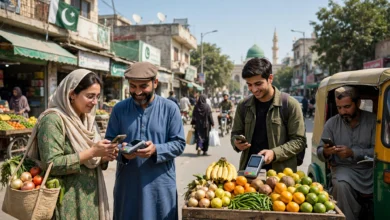
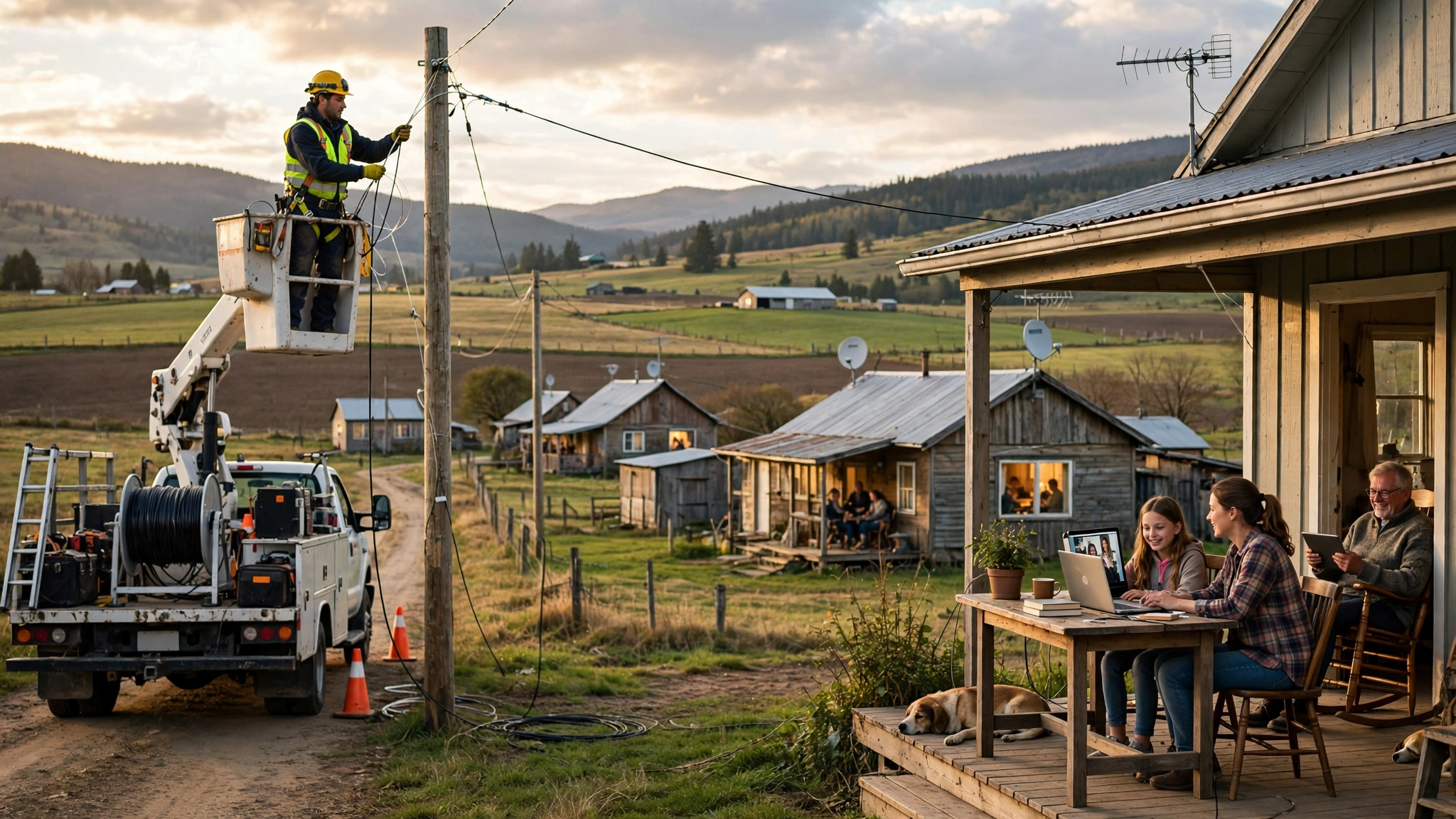
Rural broadband expansion can sound like dry infrastructure policy until you see what it changes for a family. A farmer in a southern Punjab village can check crop prices before selling to a middleman. A girl in rural Khyber Pakhtunkhwa can attend an online class that her village school can’t offer. A young man in a small Sindh town can earn dollars as a freelancer without moving to Karachi. A mother can receive money from a son working in the Gulf on her phone instead of travelling to the nearest city.
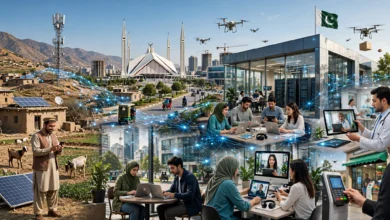
Pakistan has made real progress on connectivity. Broadband subscriptions now run into the hundreds of millions, 4G covers most of the population, and the government’s Universal Service Fund has brought service to tens of millions of people in areas commercial operators had ignored. The gender gap in mobile internet use has also narrowed sharply.
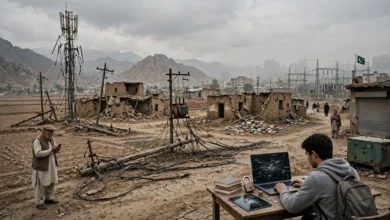
The picture has another side. Thousands of telecom towers have been looted for diesel, batteries and equipment. Illegal signal boosters degrade networks for everyone nearby. Illegal gateway exchanges have used internet connections to cheat the national treasury. In parts of Balochistan, the most rural areas have repeatedly had mobile internet switched off by the state for long stretches.
This article looks at how rural broadband expansion is helping to bridge the digital divide in Pakistan: what the numbers show, the seven biggest benefits, the crimes and policy choices holding progress back, and what needs to happen next so connectivity reaches everyone fairly.
What the Digital Divide Looks Like in Pakistan Today
Big headline numbers
On paper, Pakistan looks well connected. The 2025-26 Economic Survey reported that cellular mobile services now cover 92pc of the population, with 3G and 4G signals reaching over 81pc of the country’s area. Broadband penetration has nearly doubled from 32.6pc in 2019. By July 2026, Pakistan’s broadband penetration reached 65.79 percent, with 166.12 million broadband subscribers.
The gaps behind the headlines
The numbers hide some important gaps:
- Mobile dominates. Of the country’s 166.12 million broadband subscribers, 161.71 million were using mobile broadband services, while 4.41 million had fixed broadband connections. Rural areas rely almost entirely on mobile signals, which are less reliable for heavy work like video classes or large uploads.
- Coverage isn’t the same as use. A signal reaching a village doesn’t mean everyone there can afford a smartphone and data.
- Women still lag in phone ownership. Pakistan continued to have the widest mobile phone ownership gender gap among all countries surveyed, with 68 percent of women owning a mobile phone compared with 93 percent of men.
The digital divide in Pakistan is therefore not just about urban versus rural. It’s also about men versus women, mobile versus fixed, and people who can afford data versus people who can’t.
How Rural Broadband Expansion Works in Pakistan
The Universal Service Fund model
Commercial operators build networks where they can make money, which means cities first. The Universal Service Fund (USF) fills the gap. Telecom companies pay into the fund, and the USF then pays operators to build in areas that wouldn’t otherwise be profitable. Projects are awarded to service providers selected through what the fund described as a transparent bidding process based on the lowest compliant offers.

The scale so far
The results are significant. To date, 39.4 million people in rural areas have been provided broadband, voice and fixed-line services through the USF projects. The fund currently runs 28 projects – 17 Next Generation Broadband Service Delivery schemes and 11 Next Generation Optical Fibre Network Services schemes. The ministry also told the National Assembly that completed fibre projects have covered 1,089 locations and deploying more than 18,300 kilometers of optical fibre cable.
For official project updates, the Universal Service Fund’s news page lists approvals and coverage targets district by district.
7 Ways Rural Broadband Expansion Is Bridging the Digital Divide
1. Connecting Villages That Were Never Profitable to Serve
The most direct benefit of rural broadband expansion is reaching places that had no service at all. In December 2025, the USF approved nine new telecom projects worth Rs13.05 billion to provide high-speed internet and voice services to 5.55 million unserved and underserved residents across the country. In 2026 it went further, approving a Rs32.90 billion budget for fiscal year 2026-27 on Tuesday and advanced 15 4G projects that target 3.66 million people across 1,893 mauzas in 21 districts.
Some projects focus on the hardest regions. In Balochistan, the USF has planned three new 4G connectivity projects for 296 underserved villages in Balochistan, covering an estimated population of 257,723 across Khuzdar, Dera Bugti, Kohlu and Washuk districts.
2. Laying the Fibre Backbone
Mobile towers need a fast backbone behind them, which usually means optical fibre cable. One set of USF projects will lay 1,428 kilometers of Optical Fiber Cable across 178 Town/Union Councils in four districts and enable connectivity to 4,292,639 population. The ministry also plans to lay 3,809 kilometers of optical fibre cable to connect 459 unserved union councils and towns.
Fibre matters because it makes 4G faster, prepares rural areas for 5G, and can bring fixed broadband to schools, clinics and local government offices.
3. Bringing Women Online
Pakistan’s progress on the mobile internet gender gap is one of the most encouraging digital stories in the region. GSMA data shows that in 2024, 8 million women came online – reducing the gender gap in mobile internet adoption from 38% in 2023 to 25% in 2024. The next year was even better: 53% of women and 58% of men used mobile internet in 2025, while the GSMA report placed the country’s mobile internet gender gap at 8%.
The hard truth: many women still don’t own the device they use. The 2026 report found that 28 percent of Pakistani women who use mobile internet rely on someone else’s phone. Without their own device, women have less privacy, less control and less safety online.
4. Opening Doors to Freelancing and Remote Work
Rural connectivity lets young people join the global digital economy without moving to a big city. Freelancing is growing fast nationwide. Pakistan’s freelancers earned a record $1.76 billion in foreign exchange during FY2025-26, up 78% from $984 million in the previous fiscal year, according to State Bank of Pakistan (SBP) data. National figures don’t separate rural from urban freelancers, but every village with stable 4G adds potential earners to that total.
5. Making Digital Payments Possible in Villages
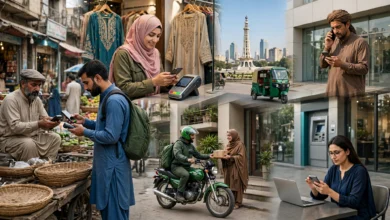
Mobile wallets and instant payments only work where there is a signal. Nationally, digital payment channels processed 3.4bn transactions, accounting for a 92pc share in total retail payments by volume in early 2026. In villages, broadband means remittances, utility bills, social protection payments and small business sales can move without a long trip to a bank branch.
6. Supporting Health and Education Services
The USF highlights its vital support for the IT industry, freelancers and essential health and educational services. In practice, a connected village clinic can consult doctors remotely, and a connected school can use online lessons, digital textbooks and teacher training that would otherwise be out of reach.
7. Cheaper, Locally Made Smartphones
Connectivity is useless without a device. Local manufacturing has helped. Pakistan produced 161.6 million mobile handsets up to March 2026. This included 67 million smartphones, accounting for 71.6pc of total production and reflecting a rapid decline in feature phone demand as 4G services expand. Cheaper locally assembled smartphones lower one of the biggest barriers for rural families.
The Hard Realities: Illegal Activities and Barriers Slowing Rural Broadband
The benefits above are real, but rural broadband expansion faces serious problems, many of them criminal. These cases matter because they hit rural users hardest.
Reality 1: Tower Theft and Vandalism
Rural towers are often isolated, run on diesel generators and batteries, and are poorly guarded. That makes them easy targets. The PTA told a Senate subcommittee that more than 9,200 incidents of theft and vandalism targeting telecom infrastructure were reported across Pakistan during the past 11 months, disrupting mobile and internet services and affecting nearly 16 percent of the country’s cellular network. The PTA named Lakki Marwat, Bannu, Turbat, and Killa Abdullah as the highest-risk districts.
Power cuts make theft worse. Officials said persistent loadshedding had severely deteriorated service continuity by rapidly depleting backup batteries and exhausting local generators. When diesel is stolen during a power cut, the tower simply goes dark. The Senate subcommittee also recommended that the Ministry adopt a Standard Operating Procedure (SOP) requiring telecom operators to register FIRs in every case of theft from telecom towers.
The lesson: building a tower is only half the job. Protecting it, powering it and keeping it running are just as important, especially where it is the only connection a village has.
Reality 2: Illegal Signal Boosters
When signals are weak, some people buy cheap boosters to improve their own reception. These devices harm everyone else. A PTA legal notice said these GSM amplifiers and boosters cause interference in the licensed frequency spectrum bands allocated to the cellular mobile operators and cause deterioration in the quality of cellular mobile services. Using them is illegal: Individuals installing boosters or amplifiers on their own are subject to legal action under relevant provisions of the Pakistan Telecommunication (Re-Organisation) Act 1996.
Critics have argued that enforcement alone isn’t enough. One commentary said PTA should focus on improving cellular coverage and quality/consistency of service so that signal boosters aren’t needed anymore.
The lesson: illegal boosters are a symptom of poor coverage. Better rural networks are the real fix.
Reality 3: Illegal Gateway Exchanges and Grey Traffic
Broadband connections have also been misused to cheat the state. Illegal VoIP gateway exchanges route international calls over the internet to avoid fees. In one case, the FIA and PTA busted dozens of illegal gateway exchanges that have cost the national exchequer Rs162.5 million. In another raid in Sialkot, officials confiscated seven illegal VoIP gateway exchanges, two CPUs, two PTCL broadband DSL connections and several SIM cards.
The lesson: revenue lost to grey traffic is money that could have gone into licensing fees and, indirectly, into the funds that pay for rural networks.
Reality 4: Internet Shutdowns in Rural Areas
The hardest reality for rural users is that the state itself sometimes switches the internet off. Authorities cite security concerns, and those concerns are real in parts of the country. The cost to ordinary people is also real and heavy. In November 2025, Balochistan suspended mobile internet across all 36 districts, and officials said “The Internet service will remain suspended in the rural areas of the entire province,” while Quetta was exempted. That shutdown disrupted daily life and paralyzed small businesses and halted mobile money services.
Some areas have gone without for years. A resident told Global Voices that the Panjgur district in Balochistan province in southern Pakistan has been without mobile internet for four years. The same report noted that a VPN review site ranked Pakistan third globally for shutdown duration (9,735 hours) in 2024 and estimated the economic loss at USD 1.62 billion.
The lesson: building networks with public money and then switching them off for long periods undermines the whole purpose of rural broadband expansion. Any restrictions should be narrow, time-limited, transparent and open to legal challenge.
Reality 5: New Users Targeted by Fraud
People coming online for the first time are often the easiest targets for scammers. National cybercrime officials told a Senate panel that financial fraud through WhatsApp hacking has increased, with money being extorted from friends and family by compromising accounts. Criminals also exploit the identity checks that rural SIMs and wallets depend on. In one Lahore raid, investigators recovered 415 fake active SIM cards, 610 fake silicone thumb impressions, 56 ATM cards and 13 biometric verification devices.
The lesson: connecting people without teaching them basic online safety leaves them exposed. Digital literacy has to come with the signal.
Ethical Questions Around Rural Broadband Expansion
Is coverage the same as inclusion?
No. A tower in a village helps only those who can afford a phone and data, can read the screen, and feel safe online. Inclusion means addressing price, skills and social barriers, not just signal bars.
Who gets connected first?
Lowest-bid contracts keep costs down, but they can also mean minimal quality. Communities need clear service standards, public reporting of speeds and uptime, and a way to complain when a USF-funded tower doesn’t work.
Do women have real control?
Pakistan’s gender gap progress is impressive, but women who use borrowed phones don’t have private, independent access. Programs that help women own their own devices and SIMs are an ethical priority.
When is switching off the internet justified?
Security threats are real, but blanket and repeated rural shutdowns punish students, freelancers, small businesses and patients who rely on connectivity. Narrow, legally reviewable measures balance security and rights better than switching off whole provinces.
What Needs to Happen Next
- Protect rural towers. Require FIRs for every theft, add solar power and secure battery cabinets, and work with local communities to watch over sites.
- Fix power at telecom sites. Prioritise solar and hybrid systems for remote towers so loadshedding doesn’t knock them offline.
- Expand fixed broadband to public institutions. Connect every rural school, health centre and union council office with fibre.
- Enforce against boosters and grey traffic, and improve coverage too. Enforcement works better when people have a legal way to get a usable signal.
- Limit internet shutdowns. Publish the legal basis, duration and scope of each shutdown, and keep them as narrow and short as possible.
- Close the device gap for women. Support affordable handsets and SIMs registered in women’s own names.
- Teach digital safety in local languages. Pair every new rollout with basic training on scams, privacy and safe mobile money use.
- Publish performance data. Report speed, uptime and adoption for every USF project, not just the population “covered.”
The GSMA’s report on women’s digital inclusion in Pakistan is a useful source on the gender side of the rural divide.
Practical Tips for Rural Internet Users
- Don’t install signal boosters. They are illegal and make service worse for your neighbours. Report weak coverage to your operator and the PTA instead.
- Protect your WhatsApp and wallet accounts with two-step verification, and never share OTP codes.
- Report tower theft you see to the police and the operator, since a looted tower cuts off the whole village.
- Check data packages carefully and choose bundles that match how you actually use the internet.
- Help family members, especially elderly relatives and women, set up safe accounts on their own devices.
Conclusion
Rural broadband expansion is one of the most important ways Pakistan is narrowing its digital divide. The Universal Service Fund has brought broadband, voice and fixed-line services to about 39.4 million rural people, laid more than 18,000 kilometres of fibre, and is now funding new 4G projects for millions more in some of the country’s hardest-to-reach districts. Broadband penetration has climbed past 65%, the mobile internet gender gap has fallen to 8%, locally made smartphones are cheaper, and connectivity is supporting freelancing, digital payments, education and health care. The hard realities are just as clear: more than 9,200 incidents of theft and vandalism have hit telecom towers, illegal boosters degrade rural signals, illegal gateway exchanges have cost the treasury millions, new users are targeted by fraud, and repeated shutdowns have left rural Balochistan offline for long periods. Bridging the divide for real means protecting and powering rural towers, connecting schools and clinics with fibre, closing the device gap for women, teaching digital safety, publishing project performance, and treating internet shutdowns as a last resort. If Pakistan gets those right, a signal bar in a village can become a lasting path to opportunity.