How to Choose a Solar Charger for Power Outages
Solar charger buying guide for power outages: how to size watts and battery, avoid fake capacity claims and unsafe power banks, and stay charged longer.
How to Choose a Solar Charger for Power Outages
Introduction: Why a Solar Charger Belongs in Every Outage Kit
A solar charger is one of the simplest ways to stay connected when the grid goes down. When a storm knocks out power for days, or load shedding stretches through the evening, your phone becomes your torch, your news source and your only way to reach family or emergency services. A charged phone can matter more than almost anything else in the house.
The problem is that the market is full of confusing and sometimes dishonest claims. Listings advertise “30,000 mAh” power banks that hold half that, or tiny panels that promise to charge a laptop in an hour. Some cheap units have been recalled because their batteries swell and overheat. Even the wider solar trade has seen serious crime: in Pakistan, tax authorities uncovered about Rs 69.5 billion in over-invoicing linked to solar panel imports.
So choosing a solar charger for power outages is not just about picking the biggest number on the box. It is about matching real output to your real needs, checking safety, and buying from sellers you can trust.
This guide walks you through every step. You will learn the main types of solar chargers, how to work out how much power you actually need, which specs matter and which are marketing, and how to spot fake claims and unsafe products. We will also cover real fraud and recall cases, practical tips for using your charger during an outage, and a short FAQ to answer the most common questions.
Tip 1: Know the Types of Solar Charger Before You Buy
Not every solar charger does the same job. Most products fall into four groups, and picking the right group matters more than picking the right brand.
Solar Power Bank (Panel Built Into a Battery)
A solar power bank is a battery pack with a small panel on the front. It is cheap and compact, which makes it popular in emergency kits. The catch is that the built-in panel is tiny, often 1 to 3 watts. In real sunlight it may take several days to fill the battery from empty. Treat it as a power bank you charge from the wall before an outage, with solar as a slow top-up.
Foldable Portable Solar Panel
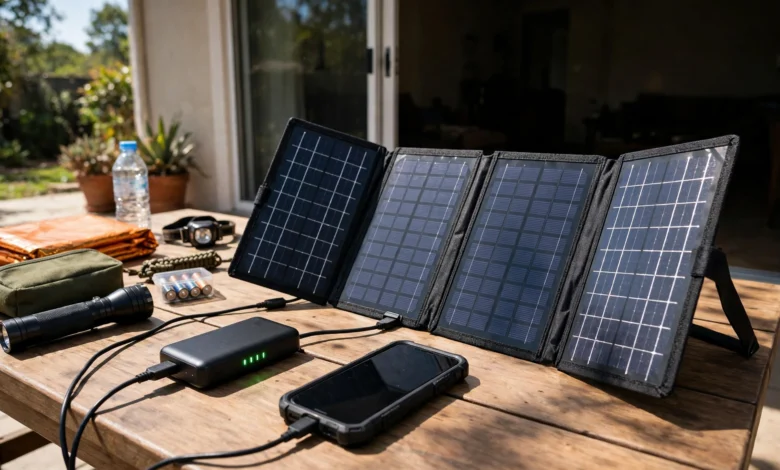
A portable solar charger in panel form folds out into two to six panels, usually rated from 15 to 100 watts. It has USB ports, and sometimes a DC output, but often no battery of its own. This type is far better at actually collecting energy. Pair it with a separate power bank so you can store power in the day and use it at night.
Solar Panel and Battery Kit
Some brands sell a matched kit: a foldable panel plus a good-sized battery. This is the most practical emergency solar charger setup for most households, because the panel and battery are designed to work together and you get reliable day-and-night power.
Portable Power Station With Solar Input
A portable power station, often marketed as a solar generator, is a large battery with AC sockets, USB ports and a solar input. Paired with 100 to 400 watts of panels, it can run a router, fan, lights or even a small fridge for short periods. It costs much more, but for long or frequent outages it is the only option that goes beyond phones and lights.
Tip 2: List the Devices Your Solar Charger Must Power
Before comparing models, write down exactly what you need to keep running during an outage. Be honest and keep it short. A typical list looks like this:
- One or two smartphones.
- A rechargeable LED lamp or torch.
- A Wi-Fi router, if your internet provider stays up.
- A laptop for work or study.
- Medical devices such as a CPAP machine, if anyone in the home relies on one.
The more items on the list, the bigger the solar charger and battery you will need. Phones and lights need a small kit. Laptops need more. A fridge or CPAP needs a power station.
Tip 3: Do the Simple Power Maths
This is the step most buyers skip, and it is where most disappointment comes from. You only need two numbers: watt-hours (Wh) for battery storage, and watts (W) for panel output.
Convert mAh to Watt-Hours
Power banks are usually labelled in mAh, which is misleading because it ignores voltage. Use this quick formula:
Wh = mAh × 3.7 ÷ 1000
So a 10,000 mAh power bank stores about 37 Wh. After conversion losses, expect roughly 60 to 70% of that to reach your phone. A modern smartphone battery holds roughly 15 to 20 Wh, so a genuine 10,000 mAh bank gives you about one and a half to two full phone charges.
Estimate What the Panel Really Produces
A panel’s rated wattage is measured in ideal lab conditions. In real life, expect a solar charger to deliver about half to two-thirds of its rating in good direct sun, and much less on cloudy days.
A rough example for a sunny day:
- A 20 W panel delivers maybe 10 to 13 W in practice.
- With around 5 hours of strong sunlight, that is roughly 50 to 65 Wh per day.
- That is enough to fill a 10,000 mAh power bank and charge a phone, but not to run a laptop all day.
Quick Sizing Guide
| What you need to power | Suggested panel | Suggested battery |
|---|---|---|
| One phone and a torch | 10 to 20 W | 10,000 to 20,000 mAh |
| A family’s phones and lights | 20 to 40 W | 20,000 to 30,000 mAh |
| Phones plus a laptop | 40 to 100 W | Power bank with 60 W USB-C output, or small power station |
| Router, fan, lights, laptop | 100 to 200 W | Power station of 300 to 500 Wh |
| Small fridge or CPAP | 200 to 400 W | Power station of 500 Wh or more |
These are rough starting points. Sunlight, season and how carefully you use power all change the result.
Tip 4: Check the Solar Charger Specs That Actually Matter
Once you know your size, compare models on the specs that change real-world performance. Ignore the dramatic photos and read the numbers.
Panel Type: Monocrystalline Wins
Most good chargers use monocrystalline panels, which convert more sunlight into power per square inch than polycrystalline or thin-film panels. For a portable solar charger where every bit of surface counts, monocrystalline is almost always the better pick. Look for named cell suppliers in the spec sheet rather than vague claims like “high-efficiency cells.”
Output Ports and Charging Speed
The ports decide what you can charge and how fast.
- USB-A ports are fine for phones and lights, usually up to 12 to 18 W.
- USB-C Power Delivery (PD) ports are essential if you want to charge laptops or tablets. Check the wattage: 30 W suits tablets, 60 W or more suits most laptops.
- DC outputs are useful for charging a power station or a 12 V battery.
- AC sockets only appear on power stations. Check the continuous wattage rating, not just the peak.
A solar charger with auto-restart is a big plus. Cheap panels stop charging when a cloud passes and do not resume, which means you come back to a phone that charged for two minutes.
Battery Chemistry and Capacity
If your kit includes a battery, check its chemistry:
- Lithium-ion is light and common in power banks.
- LiFePO4 (lithium iron phosphate) is heavier but far safer and lasts thousands of charge cycles. It is the better choice for power stations you will keep for years.
Always check the capacity in Wh, not just mAh, and compare it with your sizing from Tip 3.
Tip 5: Look for Durability and Weather Resistance
Outages often come with storms, heat or dust, so your emergency solar charger needs to survive rough conditions.
- Water resistance: An IP65 or higher rating means the panel can handle rain and dust. Keep in mind that the ports and battery are often less protected than the panel surface.
- Heat tolerance: Panels lose efficiency when very hot, and batteries degrade in heat. Never leave a power bank in direct sun behind a car windscreen.
- Build quality: Look for strong stitching on fabric panels, metal eyelets for hanging, and a sturdy kickstand.
- Weight: For a home kit, weight matters less. For evacuation bags, keep it light.
Tip 6: Insist on Safety Certifications
A solar charger with a battery stores a lot of energy in a small space. A badly made one can swell, overheat or catch fire. Look for recognised safety marks such as UL, CE, FCC or IEC certification for the battery, and buy from brands that publish a real address and warranty terms.
This is not a theoretical risk. Regulators regularly recall power banks, including solar models, after reports of swelling and overheating. We look at real examples in the next section.
Tip 7: Avoid Solar Charger Scams, Fake Specs and Unsafe Products
The solar boom has attracted honest companies and dishonest ones. Knowing how fraud and safety failures have played out in real life makes it much easier to protect yourself.
Case 1: Pakistan’s Rs 69.5 Billion Solar Import Scandal
Pakistan’s rush to solar created one of the country’s biggest trade-based money laundering cases. Because solar panels could be imported free of duty and sales tax, some importers used them as cover to move money abroad by declaring panels at inflated prices.
An audit by the Federal Board of Revenue found over-invoicing of about Rs 69.5 billion across 6,232 import declarations by 63 importers between 2017 and 2022. According to ProPakistani, the Senate Standing Committee on Finance directed the Federal Investigation Agency to probe the scam. Two firms alone were reported to have sent about Rs 72.83 billion out of the country while the panels they imported sold locally for far less, and FIRs were registered against them.
Why it matters to you: This was a crime at the import level, but it shaped the market buyers shop in. When paperwork and pricing are manipulated upstream, it becomes harder for ordinary customers to judge whether a product is genuine and fairly priced. Buying from established dealers who issue proper invoices and warranties is your best protection.
Case 2: Recalled Solar Power Banks and Battery Fires
In 2026, the U.S. Consumer Product Safety Commission announced a recall of about 7,400 Super Off-Road 12,000 mAh Solar Wireless Power Banks in the United States, plus nearly 5,000 in Canada, because the lithium-ion battery could swell and overheat. The units had been handed out as promotional giveaways, so many owners likely never knew the brand or where it came from.
That case had no injuries, but others have been far more serious. A separate recall of Casely wireless power banks was reannounced in 2026 after new incidents, including a fatal fire involving an elderly woman who was charging her phone with the power bank on her lap.
In the United States it is illegal to sell a product that is under a CPSC recall. Yet recalled and counterfeit batteries still turn up on second-hand marketplaces and in grey-market imports elsewhere.
Why it matters to you: An emergency solar charger often sits unused in a drawer for months, then gets charged in a hurry during a crisis. That is exactly when a poorly made battery is most dangerous.
Red Flags of a Fake or Unsafe Solar Charger
Watch for these warning signs:
- Impossible capacity for the size or weight. A pocket-sized solar power bank claiming 50,000 mAh or more is almost certainly overstated.
- A tiny panel promising fast charging. A 2 W panel cannot fast-charge anything. If the listing claims it can, the seller is misleading you.
- No Wh rating anywhere, only a huge mAh number.
- No brand address, warranty or certification marks.
- Prices far below every reputable competitor.
- A swollen, hot or bulging battery at any point. Stop using it at once and dispose of it at an e-waste point, never in household rubbish.
Ethical Buying Habits
- Ask for a proper bill and warranty, especially for panels and power stations.
- Report unsafe products to your local consumer authority or the platform where you bought them.
- Do not resell recalled or damaged batteries, even cheaply.
- Dispose of old batteries responsibly at e-waste collection points so they do not cause fires in garbage trucks or landfills.
Tip 8: Use Your Solar Charger Properly During an Outage
Even the best solar charger will disappoint if you use it badly. These habits get the most out of every hour of sunlight.
Before the Outage
- Charge everything from the wall first. Your power banks and power station should start every storm or outage season full. Solar is for topping up, not for starting from zero.
- Test your kit. Set up the panel outside on a sunny day and check that every port works with your devices and cables.
- Store it where you can find it. Keep the panel, battery, cables and a torch together in one bag.
- Recharge stored batteries every two to three months. Lithium batteries slowly lose charge and can be damaged if left completely empty for long periods.
During the Outage
- Put the panel in direct sun. Shade from a tree, wall or even a window frame can cut output sharply. Solar chargers do not work well behind glass.
- Angle it towards the sun and adjust it every couple of hours as the sun moves.
- Charge the battery during the day, then charge phones from the battery at night. This works better than plugging your phone straight into the panel, where passing clouds cause constant interruptions.
- Keep the battery shaded while the panel sits in the sun. Heat hurts batteries.
- Save power on your phone. Use low power mode, lower screen brightness and turn off apps you do not need.
Safety Reminders
A solar charger is one of the safest backup power options because it produces no fumes. Never run a petrol or diesel generator indoors or in an attached garage, since carbon monoxide poisoning is a leading cause of death after storms. For more preparedness basics, Ready.gov’s power outage guide covers food safety, medical devices and generator safety in plain language.
Tip 9: Match Your Budget to the Right Solar Charger
You do not need to spend a fortune. Match your spending to your list from Tip 2.
Budget Kit
A quality 10,000 to 20,000 mAh power bank charged from the wall, plus a 15 to 20 W foldable portable solar charger. This combination keeps phones and a torch going through multi-day outages and costs far less than a power station.
Mid-Range Kit
A 40 to 60 W foldable panel with USB-C PD, paired with a power bank that supports 60 W laptop charging. Good for students, remote workers and families who need a laptop running.
Home Backup Kit
A 300 to 1,000 Wh LiFePO4 portable power station with 100 to 400 W of panels. It can keep a router, fans, lights and laptops going, and in larger sizes a small fridge or CPAP. This is the right choice in areas with frequent long outages or regular load shedding.
Smart Buying Checklist
- Compare at least three reputable sellers.
- Confirm the warranty period in writing.
- Read user reviews that mention real-world output, not just unboxing photos.
- Check whether replacement cables and parts are available locally.
- Keep your receipt and register the product so you hear about any recall.
Solar Charger FAQs
Can a solar charger charge a phone on a cloudy day?
Yes, but slowly. Output can drop to a small fraction of the rating under heavy cloud. That is why a solar charger works best paired with a battery you fill on sunny days.
How many watts does a solar charger need for a phone?
A 10 to 20 W foldable panel is enough to charge a phone and top up a small power bank on a sunny day. Built-in panels on solar power banks, usually 1 to 3 W, are too small to rely on alone.
Can a solar charger run a laptop during a power outage?
Only a larger setup can. You need a panel of 40 W or more and a power bank or power station with a USB-C PD output of at least 60 W, or an AC socket.
Is a solar charger better than a generator?
For phones, lights, routers and laptops, yes. It is silent, needs no fuel and produces no fumes. For running heavy appliances like air conditioners, you need a large power station or a properly installed backup system instead.
How long does a solar charger last?
Good monocrystalline panels can last many years with care. The battery is usually the part that wears out first, so choose LiFePO4 for long-term home backup and replace swollen or weak lithium-ion packs promptly.
Conclusion
Choosing the right solar charger for power outages comes down to a few honest steps: understand the four main types, list the devices you truly need to power, do the simple maths with watt-hours and realistic panel output, check the specs that matter such as monocrystalline cells, USB-C PD and battery chemistry, insist on durability and safety certifications, and use your kit wisely by charging batteries in daylight and phones at night, while staying alert to fraud and unsafe products, because cases like Pakistan’s Rs 69.5 billion solar import over-invoicing scandal and recalls of overheating solar power banks show that cutting corners on where and what you buy can cost far more than a slightly higher price for a trusted, certified charger.